

안녕하세요! 매일한글 에디터입니다. Have you ever walked into a buzzing, lively Korean restaurant in Hongdae or Myeongdong, tummy rumbling for savory Korean BBQ or piping hot tteokbokki, only to freeze when seated at a table with no menu in sight?
You look around frantically. Other tables are happily grilling meat and clinking glasses, but you are stuck sitting awkwardly, wondering if the menu is magically hidden or if you have to walk up to the counter. In K-Dramas, characters sit down and delicious stews immediately appear as if by telepathy. In real life, however, asking for a menu is your very first hurdle! Over the past decade tutoring hundreds of beginners, I have seen so many learners get paralyzed by this exact moment. Today, we are turning you into a confident diner who can politely and naturally ask for the menu without breaking a sweat.
Phase 2: 3 Core Expressions Deep Dive
1. 메뉴판 좀 주세요 (Menupan jom juseyo)
- Pronunciation: [Me-nyu-pan jom ju-se-yo] (Think: “Menu-pahn johm joo-say-yo” – gentle and rhythmic!)
- Meaning: Literal: “Please give menu board a little” | Real Nuance: “Could I please have a menu?”
- K-Culture Moment: You will hear this in almost every casual dining scene in dramas like Weightlifting Fairy Kim Bok-joo when hungry friends sit down at their favorite diner.
- Editor’s Insight: The tiny magic word 좀 (jom) literally means “a little,” but in Korean requests, it softens your tone from a demanding order to a polite, sweet request.
- Situation Spectrum: Casual (⚠️ with friends: 메뉴판 줘), Semi-formal (✅ 메뉴판 좀 주세요), Formal (✅ 메뉴판 부탁드립니다)
- 🤔 Think About It: In English, we often say “Could I see the menu?” focusing on visual access, whereas Koreans say “Please give me the menu board.” How does requesting physical possession change how you view hospitality?
2. 영어 메뉴판 있어요? (Yeongeo menupan isseoyo?)
- Pronunciation: [Yeong-eo me-nyu-pan it-sseo-yo] (Think: “Young-aw menu-pahn ees-saw-yo?”)
- Meaning: Literal: “English menu board exists?” | Real Nuance: “Do you have an English menu?”
- K-Culture Moment: Seen in international food travel shows where foreign guests explore traditional alleys in Insadong or Gwangjang Market.
- Editor’s Insight: If you feel overwhelmed by all-Korean text or handwritten calligraphy on walls, this phrase is your best friend. Ending with a rising tone on 있어요? (isseoyo?) shows polite inquiry.
- Situation Spectrum: Casual (⚠️ 영어 메뉴판 있어?), Semi-formal (✅ 영어 메뉴판 있어요?), Formal (✅ 영어 메뉴판이 준비되어 있습니까?)
- 🤔 Think About It: Notice how Korean creates questions simply by raising pitch at the end rather than flipping verb and subject order like English!
3. 여기 메뉴판 하나 더 주세요 (Yeogi menupan hana deo juseyo)
- Pronunciation: [Yeo-gi me-nyu-pan ha-na deor ju-se-yo] (Think: “Yaw-ghee menu-pahn ha-nah daw joo-say-yo”)
- Meaning: Literal: “Here, menu board one more please give” | Real Nuance: “Excuse me, could we get one more menu here?”
- K-Culture Moment: Standard phrase in group dinner (Hoesik) scenes in office K-Dramas like Misaeng when colleagues at opposite ends of the table need their own menus.
- Editor’s Insight: 여기 (yeogi) translates to “here,” but calling it out gently functions as “excuse me / over here!” in Korean restaurants.
- Situation Spectrum: Casual (⚠️ 여기 메뉴판 더 줘), Semi-formal (✅ 여기 메뉴판 하나 더 주세요), Formal (✅ 여기 메뉴판 하나 더 부탁드립니다)
- 🤔 Think About It: Why do Koreans call attention with location (“Here!”) rather than addressing the staff’s person directly?
Phase 3: Textbook Korean vs. Real Korean
Scenario 1: Getting the Staff’s Attention to Ask for a Menu
- 📖 교과서 한국어 (Textbook): “실례합니다. 저에게 메뉴판을 주시겠습니까?” (Excuse me. Would you give me a menu?)
- 🗣️ 진짜 한국어 (Real-life): “저기요~ 메뉴판 좀 부탁드려요!” (Excuse me~ Menu please!)
- 💡 왜 다를까? (Why the difference?): While “실례합니다” is grammatically correct, native speakers rarely use it to call servers in busy restaurants. “저기요” with a friendly tone is standard and natural.
Scenario 2: Asking Where to Look for Food Items
- 📖 교과서 한국어 (Textbook): “음식 목록이 적힌 판은 어디에 있습니까?” (Where is the board on which the food list is written?)
- 🗣️ 진짜 한국어 (Real-life): “사장님, 메뉴판 벽에 붙어있는 게 다인가요?” (Boss, is the wall menu everything?)
- 💡 왜 다를까? (Why the difference?): Many local Korean spots do not have handheld physical books; the menu is displayed largely on the wall (벽 메뉴판).
Phase 4: K-Culture Deep Dive & Non-Verbal Manners
4-1. 눈치 (Nunchi) & Gestures
In Korea, calling a server requires a balance of confidence and politeness. Raise one hand slightly (elbow at table height, hand open, fingers together) and make gentle eye contact. Never snap your fingers, whistle, or wave vigorously. When the server brings the menu, receive it using both hands (or place your left hand under your right wrist) as a sign of mutual respect.
4-2. Cultural Code: The Table Call Button (벨)
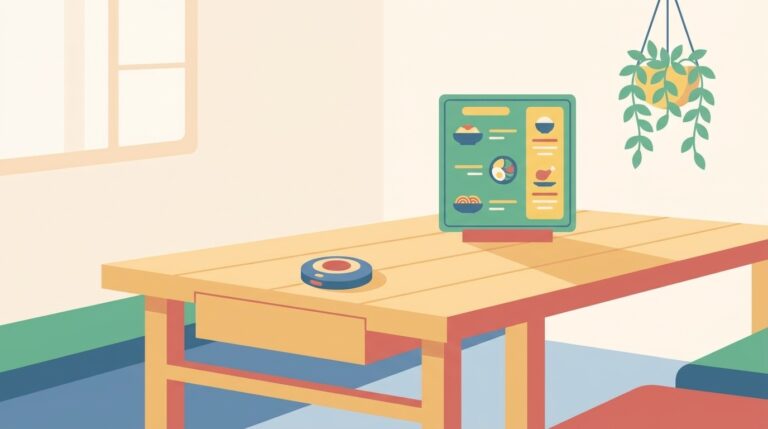
Look at the side of your table! In modern Korean diners, you will find a small round buzzer button labeled 벨 (Bell) or 호출 (Call). Pressing it rings a chime (Ding-dong!) and displays your table number to staff. If the button is present, there is no need to shout across the room—just press it once and ask for your menu when they approach.
Phase 5: Real-World Roleplay Scenario
Setting: You walk into Hansik Dabang, a cozy stew restaurant in Seoul. The friendly owner, Aunty (이모님), is busy serving steaming bowls of Kimchi Jjigae.
- You: 저기요, 안녕하세요! (Jeogiyo, annyeonghaseyo!) — 🎭 Raising hand slightly with a warm smile. — “Excuse me, hello!”
- 이모님 (Server): 네~ 몇 분이세요? 편한 자리 앉으세요! (Ne~ myeot bun-iseyo? Pyeonhan jari anjeuseyo!) — 🎭 Wiping a clean table quickly. — “Yes~ How many people? Please sit anywhere comfortable!”
- You: 두 명이에요. 저, 메뉴판 좀 볼 수 있을까요? (Du myeong-ieyo. Jeo, menupan jom bol su isseulkkayo?) — 🎭 Taking a seat and looking around. — “Two people. Um, could we see a menu?”
- 이모님 (Server): 아, 우리 집은 저쪽 벽에 메뉴 적혀있어요! (A, uri jibeun jeojjok byeoge menyu jeokhyeo-isseoyo!) — 🎭 Pointing toward the wooden menu boards on the wall. — “Ah, in our restaurant the menu is written on that wall over there!”
- You: 아, 그렇군요! 혹시 영어 메뉴판도 따로 있나요? (A, geureokunyo! Hoksi yeongeo menupando ttaro innayo?) — 🎭 Nodding thoughtfully. — “Ah, I see! By any chance, do you have an English menu separately?”
- 이모님 (Server): 그럼요, 외국인 손님용 코팅 메뉴판 가져다줄게요. (Geureomyo, oegugin sonnimyong koting menupan gajyeodajulgeyo.) — 🎭 Pulling a laminated English sheet from the counter. — “Of course, I’ll bring you our laminated menu for international guests.”
- You: 감사합니다, 이모님! 천천히 보고 주문할게요. (Gamsahamnida, imonim! Cheoncheonhi bogo jumunhalgeyo.) — 🎭 Receiving the menu with both hands and bowing head slightly. — “Thank you, Aunty! We’ll look over it and order soon.”
- 이모님 (Server): 네, 고르면 벨 눌러줘요~ (Ne, goreumyeon bel nulleojwoyo~) — 🎭 Giving a friendly wink before heading to the kitchen. — “Sure, press the table bell when you have picked!”
🔀 Interactive Choice Point
You realize your friend has specific dietary questions about spicy dishes. What do you say when the server returns?
* Option A: “이거 안 매운 메뉴도 추천해 주세요.” (Could you also recommend a non-spicy dish here?)
👉 Feedback [Best]: Natural, polite, and directly invites the server’s helpful recommendation.
* Option B: “메뉴판 다시 가져가세요!” (Take the menu back!)
👉 Feedback [Bad]: Overly blunt and sounds like you are rejecting their service.
* Option C: “영어 못해요?” (You can’t speak English?)
👉 Feedback [Risk]: Can come across as impolite and confrontational in a local Korean restaurant context.
Phase 6: 10-Second Emotion Shadowing Drill
Practice saying these aloud with the designated emotion and rhythm pauses (/):
[😊 Polite & Bright]저기요~ / 메뉴판 좀 / 보여주세요! (Jeogiyo~ / menupan jom / boyeojuseyo!)[🤔 Curious & Soft]혹시 / 사진 있는 메뉴판 / 있을까요? (Hoksi / sajin inneun menupan / isseulkkayo?)[🙏 Grateful & Sweet]감사합니다! / 천천히 보고 / 주문할게요~ (Gamsahamnida! / cheoncheonhi bogo / jumunhalgeyo~)
Phase 7: K-Culture Mini Dictionary
- 메뉴판 (Menupan): Physical menu board/sheet. Essential for choosing dishes in any dining spot.
- 저기요 (Jeogiyo): Polite calling phrase meaning “Excuse me / over there.” Used to politely summon restaurant staff.
- 호출벨 (Hochul-bel): The electronic call button mounted on restaurant tables across Korea.
- 추천 메뉴 (Chucheon Menyu): Recommended dishes / house specials highlighted by the chef or owner.
Phase 8: Traveler Survival Kit
Survival Phrases TOP 3
- 여기 메뉴판 주세요! (Yeogi menupan juseyo!) — Pro Tip: Use when seated with zero menus in sight.
- 사진 메뉴 있어요? (Sajin menyu isseoyo?) — Pro Tip: Perfect when Korean dish names look like mystery puzzles.
- 추천해 주세요! (Chucheon-hae juseyo!) — Pro Tip: Let the server surprise you with the freshest house specialty.
Editor’s Travel Note
- Install the Naver Map app download for smart navigation before your trip; restaurant listings on Naver often show uploaded photo menus so you can preview dishes before even sitting down.
- In Korea, water and side dishes (반찬) are almost always complimentary and frequently self-service (셀프, “Self”).
Phase 9: One Step Deeper
In Korean dining, language reflects community spirit (정, Jeong). When you call out “저기요” or add “좀 (jom)” to your request, you are signaling warm interpersonal cooperation rather than a cold customer-employee transaction. This slight linguistic softness instantly builds rapport with restaurant owners, often earning you extra side dishes (service!).
💬 Your Turn: What was your most memorable dining experience abroad where you struggled to read the menu? Share your story in the comments below!
Phase 10: FAQ & Common Mistakes
Q: Can I call the waiter by saying “이모” (Aunt) or “사장님” (Boss)?
A: Yes! For middle-aged female staff at casual, cozy diners, “이모님” (Imonim) is affectionate and polite. For male owners or general spots, “사장님” (Sajangnim) works universally.
Q: What should I do if the menu is only written on the wall in Korean?
A: Use your phone camera with live translation apps, or politely ask: “사진 메뉴판 있어요?” (Do you have a picture menu?).
Q: Is tipping expected when they bring the menu and serve food?
A: No tipping is required or expected anywhere in South Korea. Excellent service is built right into the dining culture.
🚨 Common Mistakes Warning Board
- ❌ Saying “웨이터! (Waiter!)” ➡️ Correct Action: Say “저기요~” or press the table call button.
- ❌ Snapping fingers or waving wildly ➡️ Correct Action: Raise your hand politely at eye level.
- ❌ Demanding “메뉴판 줘!” without honorifics ➡️ Correct Action: Always attach “-주세요” (juseyo).
Phase 11: Action Missions
- 🥉 Bronze Mission (Solo Practice): Stand in front of a mirror and say “저기요, 메뉴판 좀 주세요!” with a bright smile 3 times.
- 🥈 Silver Mission (SNS Voice): Record a short 5-second audio clip practicing the Phase 6 shadowing drill and tag your study buddy.
- 🥇 Gold Mission (Real Life): Visit your local K-Town restaurant or a Seoul eatery and order entirely using Korean menu requests!
- 🎮 K-Culture Mission: Watch an episode of a food variety show like Street Food Fighter and spot how locals interact with restaurant owners.
Phase 12: Interactive Quiz Challenge
Question 1 (Situation Judgment): You sit at a BBQ restaurant with no menu. You want to ask for an English menu politely. Which phrase should you say?
* A) 메뉴판 줘!
* B) 저기요, 영어 메뉴판 있어요?
* C) 실례지만 음식 책을 주시오.
🔍 Click to Reveal Answer & Explanation
Correct Answer: B
Explanation: “저기요, 영어 메뉴판 있어요?” is the natural, polite way to ask for an English menu. Option A is rude (no honorifics), and Option C is archaic textbook phrasing that native speakers do not use.
Question 2 (Fill in the Blank): Complete the magic polite request:
“여기 메뉴판 ____ 주세요!” (Meaning: “Please give me a menu board here!”)
🔍 Click to Reveal Answer & Explanation
Correct Answer: 좀 (jom)
Explanation: Adding 좀 (jom) softens the request and makes you sound like a natural Korean speaker!
Question 3 (True or False): In Korea, pressing the electronic bell on the side of your dining table is considered rude.
🔍 Click to Reveal Answer & Explanation
Correct Answer: False
Explanation: The table bell (호출벨) is specifically designed to make calling staff efficient and quiet without shouting across the room!







