

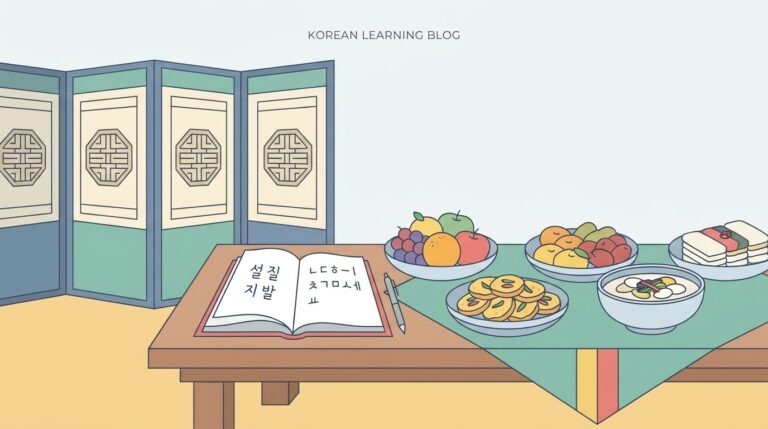
Phase 1: Empathy (Narrative Opening)
안녕하세요! 매일한글 에디터입니다.
Imagine waking up at 6:30 AM on a freezing winter morning in Seoul. The entire house is already bustling with the rich, savory aroma of sizzling jeon (pan-fried battered delicacies) and boiling beef-radish tteokguk broth. You walk cautiously into the living room, only to be confronted with a grand wooden table lined with red lacquer dishware, dozens of intricate dishes, and a cluster of family elders passionately debating the exact placement of dried pollack versus peeled chestnuts. If you have ever watched family holiday episodes in K-dramas like Reply 1988 or My Golden Life, you know the sheer intensity of preparing a Korean Lunar New Year (Seollal) table.
For advanced learners and foreign residents in Korea, participating in Charye (차례)—the ancestral memorial rite performed on traditional holidays—is often an intimidating linguistic and cultural gauntlet. The rules of Charyesang (the ritual table) are dictated by centuries-old Four-Character Idioms (Sajasung-eo), archaic honorifics, and strict spatial etiquette. You might worry: What if I put the apples on the wrong side? How do I offer help without sounding clumsy or intrusive?
Drawing from a decade of coaching expatriates, cross-cultural couples, and advanced professionals navigating Korean family dynamics, this guide breaks down the high-register vocabulary, idiomatic expressions, and non-verbal nuances you need to navigate Seollal Charyesang with effortless cultural finesse and linguistic precision.
Phase 2: Core Expressions Deep Dive (C1 Level)
1. 정성을 들이다 (Jeong-seong-eul deu-ri-da)
- Pronunciation: [Jeong-seong-eul deu-ri-da] (Think: “Jung” as in Jungian psychology + “Song” + “Eul” + “Deu-ree-da”)
- Meaning: Literal: “To invest devoted sincerity” | Nuance: To dedicate immense mental care, unhurried craftsmanship, and genuine heart into preparing something solemn or meaningful.
- K-Culture Moment: Frequently heard when matriarchs or elders explain why ancestral dishes must be trimmed meticulously by hand rather than bought pre-packaged from modern department stores.
- Editor’s Insight: In C1 discourse, moving beyond generic verbs like 열심히 만들다 (to make diligently) to 정성을 들이다 immediately elevates your Korean. It emphasizes internal reverence rather than mere mechanical labor.
- Situation Spectrum: Casual (⚠️ slightly heavy for trivial daily tasks) | Semi-formal (✅) | Formal / Traditional Rites (✅)
- 🤔 Think About It: Does your native culture distinguish between “doing a task meticulously” and “pouring spiritual sincerity (jeongseong)” into an object or ritual?
2. 홍동백서 (Hong-dong-baek-seo)
- Pronunciation: [Hong-dong-baek-seo] (Think: “Hong” as in Hong Kong + “Dong” + “Baek” + “Suh”)
- Meaning: Literal: “Red (fruits) to the East, White (fruits) to the West” | Nuance: The classic cosmological rule dictating fruit placement on the ancestral table based on color and directional symbolism.
- K-Culture Moment: In K-drama heritage scenes, this phrase is inevitably uttered by the eldest family head when correcting the placement of red apples versus white peeled pears.
- Editor’s Insight: This is a quintessential Sajasung-eo associated with Charyesang, alongside Eodongyukseo (어동육서: fish to the east, meat to the west) and Joyurisi (조율이시: jujube, chestnut, pear, persimmon in sequence). Using these idioms shows deep cultural literacy.
- Situation Spectrum: Casual (⚠️ only used humorously) | Semi-formal (✅) | Formal / Traditional Rites (✅)
- 🤔 Think About It: How do traditional rituals in your culture use cardinal directions (East/West/North/South) or symbolic colors to structure sacred spaces?
3. 덕담을 나누다 (Deok-dam-eul na-nu-da)
- Pronunciation: [Deok-dam-eul na-nu-da] (Think: “Duck” + “Dahm” + “Eul” + “Nah-noo-dah”)
- Meaning: Literal: “To share words of virtue/blessing” | Nuance: The formal exchange of auspicious wishes and benevolent life advice following the ceremonial bow (Sebae).
- K-Culture Moment: After the ritual bow, the family sits in a circle to receive Deokdam from the grandparents, followed by the iconic distribution of Sebaetdon (New Year’s pocket money).
- Editor’s Insight: Deokdam is distinct from casual congratulations (chuk-ha). It carries an ancestral, intergenerational blessing, wishing health, career milestones, and peace for the coming year.
- Situation Spectrum: Casual (⚠️) | Semi-formal (✅) | Formal / Festive Gatherings (✅)
- 🤔 Think About It: In your culture, are holiday blessings delivered unilaterally by elders, or are they mutually exchanged among all generations?
Phase 3: Textbook Korean vs. Real Native Korean
Situation 1: Offering assistance to elder hosts during table setup
- 📖 Textbook Korean: “제가 차례상 차리는 것을 도와드리겠습니다.” (I will help you set the Charye table.)
- 🗣️ Real Native Korean: “어르신, 제가 손 보탤 일이나 거들 부분 있으면 편하게 말씀해 주세요.” (Elder, please let me know comfortably if there is anything I can lend a hand with.)
- 💡 Why the difference? The textbook phrase can sound prescriptive, assuming you already know how to arrange the complex sacred layout. Using 손을 보태다 (lend a hand) and 거들다 (assist subtly) demonstrates humble awareness of ritual hierarchies.
Situation 2: Praising the exquisite balance and care of holiday banquet dishes
- 📖 Textbook Korean: “이 음식들이 아주 맛있고 정갈합니다.” (These foods are very delicious and neat.)
- 🗣️ Real Native Korean: “음식 하나하나에 손이 정말 많이 갔겠어요. 간도 딱 맞고 정성이 대단하세요.” (Every single dish must have taken tremendous labor. The seasoning is impeccable, and the devotion is remarkable.)
- 💡 Why the difference? C1 native speakers praise the hidden labor (손이 많이 가다) and delicate flavor equilibrium (간이 맞다) rather than offering superficial sensory compliments like 맛있어요.
Phase 4: K-Culture Deep Dive & Non-Verbal Manners
4-1. 눈치 (Nunchi) & Physical Protocol
- Gongsubeop (공수법 – Hand Placement): During ancestral rites, clasp your hands together respectfully over your belly button. For men, the right hand traditionally covers the left hand during ancestral rites (Charye / Jesa—reversing everyday life etiquette). For women, the left hand covers the right hand.
- Postural Decorum: When walking near the Charyesang, never step directly across the central viewing axis of the ancestral spirit screen (Byeongpung). Walk along the perimeter and maintain a slightly lowered gaze.
- Two-Handed Transfers: When passing ceremonial brassware (Yugi) or sacrificial food plates, hold the dish firmly with both hands, elbows lightly tucked close to your torso.
4-2. Cultural Code Analysis: The Modern Transformation of Charye
In historical Joseon traditions, Charye was a deeply solemn ritual reserved exclusively for paternal lineages. Today, as seen in modern Korean series and social discourse, Charye is undergoing a cultural renaissance. While historical norms like Hongdongbaekseo are still respected as intellectual cultural heritage, contemporary families focus increasingly on the communal aspect of Eumbok (음복—partaking in the consecrated feast together). Understanding both the rigid orthodox rules and the progressive transition toward simplified family celebrations marks the hallmark of an advanced Korean observer.
Phase 5: Real-World Roleplay Scenario
Setting: 7:15 AM on Seollal morning. You are in the ancestral home’s main living area assisting Uncle Min-woo (민우 삼촌), a meticulous 55-year-old traditionalist who is carefully supervising the placement of the fruits and braised beef.
- Turn 1 (Min-woo): “자, 사과는 붉은 계열이니까 동쪽에 두고, 배는 껍질 벗겨서 서쪽에 놓아야 해.”
(Ja, sagwa-neun bulgeun gye-yeor-inikka dong-jjoge dugo, bae-neun kkeopjil beotgyeoseo seo-jjoge no-aya hae.)
“Now, apples are reddish, so put them on the East, and peel the pears before placing them on the West.”
🎭 [Holding a lacquered wooden tray with focused concentration] -
Turn 2 (You): “아, 홍동백서 원칙 말씀이시군요. 사과는 이쪽 줄 오른편에 올리면 될까요?”
(A, hong-dong-baek-seo wonchik malsseum-isigun-yo. Sagwa-neun i-jjok jul oreun-pyeone ollimyeon doel-kkayo?)
“Ah, you mean the ‘Hongdongbaekseo’ rule. Should I place the apples on the right side of this row?”
🎭 [Gently presenting the wooden plate with both hands] -
Turn 3 (Min-woo): “오, 자네가 홍동백서도 아는가? 맞아, 신위 기준으로 동쪽이니 이쪽이 맞네.”
(O, jane-ga hong-dong-baek-seo-do aneun-ga? Maja, sin-wi gijun-euro dong-jjog-ini i-jjogi manne.)
“Oh, you even know ‘Hongdongbaekseo’? Correct, since East is relative to the ancestral spirit tablet, this side is right.” -
Turn 4 (You): “조율이시 순서에 맞춰 대추와 밤도 좌측부터 가지런히 정리해 두었습니다.”
(Jo-yul-i-si sunseo-e matchwo daechu-wa bam-do jwa-cheuk-buteo gajireon-hi jeongni-hae dueotseumnida.)
“Following the ‘Joyurisi’ order, I also neatly aligned the jujubes and chestnuts starting from the left side.” -
Turn 5 (Min-woo): “하하, 보통 정성이 아니구만. 이번 명절 상차림은 아주 순조롭겠어.”
(Haha, botong jeongseong-i aniguman. Ibeon myeongjeol sang-charim-eun aju sunjo-ropgesseo.)
“Haha, that is no ordinary devotion! This holiday table arrangement is going very smoothly.” -
Turn 6 (You): “어르신들께서 오랜 세월 지켜오신 예법인데, 조금이나마 보탬이 되어 다행입니다.”
(Eoreusin-deul-kkeseo oraen se-wol jikyeo-osin yebeom-inde, jogeum-inama botaem-i doeeo dahaeng-imnida.)
“It is a revered etiquette maintained by our elders for generations, so I am glad to be of some small help.” -
Turn 7 (Min-woo): “차례 마치고 나면 바로 음복할 테니, 따뜻한 떡국 한 그릇 든든하게 뜨세.”
(Charye machigo namyeon baro eum-bok-hal teni, ttatteut-han tteokguk han geureut deundeun-hage tteuse.)
“Once the rite concludes, we will share the feast right away, so make sure to enjoy a hearty, warm bowl of tteokguk.” -
Turn 8 (You): “감사합니다, 삼촌. 덕담 나누는 시간도 기대하고 있겠습니다.”
(Gamsahamnida, samchon. Deokdam nanuneun sigan-do gidae-hago itgetseumnida.)
“Thank you, Uncle. I look forward to exchanging words of blessing together as well.”
🎭 [Bowing your head slightly with a respectful, warm smile]
🔀 Interactive Decision Point
After the incense is lit, Uncle Min-woo asks if you would like to pour the ceremonial drink (Cheonju). How do you respond?
- Option A: “제가 아직 미숙하여 법도를 그르칠까 조심스러우니, 어르신께서 먼저 시범을 보여주시면 감사히 배우겠습니다.”
Feedback: [BEST CHOICE] Demonstrates exquisite humility, high-level vocabulary (미숙하다, 법도를 그르치다), and shows deep willingness to learn ancestral etiquette properly. - Option B: “네! 술 따르는 건 맥주 따르듯이 그냥 가득 채우면 되죠?”
Feedback: [BAD CHOICE] Comparing ancestral sacred libations to casual beer pouring undermines the solemnity of the memorial rite and may dismay traditional elders. - Option C: “술은 머리 아파서 안 마시는데, 제사상에도 안 올리면 안 될까요?”
Feedback: [RISKY CHOICE] Confuses the symbolic ritual offering (Jebal) with personal beverage consumption preferences, creating an awkward cultural pause.
Phase 6: 10-Second Emotional Shadowing Drill
[🙏 경건하고 공손하게 / Reverent & Solemn]
조상님께 올리는 상이니 / 작은 제기 하나도 / 정성을 다해 다루어야 합니다.
(Since this is a table offered to our ancestors, / we must handle even a single ceremonial vessel / with utmost devotion.)-
[😊 살갑고 싹싹하게 / Attentive & Cheerful]
손질할 나물이나 / 전 부칠 재료가 더 남았으면 / 제가 얼른 손 보태겠습니다!
(If there are more wild greens to trim / or ingredients left for frying pancakes, / I will quickly lend a hand!) -
[🤝 따뜻하고 격식 있게 / Warm & Cultured]
새해에는 소망하시는 모든 일이 순조롭게 풀리시기를 / 진심으로 기원합니다.
(In the New Year, I sincerely pray / that all your cherished aspirations / unfold smoothly and fruitfully.)
Phase 7: K-Culture Mini Dictionary
- 차례 (Charye) | Holiday Memorial Rite
A simplified ancestral ritual performed exclusively during major seasonal solstices/holidays (Seollal and Chuseok) during daylight hours, distinct from Gije-sa (late-night death anniversary rites). - 음복 (Eumbok) | Ritual Partaking of Consecrated Food
The communal act of eating food and drinking wine that has been offered to ancestors. It is believed to impart ancestral blessings and longevity onto the descendants. - 세배 (Sebae) | New Year’s Formal Bow
A deep, full-kneeling prostration performed on New Year’s Day to living elders, expressing gratitude and wishing them vitality in the coming year. - 설빔 (Seolbim) | New Year’s Attire
Historically, pristine new traditional garments prepared for the New Year. Today, it colloquially refers to wearing your best, most dignified outfit to festive family gatherings.
Phase 8: Traveler’s Survival Kit
- Survival Phrase 1: 새해 복 많이 받으시고 늘 건강하십시오. (Saehae bok mani badeusigo neul geongang-hasipsio.) — The gold-standard formal New Year greeting for elders, in-laws, or senior business partners.
- Survival Phrase 2: 음식이 정갈하고 상차림이 참 품격 있습니다. (Eumsigi jeonggal-hago sang-charimi cham pumgyeok itseumnida.) — Sophisticated compliment for the holiday banquet layout.
- Survival Phrase 3: 어떤 순서로 절을 올리면 되겠습니까? (Eotteon sunseo-ro jeor-eul ollimyeon doegetseumnikka?) — Asking respectfully about the sequence of ceremonial bowing.
🧭 Editor’s Travel Note
If you are traveling in Korea during Seollal, remember that the entire country undergoes massive holiday migration (Gwisung-gil). Train tickets on major routes sell out weeks in advance; always verify your itinerary early via Korail KTX Train Reservation. Additionally, many local boutique restaurants in Seoul close on Seollal day, so download the Naver Map Navigation App to check real-time holiday business hours for palace grounds and major museums that remain open for free traditional festivities.
Phase 9: Stepping Deeper (Cultural Reflection)
At its philosophical core, Charye is not merely an ancient religious ritual; it functions as a masterclass in collective memory and familial continuity. By gathering generations around a strictly choreographed table of seasonal bounties, Korean society reinforces respect for roots, gratitude for the unseen sacrifices of forebears, and intergenerational bonding. While contemporary Korean society continues to debate and reform gender division of labor during holiday preparations, the fundamental spirit—Jeongseong (sincerity of heart)—remains the unshakeable foundation of Korean cultural identity.
💬 Your Turn: How does your home culture commemorate ancestors or bring distant generations together during major holidays? Share your family customs below!
Phase 10: FAQ & Common Mistakes
Q: What is the primary difference between Charye (차례) and Jesa (제사)?
A: Charye is a celebratory daylight rite conducted on seasonal holidays (Seollal and Chuseok) for all generations of ancestors simultaneously, featuring seasonal dishes like Tteokguk or Songpyeon. In contrast, Jesa (specifically Gije-sa) is an individual memorial service held late at night on the specific anniversary of an ancestor’s passing, traditionally serving cooked rice and soup.
Q: Why are peach (boksung-ah) and fish without scales (like catfish) prohibited on the Charyesang?
A: In traditional Korean folk cosmology, peach trees possess mystical yang energy that drives away spirits, which would prevent the benevolent ancestors from approaching the table. Similarly, scaleless fish or fish ending in the syllable -chi (like Galchi or Myeolchi) were historically viewed as inferior or coarse foods unsuitable for an honored memorial table.
Q: How many times do you bow during Charye versus Sebae?
A: During Charye (for deceased ancestors), you perform two full bows and a half-nod (I-bae). When performing Sebae (for living elders), you perform exactly one full bow (Il-bae). Mixing these up is a major cultural faux pas!
🚨 Common Mistakes Alert!
- Bowing Twice to Living Elders: Never bow twice to your living grandparents or parents during Sebae. Two full bows are strictly reserved for deceased spirits.
Correct Action: Perform one graceful, deep prostration, pause momentarily, rise smoothly, and sit with clasped hands to receive Deokdam. - Reversing Fish Placement (Eodongyukseo): Placing the fish head pointing westward.
Correct Action: Follow Dumi-seo (두동서미: head to the East, tail to the West) and Eodongyukseo (fish on the East, red meat on the West). - Wearing Overly Casual or Revealing Attire: Showing up to the ancestral rite in sweatpants, bright neon sportswear, or bare feet.
Correct Action: Wear clean, muted semi-formal attire or Hanbok, and always ensure you wear neat socks as a sign of basic courtesy.
Phase 11: Action Missions
- 🥉 Bronze Mission (Solo Practice): Stand in front of a mirror and practice the formal greeting: “새해 복 많이 받으시고, 올 한 해도 만수무강하십시오.” Practice pausing at the emotion slash markers.
- 🥈 Silver Mission (Social Share): Photograph your favorite festive holiday dish, post it on social media, and write a two-sentence caption in Korean utilizing the term 정성을 들이다.
- 🥇 Gold Mission (Real-Life Application): During your next holiday interaction with Korean friends or family, respectfully inquire about their ancestral layout using the phrase: “상차림 준비하실 때 제가 도울 수 있는 손쉬운 일부터 거들겠습니다.”
- 🎮 K-Culture Mission: Watch an episode of a Korean drama featuring a holiday morning (e.g., Reply 1988 Ep. 13) and spot at least two Charyesang fruit rules discussed in this lesson!
Phase 12: Interactive Quiz Challenge
Test your mastery of Korean New Year customs and C1 expressions!
1. Situation Judgment: You want to offer help to your host who is frying Jeon in the kitchen. Which phrase sounds most polished and native at the C1 level?
* A) 제가 전을 다 부쳐드릴게요. 비켜보세요.
* B) 손이 정말 많이 가는 작업이네요. 제가 옆에서 꼬치 꽂는 것부터 좀 거들까요?
* C) 그냥 배달 음식 시키는 게 더 편하지 않으세요?
2. Fill-in-the-Blank: Complete the traditional Charyesang rule regarding the placement of red and white fruits:
“붉은 과일은 동쪽에, 흰 과일은 서쪽에 놓는다는 원칙을 네 글자로 (____________)라고 합니다.”
3. True or False: During the Sebae (New Year’s formal bow to living parents), you should perform two complete full bows to show extra respect. (T / F)
👉 Click here for Answers and In-depth Explanations
-
Answer: B
Explanation: Option B acknowledges the immense labor involved (손이 많이 가다) and offers a specific, modest assisting task (거들다) with high politeness. Option A is overly blunt/commanding, while Option C violates traditional holiday sentiment. -
Answer: 홍동백서 (Hongdongbaekseo)
Explanation: Hong (Red), Dong (East), Baek (White), Seo (West). This 4-character idiom is the cornerstone of holiday fruit arrangement. -
Answer: False
Explanation: Two bows (I-bae) are strictly reserved for deceased ancestral spirits during Charye or funerals. Bowing twice to a living person is considered very taboo. Only one bow (Il-bae) is given to living elders during Sebae.







