

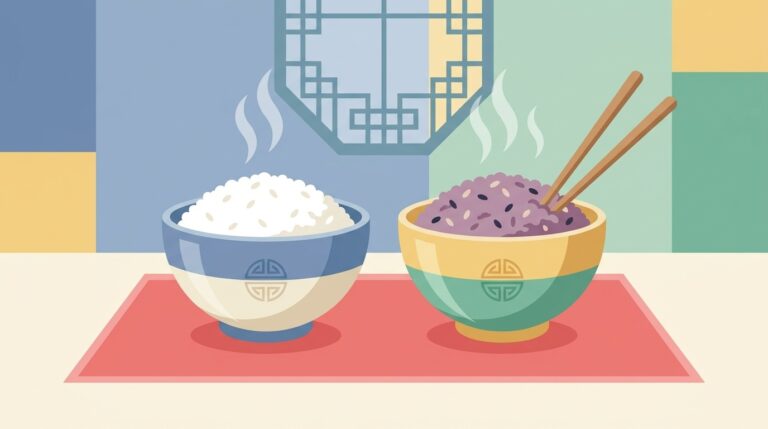
The Ultimate Guide to Korean Rice Culture: White Rice vs. Multigrain Rice
Phase 1: 공감 (Story-Driven Opening)
안녕하세요! 매일한글 에디터입니다. Have you ever walked into a traditional Baekban (home-style meal) restaurant in Seoul, ordered a piping-hot bowl of Doenjang-jjigae (soybean paste stew), and suddenly panicked when the server asked, “공깃밥 뭐로 드릴까요? 흰밥? 잡곡밥?” (Gong-git-bap mwo-ro deu-ril-kka-yo? Huin-bap? Jap-gok-bap? — “Which bowl of rice would you like? White rice or multigrain rice?”)
You might think, Isn’t rice just rice? Or maybe in a K-drama, you noticed the wealthy family dining on pristine, pearly-white rice while an athletic character or health-conscious mom insists on purple-tinted, bean-filled rice. Rice in Korea isn’t merely a side dish or neutral carb; it is the culinary backbone, emotional anchor, and cultural mirror of the nation.
Many intermediate learners understand basic dining vocabulary, but navigating the subtle cultural nuances, health perceptions, and social etiquette between 흰 쌀밥 (Huin Ssalbap – White Rice) and 잡곡밥 (Japgokbap – Multigrain Rice) often leaves them hesitating. Based on feedback from hundreds of Daily Hangul learners who froze at restaurant tables, this comprehensive guide will equip you with the exact linguistic instincts and cultural insight to order, compliment, and appreciate Korean rice like a true local.
Phase 2: 핵심 표현 3선 심층 분석 (Core Expressions Deep Dive)
1. 밥맛이 꿀맛이에요 (Bap-mas-i kkul-mas-i-e-yo)
- Pronunciation: [Bap-ma-si kkool-ma-si-e-yo] (Sounds like “Bap-mah-she cool-mah-she-eyo”)
- Meaning: Literal: “The taste of rice is honey-taste.” / Actual Nuance: “The meal is absolutely delicious and appetizing.”
- K-Culture Moment: Seen in variety shows like Three Meals a Day (삼시세끼) when cast members take their very first bite of freshly cooked pot rice after hours of harvesting grains.
- Editor’s Insight: In Korean, “밥” (bap) represents both cooked rice and food/meals in general. Saying the rice tastes like honey means your appetite is at its peak and the food is deeply satisfying.
- Situation Spectrum: Casual: ✅ | Semi-formal: ✅ | Formal: ⚠️
- 🤔 Think About It: Why do you think Korean uses the word for ‘rice’ as a synonym for an entire meal and overall well-being?
2. 잡곡밥으로 변경 가능한가요? (Jap-gok-bab-eu-ro byeon-gyeong ga-neung-han-ga-yo?)
- Pronunciation: [Jap-gok-pa-beu-ro byon-gyong ga-neung-han-ga-yo?] (Sounds like “Jap-goke-bah-beu-ro byun-gyung gah-neung-hahn-gah-yo?”)
- Meaning: Literal: “Is changing to multigrain rice possible?” / Actual Nuance: “Could I substitute white rice with multigrain rice, please?”
- K-Culture Moment: Ordering at upscale modern Korean diners or trendy wellness spots in Seongsu-dong where diners customize their grain base (Heukmi-bap, Hyeonmi-bap).
- Editor’s Insight: The phrase uses “~로 변경 가능하다” (byeon-gyeong ga-neung-hada), which is polite, polished, and intermediate-level Korean for making smooth dining requests without sounding demanding.
- Situation Spectrum: Casual: ⚠️ | Semi-formal: ✅ | Formal: ✅
- 🤔 Think About It: How does phrasing requests with possibility (~가능한가요?) rather than direct demand (~주세요) alter the politeness dynamic in Korean society?
3. 밥심으로 살아요 (Bap-sim-eu-ro sa-ra-yo)
- Pronunciation: [Bap-shim-eu-ro sah-rah-yo] (Sounds like “Bahp-sheem-eu-ro sah-rah-yo”)
- Meaning: Literal: “I live by rice power.” / Actual Nuance: “A proper hearty meal is what keeps me energized through life’s challenges.”
- K-Culture Moment: A comforting line frequently spoken by grandparents in family K-dramas when packing warm side dishes and freshly cooked rice for hardworking grandchildren.
- Editor’s Insight: 밥심 (bapsim) combines 밥 (rice) and 힘 (power/strength, pronounced 심 in colloquial dialect). It captures the collective cultural belief that stamina and emotional resilience stem directly from eating warm rice.
- Situation Spectrum: Casual: ✅ | Semi-formal: ✅ | Formal: ⚠️
- 🤔 Think About It: In your culture, what staple food or routine is considered the ultimate symbol of daily vitality?
Phase 3: 교과서 한국어 vs 진짜 한국어 (Textbook vs. Real Korean)
Situation 1: Choosing your rice type at a restaurant
- 📖 교과서 한국어 (Textbook Korean): 저는 잡곡밥을 원합니다. 그것을 주십시오. (Jeo-neun jap-gok-bap-eul won-ham-ni-da. Geu-geos-eul ju-sip-si-o. – “I desire multigrain rice. Please give me that.”)
- 🗣️ 진짜 한국어 (Real Korean): 혹시 밥을 잡곡밥이나 흑미밥으로 바꿀 수 있을까요? (Hok-si bap-eul jap-gok-bab-i-na heuk-mi-bab-eu-ro ba-kkul su iss-eul-kka-yo? – “By any chance, could I switch the rice to multigrain or black rice?”)
- 💡 왜 다를까? (Cultural Insight): Real native speakers soften questions with 혹시 (by any chance) and conditional endings (~수 있을까요?) to show polite consideration towards busy restaurant staff.
Situation 2: Complimenting freshly cooked rice
- 📖 교과서 한국어 (Textbook Korean): 이 쌀밥은 매우 품질이 좋습니다. (I ssal-bap-eun mae-u pum-jil-i joh-seum-ni-da. – “This white rice has very good quality.”)
- 🗣️ 진짜 한국어 (Real Korean): 와, 밥에 윤기가 자르르 흐르네요! 찰져요! (Wa, bab-e yun-gi-ga ja-reu-reu heu-reu-ne-yo! Chal-jyeo-yo! – “Wow, the rice has such a glossy sheen! It’s so chewy and delicious!”)
- 💡 왜 다를까? (Cultural Insight): Koreans judge superior rice by sensory textures like 윤기 (glossy sheen) and 찰기 (stickiness/chewiness), utilizing rich onomatopoeia like 자르르 (glossily flowing).
Phase 4: K-Culture 딥다이브 & 비언어적 매너 (Deep Dive & Etiquette)
4-1. 눈치 (Nunchi) & Dining Gestures
- The Two-Handed Rice Bowl Handover: When receiving a hot stainless steel rice bowl (공깃밥), always support your right forearm with your left hand or place your left hand gently under the bowl. It shows deep respect to elders or servers.
- Never Stick Chopsticks Vertically: Sticking your metal chopsticks upright into a bowl of white rice mimics ancestral memorial incense burners (제사), which is considered extremely disrespectful during everyday meals.
- Reading the Rice Selection: In Korean corporate lunches, senior bosses watching their health might proactively order 현미밥 (brown rice) or 잡곡밥 (multigrain). Noticing this and accommodating healthy dining spots shows exceptional Nunchi.
4-2. 문화 코드 분석 (K-Food & Historical Context)
Historically in Korea, pure 흰 쌀밥 (white rice) symbolized wealth and luxury, while 잡곡밥 (multigrain rice containing barley, millet, or beans) was associated with lean spring months (보릿고개 – barley hump). Today, however, the perception has flipped: white rice is the standard daily default, whereas 잡곡밥, 현미밥, and 흑미밥 are celebrated as premium, nutrient-dense health foods praised across K-wellness media!
Phase 5: 실전 롤플레이 시나리오 (Interactive Role-Play Scenario)
Setting: A cozy traditional Korean table d’hôte (한정식) restaurant in Insadong, Seoul. You are dining with your Korean colleague, Min-ji.
- 민지 (Min-ji): 🎭 (메뉴판을 넘기며 밝게 미소 짓는다) “여기 솥밥 정식 정말 맛있어요! 쌀밥이랑 영양 잡곡밥 중에 고를 수 있대요.”
(Yeo-gi sot-bap jeong-sik jeong-mal mas-iss-eo-yo! Ssal-bab-i-rang yeong-yang jap-gok-bap jung-e go-reul su it-dae-yo. / “The hot stone pot rice set here is amazing! They say we can choose between white rice and nutritious multigrain rice.”) - Learner (You): 🎭 (호기심 가득한 눈빛으로) “잡곡밥에는 보통 어떤 곡물이 들어가요?”
(Jap-gok-bab-e-neun bo-tong eo-tteon gok-mul-i deul-eo-ga-yo? / “What kinds of grains usually go into multigrain rice?”) - 민지 (Min-ji): 🎭 (손가락으로 세어가며) “보통 검은콩, 흑미, 조, 수수가 들어가서 훨씬 고소하고 소화도 잘 돼요!”
(Bo-tong geom-eun-kong, heuk-mi, jo, su-su-ga deul-eo-ga-seo hwol-ssin go-so-ha-go so-hwa-do jal dwae-yo! / “Usually black beans, black rice, millet, and sorghum, so it’s much nuttier and great for digestion!”) - 서빙 직원 (Server): 🎭 (테이블 옆으로 다가와 주문 수첩을 들며) “손님, 주문 도와드릴까요? 밥 종류는 어떻게 준비해 드릴까요?”
(Son-nim, ju-mun do-wa-deu-ril-kka-yo? Bap jong-ryu-neun eo-tteoh-ge jun-bi-hae deu-ril-kka-yo? / “Ready to order? Which type of rice should we prepare for you?”)
🔀 인터랙티브 분기점 (Your Choice):
- Choice A: “저는 씹는 맛이 좋은 영양 잡곡밥으로 부탁드릴게요!”
- Choice B: “아무거나 대충 빨리 나오는 걸로 주세요.”
- Choice C: “잡곡밥 싫어요. 그냥 흰밥만 많이 줘요.”
Feedback & Outcome:
* Choice A (Best): 🌟 Polite, articulate, and naturally highlights the chewy texture (씹는 맛) of multigrain rice. The server smiles and prepares a fresh hot stone pot!
* Choice B (Bad): ⚠️ Using 대충 (carelessly/roughly) sounds impatient and dismissive to Korean service staff.
* Choice C (Risk): 🚫 Lacks polite sentence endings (~요 instead of ~세요 / ~부탁드려요) and sounds blunt and childish.
Phase 6: 10초 감정 섀도잉 드릴 (Emotion Shadowing Drill)
- [😋 군침 돌며 기대감 가득하게 / Anticipation & Appetite]
“와, / 갓 지은 밥 냄새가 / 진짜 구수해요!”
(Wa, / gat ji-eun bap naem-sae-ga / jin-jja gu-su-hae-yo! – “Wow, the smell of freshly cooked rice is so comforting and savory!”) -
[🧐 건강을 생각하며 진지하고 상냥하게 / Health-conscious & Polite]
“혹시 / 흰 쌀밥 대신 / 현미 잡곡밥으로 / 변경할 수 있을까요?”
(Hok-si / huin ssal-bap dae-sin / hyeon-mi jap-gok-bab-eu-ro / byeon-gyeong-hal su iss-eul-kka-yo? – “By any chance, could I switch white rice for brown multigrain rice?”) -
[🥰 든든하고 만족스럽게 / Content & Deeply Satisfied]
“한국인은 역시 / 든든한 밥심으로 / 하루를 시작하네요!”
(Han-guk-in-eun yeok-si / deun-deun-han bap-sim-eu-ro / ha-ru-reul si-jak-ha-ne-yo! – “As expected, Koreans start their day powered by a hearty bowl of rice!”)
Phase 7: K-Culture 미니 사전 (Mini Dictionary)
- 흑미밥 (Heuk-mi-bap) | Black Rice / Purple Rice | White rice blended with anthocynanin-rich black rice, turning the whole bowl a striking purple color. Highly popular in student cafeterias and home meal kits.
- 현미밥 (Hyeon-mi-bap) | Brown Rice | Unpolished whole grain rice retaining bran and germ. The go-to choice for K-Pop idols and fitness enthusiasts managing glycemic levels.
- 오곡밥 (O-gok-bap) | Five-Grain Rice | Traditional celebratory rice made of glutinous rice, millet, sorghum, red beans, and black beans eaten during the first full moon (Jeongwol Daeboreum) for good fortune.
- 누룽지 (Nu-rung-ji) | Scorched Rice Crust | The crunchy golden layer at the bottom of a rice pot. Koreans pour hot water over it to make soothing Sungnyung (tea) at the end of meals.
Phase 8: 여행자를 위한 생존 키트 (Traveler’s Survival Kit)
Top 3 Survival Expressions
- 1. “공깃밥 하나 추가해 주세요.” (Gong-git-bap ha-na chu-ga-hae ju-se-yo.) — “Please add one extra bowl of rice.” (Pro Tip: Essential for sharing spicy stews!)
- 2. “밥 조금만 덜어 주셔도 돼요.” (Bap jo-geum-man deol-eo ju-syeo-do dwae-yo.) — “You can give me a slightly smaller portion of rice.” (Pro Tip: Prevents food waste gracefully).
- 3. “숭늉 만들어 먹게 따뜻한 물 좀 주세요.” (Sung-nyung man-deul-eo meok-ge tta-tteut-han mul jom ju-se-yo.) — “Please give me warm water so I can make scorched rice tea in the stone pot.”)
Editor’s Travel Note
When hunting down authentic stone-pot rice restaurants in Seoul or Jeonju, search using the 네이버 지도 앱 다운로드 with the keyword “솥밥 전문점” (Sotbap specialty restaurant). Remember that table bells are common in Korea; press the button gently rather than shouting across the restaurant!
Phase 9: “한 발 더 깊이” (Cultural Reflection)
In Korean society, asking “밥 먹었어요?” (Did you eat rice/a meal?) is the ultimate greeting of empathy, born from historical times when food security was a community concern. To share rice is to share life, warmth, and care (정, Jeong). Choosing between white rice and multigrain rice is not just a dietary preference, but a conscious modern lifestyle balance between nostalgic culinary comfort and health-oriented mindful eating.
💬 Your Turn: Which do you prefer in your daily meals: pure silky white rice or nutty, textured multigrain rice? Let us know in the comments below!
Phase 10: FAQ & 오해 방지 (FAQ Schema)
Q: Why is my multigrain rice purple in Korean restaurants?
A: It is due to 흑미 (Heukmi – black rice)! When even a small spoonful of raw black rice is mixed with white rice and boiled, the natural purple anthocyanin pigments disperse and dye the entire batch an appetizing violet tone.
Q: Is multigrain rice always more expensive than white rice?
A: In standard home cooking and many local restaurants, multigrain rice or black rice is served at the same price as regular gong-git-bap. However, specialized hot stone pots (돌솥 영양밥) with chestnuts and ginseng carry a modest premium.
Q: Can I ask for brown rice in any ordinary street snack bar (Bunsikjeom)?
A: Most fast casual bunsikjeom (like Kimbap shops) serve standard white rice for quick service. Specialty grain options are more prevalent in modern salad bowls, Hansik diners, and traditional pot-rice houses.
🚨 흔한 실수 (Common Mistakes Warning Board)
- Mistake 1: Calling all rice Ssal (쌀). -> Correction: Ssal is raw, uncooked grain. Once cooked and ready to eat, always call it Bap (밥)!
- Mistake 2: Leaving your spoon resting inside the rice bowl. -> Correction: Place your spoon and chopsticks neatly on the table or paper chopstick holder (수저받침).
- Mistake 3: Assuming purple rice contains artificial food dye. -> Correction: Recognize it proudly as healthy, natural antioxidant 흑미밥!
Phase 11: 액션 미션 & 참여 유도 (Action Missions)
- 🥉 Bronze Mission (Solo Practice): Practice the sentence “잡곡밥으로 변경 가능한가요?” 5 times using smooth intonation in front of a mirror.
- 🥈 Silver Mission (SNS Sharing): Snap your next rice dish, tag #DailyHangul #KoreanRiceCulture, and label whether it is 흰쌀밥, 흑미밥, or 잡곡밥.
- 🥇 Gold Mission (Real-World Challenge): The next time you visit a Korean restaurant or grocery store, ask the staff for 잡곡밥 or look for multigrain instant rice (햇반 잡곡밥).
- 🎮 K-Culture Mission: Watch an episode of a Korean food variety show and spot how many different grain names appear in the subtitles!
Phase 12: 인터랙티브 퀴즈 챌린지 (Interactive Quiz Challenge)
Q1. What is the traditional cultural term for the physical stamina derived from eating Korean rice?
a) 면심 (Myeonsim)
b) 밥심 (Bapsim)
c) 국심 (Guksim)
Q2. Fill in the blank:
“밥에 윤기가 흐르고 정말 (________) 맛나요!” (Hint: chewy/sticky texture)
a) 딱딱해서 (Hard)
b) 찰져서 (Chewy/Sticky)
c) 미끄러워서 (Slippery)
Q3. True or False: Sticking chopsticks vertically into a bowl of white rice is a traditional polite gesture when dining with Korean elders.
🔍 Click here to reveal the answers and explanations!
- Answer: b) 밥심 (Bapsim) — Koreans affectionately believe everyday resilience comes from warm rice (밥심으로 산다).
- Answer: b) 찰져서 (Chal-jyeo-seo) — 찰지다 describes perfectly cooked, sticky, high-moisture Korean short-grain rice.
- Answer: False — Placing chopsticks vertically mimics funeral rituals and is strictly taboo at the dining table!
“







