

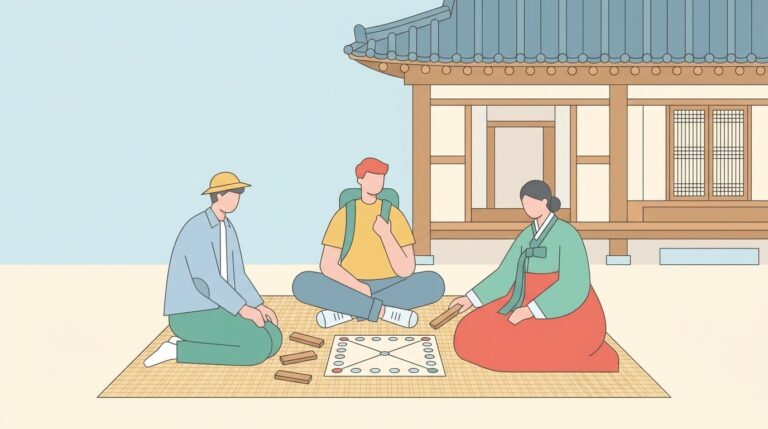
Phase 1: 공감 (Story-Driven Opening)
안녕하세요! 매일한글 에디터입니다. Have you ever visited a Korean palace like Gyeongbokgung during Chuseok or watched an episode of Running Man where the cast gets hilariously competitive over a wooden board game or kicking a feathered shuttlecock? You see people laughing, shouting, tossing four wooden sticks into the air, and you want so badly to join the circle. But suddenly, your mind goes blank. How do you ask for a turn? What do you yell when your piece knocks an opponent off the board in Yut Nori?
Many intermediate Korean learners know basic polite phrases, but when stepping into hands-on cultural spaces like Namsangol Hanok Village or Insadong folk workshops, traditional game terminology feels like a whole new language. Don’t worry! Drawing from hundreds of real workshop sessions with our Daily Hangul learners, this guide gives you the exact conversational tools, game calls, and playful banter to jump right into Korean folk games with confidence and natural charm.
Phase 2: 핵심 표현 3선 심층 분석 (Key Expressions Deep Dive)
1. 한 판 더 해요! (Han pan deo hae-yo!)
- Pronunciation: Han pan deo hae-yo! (Sounds like: Hahn pahn duh heh-yo! – imagine saying “pan” with a crisp ‘p’ sound!)
- Meaning: Literal: “Let’s do one more board/round!” | Real Nuance: “Rematch! Let’s play one more round!”
- K-Culture Moment: Seen frequently in variety shows like 2 Days & 1 Night when an idol loses a quick round of Ddakji and playfully demands another chance.
- Editor’s Insight: The counter word 판 (pan) is specifically used for games, matches, and rounds. Adding 더 (deo, more) shows energetic sportsmanship without sounding overly intense.
- Situation Spectrum: Casual ✅ | Semi-formal ✅ | Formal ⚠️
- 🤔 Think About It: In English, we often say “Best two out of three!” How does the Korean focus on 판 (pan, the physical playing board/round) highlight shared spatial energy?
2. 제가 먼저 던져볼게요. (Je-ga meon-jeo deon-jyeo-bol-ge-yo.)
- Pronunciation: Je-ga meon-jeo deon-jyeo-bol-ge-yo. (Sounds like: Jay-gah mun-juh dun-jyuh-bohl-geh-yo.)
- Meaning: Literal: “I will try throwing first.” | Real Nuance: “I’ll take the first turn (in throwing the sticks/arrows).”
- K-Culture Moment: In historical K-Dramas (Sageuk) or festival specials, characters playing Tuho (pitch-pot arrow throwing) take turns stepping up to the line.
- Editor’s Insight: Using the ~아/어 보다 (~a/eo bo-da, to try doing) grammatical structure softens your statement, turning a self-nomination into a polite, natural offer.
- Situation Spectrum: Casual ✅ | Semi-formal ✅ | Formal ✅
- 🤔 Think About It: Why do Koreans prefer saying “I’ll try doing it” over “I will do it” in social games?
3. 아, 아깝다! (A, a-kkap-da!)
- Pronunciation: A, a-kkap-da! (Sounds like: Ah, ah-gahp-dah! with a sharp ‘kk’ pop on the second syllable.)
- Meaning: Literal: “Ah, it is a waste/pity!” | Real Nuance: “Oh, so close! / What a near miss!”
- K-Culture Moment: Every Korean variety show subtitle flashes 아깝다! in bold font whenever a player misses a Jegichagi kick by a split second.
- Editor’s Insight: This spontaneous exclamation conveys shared empathy. Whether you missed or your friend missed, shouting this keeps the mood warm and exciting.
- Situation Spectrum: Casual ✅ | Semi-formal ⚠️ | Formal 🚫
- 🤔 Think About It: Does your native language have an instant reaction word for “so close yet so far” that immediately bonds players together?
Phase 3: 교과서 한국어 vs 진짜 한국어 (Textbook vs. Real Korean)
Situation 1: Asking how to play a traditional game
- 📖 교과서 한국어 (Textbook): 이 전통놀이의 규칙을 설명해 주시겠습니까? (Is this traditional game’s rule explainable to me?)
- 🗣️ 진짜 한국어 (Real-World): 이거 어떻게 하는 거예요? (How do you play this?)
- 💡 왜 다를까? (Why the difference?): In actual cultural booths, staff members prefer direct, conversational questions over stiff honorific textbook grammar.
Situation 2: Celebrating a great move or successful toss
- 📖 교과서 한국어 (Textbook): 당신이 매우 잘했습니다. (You have performed very well.)
- 🗣️ 진짜 한국어 (Real-World): 와, 대박! 완전 잘 던졌어요! (Wow, awesome! You threw that so well!)
- 💡 왜 다를까? (Why the difference?): Real game settings thrive on dynamic interjections like 대박 (daebak) and 완전 (wanjeon) to spark lively group energy.
Phase 4: K-Culture 딥다이브 & 비언어적 매너 (Deep Dive & Non-Verbal Manners)
4-1. Nunchi (눈치) & Non-Verbal Etiquette
- The Two-Handed Handover: When passing Yut sticks (윷가락) or Tuho arrows (화살) to an elder or opponent, always hold them with both hands or support your right elbow with your left hand.
- The Group Cheer Rhythm: When a teammate tosses the Yut sticks, clap rhythmically and chant: 윷 나와라, 모 나와라! (Yut na-wa-ra, Mo na-wa-ra! – “Come out, Yut! Come out, Mo!”).
4-2. Cultural Code: The Spirit of ‘Jeong’ & Teamwork in Folk Games
Traditional games like Yut Nori are not individualistic; they are collective rituals born in agrarian Korea to predict good harvests and foster communal harmony (Jeong). Even when you are competing, the goal is shared laughter rather than ruthless elimination.
Phase 5: 실전 롤플레이 시나리오 (Real-World Roleplay Scenario)
Setting: A sunny afternoon at the Bukchon Hanok Village Experience Center. Master Craftsman Park (박 명인) is hosting a Tuho (arrow throwing) and Yut Nori challenge.
- 박 명인 (Master Park): 🎭 (미소를 지으며 윷가락을 정리한다 – Smiling while setting up the Yut sticks) 어서 오세요! 전통놀이 한번 해보실래요?
- Eoseo oseyo! Jeontong-nori hanbeon haebosillaeyo?
- “Welcome! Would you like to try a traditional game?”
- 민우 (Learner Minwoo): 🎭 (고개를 끄덕이며 반갑게 인사한다 – Nodding and greeting brightly) 네, 좋아요! 이거 어떻게 하는 거예요?
- Ne, jo-a-yo! Igeo eotteoke haneun geo-ye-yo?
- “Yes, I’d love to! How do you play this?”
- 박 명인 (Master Park): 🎭 (윷가락 네 개를 건네며 – Handing over four Yut sticks) 네 개를 공중에 던져서 나오는 모양대로 말을 움직이는 거예요.
- Ne gae-reul gongjung-e deonjyeoseo naoneun moyang-daero mar-eul umjigineun geo-ye-yo.
- “You throw these four sticks in the air and move your tokens according to how they land.”
- 민우 (Learner Minwoo): 🎭 (두 손으로 공손히 받으며 – Receiving politely with both hands) 아, 이해했어요. 제가 먼저 던져볼게요!
- A, ihae-haesseoyo. Je-ga meon-jeo deon-jyeo-bol-ge-yo!
- “Ah, I understand. I will try throwing first!”
- 박 명인 (Master Park): 🎭 (박수를 치며 응원한다 – Clapping and cheering) 자, 힘차게 던져보세요! 윷 나와라!
- Ja, himchage deonjyeo-boseyo! Yut na-wa-ra!
- “Now, give it a spirited toss! Come out, Yut!”
- 민우 (Learner Minwoo): 🎭 (조심스럽게 던졌으나 ‘도’가 나와서 멈춘다 – Throws carefully but gets a single step ‘Do’) 아, 아깝다! 한 칸만 가네요.
- A, a-kkap-da! Han kan-man gane-yo.
- “Ah, so close! It only moves one space.”
- 박 명인 (Master Park): 🎭 (호탕하게 웃으며 – Laughing heartily) 하하, 시작이 반이에요. 자, 이제 제 차례입니다.
- Haha, sijag-i ban-i-e-yo. Ja, ije je charye-imnida.
- “Haha, well begun is half done! Now, it’s my turn.”
- 민우 (Learner Minwoo): 🎭 (주먹을 쥐고 파이팅을 외치며 – Pumping fist with excitement) 기대할게요! 끝나고 한 판 더 해요!
- Gidae-hal-ge-yo! Kkeutnago han pan deo hae-yo!
- “Looking forward to it! Let’s play one more round after this!”
🔀 Interactive Choice Point
Master Park throws and gets a rare “Mo” (모 – 5 spaces + bonus turn)! How do you react?
* Choice A: “우와, 대박! 모 나왔네요! 한 번 더 던지세요!” (Wow, awesome! You got Mo! Throw one more time!
* Choice B: “당신은 운이 너무 좋습니다. 화가 납니다.” (You are too lucky. I feel angry.)
* Choice C: “그만하고 집에 갈래요.” (Let’s stop, I want to go home.)
Feedback:
* Choice A (Best): Perfect reaction! In Yut Nori, getting a Mo gives an extra toss. You celebrated his success with genuine Korean enthusiasm.
* Choice B (Bad): While meant as a joke, phrasing it as “화가 납니다” sounds stiff and unintentionally aggressive.
* Choice C (Risk): Abruptly leaving kills the communal festival mood (Heung).
Phase 6: 10초 감정 섀도잉 드릴 (Emotion Shadowing Drill)
[😊 신나고 당당하게 - Excited & Confident]- 제가 / 먼저 / 던져볼게요! (Je-ga / meon-jeo / deon-jyeo-bol-ge-yo!)
[🥺 아쉽고 몰입해서 - Disappointed & Engaged]- 아, / 아깝다! / 조금만 더 / 갈 수 있었는데! (A, / a-kkap-da! / Jo-geum-man deo / gal su isseonneunde!)
[🔥 승부욕 넘치고 유쾌하게 - Playful & Competitive]- 이번엔 / 안 질 거예요, / 한 판 더 해요! (Ibeon-en / an jil geo-ye-yo, / han pan deo hae-yo!)
Phase 7: K-Culture 미니 사전 (Mini Dictionary)
- 윷놀이 (Yut-nori): The traditional four-stick board game played nationwide during Lunar New Year.
- 제기차기 (Jegi-chagi): The game of kicking a weighted feathered shuttlecock repeatedly with the inner foot without letting it touch the ground.
- 투호 (Tu-ho): The royal pitch-pot game where players toss wooden arrows into a slender bronze vase.
- 흥 (Heung): An untranslatable Korean cultural concept denoting spontaneous joy, groove, collective excitement, and high spirits.
Phase 8: 여행자를 위한 생존 키트 (Traveler’s Survival Kit)
- Top 1: 규칙 다시 설명해 주실 수 있어요? (Gu-chik da-si seol-myeong-hae ju-sil su isseo-yo? – “Could you explain the rules one more time?”) 💡 Pro Tip: Use this when the scoring in Yut Nori gets confusing!
- Top 2: 제 차례인가요? (Je cha-rye-in-ga-yo? – “Is it my turn?”) 💡 Pro Tip: Perfect for large group games where the rotation moves quickly.
- Top 3: 같이 사진 한 장 찍어도 될까요? (Ga-chi sa-jin han jang jji-geo-do doel-kka-yo? – “May we take a photo together?”) 💡 Pro Tip: Great for capturing memories with Hanbok-clad cultural masters.
Editor’s Travel Note
When exploring folk villages, check out the Visit Korea Official Travel Guide for scheduled seasonal folk festivals. To navigate small palace courtyards easily, make sure to use the Naver Map Navigation App.
Phase 9: “한 발 더 깊이” (Cultural Reflection)
In Western board games, dice determine fate with numbered dots, whereas Korean Yut Nori uses carved wooden sticks with flat and curved sides, mimicking natural agricultural cycles. Notice how victory in Korean folk games is rarely celebrated in silence; the whole village gathers to share food, drinks, and laughter. Language during play is less about strict rule enforcement and more about building collective Heung (excitement).
💬 Your Turn: What traditional folk game from your home country brings people together just like Yut Nori? Share your favorite childhood game story in the comments below!
Phase 10: FAQ & 오해 방지 (FAQ & Common Mistakes)
Q: Can I play traditional games without wearing a Hanbok?
A: Absolutely! Hanbok adds wonderful photos to your memory book, but all cultural experience zones welcome travelers in casual, comfortable attire.
Q: What is the highest score in Yut Nori?
A: The highest combinations are Yut (윷 – 4 flat sides up, move 4 spaces) and Mo (모 – 4 round sides up, move 5 spaces). Both grant you an extra bonus throw!
Q: Is betting money common during traditional folk games?
A: No, traditional games are played for fun, lighthearted chores (like washing dishes after Chuseok dinner), or small souvenir snacks.
🚨 흔한 실수 (Common Mistakes) Checklist
- ❌ Mistake 1: Tossing Yut sticks far outside the designated straw mat (Meokseok).
➡️ Correct Action: Keep your throw contained above the mat; throwing out of bounds is often considered a foul (Nak)! - ❌ Mistake 2: Using informal panmal (e.g., 야, 던져!) with cultural workshop hosts.
➡️ Correct Action: Use polite 존댓말 (던져보세요! or 던지세요!). - ❌ Mistake 3: Staying completely quiet when another player makes a good move.
➡️ Correct Action: Cheer aloud! Shouting 와! or 나이스! is expected and welcomed.
Phase 11: 액션 미션 & 참여 유도 (Action Missions)
- 🥉 Bronze Mission: Stand in front of the mirror and practice saying “아, 아깝다!” with dramatic facial expressions three times.
- 🥈 Silver Mission: Record an audio clip of yourself chanting “윷 나와라, 모 나와라!” and share it on Instagram or TikTok tagging
@DailyHangul. - 🥇 Gold Mission: Visit a Korean cultural center or palace and use “제가 먼저 던져볼게요!” before starting a game.
- 🎮 K-Culture Mission: Watch a variety show episode (e.g., Running Man Lunar New Year special) and spot at least two players yelling “한 판 더 해요!”
Phase 12: 인터랙티브 퀴즈 챌린지 (Interactive Quiz Challenge)
Q1. When you want to ask for an exciting rematch after losing a round, what should you say?
(A) 한 잔 더 주세요
(B) 한 판 더 해요
(C) 먼저 가세요
🔍 정답 및 해설 보기 (Click for Answer & Explanation)
정답: (B) 한 판 더 해요!
해설: ‘판’ is the counter for game rounds. (A) means “Give me one more drink,” and (C) means “Please go first.”
Q2. True or False: In Tuho (arrow throwing), passing arrows with both hands is considered polite Korean etiquette.
🔍 정답 및 해설 보기 (Click for Answer & Explanation)
정답: True (참)
해설: Receiving and handing items with both hands shows deep respect and polite social manner in Korean culture.







