

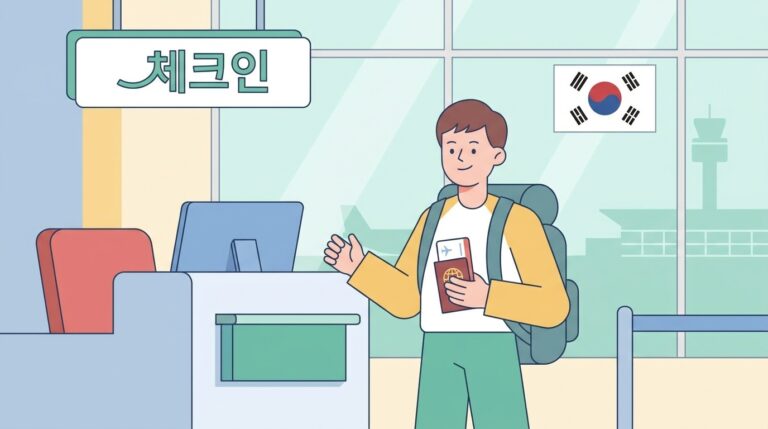
Your Ticket to Seoul: How to Book Flights in Korean Like a Native
Phase 1: Empathy & Immersion
안녕하세요! Welcome back to Daily Hangul! I’m your Korean culture navigator and your best friend in all things Korean.
Picture this: You are curled up on your sofa watching a classic K-Drama scene. The main lead dramatically sprints through Incheon International Airport to catch their flight, clutching a glowing passport and boarding pass. Inspired, you open a Korean booking website to finally plan your dream trip to Seoul or Jeju Island. But wait—suddenly you’re greeted with buttons saying 왕복 (wang-bok), 편도 (pyeon-do), and 매진 (mae-jin). Your heart skips a beat!
Navigating flight booking platforms or speaking to ticketing agents at airport counters can feel intimidating for beginners. But here is the secret: you don’t need hundreds of complex words to book a ticket smoothly. With just a handful of authentic, friendly expressions tailored for A2 learners, you will feel completely in control. This guide is built directly from real student feedback, giving you the exact words, sounds, and cultural tips you need to secure your seat hassle-free. Let’s make that trip to Korea happen!
Phase 2: Top 3 Core Expressions Deep-Dive
1. 서울행 비행기표 예약하고 싶어요 (한글)
- Pronunciation: [Seoul-haeng bi-haeng-gi-pyo ye-yak-ha-go si-peo-yo] (Think: “Soul-hang bee-hang-gee-pyo yeah-yahk-hah-go she-paw-yo”)
- Meaning: Literal: “I want to reserve a Seoul-bound airplane ticket.” / Actual Nuance: “I’d like to book a flight ticket to Seoul, please.”
- K-Culture Moment: Heard frequently at airport service desks when characters plan an impromptu getaway to Seoul in travel vlogs or romance dramas.
- Editor’s Insight: Attaching -행 (haeng) to a city name means “destination/bound for.” The grammar pattern -고 싶어요 (-go si-peo-yo) softens your request politely, making you sound friendly rather than demanding.
- Situation Spectrum: Casual: ⚠️ (Use ‘예약할래’ with close friends) | Semi-formal: ✅ (Perfect for counters and phone agents) | Formal: ✅ (예약하고자 합니다 is for business presentations)
- 🤔 Think About It: In English, we often say “I need a ticket.” Why do you think Korean prefers expressing desire (-고 싶어요) combined with soft honorifics rather than direct command verbs when dealing with service staff?
2. 왕복으로 제일 빠른 표 있어요? (한글)
- Pronunciation: [Wang-bog-eu-ro je-il ppa-reun pyo i-sseo-yo?] (Think: “Wahng-boh-goo-ro jay-il pah-reun pyo ee-ssuh-yo?”)
- Meaning: Literal: “As a round-trip, is there the fastest/earliest ticket?” / Actual Nuance: “Do you have the earliest round-trip flight available?”
- K-Culture Moment: Think of Korean variety shows like 2 Days & 1 Night where cast members rush to the terminal counter to grab the earliest flight out to Jeju!
- Editor’s Insight: 왕복 (wang-bok) means “round-trip” (going and returning). Pairing it with 제일 (je-il – most/number one) helps you instantly request priority timings without lengthy explanations.
- Situation Spectrum: Casual: ⚠️ | Semi-formal: ✅ (Standard polite for customer service) | Formal: ✅
- 🤔 Think About It: Korean combines Chinese character roots (Han-ja) like 往 (go – 왕) and 復 (return – 복) for travel terms. How does your native language compress compound travel concepts?
3. 창가 자리로 부탁드려요 (한글)
- Pronunciation: [Chang-ga ja-ri-ro bu-tak-deu-ryeo-yo] (Think: “Chahng-gah jah-ree-roh boo-tahk-deu-ryuh-yo”)
- Meaning: Literal: “By means of a window seat, I politely request.” / Actual Nuance: “A window seat, please!”
- K-Culture Moment: Taking the iconic aesthetic cloud-and-wing photo for Instagram as soon as your flight ascends above the Han River.
- Editor’s Insight: 부탁드려요 (bu-tak-deu-ryeo-yo) translates to “I kindly ask of you.” It adds warmth and gratitude to any request, transforming a simple order into a polite exchange.
- Situation Spectrum: Casual: 🚫 (Too polite for close buddies) | Semi-formal: ✅ (Ideal for airline staff) | Formal: ✅
- 🤔 Think About It: Why is asking with a humility verb (드리다 – to give upwards) so emotionally comforting in Korean service interactions?
Phase 3: Textbook Korean vs. Real Native Korean
Situation 1: Choosing a One-way vs. Round-trip Ticket
- 📖 Textbook Korean: “저는 편도 티켓을 구매하기를 원합니다.” (I wish to purchase a one-way ticket.)
- 🗣️ Real Native Korean: “편도로 한 장 주세요!” (Just one one-way ticket, please!)
- 💡 Why is it different? Real Koreans favor brevity and actionable particles like -로 (by way of) instead of lengthy textbook grammar constructs like ~하기를 원합니다.
Situation 2: Asking if Seats are Sold Out
- 📖 Textbook Korean: “이 비행기의 좌석은 모두 매진되었습니까?” (Have all seats on this airplane been sold out?)
- 🗣️ Real Native Korean: “혹시 남은 자리 없어요?” (By any chance, are there no seats left?)
- 💡 Why is it different? Native speakers often soften inquiries by starting with 혹시 (hok-si – by any chance) and asking in the negative to avoid sounding confrontational.
Phase 4: K-Culture Deep Dive & Non-Verbal Manners
4-1. Eye Contact & Hand Manners (Nunchi)
When handling passports, credit cards, or flight tickets at Korean check-in counters, always use two hands (or support your right elbow lightly with your left hand). Handing a document over with just one hand can appear dismissive. Offer a subtle, 15-degree head nod while saying 감사합니다 (gam-sa-ham-ni-da). This shows instant respect and sets a friendly vibe.
4-2. The “Ppalli-Ppalli” Efficiency Culture in Travel
Korea’s airport infrastructure (such as Incheon Airport, consistently rated among the world’s best) operates on precision, speed, and helpful service. When speaking to Korean airline agents, being clear, concise, and holding your passport open to the photo page demonstrates great Nunchi (situational awareness) and speeds up your check-in delightfully!
Phase 5: Real-Life Roleplay Scenario
Setting: Counter at Gimpo Airport. You are speaking with Agent Min-ji at the domestic ticketing desk to book a short weekend getaway to Jeju Island.
- Agent Min-ji: 어서 오세요! 어디로 가시나요?
(Eoseo oseyo! Eodiro gasinayo? / Welcome! Where are you traveling to?)
🎭 Smiles warmly behind the desk and bows slightly. -
You: 안녕하세요! 제주도행 비행기표 예약하고 싶어요.
(Annyeonghaseyo! Jeju-do-haeng bi-haeng-gi-pyo ye-yak-ha-go si-peo-yo. / Hello! I’d like to book a flight ticket to Jeju Island.)
🎭 Holds passport with both hands. -
Agent Min-ji: 네, 편도이신가요, 왕복이신가요?
(Ne, pyeon-do-i-sin-ga-yo, wang-bok-i-sin-ga-yo? / Sure, is it one-way or round-trip?) -
You: 이번 주 금요일 출발하는 왕복으로 부탁드려요.
(Ibeon ju geum-yo-il chul-bal-ha-neun wang-bog-eu-ro bu-tak-deu-ryeo-yo. / Round-trip departing this Friday, please.) -
Agent Min-ji: 오전 10시와 오후 2시 비행기가 있습니다. 어떤 시간대로 해 드릴까요?
(Ojeon yeol-si-wa ohu du-si bi-haeng-gi-ga it-seumnida. Eotteon si-gan-dae-ro hae deu-ril-kka-yo? / We have flights at 10 AM and 2 PM. Which time would you prefer?) -
You: 오전 10시 출발로 해 주세요. 창가 자리 있어요?
(Ojeon yeol-si chul-bal-ro hae ju-se-yo. Chang-ga ja-ri i-sseo-yo? / 10 AM departure, please. Do you have a window seat?) -
Agent Min-ji: 네, 창가 자리 가능합니다. 여권과 결제 카드 부탁드립니다.
(Ne, chang-ga ja-ri ga-neung-ham-nida. Yeo-gwon-gwa gyeol-je ka-deu bu-tak-deu-rim-nida. / Yes, a window seat is available. Passport and payment card, please.) -
You: 여기 있습니다. 감사합니다!
(Yeogi it-seumnida. Gam-sa-ham-ni-da! / Here you go. Thank you!)
🎭 Passes payment card with both hands.
🔀 Interactive Choice Point
Agent Min-ji says: “죄송하지만 오전 10시 비행기는 매진입니다. 어떻게 하시겠어요?” (Sorry, the 10 AM flight is sold out. What would you like to do?)
- Choice A: “그럼 다음으로 빠른 비행기표 있어요?” (Then, is there the next earliest flight ticket?)
👉 Feedback (Best! ⭐): Natural, polite, and solves the problem right away. - Choice B: “안 돼요! 꼭 타야 돼요.” (No way! I definitely must get on.)
👉 Feedback (Bad ❌): Too blunt and demanding for Korean customer service etiquette. - Choice C: “그냥 취소해 주세요.” (Just cancel everything, please.)
👉 Feedback (Risk ⚠️): You miss out on checking the 2 PM flight or alternative options!
Phase 6: 10-Second Emotion Shadowing Drill
Practice matching the cadence and emotion markers. Take a breath at the slash (/) marks!
[😊 Cheerful & Inquiring]
저기요! / 제주도 가는 표 / 아직 있어요?
(Jeo-gi-yo! / Jeju-do ga-neun pyo / a-jik i-sseo-yo?)-
[✈️ Confident & Clear]
왕복으로 / 창가 자리 / 한 장 부탁드려요!
(Wang-bog-eu-ro / chang-ga ja-ri / han jang bu-tak-deu-ryeo-yo!) -
[🥺 Slightly Hopeful & Polite]
혹시 / 오늘 출발하는 비행기 / 남은 표 있나요?
(Hok-si / oneul chul-bal-ha-neun bi-haeng-gi / na-meun pyo in-na-yo?)
Phase 7: K-Culture Mini Dictionary
- 편도 (Pyeon-do) / 왕복 (Wang-bok) | One-way / Round-trip
Usage: The most critical filter buttons when using Korean flight booking apps like Jeju Air, T’way, or Korean Air. - 창가 (Chang-ga) / 복도 (Bok-do) | Window Seat / Aisle Seat
Usage: Essential terms when an agent asks “좌석 어디로 해 드릴까요?” (Which seat type would you prefer?). - 매진 (Mae-jin) | Sold Out
Usage: Seeing red text saying ‘매진’ means no seats remain for that timeslot; look for alternate departures! - 탑승구 (Tap-seung-gu) | Boarding Gate
Usage: Look for this on your boarding pass to find your flight gate at airport terminals.
Phase 8: Traveler’s Survival Kit
Survival Expressions TOP 3
- 모바일 탑승권 어디서 확인해요? (Where do I check my mobile boarding pass?)
Pro Tip: Use when seeking gate or check-in assistance on your phone. - 수하물 추가 요금 얼마예요? (How much is the extra baggage fee?)
Pro Tip: Handy for budget airline flights when luggage exceeds 15kg. - 체크인 카운터가 몇 번이에요? (Which number is the check-in counter?)
Pro Tip: Perfect when entering vast departure halls like Incheon Terminal 1.
Editor’s Travel Note
Before flying domestic or international routes in Korea, check booking apps directly. To plan airport train transit smoothly from downtown Seoul, make sure to read our Naver Map subway and transit guide. Remember: Korean domestic check-in closes strictly 20 minutes before departure, so arrive at least 1 hour early!
Phase 9: A Step Deeper
In Korean culture, booking a ticket represents more than a transaction—it is treated as entering into a shared journey (동행). Notice how service counters in Korea conclude exchanges with “조심히 다녀오세요!” (Travel safely!) rather than a simple “goodbye.” This community-centric mindfulness reflects Korea’s value on care and safety for every traveler.
💬 Your Turn: Where in Korea are you most eager to fly to first—vibrant Seoul, coastal Busan, or magical Jeju Island? Let us know in the comments below!
Phase 10: FAQ & Common Mistakes
Q: Can I use English at Korean airport ticketing counters?
A: Major hubs like Incheon and Gimpo have English-speaking staff, but greeting them and making initial seat/ticket requests in basic Korean earns enthusiastic smiles and faster assistance.
Q: What is the difference between 표 (pyo) and 티켓 (ti-ket)?
A: Both are widely used! 표 is native Korean for ticket, while 티켓 is the loanword. Saying 비행기표 (bi-haeng-gi-pyo) sounds very natural.
Q: How do I say ‘Economy’ and ‘Business Class’?
A: Economy is 일반석 (il-ban-seok) or 이코노미, while Business is 비즈니스석 (bi-jeu-ni-seu-seok).
🚨 Common Mistakes Alert
- Mistake: Saying “창문 자리” instead of “창가 자리”.
Correct Action: Use 창가 (chang-ga) for window seat. - Mistake: Confusing 출발 (chul-bal – departure) with 도착 (do-chak – arrival) when searching dates.
Correct Action: Double-check that your booking dates align with 출발일 (departure date). - Mistake: Forgetting to present ID/Passport with both hands.
Correct Action: Use two hands when passing items across service counters.
Phase 11: Action Mission
- 🥉 Bronze: Stand in front of a mirror and say “창가 자리로 부탁드려요!” three times with a bright smile.
- 🥈 Silver: Leave a comment below introducing your destination using the formula:
[City Name] + 행 비행기표 예약하고 싶어요! - 🥇 Gold: Next time you watch a Korean airport vlog or travel drama, pause and write down at least two flight-related vocabulary words you spotted.
🎮 K-Culture Mission: Look up a Korean flight search portal and spot the buttons for 왕복, 편도, and 좌석 선택 (seat selection)!
Phase 12: Interactive Quiz Challenge
1. You want to ask for a round-trip ticket. Which word must you use?
* A) 편도 (Pyeon-do)
* B) 왕복 (Wang-bok)
* C) 환승 (Hwan-seung)
👉 Click to reveal Answer & Explanation
Answer: B) 왕복 (Wang-bok)
Explanation: 왕복 means round-trip! 편도 means one-way, and 환승 means transfer.
2. Fill in the blank:
“제주도______ 비행기표 두 장 주세요.” (Two flight tickets bound for Jeju Island, please.)
* A) -행 (-haeng)
* B) -랑 (-rang)
* C) -만 (-man)
👉 Click to reveal Answer & Explanation
Answer: A) -행 (-haeng)
Explanation: -행 attached after a place name denotes “bound for / destination.”
3. True or False:
Handing your passport to the counter agent with one hand while looking at your phone is considered standard etiquette in Korea.
👉 Click to reveal Answer & Explanation
Answer: False
Explanation: Always use two hands (or support your elbow) and offer a polite greeting to show good manners and respect!







