

Phase 1: Empathy & Immersion
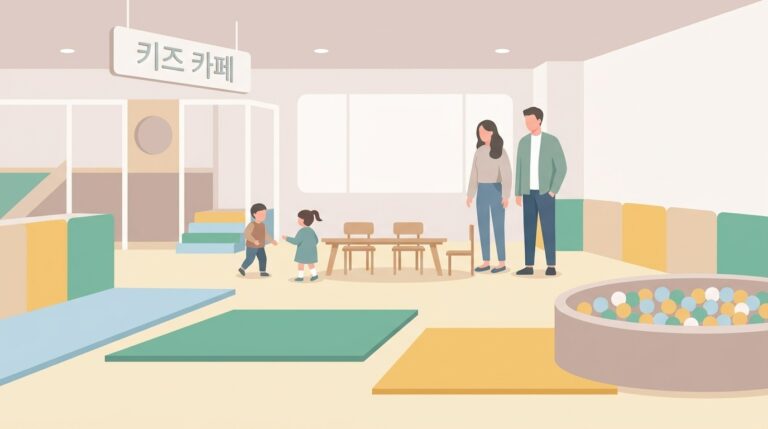
안녕하세요! This is your Daily Hangul editor. Picture this: You’re at a sprawling, pastel-toned kids’ cafe in Gangnam or Pangyo. Gentle lofi beats play, parents sip iced Americanos from plush recliners, and toddlers navigate mini-trampolines. Suddenly, a shriek echoes across the ball pit. Your child accidentally collided with another toddler while sliding down together. In seconds, the tranquil ambiance shifts. You feel multiple pairs of eyes darting your way—the unspoken social radar of Korean nunchi (눈치) activates instantly.
Navigating kids’ cafes (키즈카페) in Korea requires far more than basic playground etiquette. In ultra-connected Korean urban communities, kids’ cafes represent a high-stakes ecosystem of shared parental vigilance, subtle public decorum, and strict social liability. How do you de-escalate tension gracefully? How do you distinguish between mutual peer play and actionable negligence (주의의무 위반) in refined, polite Korean? Drawing from extensive field queries from expat parents and bilingual families, this masterclass equips you with near-native, C2-level Korean expressions to handle social friction, staff mediation, and liability gracefully.
Phase 2: Core Expressions in Depth
1. 저희 아이가 부주의해서 다치게 한 건 아닌지 정말 걱정되네요.
- Pronunciation: Jeo-hui a-i-ga bu-ju-ui-hae-seo da-chi-ge han geon a-nin-ji jeong-mal geok-jeong-dwae-yo. (Sounds like: joh-hee eye-gah boo-joo-ee-hae-so dah-chee-geh hahn gon ah-neen-jee jung-mahl guk-jung-dweh-yo)
- Meaning: Literal: “I am truly worried whether my child caused an injury due to carelessness.” / Nuance: A proactive, highly empathetic preemptive apology that validates the other parent’s shock while showing immediate parental accountability without prematurely conceding legal fault.
- K-Culture Moment: Heard in K-dramas depicting upscale kindergarten or kids’ cafe confrontations where polite language sets the psychological tone before tension escalates.
- Editor’s Insight: Using “저희 아이” (our child) instead of “내 아이” reflects Korean humility. Framing your concern around the other child’s well-being disarms anger immediately.
- Situation Spectrum: Casual: 🚫 | Semi-formal: ✅ | Formal: ✅
- 🤔 Think About It: In many Western individualistic contexts, apologizing too quickly can be viewed as an admission of legal guilt. Why does Korean relational ethics prioritize emotional de-escalation over rigid liability demarcation?
2. 혹시 아이 다친 곳은 없나요? 병원 진료가 필요하시면 말씀해 주세요.
- Pronunciation: Hok-si a-i da-chin go-seun eom-na-yo? Byeong-won jin-ryo-ga pil-yo-ha-si-myeon mal-sseum-hae ju-se-yo. (Sounds like: hohk-shee eye dah-cheen goh-seun um-nah-yo? byung-won jeen-ryoh-gah peel-yoh-hah-shee-myun mahl-sseum-hae joo-seh-yo)
- Meaning: Literal: “Is there any place the child got hurt? If a hospital visit is needed, please let me know.” / Nuance: Demonstrates sincere, active responsibility and willingness to cooperate on medical costs if required, closing the loop on potential conflict.
- K-Culture Moment: The textbook gold-standard phrase used by conscientious parents when a physical collision happens near trampolines or obstacle courses.
- Editor’s Insight: Notice the honorific verb 말씀해 주세요 (please speak/tell me) instead of 말해 주세요. This linguistic respect signals that you are mature and cooperative.
- Situation Spectrum: Casual: ⚠️ | Semi-formal: ✅ | Formal: ✅
- 🤔 Think About It: How does offering medical support right away preserve harmonious community atmosphere in tight-knit residential neighborhoods?
3. 시설 내 영업배상책임보험 접수가 가능한지 확인 부탁드립니다.
- Pronunciation: Si-seol nae yeong-eop-bae-sang-chaek-im-bo-heom jeop-su-ga ga-neung-han-ji hwak-in bu-tak-deu-rim-ni-da. (Sounds like: shee-sul neh yung-up-beh-sahng-chek-eem-boh-hum jup-soo-gah gah-neung-hahn-jee hwahk-een boo-tahk-deu-reem-nee-dah)
- Meaning: Literal: “Please check whether filing a claim under the venue’s public business liability insurance is possible.” / Nuance: Professional request to the kids’ cafe management to initiate commercial insurance coverage for facility-related accidents.
- K-Culture Moment: Used by seasoned parents when an incident is caused by equipment malfunction, slippery flooring, or inadequate staff supervision.
- Editor’s Insight: Kids’ cafes in Korea are legally mandated to carry liability insurance. Using precise institutional terminology (영업배상책임보험 접수) ensures immediate administrative action from managers.
- Situation Spectrum: Casual: 🚫 | Semi-formal: ⚠️ | Formal: ✅
- 🤔 Think About It: How does shifting from parent-versus-parent dispute to objective institutional claims processing protect interpersonal harmony in Korean public spaces?
Phase 3: Textbook Korean vs. Real Korean
Situation 1: Asking staff to monitor a hazardous area
- 📖 교과서 한국어: “직원분, 저기 위험하니까 아이들을 봐주세요.”
- 🗣️ 진짜 한국어: “매니저님, 트램펄린 존에 큰 아이들이 몰려서 위험해 보이는데, 안전 지도 한번만 부탁드려도 될까요?”
- 💡 왜 다를까? Simply demanding supervision can sound blunt. Native C2 speakers identify the specific hazard (트램펄린 존), refer to staff respectfully as 매니저님, and frame the intervention as 안전 지도 (safety guidance) via soft honorific request (부탁드려도 될까요?).
Situation 2: Proposing a gentle pause between squabbling children
- 📖 교과서 한국어: “싸우지 말고 같이 놀아라.”
- 🗣️ 진짜 한국어: “얘들아, 서로 양보하면서 차례차례 타자. 잠깐 진정하고 다른 구역 먼저 가볼까?”
- 💡 왜 다를까? Direct imperatives trigger defensiveness in modern Korean parenting cultures. Framing with 양보 (mutual concession), 차례차례 (taking turns), and suggestive redirecting creates calm cooperation.
Phase 4: K-Culture Deep Dive & Non-Verbal Etiquette
4-1. Nunchi & Physical Mannerisms at Kids’ Cafes
- The 45-Degree Lowered Stance: When approaching another parent after a collision, immediately stoop down to eye level with the children first, then maintain a slight bow when speaking to the guardian. Towering upright triggers friction.
- Physical Separation without Blame: Gently place your hands behind your own child’s shoulders to pull them gently back into your personal orbit. Never physically touch another parent’s child without explicit consent.
- Eye Contact Rhythm: Direct, unblinking eye contact in tense Korean situations can be perceived as confrontational. Use a softened gaze, glancing periodically between the child’s injury status and the parent’s expression.
4-2. Cultural Code: The Ecosystem of Mom Communities (맘카페)
Modern Korean kids’ cafes operate under the subtle influence of local hyper-local parent forums (Mom Cafes). A single unresolved altercation or rude behavior can quickly become a neighborhood dispute. As a result, parents expect high standards of etiquette: cleaning up spilled snacks, enforcing anti-slip grip socks (미끄럼 방지 양말), and offering swift apologies when boundary breaches occur.
Phase 5: Real-World Roleplay Scenario
- Setting: Premium Kids Cafe in Bundang. Your child slipped while chasing a toy and knocked down another 4-year-old on the wooden play bridge.
- Characters: You (민우 보호자 – Minwoo’s Guardian) & Jiho’s Mother (지호 어머님 – meticulous local parent).
- You: 🎭 (Rushing over with a concerned expression, bending down) “어머, 지호야 괜찮니? 지호 어머님, 정말 죄송합니다. 저희 아이가 급하게 뛰다가 부딪힌 것 같아요.”
- 지호 어머님: 🎭 (Checking Jiho’s knee with a sigh) “아이가 워낙 순식간에 뛰어나와서요. 무릎 쪽을 좀 부딪힌 것 같네요.”
- You: 🎭 (Carefully inspecting the area together) “정말 놀라셨겠어요. 혹시 까지거나 멍든 곳은 없나요? 제가 연고나 얼음팩이라도 바로 카운터에서 받아올까요?”
- 지호 어머님: 🎭 (Tone softening at your proactive care) “겉으로 피가 나는 건 아닌데, 애가 좀 놀란 것 같아요. 얼음팩 하나 부탁드릴게요.”
- You: 🎭 (Fetching the ice pack from staff and returning immediately) “여기 얼음팩 가져왔습니다. 손수건에 감싸 두었으니 잠시 대고 있어보세요.”
- 지호 어머님: 🎭 (Gently applying it) “신경 써주셔서 감사합니다. 아이들 놀다 보면 그럴 수도 있죠.”
- You: 🎭 (Taking out your phone politely) “혹시라도 귀가 후에 붓거나 통증이 지속되면 병원 진료 꼭 받으시고 제게 연락 주세요. 제 연락처 남겨드릴게요.”
- 지호 어머님: 🎭 (Smiling warmly) “말씀만으로도 정말 안심이 되네요. 조심히 놀도록 저희도 잘 지켜볼게요.”
🔀 Interactive Decision Point
Suppose Jiho’s mother remarks: “바닥 매트가 미끄러워서 더 크게 넘어진 것 같은데요?” (The slippery floor mat made them fall harder.) How do you respond?
- Option A: “그건 매장 탓이지 저희 아이 잘못은 아니잖아요?”
- Option B: “맞아요, 저도 여기 바닥이 미끄러워 보여 걱정됐어요. 매니저님께 시설 안전 점검 및 보험 접수 여부를 같이 문의해 볼까요?”
- Option C: “그럼 카운터에 가서 따져보세요.”
Feedback:
* Option A (Bad): Shifts blame defensively, instantly antagonizing the other parent and creating unnecessary hostility.
* Option B (Best): Empathetically aligns with the parent’s observation, shifting liability constructively toward facility maintenance and formal insurance coverage without conflict.
* Option C (Risk): Cold and dismissive; violates collective community manners and leaves tensions simmering.
Phase 6: 10-Second Shadowing Drill
Practice natural cadences, rhythm pauses (/), and emotional micro-intonations:
[🥺 진심 어린 사과와 공감]
“어머, / 정말 죄송합니다. / 다친 곳은 없는지 / 제가 먼저 확인해 봐도 될까요?”[🤝 차분하고 책임감 있는 제안]
“혹시 귀가 후에 / 이상이 생기시면 / 언제든 부담 갖지 마시고 / 연락처로 말씀해 주세요.”[👔 관리자에 대한 정중한 요구]
“매니저님, / 볼풀장 모서리 마감이 / 헐거워져 있는데 / 신속한 안전 조치 부탁드립니다.”
Phase 7: K-Culture Mini Dictionary
- 주의의무 (Ju-ui-ui-mu) | Duty of Care / Parental Supervision Liability
- Essential legal and social concept defining a parent’s obligation to oversee their minors in public leisure facilities.
- 영업배상책임보험 (Yeong-eop-bae-sang-chaek-im-bo-heom) | Public Business Liability Insurance
- Mandatory commercial insurance carried by indoor playgrounds to compensate for guest injuries caused by facility defects.
- 미끄럼 방지 양말 (Mi-kkeu-reom bang-ji yang-mal) | Non-slip Grip Socks
- A compulsory wardrobe item at virtually all Korean kids’ cafes; entering barefoot or in plain socks often results in entry denial.
- 안전요원 (An-jeon-yo-won) | Safety Supervisor / Attendant
- Staff designated to patrol active play zones; asking for their assistance is standard practice during overcrowding.
Phase 8: Survival Kit for Expat Parents
Survival Phrases TOP 3
- “미끄럼 방지 양말 착용했는지 확인해 주세요.” (Please check if you’re wearing non-slip grip socks.) -> Staff will check this at admission.
- “CCTV 열람 요청이 가능한 상황인가요?” (Is it possible to request a CCTV review under these circumstances?) -> Essential if there is an unobserved dispute or injury.
- “상비약과 소독약이 구비되어 있나요?” (Do you have a first-aid kit and disinfectant available?) -> Quick request at the front desk for minor scrapes.
Editor’s Travel & Parenting Note
- App Guide: Search and reserve high-rated clean venues using the Naver Map App for local kids cafe reviews.
- Facility Rules: Most Korean kids’ cafes charge standard 2-hour passes with per-10-minute overtime fees. Guardians must wear standard socks for hygiene.
Phase 9: Think Deeper
In Korean society, a kids’ cafe is not merely a commercial entertainment facility; it is a shared micro-society reflecting deep collective responsibility (공동체 의식). While individual rights are respected, public harmony (화합) is maintained when parents openly display mutual consideration (배려) before legal discussions even begin. When an accident occurs, the cultural priority is emotional restoration first, followed by institutional resolution second.
💬 Your Turn: Have you ever encountered a playground mishap in a foreign country? How does the balance between personal responsibility and community empathy compare to your home culture? Share your thoughts below!
Phase 10: FAQ & Common Mistakes
Q: If another child caused my child to get injured at a kids’ cafe, who pays the medical bill?
A: Primarily, if there was clear parental negligence or intentional pushing, the other child’s guardian is liable (often covered under personal liability insurance, 일상생활배상책임보험). However, if the injury occurred due to defective play equipment or negligent staff monitoring, the kids’ cafe facility insurance (영업배상책임보험) covers the claim.
Q: Can I review the CCTV footage immediately if my child got hurt?
A: Under Korea’s Personal Information Protection Act, managers cannot immediately share raw footage containing other identifiable children without privacy redaction or police presence. You can, however, ask the manager to preserve the recorded timestamp (영상 보존 요청) for formal inspection.
Q: What should I do if the other parent refuses to apologize or cooperate?
A: Avoid shouting or public confrontation. Request the kids’ cafe manager to act as a neutral witness, record the time and location, photograph any injuries, and request the facility’s incident log documentation.
🚨 Common Mistakes Warning
- ❌ Mistake 1: Scolding another person’s child directly in public.
- ✅ Action: Always address the guardian or staff politely rather than disciplining someone else’s child.
- ❌ Mistake 2: Assuming facility staff are full-time babysitters.
- ✅ Action: Staff supervise general area safety; legal duty of supervision (보호자 감독 의무) remains with the parent.
- ❌ Mistake 3: Forgetting guardian socks.
- ✅ Action: Adults must wear socks for hygiene; buying them at the counter adds unnecessary extra expense.
Phase 11: Action Mission & Challenge
- 🥉 Bronze Mission: Practice reciting Core Expression #1 aloud three times focusing on the polite tone shift.
- 🥈 Silver Mission: Save Core Expression #2 in your phone notes app so you can reference it swiftly during playdates.
- 🥇 Gold Mission: Visit a local Korean indoor playground and successfully order socks and ask staff about play zone rules using honorific Korean.
- 🎮 K-Culture Media Mission: Watch an episode of The Return of Superman (슈퍼맨이 돌아왔다) and identify how parents handle peer conflicts between children.
Phase 12: Interactive Quiz Challenge
- Situational Judgment: Your child accidentally drops a block on another child’s foot. What is the most appropriate first reaction?
- A) Walk away quietly since the staff should manage it.
- B) Approach the parent immediately with a bow, check the child’s foot, and offer sincere concern.
- C) Demand the other child wear thicker shoes.
- Fill in the Blank: “시설 결함으로 다친 경우, 매장에 [ ] 처리가 가능한지 문의해야 합니다.”
-
True / False: In Korea, adults can enter kids’ play areas barefoot as long as children wear non-slip socks.
🔍 Click here to reveal Answers & Explanations
- Answer: B | Demonstrates proactive parental responsibility (주의의무) and maintains social decorum.
- Answer: 영업배상책임보험 (Public Business Liability Insurance) | The standard commercial insurance for indoor entertainment venues.
- Answer: False | Adults are required to wear socks for hygiene and safety regulations across Korean indoor playgrounds.






