

Phase 1: Empathy (Story-Driven Opening)
안녕하세요! It’s your Daily Hangul editor and cultural navigator here. Have you ever watched a K-Drama like Queen of Tears or Reborn Rich, where a character walks into an elegant boardroom or traditional hanok, opens their mouth, and suddenly the entire atmosphere shifts? You might know standard polite Korean—slapping -요 (-yo) or -습니다 (-seumnida) onto the end of verbs. But then your Korean friend’s grandmother asks if you’ve eaten, and replying with “밥 먹었어요?” (even politely conjugated) sends an awkward silence across the dinner table.
Here is the intermediate (B2) truth: true honorific mastery in Korean isn’t just about changing verb endings; it’s about changing entire vocabulary words. When addressing elders, professors, executives, or in-laws, everyday words like 밥 (rice/meal), 집 (house), and 말하다 (to speak) undergo a complete transformation into their extreme honorific (극존칭) counterparts.
Over the past decade of coaching learners, I’ve seen countless intermediate speakers freeze up right here. You understand the grammar, but your brain stumbles over lexical honorific shifts. In this comprehensive guide, we will break down these lexical power-shifts so you can speak with effortless poise, cultural tact, and authentic respect without feeling stiff or intimidated. Let’s dive in!
Phase 2: Top 3 Core Lexical Shifts In-Depth
1. 말씀하시다 & 여쭙다 (Speaking & Inquiring)
- Pronunciation: Mal-sseum-ha-si-da (sounds like “Mahl-seum-ha-she-da”) & Yeo-jjup-da (sounds like “Yeo-jjoop-dah”)
- Meaning: Literal: To speak / To ask | Actual Nuance: To honorably speak (exalting the subject) / To humbly inquire/ask (lowering oneself while elevating the listener).
- K-Culture Moment: In corporate K-Dramas, junior managers never say “질문 있어요” (I have a question) to the CEO. They bow slightly and say: “사장님, 한 가지 여쭤봐도 되겠습니까?” (Director, may I humbly ask one question?).
- Editor’s Insight: 말씀 (Malsseum) is a chameleon word! When someone older speaks, it honors their speech (“좋은 말씀 감사합니다” = Thank you for your wise words). But when you refer to your own words, it humbly lowers them (“제가 드릴 말씀이 있습니다” = I have something humble to tell you).
- Situation Spectrum: Casual: 🚫 | Semi-formal: ⚠️ | Formal/Elder: ✅
- 🤔 Think About It: In English, we use formal phrasing like “May I inquire?”, but Korean changes the base verb stem entirely based on relative social hierarchy. What does this reveal about interpersonal awareness in Korean culture?
2. 댁 (Daek) vs. 집 (Jip) (Residence & Sanctuary)
- Pronunciation: Daek (sharp, crisp “Dae-k”, rhyming with “deck”)
- Meaning: Literal: House/Home | Actual Nuance: An honorable estate or esteemed residence belonging to an elder or respected individual.
- K-Culture Moment: When a son-in-law visits his prospective in-laws in a family melodrama, he never asks “어머니 집이 어디예요?”. Instead, he asks with utmost warmth: “어르신, 이번 주말에 댁으로 찾아봬도 될까요?” (Elders, may I visit your esteemed residence this weekend?).
- Editor’s Insight: Calling an elder’s house 집 (jip) isn’t necessarily rude in casual slang, but using 댁 (daek) instantly conveys elegance and traditional upbringing (가정교육).
- Situation Spectrum: Casual: 🚫 | Semi-formal: ⚠️ | Formal/Elder: ✅
- 🤔 Think About It: Why do you think Korean society created a separate noun for an elder’s physical living space, treating the home itself with honorific dignity?
3. 드리다 vs. 주시다 (The Asymmetric Dynamics of Giving)
- Pronunciation: Deu-ri-da (sounds like “Deu-ree-dah”) vs. Ju-si-da (sounds like “Joo-she-dah”)
- Meaning: Literal: To give | Actual Nuance: 드리다 = To offer/give upward (humble giving); 주시다 = An elder or senior giving downward/to you (exalted giving).
- K-Culture Moment: In cafe interactions or high-end dining, staff say “영수증 드릴까요?” (May I offer you your receipt?), while you say to an elder “제가 먼저 가져다 드리겠습니다” (I will bring it to you).
- Editor’s Insight: Never say “할머니가 저한테 드렸어요” (Grandmother offered it to me). Because Grandmother is higher in hierarchy, she 주셨어요 (graciously gave). You only 드리다 when YOU give to her!
- Situation Spectrum: Casual: ⚠️ (when referencing elders) | Semi-formal: ✅ | Formal: ✅
- 🤔 Think About It: Notice how “giving” requires you to map out who is socially higher before you choose the verb stem. How does this compare to your native language?
Phase 3: Textbook Korean vs. Real Native Korean
Situation A: Asking for an Elder’s Name in a Professional or Formal Setting
- 📖 Textbook Korean: 이름이 무엇입니까? (I-reum-i mu-eot-im-ni-kka? – What is your name?)
- 🗣️ Real Native Korean: 성함이 어떻게 되시나요? (Seong-ham-i eo-tteo-ke doe-si-na-yo? / 성함을 여쭤봐도 될까요?)
- 💡 Why it matters: Asking an elder or client “이름이 뭐예요?” can feel blunt or interrogative. Replacing 이름 (name) with the lexical honorific 성함 (seong-ham) and using the soft indirect ending 어떻게 되세요? turns a harsh demand into polished courtesy.
Situation B: Asking If an Elder Has Eaten
- 📖 Textbook Korean: 밥 먹었어요? (Bap meog-eoss-eo-yo? – Did you eat rice/food?)
- 🗣️ Real Native Korean: 진지 잡수셨어요? (Jin-ji jap-su-syeoss-eo-yo? – for elderly) or 식사하셨어요? (Sik-sa-ha-syeoss-eo-yo? – for seniors/bosses)
- 💡 Why it matters: 밥 먹다 is strictly for peers or younger friends. For grandparents, 진지 잡수시다 is the gold standard of extreme honorifics, while 식사하시다 is ideal for workplace bosses.
Phase 4: K-Culture Deep Dive & Non-Verbal Manners
4-1. 눈치 (Nunchi) & Body Gestures
Extreme honorific words sound hollow if your body language doesn’t match! When using lexical honorifics:
1. The Two-Hand Rule (두 손): When handing something over (드릴 때), support your right forearm or wrist with your left hand, accompanied by a slight 15-to-30 degree bow.
2. Eye Contact Calibration: Avoid staring unwaveringly into an elder’s eyes while using honorifics; instead, maintain soft eye contact, gently shifting your gaze downward towards their collarbone while listening attentively.
3. Posture of Reception: When receiving something (받을 때), use both hands with palms upward and nod slightly while saying “감사히 받겠습니다” (I receive this with gratitude).
4-2. Cultural Code Analysis: The Boardroom & In-Law Dynamics
In contemporary K-Dramas (such as Crash Landing on You or Business Proposal), the tension in dialogue is almost entirely created through lexical honorific shifts. When a chaebol heir switches from standard polite language to extreme humble verbs (여쭙다, 말씀 올리다), it signals absolute submission or strategic corporate diplomacy. Master these words, and you unlock the subtext of every major Korean drama scene!
Phase 5: Real-World Roleplay Scenario
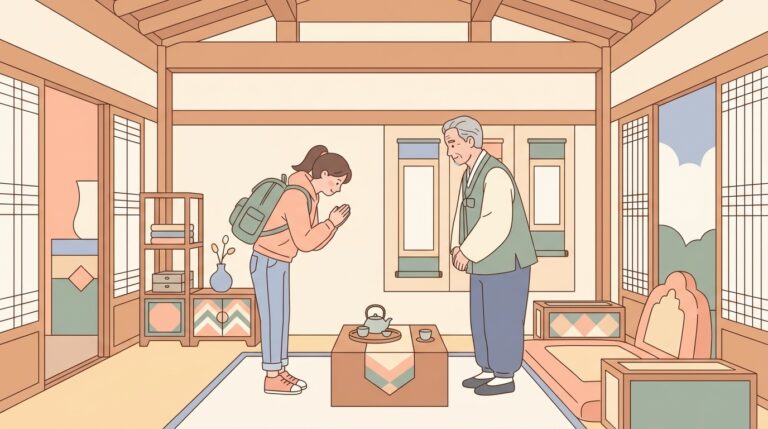
Setting: You are visiting the traditional family home (본가) of your Korean mentor/partner’s grandmother (할머니, Mrs. Park, Age 78). The living room is scented with roasted barley tea and polished wood.
- Turn 1 (Grandmother): “아이고, 먼 길 오느라 고생 많았어요. 배고프지 않아요?”
(Aigo, meon gil o-neu-ra go-saeng man-ass-eo-yo. Bae-go-peu-ji anh-a-yo?)
“Oh dear, you must be exhausted from the long trip. Aren’t you hungry?”
🎭 Warmly patting the cushion next to her. -
Turn 2 (You): “아닙니다, 할머니! 찾아뵙게 되어 정말 영광입니다.”
(A-nip-ni-da, hal-meo-ni! Cha-ja-boep-ge doe-eo jeong-mal yeong-gwang-im-ni-da.)
*”Not at all, Grandmother! It is truly an honor to come visit you.”
🎭 Bowing respectfully at 45 degrees before sitting down. -
Turn 3 (Grandmother): “우리 집에 처음 왔는데, 차 한잔 내올게요.”
(U-ri jip-e cheo-eum wat-neun-de, cha han-jan nae-ol-ge-yo.)
“Since it’s your first time at our home, let me bring out some tea.”
🎭 Starting to stand up slowly. -
Turn 4 (You): “할머니, 편히 앉아 계세요! 제가 가져다 드리겠습니다.”
(Hal-meo-ni, pyeon-hi an-ja gye-se-yo! Je-ga ga-jyeo-da deu-ri-get-seum-ni-da.)
*”Grandmother, please remain comfortably seated! I will bring it over to you.”
🎭 Gently gesturing with open palms, standing up promptly. -
Turn 5 (Grandmother): “호호, 한국말을 참 곱게 하네. 혹시 요즘 건강은 어때요?”
(Ho-ho, han-guk-mal-eul cham gop-ge ha-ne. Hok-si yo-jeum geon-gang-eun eo-ttae-yo?)
“Hoho, you speak Korean so beautifully. How has your health been these days?”
🎭 Smiling brightly with delighted eyes. -
Turn 6 (You): “저는 건강합니다! 할머니께선 요즘 편찮으신 곳은 없으신가요?”
(Jeo-neun geon-gang-ham-ni-da! Hal-meo-ni-kke-seon yo-jeum pyeon-chanh-eu-sin got-eun eop-seu-sin-ga-yo?)
*”I am very healthy! As for you, Grandmother, is there anywhere you are feeling unwell?”
🎭 Asking with genuine, attentive concern. -
Turn 7 (Grandmother): “나야 나이가 들었으니 여기저기 쑤시지. 그래도 이렇게 와주니 힘이 나네.”
(Na-ya na-i-ga deul-eoss-eu-ni yeo-gi-jeo-gi ssu-si-ji. Geu-rae-do i-reoh-ge wa-ju-ni him-i na-ne.)
*”Well, at my age aches are normal. But seeing you visit gives me so much energy.”
🎭 Reaching out to hold your hands. -
Turn 8 (You): “할머니의 연세가 믿기지 않을 정도로 정정하십니다. 오래오래 건강하세요!”
(Hal-meo-ni-ui yeon-se-ga mit-gi-ji anh-eul jeong-do-ro jeong-jeong-ha-sim-ni-da. O-rae-o-rae geon-gang-ha-se-yo!)
*”You are so vigorous that your age is hard to believe! Please stay healthy for a very long time!”
🎭 Holding her hands warmly with both of your hands.
🔀 Interactive Choice Point
Grandmother asks: “선물도 챙겨왔어요? 이게 뭐예요?” (You brought a gift too? What is this?)
- Choice A: “이거 할머니한테 주는 홍삼이에요.” (This is red ginseng I give to you, Grandma.)
- Choice B: “할머니 생신이셔서 작은 선물을 준비해 드렸습니다.” (Since it’s your birthday, I prepared a small gift for you.)
- Choice C: “할머니 생신을 맞아 약소하지만 건강식품을 챙겨 가지고 왔습니다. 받아주세요.” (In honor of your birthday, I brought some health food, though modest. Please accept it.)
Feedback:
* 🚫 Choice A (Bad): Using 주는 (giving down) and 이거 sounds like talking to a 7-year-old child! Big cultural faux pas.
* ⚠️ Choice B (Risk): Good attempt, but 생신 and 준비해 드렸습니다 are slightly mismatched with the phrasing.
* 🏆 Choice C (Best): Flawless B2 level execution! It pairs humility (약소하지만), honorific nouns (생신), and respectful request (받아주세요).
Phase 6: 10-Second Emotion Shadowing Drill
Read these out loud, pausing at the / marks and channeling the assigned emotion!
[🙇 Humble & Attentive]
사장님, / 말씀 중에 죄송하지만 / 한 가지만 여쭤보아도 / 되겠습니까?
(Sa-jang-nim, / mal-sseum jung-e joe-song-ha-ji-man / han ga-ji-man yeo-jjwo-bo-a-do / doe-get-seum-ni-kka?)-
[😊 Heartfelt & Caring]
어르신, / 날씨가 많이 쌀쌀한데 / 댁으로 조심히 / 들어가세요.
(Eo-reu-sin, / nal-ssi-ga man-i ssal-ssal-han-de / daek-eu-ro jo-sim-hi / deu-reo-ga-se-yo.) -
[🥺 Polite & Concerned]
혹시 / 어디 편찮으신 곳은 / 없으신가요? / 진지 잡수셨어요?
(Hok-si / eo-di pyeon-chanh-eu-sin got-eun / eop-seu-sin-ga-yo? / Jin-ji jap-su-syeoss-eo-yo?)
Phase 7: K-Culture Mini Dictionary (Core Honorific Lexicon)
- 진지 (Jin-ji) / 잡수시다 (Jap-su-si-da)
- Translation: Honorable Meal / To honorably dine.
- Usage: Used exclusively for grandparents or senior citizens aged 65+. Replaces 밥 and 먹다.
- 연세 (Yeon-se)
- Translation: Honorable Age.
- Usage: Replaces 나이 (nai) when inquiring about an elder’s age: “연세가 어떻게 되시나요?”
- 편찮으시다 (Pyeon-chanh-eu-si-da)
- Translation: To be unwell/sick.
- Usage: Replaces 아프다 (a-peu-da) when asking about a professor’s, boss’s, or elder’s condition.
- 뵙다 / 찾아뵙다 (Boep-da / Cha-ja-boep-da)
- Translation: To humbly meet / To visit someone esteemed.
- Usage: Replaces 만나다 (man-na-da). Example: “내일 교수님을 찾아뵐 예정입니다.” (I plan to visit the professor tomorrow).
Phase 8: Traveler’s Survival Kit
Top 3 Survival Phrases
- “어르신, 먼저 타세요. 제가 잡아드릴게요.”
(Eo-reu-sin, meon-jeo ta-se-yo. Je-ga jab-a-deu-ril-ge-yo.)
Pro Tip: Use this on the Seoul Subway or bus when offering your seat or holding the door for an elderly person. - “기사님, 댁까지 가시는 길에 여기서 내려주시겠어요?”
(Gi-sa-nim, daek-kka-ji ga-si-neun gil-e yeo-gi-seo nae-ryeo-ju-si-get-eo-yo?)
Pro Tip: A super polite way to address elderly taxi drivers. - “좋은 말씀 감사드립니다.”
(Jo-eun mal-sseum gam-sa-deu-rim-ni-da.)
Pro Tip: Universal thank-you phrase when an older tour guide or host gives you cultural advice.
Editor’s Travel Note
When navigating Korean public transport, if you need to ask elderly station managers for directions, download the Naver Map Navigation App to cross-reference subway exit numbers while politely asking: “어르신, 길 좀 여쭤봐도 될까요?” (Elder, may I ask for directions?).
Phase 9: “One Step Deeper” (Cultural Reflection)
In Western languages, respect is often expressed through tone, modal verbs, or formal vocabulary (“Could you please…”). Korean, however, embeds relational sociology directly into the vocabulary roots. By substituting 밥 with 진지 and 집 with 댁, the speaker actively sculpts their own ego down while elevating the other person’s status. It is not about feeling inferior; it is a linguistic dance of social harmony, showing that you value the communal bond over individual self-assertion.
💬 Your Turn: Does your native language have words that completely change depending on who you are speaking to? Share your examples in the comments below!
Phase 10: FAQ & Common Mistakes
Q: Can I use “진지 잡수셨어요?” to my 40-year-old team leader at work?
A: No! That would actually sound humorous or slightly sarcastic. 진지 is reserved for grandparents or elderly seniors (65+). For a middle-aged boss or colleague, use “식사하셨어요?” (Sik-sa-ha-syeoss-eo-yo?).
Q: What is the difference between 있으시다 and 계시다?
A: 계시다 honors a person’s direct existence (“교수님이 연구실에 계십니다” = The professor is in the office). 있으시다 honors an elder’s possessions or traits (“할아버지께서는 걱정이 있으십니다” = Grandfather has worries / “시간 있으세요?” = Do you have time?).
Q: When do I use 말씀 for myself vs. for others?
A: Both! When you talk about what an elder said, it means “honorable words” (“선생님 말씀”). When you talk about what you are saying to an elder, it means “humble remarks” (“제가 한 말씀 올리겠습니다”).
🚨 Common Mistakes Warning Board
| Mistake | Why It Fails | Correct Action |
|---|---|---|
| ❌ 할머니가 나한테 선물을 드렸다. | You used 드리다 (humble giving upward) for Grandma giving down to you. | ✅ 할머니께서 나에게 선물을 주셨다. |
| ❌ 사장님, 이름이 어떻게 되세요? | 이름 is too basic/informal for a CEO. | ✅ 사장님, 성함이 어떻게 되시나요? |
| ❌ 제가 오늘 댁에 있겠습니다. | 댁 is only for an elder’s house, not your own! | ✅ 제가 오늘 집에 있겠습니다. |
Phase 11: Action Missions & Community Challenge
- 🥉 Bronze Mission (Solo): Stand in front of the mirror, bow with two hands covering your lower torso, and practice saying “말씀 많이 들었습니다” (I’ve heard so much about you) 5 times.
- 🥈 Silver Mission (Social): Share your favorite Korean honorific pair (e.g., 밥 vs 진지) on your Instagram story and tag
@DailyHangul! - 🥇 Gold Mission (Real-life): Next time you visit a Korean restaurant or cafe with an elderly host, say “잘 먹었습니다, 진지 맛있게 드세요!” or use “어르신”.
- 🎮 K-Culture Hunt: In the next K-Drama episode you watch, count how many times a character uses 여쭤보다 instead of 물어보다!
Phase 12: Interactive Quiz Challenge
1. Situational Judgment: You are speaking to your university professor and want to ask if they are free tomorrow afternoon. What is the most natural, polished expression?
* A) 교수님, 내일 오후에 시간 있어요?
* B) 교수님, 내일 오후에 시간 계신가요?
* C) 교수님, 내일 오후에 시간 있으신지요?
🔍 Click to reveal the Answer & Explanation
Correct Answer: C
Explanation: Time (시간) is an indirect possession, not a living person, so you must use the indirect honorific 있으시다 (not 계시다). 있으신지요 adds a respectful, gentle ending.
2. Fill-in-the-Blank: Complete the sentence with the correct honorific noun for ‘birthday’:
* “할아버지, 이번 주말 (________) 진심으로 축하드립니다!”
🔍 Click to reveal the Answer & Explanation
Correct Answer: 생신 (Saeng-sin)
Explanation: While 생일 is used for peers and younger people, 생신 is the lexical honorific required for grandparents and elders.
3. True or False Culture Check:
* “It is culturally polite to refer to your own parents’ house as ‘저희 댁’ when speaking to your boss.” (True / False)
🔍 Click to reveal the Answer & Explanation
Correct Answer: False
Explanation: You should never use 댁 for your own family’s home when speaking upward to someone outside your clan; you should say 저희 집 or 본가 (parental home) to remain humble.







