

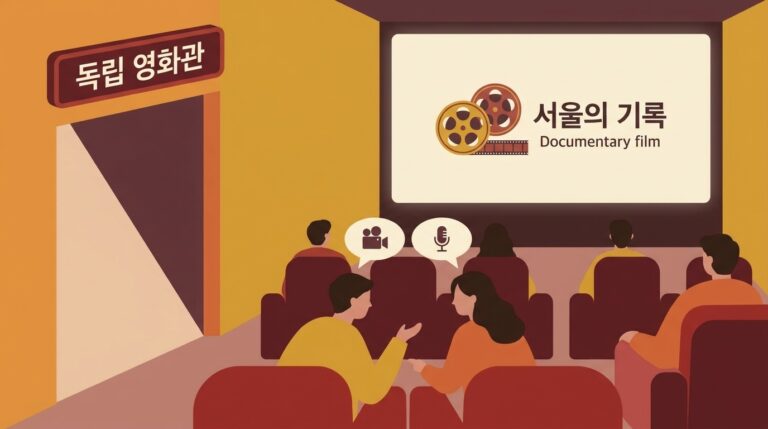
Diving Deep into Korean Documentary Criticism: Discussing Social Impact Like a Native Cultural Critic
Phase 1: Empathy (Story-Immersive Opening)
안녕하세요! This is your editor from Daily Hangul.
Picture this: You are sitting at an indie cinema café in Sangsu-dong after watching an intense, ground-breaking Korean investigative documentary like In the Name of God: A Holy Betrayal or My Love, Don’t Cross That River. The room is buzzing. Your Korean cinephile friends are passionately debating how the film exposed systemic loopholes, stirred up public outrage, and mobilized legislative changes. You want to jump into the debate with a sharp, nuanced critique, but you find yourself stuck saying, “이 영화는 진짜 중요해요 (This movie is really important).”
We have all been there! Moving from casual movie chatter to sophisticated, C1-level media analysis in Korean can feel like hitting an invisible wall. Analyzing how media shapes public discourse requires specific discourse markers, socio-cultural nuance, and sophisticated vocabulary. Based on years of feedback from our advanced learners, this guide will equip you with the exact phrases, cultural context, and critical lenses needed to critique media impact with confidence, subtlety, and intellectual flair.
Phase 2: Top 3 Core Expressions for Deep Critique
1. 사회적 반향을 불러일으키다 (Sahoejeok banhyang-eul bulleo-ireukida)
- Pronunciation: [Sah-hwe-jeok ban-hyang-eul bool-leo-ee-reu-kee-da] (Sounds like: Sah-way-juck bun-hyahng-ul bull-eo-ee-reu-key-da)
- Meaning: Literally “to summon a social echo/reflection” -> To create widespread social ripples / To provoke intense public discourse
- K-Culture Moment: Used by media critics on podcasts like Kim Eo-jun’s News Factory or film review shows when discussing documentaries that trigger investigative journalism and national debates.
- Editor’s Insight: 반향 (banhyang) implies a ripple effect or reverberation across civil society, not just passive popularity. It denotes active public reckoning.
- Situation Spectrum: Casual: ⚠️ | Semi-formal: ✅ | Formal: ✅
- 🤔 Think About It: In Korean media criticism, why is public reaction framed as an “echo” (반향) rather than simply “popularity” (인기)?
2. 공론화에 불을 지피다 (Gongronhwa-e bul-eul jipida)
- Pronunciation: [Gong-ron-hwa-eh bool-eul jee-pee-da] (Sounds like: Gong-noan-hwa-ae bool-ul jee-pee-dah)
- Meaning: Literally “to kindle the fire for making something public discourse” -> To ignite institutional and public debate on a hidden issue
- K-Culture Moment: Frequently cited in investigative journals when a documentary forces the National Assembly to propose new legislative bills (e.g., the “Dogani Bill” phenomenon).
- Editor’s Insight: 불을 지피다 evokes lighting a hearth fire in traditional Korean culture—it means initiating a process that gathers warmth and momentum over time.
- Situation Spectrum: Casual: ⚠️ | Semi-formal: ✅ | Formal: ✅
- 🤔 Think About It: How does your native language metaphorically describe taking a taboo issue into the public forum?
3. 묵직한 화두를 던지다 (Mukjikan hwadu-reul deonjida)
- Pronunciation: [Mook-jeek-han hwa-doo-reul dun-jee-da] (Sounds like: Mook-jeek-han hwah-doo-rul don-jee-dah)
- Meaning: Literally “to throw a heavy Zen topic/subject” -> To present a profound, thought-provoking question to society
- K-Culture Moment: Heard during post-screening Q&A sessions (GV: Guest Visit) at the Busan International Film Festival (BIFF) when directors challenge audience preconceptions.
- Editor’s Insight: 화두 (hwadu) originally refers to a Zen Buddhist meditation topic that demands deep contemplation. Adding 묵직한 highlights moral and emotional weight.
- Situation Spectrum: Casual: ⚠️ | Semi-formal: ✅ | Formal: ✅
- 🤔 Think About It: Reflect on how Buddhist vocabulary seamlessly integrates into contemporary Korean critical discourse.
Phase 3: Textbook Korean vs. Native Media Critic Korean
Situation 1: Expressing that a film caused major policy change
- 📖 교과서 한국어 (Textbook): 이 다큐멘터리는 법을 바꾸는 데 큰 영향을 주었습니다. (This documentary gave a big influence in changing the law.)
- 🗣️ 진짜 한국어 (Native C1): 이 작품은 단순한 고발을 넘어 제도적 개선을 이끌어내는 결정적 계기가 되었어요. (This piece went beyond mere whistleblowing and served as a decisive catalyst for institutional reform.)
- 💡 왜 다를까? (Why the difference?): Advanced native discourse avoids generic verbs like “영향을 주다” (give influence) and prefers compound nouns such as 제도적 개선 (institutional reform) and 결정적 계기 (decisive turning point).
Situation 2: Highlighting how a documentary humanizes marginalized groups
- 📖 교과서 한국어 (Textbook): 소외된 사람들의 이야기를 잘 보여줘서 감동적이에요. (It is touching because it shows marginalized people’s stories well.)
- 🗣️ 진짜 한국어 (Native C1): 소외된 타자의 목소리를 대상화하지 않고 주체적으로 담아낸 점이 돋보입니다. (What stands out is how it captures the voices of marginalized Others as subjects without objectifying them.)
- 💡 왜 다를까? (Why the difference?): Academic and cultural critiques in Korea rely on critical theory concepts like 대상화 (objectification) and 주체적 (autonomous/agentic portrayal).
Phase 4: K-Culture Deep Dive & Non-Verbal Manners
4-1. Nunchi & Bodily Posture in Critical Discussion
When engaging in intellectual or cultural critique in Korea, displaying intellectual modesty is essential. Avoid overly aggressive pointing gestures or dismissive hand-waves. When introducing a counterpoint, slightly tilt your head, nod thoughtfully, and begin with an empathetic cushion phrase such as: “물론 감독님의 의도도 십분 이해하지만…” (While I fully understand the director’s intention…). Maintain steady, respectful eye contact without staring confrontingly.
4-2. The “Dogani Effect” (도가니 현상) & Social Impact Documentaries
In modern Korean culture, media criticism is deeply tied to civic action. The term 도가니 효과 (The Silenced Effect) emerged when public outcry from media coverage led directly to statutory revisions protecting vulnerable persons. Korean audiences evaluate documentaries not solely on aesthetics, but on their civic accountability (시민사회적 책무) and ethical gaze (윤리적 시선).
Phase 5: Real-World Roleplay Scenario
Setting: A trendy book café in Hyehwa-dong following a screening at the Seoul Eco Film Festival. You are discussing an investigative piece with Min-seo (a cultural journalist).
- 민서 (Min-seo): 오늘 본 다큐멘터리, 환경 문제를 다룬 방식이 정말 파격적이지 않았어요? (Today’s documentary handled environmental issues in quite an unconventional way, didn’t it?)
- Pronunciation: Oneul bon dakyumenteori, hwangyeong munje-reul dareun bangsik-i jeongmal pagyeokjeok-iji anat-eoyo?
🎭 [안경을 고쳐 쓰며 진지한 눈빛으로]-
나 (You): 네, 기존의 환경 영화들과는 결이 완전히 다르더라고요. (Yes, the tone and texture were completely different from conventional environmental films.)
- Pronunciation: Ne, gijon-ui hwangyeong yeonghwa-deulgwaneun gyeol-i wanjeonhi dareudeoragoyo.
-
🎭 [고개를 끄덕이며 찻잔을 내려놓는다] -
민서 (Min-seo): 맞아요. 특히 피해 주민들의 증언을 배치한 편집이 탁월했어요. (Exactly. Especially the editing that arranged the testimonies of the affected residents was superb.)
- Pronunciation: Maj-ayo. Teukhi pihae jumin-deul-ui jeungeon-eul baechihan pyeonjib-i takwolhaesseoyo.
-
🎭 [노트에 키워드를 적으며] -
나 (You): 단순한 감정적 호소에 그치지 않고, 기업의 구조적 유착을 파헤쳐서 묵직한 화두를 던졌죠. (Rather than stopping at emotional appeals, it dug into structural corporate collusion and presented a heavy social question.)
- Pronunciation: Dansunhan gamjeongjeok hosoe geuchiji ankho, gieop-ui gujojeok yuchak-eul pa-hechyeoseo mukjikan hwadu-reul deonjyeotjyo.
-
🎭 [손가락으로 맥락을 짚어가며 차분하게 어필한다] -
민서 (Min-seo): 바로 그 지점이에요! 이게 여론의 공론화에 불을 지필 수 있을까요? (That’s the exact point! Do you think this can kindle public debate in the media?)
- Pronunciation: Baro geu jijeom-ieyo! Ige yeoron-ui gongronhwa-e bul-eul jipil su isseulkkayo?
-
🎭 [기대 어린 표정으로 상대방의 해석을 묻는다] -
나 (You): 방영 직후 시민단체들의 성명이 쏟아진 걸 보면, 이미 사회적 반향을 불러일으키기 시작했다고 봐요. (Seeing the flood of statements from civic organizations right after the broadcast, I believe it has already begun provoking widespread social ripples.)
- Pronunciation: Bang-yeong jikhu simin-danche-deul-ui seongmyeong-i ssodajin geol bomyeon, imi sahoejeok banhyang-eul bulleo-ireukigi sijakhaetdago bwayo.
-
🎭 [확신에 찬 어조로 미소를 띠며] -
민서 (Min-seo): 동감이에요. 미디어가 사회적 공기(公器)로서의 역할을 제대로 해냈네요. (I completely agree. The media truly fulfilled its role as a public trust.)
- Pronunciation: Dong-gam-ieyo. Midieoga sahoejeok gong-giroseoui yeokhal-eul jedaero haenaenneyo.
-
🎭 [감탄하며 고개를 깊이 끄덕인다] -
나 (You): 맞습니다. 이 작품을 계기로 법 개정 논의까지 급물살을 타길 기대해 봅니다. (Indeed. I hope this work sparks momentum for discussions on statutory amendments.)
- Pronunciation: Matseumnida. I jakpum-eul gyeogiro beop gaejeong non-uikkaji geummulsal-eul tagil gidaehae bomnida.
🎭 [따뜻하게 고개를 끄덕이며 대화를 훈훈하게 마무리한다]
🔀 Interactive Choice Point
Min-seo asks: “감독의 지나치게 주관적인 개입이 다큐멘터리의 객관성을 해쳤다는 비판에 대해서는 어떻게 생각하세요?” (What do you think about the criticism that the director’s overly subjective intervention compromised the documentary’s objectivity?)
- Option A: “그건 감독 마음이니까 상관없다고 생각해요.”
- Feedback (Bad): Too dismissive and informal for an intellectual discussion. Diminishes critical credibility.
- Option B: “객관성의 신화에 갇히기보다, 창작자의 명확한 윤리적 시선이 오히려 담론의 깊이를 더했다고 봅니다.”
- Feedback (Best – C1 Pro): Elegant, theoretically grounded, and demonstrates sophisticated defense of documentary auteurism.
- Option C: “다큐멘터리는 무조건 100% 사실만 전달해야 하므로 명백한 실패작입니다.”
- Feedback (Risk): Too dogmatic and black-and-white. Nuanced media critique requires acknowledging multiple stylistic paradigms.
Phase 6: 10-Second Emotion Shadowing Drill
Master the cadence, pauses (/), and natural vocal weight:
[🧐 분석적이고 지적인 톤]
“이 작품은 / 단순한 고발을 넘어 / 제도적 허점을 / 날카롭게 짚어내고 있습니다.”
(This piece / goes beyond mere exposure / and sharply points out / institutional loopholes.)-
[🔥 단호하고 설득력 있게]
“미디어의 침묵을 깨고 / 공론화에 불을 지폈다는 점에서 / 기념비적인 성취입니다.”
(In that it broke the media silence / and kindled public discourse / it is a monumental achievement.) -
[🤝 공감하며 여운을 남기듯]
“소외된 이들의 삶을 / 온기 있는 시선으로 조명하여 / 사회적 반향을 이끌어냈어요.”
(By illuminating the lives of the alienated / with a warm gaze / it produced profound social reverberations.)
Phase 7: K-Culture Mini Dictionary
- 사회적 공기 (社會的 公器 – Sahoejeok Gong-gi) | Public Instrument / Trust of Society
Usage: Refers to journalism and media outlets having an ethical responsibility toward society rather than operating purely as profit machines. - 급물살을 타다 (Geummulsal-eul tada) | To gain rapid momentum
Usage: Used when long-stalled policy discussions, social movements, or public investigations suddenly accelerate due to media exposure. - 문제의식 (Munje-uisik) | Critical awareness / Sense of problem
Usage: A prerequisite keyword when analyzing an auteur’s conceptual motivation in creative arts and investigative documentaries. - 담론 (Discourse – Damron) | Public / Academic discourse
Usage: Used when discussing how cultural artifacts generate systemic narratives across political, social, and philosophical domains.
Phase 8: Traveler & Film-Goer Survival Kit
Survival Expressions TOP 3 for Korean Indie Theaters & Film Festivals
- “감독과의 대화(GV) 티켓 아직 남아있나요?” (Are tickets for the Director’s Talk / Guest Visit still available?)
Pro Tip: Independent theaters like Cinematheque KOFA, Indie Space, and KT&G Sangsangmadang label Q&A sessions simply as “GV”. - “이 다큐멘터리 영문 자막 지원되나요?” (Does this documentary support English subtitles?)
Pro Tip: At major film festivals like BIFF or DMZ Docs, check screening codes labeled “E” (English subtitles included). - “사전 예매 매진인데 현장표 대기 줄이 어디인가요?” (Online tickets are sold out; where is the waiting line for on-site standby tickets?)
Pro Tip: Popular documentary screenings hold a small quota of on-site cancellation tickets available 1 hour before showtime.
Editor’s Travel Note
When navigating Korean indie cinemas and cultural centers, make sure to use the Naver Map app download for iOS and Android to search for landmark spots like Arko Arts Theater, Emo Cinema, or Indieground. Also, remember that most independent cinemas in Seoul offer contactless kiosks with English UI selection.
Phase 9: A Step Deeper: The Ethics of Representation in Korean Media
In South Korean collective consciousness, the boundary between media representation and civic responsibility is remarkably narrow. Documentaries are rarely consumed as detached artistic objects; rather, audiences hold creators to stringent standards regarding moral solidarity with victims and marginalized voices. This reflects the Confucian ethos of communal responsibility blended with South Korea’s vibrant history of grassroots democratization movements (시민 민주화 운동).
When you participate in media discussions in Korean, demonstrating that you respect this collective civic weight elevates you from a simple language learner to a true cultural insider.
💬 Your Turn: What is one documentary from your country that fundamentally transformed national legislation or public opinion? Try writing one sentence about it below using 사회적 반향 or 공론화!
Phase 10: FAQ & Common Pitfalls
Q: Can I use “영향력 (influence)” instead of “사회적 반향 (social ripple)”?
A: Yes, but 영향력 is neutral and describes general influence (e.g., “BTS의 영향력”). When critiquing documentaries that provoke moral introspection and socio-political debate, 사회적 반향 sounds significantly more professional, analytical, and native.
Q: What is the exact difference between “취재” and “인터뷰”?
A: 취재 (investigative reporting/coverage) encompasses investigative digging, gathering evidence, background checks, and on-site reporting, whereas 인터뷰 refers specifically to conversational question-and-answer sessions.
Q: How do I criticize a documentary politely without offending native speakers in a discussion?
A: Use mitigating discourse cushions. Instead of saying “이 영화는 잘못되었습니다” (This movie is wrong), frame it around artistic nuance: “~라는 점은 높이 평가하지만, ~라는 측면에서는 다소 아쉬움이 남습니다” (While I highly value X, in terms of Y there is a slight regret).
🚨 Common Mistakes Warning Board
- ❌ “이 다큐는 사회를 바꿨어요.” (Too simplistic for C1 discussions)
👉 Correct Action: “이 다큐멘터리는 사회적 공론화의 기폭제 역할을 했습니다.” (This documentary acted as a catalyst for public discourse.) - ❌ “사람들이 많이 봐서 인기 있어요.” (Focuses solely on box office popularity)
👉 Correct Action: “대중적 흥행을 넘어 유의미한 사회적 화두를 제시했습니다.” (Beyond commercial success, it presented a meaningful social issue.) - ❌ Mispronouncing 공론화 as [gong-lon-hwa]
👉 Correct Action: Pronounce it smoothly with standard Korean assimilation rules as [gong-non-hwa].
Phase 11: Action Missions
- 🥉 Bronze Mission (Solo Practice): Read a short Korean film review on Cine21 or Watcha Pedia and identify three analytical keywords (화두, 공론화, 연대).
- 🥈 Silver Mission (Social Media): Post a 1-sentence mini review of your favorite documentary on your social media using the sentence frame: “이 작품은 [주제]에 대한 묵직한 화두를 던진다.”
- 🥇 Gold Mission (Real-World Application): Attend a Korean indie screening or post-screening GV (in-person or online) and ask a question incorporating 사회적 반향 or 윤리적 시선.
🎮 K-Culture Media Mission: Watch the iconic Korean investigative documentary series Unanswered Questions (그것이 알고 싶다) on YouTube and spot how many times the host uses the phrase “우리는 여기서 질문을 던져야 합니다” (We must pose a question here).
Phase 12: Interactive Quiz Challenge
Question 1: Situational Judgment
You want to write a high-level review stating that a documentary successfully brought child welfare issues into parliamentary debate. Which sentence is most fitting for a C1 critic?
* A) 아이들 복지가 아주 슬펐습니다.
* B) 이 작품은 아동 복지 사각지대 문제를 수면 위로 끌어올려 공론화에 불을 지폈습니다.
* C) 다큐멘터리가 인기가 많아서 법이 바뀌었습니다.
Question 2: Fill in the Blank
“다큐멘터리는 단순한 오락물이 아니라 사회적 ( )로서 진실을 추구해야 합니다.”
(A) 공기 (公器) | (B) 공기 (Air) | (C) 무기 (Weapon)
Question 3: True / False Cultural Nuance
In Korean media critique, using the term ‘화두를 던지다’ originates from culinary vocabulary referring to serving a dish. (True / False)
👉 Click here to reveal the answers and explanations!
- Answer: B | Sentence B uses high-register terms like 사각지대 (blind spot), 수면 위로 끌어올리다 (bring to the surface), and 공론화에 불을 지피다 (kindle public debate).
- Answer: A | 사회적 공기 (社會的 公器) refers to media serving as a public instrument for the common good.
- Answer: False | 화두 (Hwadu) originates from Zen Buddhist philosophical traditions referring to a deep meditative question, not culinary arts!







