

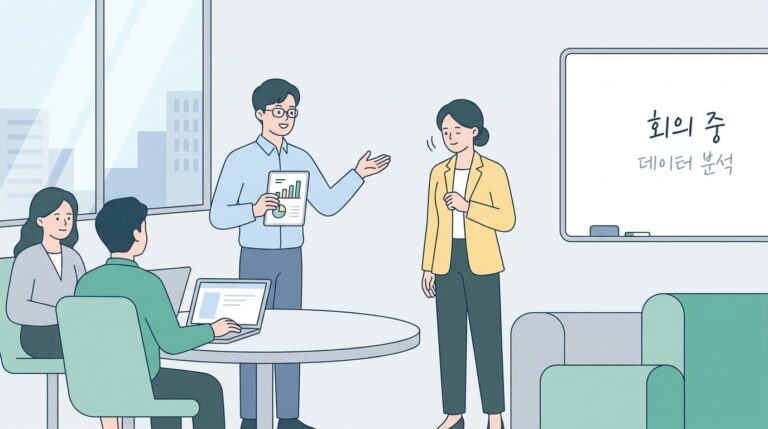
Phase 1: 공감 (Story Opening)
안녕하세요! 매일한글 에디터입니다.
Imagine this: You are working at a fast-paced tech startup in Pangyo Techno Valley—Korea’s Silicon Valley—just like a scene straight out of the hit K-Drama Start-Up. The project deadline is looming, your team’s code builds are crawling, and your local development server keeps freezing every 20 minutes. You know without a doubt that the legacy RAM and obsolete SSDs are choking productivity. But when you look across the open office at your team lead (팀장님), you hesitate. In Korean workplace culture, directly walking up and demanding, “This computer is trash, buy us new ones” is an instant career red flag.
Persuading leadership for a budget allocation—especially for hardware replacement—requires a delicate blend of business justification, polite deference, and strategic phrasing. If you sound too blunt, you come across as complaining; if you sound too passive, your request gets buried under next quarter’s backlog. Based on feedback from hundreds of intermediate (B2) Korean learners working in Korea’s IT industry, this guide gives you the exact phrases, nuances, and nunchi tactics to make your technical case logically and persuasively.
Phase 2: 핵심 표현 3선 심층 분석 (Top 3 Core Expressions)
1. 교체 주기가 지나서 업무 효율이 많이 떨어집니다.
- Pronunciation: Gyo-che ju-gi-ga ji-na-seo eom-mu hyo-yul-i man-i tteo-reo-jim-ni-da. (Sounds like: gyo-che joo-gee-gah jee-nah-suh um-moo hyo-yool-ee mahn-ee tduh-luh-jeem-nee-dah)
- Meaning: Literal: “Because the replacement cycle has passed, work efficiency drops a lot.” / Natural nuance: “The hardware is well past its lifecycle, which is significantly impacting our team’s productivity.”
- K-Culture Moment: Picture an intense IT scene in Misaeng (Incomplete Life) where a junior developer presents an upgrade proposal by framing hardware upgrades as a company-wide efficiency gain rather than personal comfort.
- Editor’s Insight: Notice the phrase 교체 주기 (replacement cycle). Instead of blaming the device as “old” (오래된), using formal corporate vocabulary depersonalizes the issue and frames it as standard operational maintenance.
- Situation Spectrum: Casual 🚫 | Semi-formal ⚠️ | Formal ✅
- 🤔 Think About It: Why does Korean corporate communication prefer attributing equipment issues to systemic cycles rather than personal inconvenience?
2. 잦은 다운 현상으로 인해 작업 리스크가 큰 상황입니다.
- Pronunciation: Jaj-eun da-un hyeon-sang-eu-ro in-hae jak-eop ri-seu-keu-ga keun sang-hwang-im-ni-da. (Sounds like: jah-jeun down hyun-sahng-oo-roh een-heh jahk-up ree-soo-koo-gah koon sahng-hwahng-eem-nee-dah)
- Meaning: Literal: “Due to frequent down phenomena, task risk is a big situation.” / Natural nuance: “With frequent system crashes, we are currently facing a high operational risk.”
- K-Culture Moment: When a deployment crash causes an emergency war-room meeting, you point out that failing physical components pose an unacceptable business risk.
- Editor’s Insight: Using ~로 인해 (due to) combined with ~상황입니다 (it is a situation where…) softens the assertiveness while highlighting urgency. It shifts the focus from “I want a new machine” to “We must protect the company’s deliverables.”
- Situation Spectrum: Casual 🚫 | Semi-formal ⚠️ | Formal ✅
- 🤔 Think About It: How does phrasing a problem as a shared “operational risk” (작업 리스크) alter the manager’s accountability compared to English?
3. 장기적인 유지보수 비용을 고려했을 때 교체하는 편이 훨씬 경제적입니다.
- Pronunciation: Jang-gi-jeok-in yu-ji-bo-su bi-yong-eul go-ryeo-haess-eul ttae gyo-che-ha-neun pyeon-i hwol-ssin gyeong-je-jeok-im-ni-da. (Sounds like: jahng-gee-juhk-een yoo-jee-boh-soo bee-yong-ool go-ryuh-hess-ool tteh gyo-cheh-hah-noon pyun-ee hwol-sseen gyung-jeh-juhk-eem-nee-dah)
- Meaning: Literal: “When considering long-term maintenance cost, replacing is much more economical.” / Natural nuance: “Taking long-term maintenance costs into account, replacement is far more cost-effective.”
- K-Culture Moment: An ambitious team lead pitching budget reallocation during a quarterly sprint review with slide decks full of ROI statistics.
- Editor’s Insight: ~하는 편이 [형용사]입니다 is a quintessential B2-level grammar structure. It offers a strong conclusion while maintaining a modest, diplomatic tone.
- Situation Spectrum: Casual 🚫 | Semi-formal ⚠️ | Formal ✅
- 🤔 Think About It: In your native language, would you emphasize cost-saving or developer comfort first when requesting upgraded tech?
Phase 3: 교과서 한국어 vs 진짜 한국어 (Textbook vs. Real-World Korean)
Situation 1: Explaining that a server or computer keeps freezing
- 📖 교과서 한국어: 컴퓨터가 너무 낡아서 자꾸 멈춥니다. 바꿔 주세요. (The computer is too old and keeps stopping. Please change it.)
- 🗣️ 진짜 한국어: 장비 노후화로 랙(lag)과 프리징이 빈번해서 교체 검토를 부탁드려도 될까요? (With aging equipment, lag and freezing occur frequently; could we request a review for replacement?)
- 💡 왜 다를까?: In actual Korean tech environments, developers mix everyday Konglish tech jargon (랙, 프리징) with high-register business endings (
교체 검토를 부탁드리다) to show competence and polite tact.
Situation 2: Emphasizing that repair is no longer worth the money
- 📖 교과서 한국어: 수리비가 비싸니까 새로 사는 것이 낫습니다. (Repair is expensive, so buying a new one is better.)
- 🗣️ 진짜 한국어: 부품 단종으로 수리 비용 대비 신규 장비 도입의 실익이 더 큽니다. (Because parts are discontinued, adopting new equipment yields far greater net benefits compared to repair costs.)
- 💡 왜 다를까?: Korean management responds to business value metrics like 실익 (actual benefits) and 부품 단종 (EOL / end of life) rather than subjective evaluations like 비싸다 (expensive).
Phase 4: K-Culture 딥다이브 & 비언어적 매너 (Non-Verbal Manners & Cultural Code)
4-1. Nunchi & Physical Etiquette in IT Meetings
When pitching hardware upgrades in a Korean corporate setting:
* Document First, Speak Second: Never bring up hardware purchases verbally by surprise. Prepare a short, bulleted 1-page memo or Slack draft (기안서 / 품의서 format) before scheduling the conversation.
* Two-Handed Tablet / Document Presentation: When handing over diagnostic logs or spec comparison sheets to a senior manager, support your right forearm or elbow with your left hand.
* Softening the Direct Gaze: While explaining technical breakdowns, maintain respectful eye contact when listening, but look down slightly at the data points while speaking to show deference and prevent appearing confrontational.
4-2. Cultural Code: The ‘Pangyo Style’ vs. Traditional Corporate Balance
Even in trendy Korean IT companies with flat hierarchies (where everyone calls each other by English names or 님), financial approval still adheres to strict budget cycles (분기별 예산). Frame your upgrade request during the budget forecasting window (usually late Q3 or early Q4) or right before major sprint milestones.
Phase 5: 실전 롤플레이 시나리오 (Interactive Roleplay Scenario)
- Setting: Pangyo Tech Valley, Meeting Room 3B.
- Characters:
- Alex (You): Intermediate B2 Korean speaker & Senior Frontend Developer.
- Team Lead Park (박 팀장님): Pragmatic yet budget-conscious engineering director.
- Turn 1 (Alex): 팀장님, 잠깐 빌드 환경 관련해서 상의드릴 말씀이 있습니다.
🎭 [두 손을 모으고 조심스럽게 다가가며]
(Team Lead Park, do you have a brief moment to discuss our build environment?) - Turn 2 (Park 팀장): 네, 알렉스 님. 무슨 일이죠? 이번 스프린트에 이슈 있나요?
(Sure, Alex. What’s going on? Any issues in this sprint?) - Turn 3 (Alex): 현재 개발 서버의 잦은 다운 현상으로 인해 배포 딜레이 리스크가 큰 상황입니다.
🎭 [태블릿으로 주간 서버 다운타임 지표를 보여주며]
(Currently, due to frequent development server crashes, there is a major risk of deployment delays.) - Turn 4 (Park 팀장): 흠… 지난달에 메모리 증설하지 않았었나요? 추가 수리로 해결이 안 될까요?
(Hmm… didn’t we expand the memory last month? Can’t we resolve this with further repairs?) - Turn 5 (Alex): 메인보드 노후화로 부품 호환에 한계가 있어서, 추가 수리보다는 신규 서버 도입이 훨씬 경제적입니다.
🎭 [단호하지만 정중한 어조로]
(Due to motherboard aging, component compatibility is limited; introducing a new server is far more cost-effective than ongoing repairs.) - Turn 6 (Park 팀장): 그렇군요. 혹시 견적서랑 ROI 비교 자료는 준비되어 있나요?
(I see. Do you happen to have the quotation and ROI comparison ready?) - Turn 7 (Alex): 네, 3개 벤더사 비교 견적서와 생산성 개선 예측치를 정리해 두었습니다.
🎭 [정리된 품의서 문서를 건네며]
(Yes, I have compiled quotes from three vendors along with projected productivity gains.) - Turn 8 (Park 팀장): 꼼꼼하게 준비하셨네요. 이번 주 예산 회의 때 정식으로 기안 올리겠습니다.
(You prepared this thoroughly. I will formally submit the proposal during this week’s budget meeting.)
🔀 인터랙티브 분기점 (Interactive Decision Point)
How should Alex respond if Team Lead Park asks: “Can we push this off until next year?” (내년으로 미루면 안 될까요?)
- Option A: “안 됩니다. 지금 당장 안 바꾸면 다음 주 릴리즈 무조건 터집니다.”
- Result (Bad): Too aggressive and disrespectful. Creates defensiveness and damages rapport.
- Option B: “팀장님 결정에 따르겠습니다. 내년까지 어떻게든 버텨보겠습니다.”
- Result (Risk): Too submissive. The bottleneck persists, and when deadlines fail, your team bears the blame.
- Option C: “연말 트래픽 급증을 감안하면, 지금 선제적으로 교체하는 편이 장애 손실 비용을 줄이는 최선의 방안입니다.”
- Result (Best): Logical, forward-looking, and polite. Frames immediate replacement as preventative cost protection.
Phase 6: 10초 감정 섀도잉 드릴 (Emotional Shadowing Drill)
Practice reading these out loud, matching the rhythm and emotional intent marked by / pauses:
[🧐 차분하고 분석적으로]
장기적인 유지보수 비용을 / 고려했을 때 / 교체하는 편이 / 훨씬 경제적입니다.[🚨 단호하지만 정중하게]
잦은 다운 현상으로 인해 / 작업 리스크가 / 매우 큰 상황입니다.[🤝 신뢰감을 주며]
구체적인 비교 견적서를 바탕으로 / 교체 검토를 / 부탁드리겠습니다.
Phase 7: K-Culture 미니 사전 (Core IT Terms)
- 품의서 (Pum-ui-seo) / 기안 (Gi-an)
- Translation: Formal purchase proposal / Authorization draft
- Context: The standard written process in Korean companies required before purchasing any tech asset or hardware.
- 노후화 (No-hu-hwa)
- Translation: Deterioration / Aging of equipment
- Context: The professional term used in corporate documentation instead of saying “old” (오래됨).
- 다운타임 (Da-un-ta-im)
- Translation: System downtime
- Context: Universally used across Korean IT to quantify losses caused by server/hardware failures.
- 선제적 대응 (Seon-je-jeok dae-eung)
- Translation: Proactive / Preemptive response
- Context: A buzzword beloved by Korean C-level executives when justifying preventive upgrades.
Phase 8: 여행자 & 실무자를 위한 생존 키트 (Survival Kit)
Top 3 Immediate Survival Phrases:
- 이 장비는 교체가 시급합니다. (This equipment urgently needs replacement.)
- Pro Tip: Use 시급합니다 (is urgent) only when hardware failure actively halts client operations.
- A/S 보증 기간이 만료되었습니다. (The warranty period has expired.)
- Pro Tip: Korean electronics support centers (
서비스 센터) check warranty status first before quoting repairs.
- Pro Tip: Korean electronics support centers (
- 비용 대비 성능이 나오지 않습니다. (It is no longer cost-effective.)
- Pro Tip: The Korean equivalent of “The price-to-performance ratio (가성비) is unacceptable.”
Editor’s Practical Note:
When working or traveling in Korea’s tech hubs, utilize the Naver Map app download to quickly locate specialized electronics districts like Yongsan Electronics Market (용산 전자상가) or Gangnam IT repair centers. Always carry digital receipts on your mobile device for quick corporate reimbursement!
Phase 9: “한 발 더 깊이” (Cultural Essay & Reflection)
In Korean organizational dynamics, proposing hardware replacements is rarely just a technical evaluation; it is an exercise in collective responsibility (공동체 책임 의식). When someone requests expensive gear simply because it is slow, it can inadvertently be seen as prioritizing individual comfort over corporate resources. However, when you frame the upgrade around team velocity, downtime risk, and fiscal prudence, leadership views you as a visionary partner invested in the company’s shared success.
💬 Your Turn: In your culture, do you usually bring data sheets first, or do you have a casual 1-on-1 chat over coffee before requesting company equipment? Share your thoughts in the comments below!
Phase 10: FAQ & 흔한 실수 (FAQ & Common Mistakes)
Q: What is the best way to mention computer hardware issues without sounding like a complainer?
A: Depersonalize the subject. Instead of saying “제 컴퓨터가 안 돼요” (My computer doesn’t work), say “현재 업무 장비의 사양이 최신 소프트웨어 환경을 지원하기에 다소 한계가 있습니다” (The current work machine specs have limitations in supporting our latest software environment).
Q: Can I use the slang ‘가성비’ in a formal budget meeting?
A: While common in casual chats, use 비용 대비 효과 (cost effectiveness) or 경제성 (economic feasibility) in formal presentations.
Q: How do I express urgency without sounding rude to my boss?
A: Use the conditional phrase ~인 점을 감안하여 (Taking into account that…) followed by 선제적 조치를 부탁드립니다 (We ask for proactive measures).
🚨 흔한 실수 (Common Mistakes) 경고판:
1. ❌ 컴퓨터가 똥컴이에요. (Using vulgar internet slang in the office)
   👉 ✅ 장비 성능이 저하되어 있습니다. (The equipment performance has degraded.)
2. ❌ 당장 새 걸로 사주세요. (Demanding directly without business data)
   👉 ✅ 교체 검토를 요청드려도 되겠습니까? (May I request a review for replacement?)
3. ❌ 수리하면 돈 낭비예요. (Sounding dismissive of existing budget constraints)
   👉 ✅ 추가 수리비 대비 교체 실익이 더 큽니다. (Replacement offers greater net benefits than additional repair costs.)
Phase 11: 액션 미션 (Action Mission)
- 🥉 Bronze Mission: Practice reading Key Expression #3 out loud 5 times using the shadowing pause marks.
- 🥈 Silver Mission: Write a 2-sentence Slack message to a hypothetical Korean team lead proposing a laptop upgrade and post it in the comments below.
- 🥇 Gold Mission: Use the phrase ~하는 편이 훨씬 경제적입니다 in a real Korean business conversation or Korean language class this week!
- 🎮 K-Culture Mission: Watch an episode of the drama Search: WWW or Misaeng and note how junior engineers pitch tech solutions to senior managers.
Phase 12: 인터랙티브 퀴즈 챌린지 (Interactive Quiz)
Q1. Which phrase is the most professional when explaining hardware lag during a team meeting?
* A) 컴퓨터가 바보예요.
* B) 장비 노후화로 인해 잦은 프리징 현상이 발생하고 있습니다.
* C) 컴퓨터 버리고 새 거 사주세요.
Q2. Fill in the blank (B2 Grammar):
장기적인 유지보수 비용을 고려했을 때, 신규 장비로 [ ______ ] 편이 훨씬 경제적입니다.
* (교체하는 / 교체하고 / 교체해서)
Q3. True or False:
In Korean corporate meetings, it is polite to demand immediate hardware replacement without showing vendor quotes or cost comparisons. (T / F)
🔍 정답 및 해설 확인하기 (Click to Reveal Answers)
- Q1 Answer: B (B provides formal technical phrasing that highlights business reality without informal emotional bias.)
- Q2 Answer: 교체하는 (The structure ~는 편이 [형용사]이다 requires the present adnominal verb ending
-는.) - Q3 Answer: False (Korean business etiquette strongly emphasizes documentation, comparative quotes, and ROI metrics before budget approval.)







