

Never Panic in a Korean Cafe: How to Ask for the Restroom Passcode Like a Local
Phase 1: Empathy (Storytelling Opening)
안녕하세요! 매일한글 에디터입니다. (Hello! I’m the lead editor at Daily Hangul!)
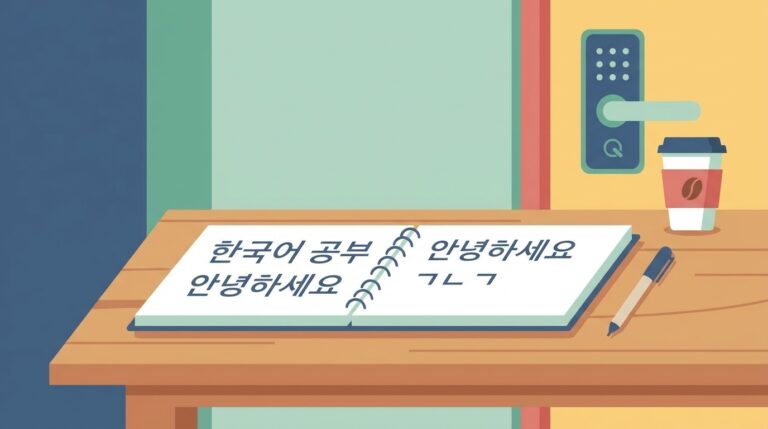
Picture this: You are sitting in a cozy, trendy cafe in Hongdae, Seoul. You’ve just enjoyed a delicious iced Americano and a thick slice of croffle. Suddenly, you need to use the restroom. You walk toward the hallway, reach for the door handle, and… click. It’s locked! Beside the door handle is a shiny electronic key pad glowing back at you.
You look around frantically, but there’s no key in sight. You walk back to the barista, feeling a sudden surge of anxiety. How do I ask for the password in Korean? What if I use the wrong words?
If you’ve ever felt this hesitation, you are definitely not alone! This is one of the most common cultural surprises foreigners experience in Korea. In Korea, most commercial restrooms are secured with digital door locks (도어락) to keep them clean and reserved for customers.
Don’t worry! By the end of this guide—crafted from real student experiences and feedback—you will know exactly what to say, where to look on your receipt, and how to ask with absolute confidence. Let’s master this essential Korean survival skill together!
Phase 2: Core Expressions Deep Dive
1. 화장실 비밀번호가 뭐예요? (Hwajangsil bimilbeonhoga mwo-ye-yo?)
- Pronunciation: [Hwa-jang-sil bi-mil-beon-ho-ga mwo-ye-yo?] (Sounds like: Hwah-jahng-seel bee-meel-bun-ho-gah mwoh-yeh-yoh?)
- Meaning: Literal: “What is the bathroom password?” | Nuance: “Excuse me, could you tell me the passcode for the restroom?”
- K-Culture Moment: A scene in a K-drama where the protagonist nervously whispers to a cafe worker while holding their stomach.
- Editor’s Insight: This is the ultimate standard phrase! It is polite, crystal clear, and perfect for beginner (A2) speakers.
- Situation Spectrum: Casual ⚠️ | Semi-formal ✅ | Formal ✅
- 🤔 Think About It: Why do you think Korean businesses use digital passcodes instead of traditional physical keys?
2. 영수증에 비밀번호 있어요? (Yeongsujeunge bimilbeonho issoyo?)
- Pronunciation: [Yeong-su-jeung-e bi-mil-beon-ho is-seo-yo?] (Sounds like: Young-soo-jung-eh bee-meel-bun-ho ees-suh-yoh?)
- Meaning: Literal: “Is the password on the receipt?” | Nuance: “Is the passcode printed on my receipt?”
- K-Culture Moment: A customer looking down at their long receipt while pointing at the bottom counter text.
- Editor’s Insight: Before asking out loud, many smart locals check their receipt first! If you are unsure, showing your receipt while asking this phrase saves time.
- Situation Spectrum: Casual ⚠️ | Semi-formal ✅ | Formal ✅
- 🤔 Think About It: How does printing passcodes on receipts help cafe owners limit restroom use to paying customers?
3. 화장실 어디에 있어요? (Hwajangsil eodie issoyo?)
- Pronunciation: [Hwa-jang-sil eo-di-e is-seo-yo?] (Sounds like: Hwah-jahng-seel uh-dee-eh ees-suh-yoh?)
- Meaning: Literal: “Where is the restroom?” | Nuance: “Excuse me, where can I find the restroom?”
- K-Culture Moment: Asking the staff right after getting your coffee order.
- Editor’s Insight: In Korea, restrooms are often located outside the actual cafe space—such as in the building stairwell or corridor. Asking where it is first is always a smart start!
- Situation Spectrum: Casual ⚠️ | Semi-formal ✅ | Formal ✅
- 🤔 Think About It: How does the layout of Korean commercial buildings affect room placement?
Phase 3: Textbook Korean vs. Real Native Korean
Situation 1: Asking for access
- 📖 Textbook Korean: 화장실 열쇠를 주시겠습니까? (Hwajangsil yeolseru jusigessneumnika? – Will you please give me the bathroom key?)
- 🗣️ Real Native Korean: 화장실 비밀번호 몇 번이에요? (Hwajangsil bimilbeonho myeot beonieyo? – What number is the bathroom password?)
- 💡 Why the difference?: Physical keys are rare in urban Korean cafes today. Almost everything is locked with an electronic keypad (도어락). Asking for numbers rather than keys is much more natural!
Situation 2: Using Korean slang/abbreviation
- 📖 Textbook Korean: 저기요, 화장실 비밀번호를 알려주세요. (Jeogiyo, hwajangsil bimilbeonhoreul allyeojuseyo. – Excuse me, please inform me of the bathroom password.)
- 🗣️ Real Native Korean: 저기요, 화장실 비번 뭐예요? (Jeogiyo, hwajangsil bibeon mwoyeyo? – Excuse me, what’s the bathroom passcode?)
- 💡 Why the difference?: Locals frequently shorten 비밀번호 (bimilbeonho) to 비번 (bi-beon). It sounds casual, fast, and natural!
Phase 4: K-Culture Deep Dive & Non-verbal Manners
4-1. Nunchi (눈치) & Gestures
Before calling out to a busy staff member, use your Nunchi (cultural awareness):
1. Look around the counter: Many cafes post a small sign near the pickup station or water jug saying 화장실 비번: 1234* (Restroom passcode: 1234*).
2. Check your receipt: Look at the bottom or very top of your paper receipt.
3. Polite Gesture: If you must ask, make slight eye contact, lightly raise one hand, and point politely toward your receipt or the hallway.
4-2. Culture Code Analysis
In Korean buildings, stores often share communal hallway spaces. The cafe itself might be clean and modern, but the restroom might be shared by multiple shops on the same floor. This is why doors are kept locked with passcodes—to maintain sanitation and prevent non-customers from using facilities.
Phase 5: Interactive Roleplay Scenario
Setting: A trendy dessert cafe in Seongsu-dong. You just received your iced latte from Minjun, a friendly staff member.
- Turn 1 (You): 저기요, 죄송한데 화장실 어디에 있어요? 🎭 (Politely holding your hands together)
- (Jeogiyo, joesonghande hwajangsil eodie isseoyo? / Excuse me, sorry to bother you, but where is the restroom?)
- Turn 2 (Minjun): 아, 매장 밖으로 나가셔서 오른쪽 계단 옆에 있어요. 🎭 (Points toward the front glass door)
- (Ah, maejang bakkeuro nagasyeoseo oreunjjok gyaedan yeope isseoyo. / Ah, go outside the store and it’s right next to the stairs on the right.)
- Turn 3 (You): 아, 네! 혹시 화장실 비밀번호가 뭐예요? 🎭 (Tapping your fingers together curiously)
- (Ah, ne! Hoksi hwajangsil bimilbeonhoga mwoyeyo? / Ah, okay! By any chance, what is the restroom password?)
- Turn 4 (Minjun): 비밀번호는 4321 별표예요. 🎭 (Smiles and holds up 4 fingers)
- (Bimilbeonhoneun sa-sam-i-il byeolpyoyeyo. / The passcode is 4321 asterisk.)
- Turn 5 (You): 4321 별표요? 영수증에도 써 있어요? 🎭 (Looking down at your paper receipt)
- (Sa-sam-i-il byeolpyoyo? Yeongsujeungedo sseo isseoyo? / 4321 asterisk? Is it written on the receipt too?)
- Turn 6 (Minjun): 네, 영수증 맨 아래에도 나와 있습니다! 🎭 (Points at the bottom of your receipt)
- (Ne, yeongsujeung maen araeedo nawa isseumnida! / Yes, it is also shown at the very bottom of the receipt!)
- Turn 7 (You): 아, 확인했어요. 정말 감사합니다! 🎭 (Bowing slightly with a bright smile)
- (Ah, hwaginhaesseoyo. Jeongmal gamsahamnida! / Ah, I see it. Thank you so much!)
- Turn 8 (Minjun): 네, 편하게 다녀오세요! 🎭 (Nods politely)
- (Ne, pyeonhage danyeooseyo! / Sure, take your time!)
🔀 Interactive Choice Point
What do you do if you forget the passcode right in front of the locked restroom door?
* Option A: Wave to a passerby and shout in English “Open please!”
* Option B: Walk back to the counter, show your receipt, and politely ask: “죄송한데, 비밀번호 다시 알려주세요!” (Sorry, could you tell me the password again?)
* Option C: Try typing random 4-digit numbers until it unlocks.
Feedback:
* Option A (Risk): People in hallways might feel flustered if approached unexpectedly in English.
* Option B (Best ✅): Perfect! Staff members are very used to this and will gladly repeat or write it down for you.
* Option C (Bad 🚫): Excessive wrong attempts can set off a loud warning alarm on Korean digital door locks!
Phase 6: 10-Second Emotion Shadowing Drill
Practice these lines out loud with the indicated pause (/) and feeling!
[🥺 Urgent yet polite]저기요… / 화장실 / 비밀번호가 / 뭐예요?
(Jeogiyo… / hwajangsil / bimilbeonhoga / mwoyeyo?)[💡 Realization]아! / 영수증에 / 비밀번호가 / 있네요!
(Ah! / yeongsujeunge / bimilbeonhoga / itneyeo!)[😊 Grateful & Relieved]감사합니다! / 잘 다녀올게요!
(Gamsahamnida! / jal danyeoolgeyo!)
Phase 7: K-Culture Mini Dictionary
- 비번 (bi-beon) | Passcode/Password | Shortened form of 비밀번호. Widely used in texting and daily spoken Korean.
- 영수증 (yeong-su-jeung) | Receipt | Paper slip printed after payment; essential for checking door codes and Wi-Fi passwords.
- 도어락 (do-eo-rak) | Digital Door Lock | Keypad locks installed on house and commercial doors across Korea.
- 건물 (geon-mul) | Building | Restrooms in Korea are often described by building areas (e.g., 건물 계단 = building staircase).
Phase 8: Survival Kit for Travelers
Top 3 Survival Phrases
- 화장실 비번 뭐예요? (Restroom passcode?)
- 휴지 있어요? (Is there toilet paper?)
- 비밀번호 눌렀는데 안 열려요. (I pressed the passcode, but it won’t open.)
Editor’s Travel Note
Need to find a clean restroom urgently while walking outside in Seoul? Download and use the Naver Map App Download to quickly locate nearby public restrooms, subway station facilities, or major accessible shopping complex restrooms!
Phase 9: “One Step Deeper” (Humanities Essay)
In many Western countries, public restrooms are either completely open or require a physical key attached to a heavy wooden block. In Korea’s hyper-connected, high-tech urban society, digital door locks represent a unique blend of safety, efficiency, and commercial etiquette. By assigning passcodes—often changing them daily—Korean store owners keep their premises clean for patrons while maintaining high community trust.
💬 Your Turn: Have you ever encountered a digital door lock in a cafe before? Share your experience in the comments below!
Phase 10: FAQ & Common Mistakes
Q: What does the ‘별표’ (byeol-pyo) mean when staff tell me the code?
A: ‘별표’ means the asterisk/star key (*). Korean door locks usually require pressing numbers followed by * (e.g., 1234*).
Q: Do I need to buy something before asking for the bathroom code?
A: Yes! Restrooms in private cafes are reserved for customers. It is proper etiquette to order your drink or food first before asking.
Q: What if there is no toilet paper inside the restroom?
A: Some older buildings keep toilet paper roll dispensers outside near the hallway entrance or near the cafe counter. Always check for paper before entering!
🚨 Common Mistakes Warning
- ❌ Mistake 1: Asking for a physical key (“열쇠 주세 요”).
- Correct Action: Ask for the passcode (“비밀번호 알려주세요”).
- ❌ Mistake 2: Forgetting to press the star (
*) key at the end of the passcode.- Correct Action: Type
[Numbers] + *on the keypad.
- Correct Action: Type
- ❌ Mistake 3: Leaving your receipt behind without checking it.
- Correct Action: Always keep your receipt until you’ve verified the bathroom code and Wi-Fi password!
Phase 11: Action Mission & Engagement
- 🥉 Bronze Mission: Practice saying “화장실 비밀번호가 뭐예요?” out loud 3 times.
- 🥈 Silver Mission: Next time you order at a Korean cafe, check the bottom of your receipt to find the passcode word (
비밀번호or비번). - 🥇 Gold Mission: Successfully ask a barista in Korean for the passcode on your next trip to Korea!
🎮 K-Culture Mission: Watch a scene from your favorite Korean vlog or drama set in a cafe, and spot where the door code or receipt details appear!
Phase 12: Interactive Quiz Challenge
Quiz 1: Situation Judgment
You received your receipt, but you don’t see any numbers written on it. What is the best phrase to say?
– A) 화장실 비번 영수증에 있어요?
– B) 화장실 없어요?
– C) 안녕히 계세요!
Check Answer & Explanation
Correct Answer: A) 화장실 비번 영수증에 있어요?
Explanation: This politely asks if the passcode is on the receipt. If not, the staff will directly tell you the code!
Quiz 2: Fill in the Blank
Complete the sentence: “화장실 ______가 뭐예요?” (What is the restroom password?)
– A) 이름
– B) 비밀번호
– C) 전화번호
Check Answer & Explanation
Correct Answer: B) 비밀번호
Explanation: ‘비밀번호’ means password/passcode. (‘이름’ = name, ‘전화번호’ = phone number).
Quiz 3: True / False
In Korea, after entering 4 digits on a door lock, you usually need to press the star key (*). (True / False)
Check Answer & Explanation
Correct Answer: True
Explanation: Most digital door locks in Korea require pressing * at the end to confirm the passcode entry!






