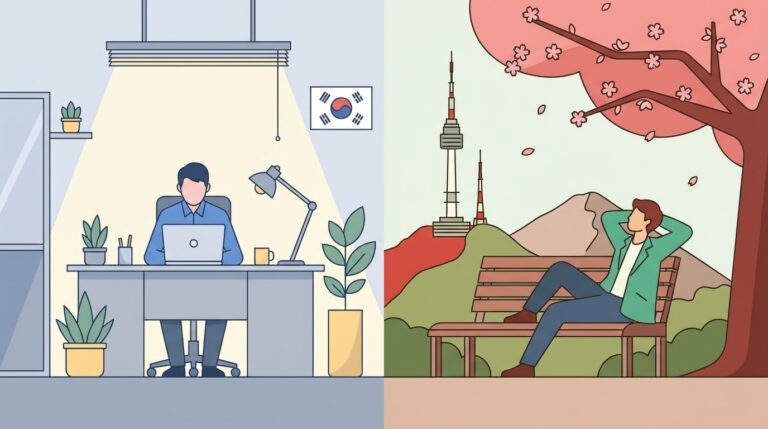
Navigating Korea’s 4-Day Workweek Debate: Master C2 Advanced Korean Business Expressions
Phase 1: Empathy & Context (스토리 몰입형 오프닝)
안녕하세요! 매일한글 에디터입니다.
If you have ever watched corporate K-dramas like Misaeng (미생) or followed the fast-paced tech scene in Pangyo—Korea’s Silicon Valley—you know that labor culture in South Korea is undergoing a seismic shift. For decades, the phrase Sinchon-mubyeol and late-night yageun (overtime) characterized Korean corporate life. However, today’s top-tier Korean enterprises and startups are deeply entrenched in a passionate debate: 주 4일 근무제 (the 4-day workweek).
Imagine sitting in an executive board meeting in Gangnam. The VP argues that reducing work hours will drop revenue, while the innovation director presents metrics showing productivity gains. As an advanced C2 learner, participating in such sophisticated, high-stakes discussions requires far more than basic business vocab. You need subtle nuance, idiomatic corporate expressions, and an acute understanding of Korean workplace diplomacy.
This guide was crafted alongside native corporate strategists and advanced Korean language educators. By the end of this lesson, you will articulate high-level arguments regarding workplace productivity, quality of life, and labor policy with absolute poise.
Phase 2: Core Expressions Deep Dive (핵심 표현 3선 심층 분석)
1. 업무 효율성을 극대화하다 (Eom-mu hyo-yul-seong-eul geuk-dae-hwa-ha-da)
- Pronunciation: [eom-mu hyo-yul-seong-eul geuk-dae-hwa-ha-da] (Sounds like “eom-moo hyo-yool-seong” with a crisp emphasis on “geuk-dae-hwa”)
- Meaning: Literally “To maximize work efficiency.” Used to express streamlining processes so that output increases while time spent decreases.
- K-Culture Moment: Commonly heard in executive boardrooms in dramas like Agency (대행사) when team leaders present revolutionary workflow overhauls.
- Editor’s Insight: While beginners say “일을 빠르게 하다” (do work fast), C2 speakers use “업무 효율성을 극대화하다” when convincing upper management that shorter hours lead to sharper focus.
- Situation Spectrum:
- Casual: 🚫
- Semi-formal: ⚠️
- Formal: ✅
- 🤔 Think About It: In your native culture, is working longer hours seen as a badge of honor, or is efficiency prized over physical presence?
2. 삶의 질을 제고하다 (Salm-ui jil-eul je-go-ha-da)
- Pronunciation: [salm-ui jil-eul je-go-ha-da] (Note: “제고(提高)” means enhancement/elevation, not to be confused with “재고(在庫)” stock/inventory)
- Meaning: To elevate/enhance the quality of life.
- K-Culture Moment: Featured in social commentary shows and news debates when discussing the societal transition from rapid economic growth to individual wellbeing (Wurabal).
- Editor’s Insight: “제고하다” is a sophisticated Sino-Korean verb reserved for formal policy discussions, press releases, and executive presentations. It replaces the basic “높이다” (to raise).
- Situation Spectrum:
- Casual: 🚫
- Semi-formal: ⚠️
- Formal: ✅
- 🤔 Think About It: How does the distinction between personal leisure time and work satisfaction reflect modern societal values in your country?
3. 탁상공론에 그치다 (Tak-sang-gong-ron-e geu-chi-da)
- Pronunciation: [tak-sang-gong-ron-e geu-chi-da] (Sounds like “tak-sang-gong-no-ne geu-chi-da”)
- Meaning: To remain mere armchair theory / impractical desk talk.
- K-Culture Moment: Used by operational managers criticizing idealistic corporate policies that fail when applied to real-world store floors or factory lines.
- Editor’s Insight: Formed from four Chinese characters: 卓 (desk), 上 (above), 空 (empty), 論 (discussion). It adds sharp rhetorical impact when pointing out that a 4-day workweek policy looks great on paper but fails in practice.
- Situation Spectrum:
- Casual: ⚠️ (Used rhetorically among colleagues)
- Semi-formal: ✅
- Formal: ✅
- 🤔 Think About It: What idiom in your native language captures the frustration of out-of-touch executive proposals?
Phase 3: Textbook Korean vs. Real Korean (교과서 한국어 vs 진짜 한국어)
Situation 1: Expressing that shorter hours force focus
- 📖 교과서 한국어: 근로 시간이 줄어들면 직원들은 집중해서 일하게 됩니다. (If working hours decrease, employees come to work with focus.)
- 🗣️ 진짜 한국어: 근무 시간이 단축되면 딴짓할 겨를 없이 업무 몰입도가 극대화될 수밖에 없습니다. (When working hours are shortened, there’s no room for distraction, so work immersion is naturally maximized.)
- 💡 왜 다를까?: Native C2 professionals use terms like “업무 몰입도” (work immersion level) and natural double-negatives or emphatic structures like “~수밖에 없습니다” to build persuasive momentum.
Situation 2: Expressing skepticism about a policy’s feasibility
- 📖 교과서 한국어: 이 정책은 현실성이 부족해서 실행하기 어렵습니다. (This policy lacks reality so it is difficult to execute.)
- 🗣️ 진짜 한국어: 현장의 목소리를 반영하지 않으면 결국 탁상공론으로 끝날 위험이 큽니다. (If we don’t reflect voices from the field, there’s a high risk this will end up as mere armchair policy.)
- 💡 왜 다를까?: Instead of plain adjectives (“어렵습니다”), native Korean executives utilize idiomatic metaphors like “탁상공론” paired with workplace terms like “현장의 목소리” (voices from the field).
Phase 4: K-Culture Deep Dive & Non-verbal Manners
4-1. Executive Nunchi (눈치) & Boardroom Mannerisms
When discussing sensitive labor reform like the 4-day workweek in Korea, Nunchi (눈치)—the art of reading social cues—is paramount.
* Slight Head Tilt & Softened Tone: When refuting a senior director’s concern about productivity drop, never say “당신 생각이 틀렸습니다” (You are wrong). Instead, pause, tilt your head slightly, and open with: “이사님의 우려도 충분히 이해합니다만…” (I fully understand your concern, Director, however…).
* Two-Handed Gesture: When gesturing toward presentation slides on labor metrics, extend your hand open-palmed using both hands or a supported right elbow.
4-2. Cultural Code: Pangyo’s Workplace Revolution
Korea’s IT cluster in Pangyo (featuring IT giants like Kakao and Naver) has been at the forefront of testing compressed workweeks and hybrid models. Unlike traditional chaebol top-down structures, modern Korean corporate culture balances 성과주의 (performance-driven culture) with 워라밸 (Work-Life Balance). Understanding this tension helps you frame arguments that appeal to both conservative metrics and modern employee retention strategies.
Phase 5: Practical Roleplay Scenario (실전 롤플레이 시나리오)
Setting: A corporate strategy meeting at a Gangnam tech firm debating a trial run for the 4-day workweek.
Characters:
* 김 팀장 (Team Lead Kim): Progressive leader advocating for trial implementation.
* 박 이사 (Director Park): Conservative executive worried about output drop.
김 팀장: 이사님, 이번 분기 테스트 결과를 보시면 주 4일제 도입 시 업무 효율성이 극대화되는 것을 확인하실 수 있습니다.
[Kim Tim-jang: I-sa-nim, i-beon bun-gi te-seu-teu gyeol-gwa-reul bo-si-myeon ju sa-il-je do-ip si eom-mu hyo-yul-seong-i geuk-dae-hwa-doe-neun geos-eul hwak-in-ha-sil su iss-seub-ni-da.]
(Director Park, looking at this quarter's test results, you can see that maximizing work efficiency is fully achievable under a 4-day workweek.)
🎭 행동 지문: Hands a concise report across the table using both hands.

박 이사: 효율성은 좋은데, 고객사 응대나 긴급 장애 대응에 차질이 생기면 어쩌려는 건가요?
[Bak I-sa: Hyo-yul-seong-eun jo-eun-de, go-gaek-sa eung-dae-na gin-geup jang-ae dae-eung-e cha-jil-i saeng-gi-myeon eo-jjeo-ryeo-neun geon-ga-yo?]
(Efficiency is fine, but what if there's a disruption in client support or emergency incident response?)
🎭 행동 지문: Adjusts glasses while leaning back thoughtfully.

김 팀장: 그래서 부서별 시차 순환 근무를 적용하여 업무 공백을 완벽히 차단하고자 합니다.
[Kim Tim-jang: Geu-rae-seo bu-seo-byeol si-cha sun-hwan geun-mu-reul jeok-yong-ha-yeo eom-mu gong-baek-eul wan-byeok-hi cha-dan-ha-go-ja ham-ni-da.]
(That is why we plan to implement staggered shift rotations by department to completely eliminate operational gaps.)
🎭 행동 지문: Points calmly to page 3 of the slide deck.

박 이사: 듣기엔 그럴듯한데... 이게 실상 탁상공론에 그치지 않을지 염려스럽군요.
[Bak I-sa: Deut-gi-en geu-reol-deut-han-de... i-ge sil-sang tak-sang-gong-ron-e geu-chi-ji anh-eul-ji yeom-ryeo-seu-reop-gun-yo.]
(Sounds plausible... but I worry this might end up as mere armchair theory in practice.)
🎭 행동 지문: Taps table softly with a pen.

김 팀장: 단순한 이론이 아닙니다. 이미 시범 부서의 삶의 질 제고는 물론, 퇴사율도 30% 감소했습니다.
[Kim Tim-jang: Dan-sun-han i-ron-i a-nib-ni-da. Im-i si-beom bu-seo-ui salm-ui jil je-go-neun mul-ron, toe-sa-yul-do sam-sip-pro gam-so-haess-seub-ni-da.]
(It is not just theory. The pilot department saw enhanced quality of life as well as a 30% drop in turnover rate.)
🎭 행동 지문: Maintains confident eye contact with a gentle smile.

박 이사: 퇴사율 감소라... 인재 유출을 막는 데는 확실히 효과가 있겠네요.
[Bak I-sa: Toe-sa-yul gam-so-ra... in-jae yu-chul-eul mag-neun de-neun hwak-sil-hi hyo-gwa-ga iss-ges-nae-yo.]
(Drop in turnover... It certainly seems effective for preventing talent drain.)
🎭 행동 지문: Nods slowly while taking a note.

김 팀장: 맞습니다. 생산성과 직원 만족도를 동시에 잡는 제도가 될 것입니다.
[Kim Tim-jang: Mat-seub-ni-da. Saeng-san-seong-gua jik-won man-jok-do-reul dong-si-e jab-neun je-do-ga doel geos-ip-ni-da.]
(Exactly. It will be a policy that captures both productivity and employee satisfaction simultaneously.)
🎭 행동 지문: Sits up straight and places hands together on the desk.

박 이사: 좋습니다. 다음 기획회의 때 전사 확대 방안을 공식 안건으로 올립시다.
[Bak I-sa: Jo-seub-ni-da. Da-eum gi-hoek-hoe-ui ttae jeon-sa hwak-dae bang-an-eul gong-sik an-geon-eu-ro ol-rip-si-da.]
(Very well. Let's put company-wide expansion on the official agenda for the next planning meeting.)
🎭 행동 지문: Closes the folder approvingly.
🔀 Interactive Branching Point
How should Team Lead Kim respond if Director Park asks: “What if client response slows down?”
* Choice A: “걱정 마세요. 직원들이 쉬면 기분이 좋아서 더 잘할 겁니다.” (Don’t worry, employees will feel good so they’ll do better.)
* Choice B: “순환 근무제와 긴급 온콜(On-call) 시스템을 연동하여 업무 공백을 차단하겠습니다.” (We will lock in seamless support by pairing rotational shifts with an emergency on-call system.)
* Choice C: “고객사에도 주 4일제를 설득해보겠습니다.” (We will try to convince our clients to adopt the 4-day workweek too.)
Feedback:
* Choice A (Bad): ❌ Too casual and lacks logical contingency planning for formal corporate decision-making.
* Choice B (BEST): ✅ Demonstrates C2 level corporate vocabulary (순환 근무제, 업무 공백 차단) and offers a concrete operational solution.
* Choice C (Risk): ⚠️ Shows high ambition but ignores real-world commercial boundaries and risks alienating existing clients.
Phase 6: 10-Second Emotion Shadowing Drill (감정 섀도잉 드릴)
Practice these high-level executive sentences out loud matching the emotional markers and rhythm breaks (/):
[💼 Confident & Persuasive]
근무 시간 단축은 / 단순한 휴식이 아니라 / 업무 효율성을 극대화하는 / 전략적 선택입니다.
(Geun-mu si-gan dan-chuk-eun / dan-sun-han hyu-sig-i a-ni-ra / eom-mu hyo-yul-seong-eul geuk-dae-hwa-ha-neun / jeon-ryak-jeok seon-taek-ip-ni-da.)-
[🤔 Empathetic yet Firm]
현장의 우려를 반영하지 않는 정책은 / 결국 탁상공론에 그칠 수밖에 없습니다.
(Hyeon-jang-ui u-ryeo-reul ban-yeong-ha-ji anh-neun jeong-chaeg-eun / gyeol-guk tak-sang-gong-ron-e geu-chil su-baek-e eops-seub-ni-da.) -
[🌱 Visionary & Inspiring]
직원들의 삶의 질을 제고하는 것이 / 장기적으로 회사의 경쟁력을 높이는 길입니다.
(Jik-won-deul-ui salm-ui jil-eul je-go-ha-neun geos-i / jang-gi-jeok-eu-ro hoe-sa-ui gyeong-jaeng-ryeog-eul nop-i-neun gil-ip-ni-da.)
Phase 7: K-Culture Mini Dictionary (K-Culture 미니 사전)
- 워라밸 (Wurabal) | Work-Life Balance | Short for “Work and Life Balance” (Work-Life Balance). Widely used in talent recruitment and workplace satisfaction discussions.
- 포괄임금제 (Pogwal Imgeumje) | Comprehensive Wage System | A wage scheme where overtime pay is bundled into the base salary. A hot topic in labor debates regarding working hours.
- 유연근무제 (Yuyeon Geunmuje) | Flexible Working System | Flexible hours allowing employees to choose starting and ending times to maximize efficiency.
- 업무 공백 (Eommu Gongbaek) | Operational Gap / Coverage Void | Refers to times when no employee is available to handle urgent tasks or client requests.
Phase 8: Traveler & Professional Survival Kit (생존 키트)
TOP 3 Business Expressions:
- 조기 퇴근제 도입을 검토 중입니다. (Jo-gi toe-geun-je do-ip-eul geom-to jung-im-ni-da.)
- Pro Tip: Use this when discussing early exit Fridays or flex-time policies.
- 업무 몰입도를 높이는 방안을 모색해야 합니다. (Eom-mu mol-ip-do-reul nop-i-neun bang-an-eul mo-saek-hae-ya ham-ni-da.)
- Pro Tip: Ideal phrase for strategy meetings focusing on productivity solutions.
- 시범 운영을 거쳐 정식 도입 여부를 결정하겠습니다. (Si-beom un-yeong-eul geo-chyeo jeong-sik do-ip yeo-bu-reul gyeol-jeong-ha-ges-seub-ni-da.)
- Pro Tip: Standard business phrasing for implementing trial runs.
Editor’s Travel Note:
If you are traveling or working remotely in Seoul, navigating office hubs like Yeouido, Gangnam, or Pangyo requires smart mobility. Make sure you install local apps beforehand. You can check route maps via the Naver Map application download page.
Phase 9: A Step Deeper (한 발 더 깊이)
Korea’s modern employment discourse is a captivating lens into its rapid economic evolution. The older generation built South Korea’s industrial miracle through unyielding resilience (Gundae-munhwa and late-night dedication). Conversely, today’s MZ generation prioritizes sustainable output, psychological safety, and individual fulfillment. The debate over the 4-day workweek is not merely about resting more; it represents a fundamental redefinition of social value—moving from quantitative labor hours to qualitative cognitive output.
💬 Your Turn: What is the general sentiment regarding the 4-day workweek in your home country? Share your thoughts in Korean below using today’s C2 expressions!
Phase 10: FAQ & Common Mistakes (자주 묻는 질문 & 실수 경고판)
Q: Can I use “탁상공론” when talking to my boss directly?
A: Yes, but frame it neutrally regarding policies or proposals, not as a personal attack. For example, say “이 제도가 탁상공론이 되지 않으려면 현장의 의견이 필요합니다” rather than pointing at your boss’s ideas.
Q: Is “삶의 질을 제고하다” appropriate in casual conversation?
A: It sounds overly formal and academic for casual coffee chats. In casual settings, use “삶의 질이 좋아지다” or “더 여유로워지다”.
Q: What is the exact difference between “효율성” and “생산성”?
A: “효율성” (Efficiency) focuses on minimizing waste and time, while “생산성” (Productivity) measures the total output generated per unit of input.
🚨 Common Mistakes TOP 3
- Misusing “제고하다” vs “재고하다”:
- ❌ 삶의 질을 재고하겠습니다 (This means “I will reconsider quality of life”).
- ✅ 삶의 질을 제고하겠습니다 (This means “I will elevate quality of life”).
- Translating “Work-Life Balance” word-for-word as “일과 삶의 균형” in fast conversation:
- ❌ 일과 삶의 균형이 중요해요 (Correct, but sounds slightly unnatural in business pitch context).
- ✅ 워라밸 보장이 중요합니다 (Widely accepted corporate shorthand).
- Using overly informal endings during executive debates:
- ❌ 4일제 하면 훨씬 효율적이에요. (Too casual for formal board presentations).
- ✅ 4일제를 도입하면 업무 효율성이 훨씬 제고될 것입니다. (Appropriate C2 business register).
Phase 11: Action Mission & Engagement (액션 미션)
- Bronze Level: Read the Phase 6 Shadowing Drill 3 times out loud with natural pauses.
- Silver Level: Write a 2-sentence comment below arguing for or against the 4-day workweek using
업무 효율성and탁상공론. - Gold Level: Record your voice delivering Team Lead Kim’s argument from Phase 5 and listen for pitch control and confident cadence.
🎮 K-Culture Mission: Watch a scene from corporate dramas like Misaeng or Agency and write down every time you hear Sino-Korean vocabulary ending in -성(性) (e.g., 효율성, 생산성, 가능성)!
Phase 12: Interactive Quiz Challenge (인터랙티브 퀴즈 챌린지)
Quiz 1. Situation Judgment
Which phrase is best suited when asserting that a policy must be grounded in real workplace conditions rather than useless paper ideas?
* A) 포괄임금제
* B) 탁상공론
* C) 유연근무제
Click to reveal answer
Correct Answer: B) 탁상공론
Explanation: “탁상공론” means armchair/impractical debate. Using it highlights the need for practical, field-tested policies.
Quiz 2. Fill in the Blank
“근무 시간 단축을 통해 직원들의 삶의 질을 ( )하고 업무 몰입도를 높일 수 있습니다.”
* A) 재고
* B) 제고
* C) 광고
Click to reveal answer
Correct Answer: B) 제고
Explanation: “제고(提高)” means to elevate or enhance quality/status.
Quiz 3. True / False Culture Quiz
In Korean corporate debates, using head tilts and open-palmed gestures when refuting a senior manager’s point is considered impolite. (True / False)
Click to reveal answer
Correct Answer: False
Explanation: Softening your body language with slight head tilts and open-palmed gestures helps cushion your argument while maintaining respectful boardroom decorum.