

Phase 1: Empathy (Story-Driven Opening)
안녕하세요! 매일한글 에디터입니다.
Have you ever been watching a thrilling K-drama like Like a Flower in Sand or a high-stakes Korean reality show, only to hear the commentators shout about “flipping the board” (판을 뒤집다) or engaging in a intense “satba fight” (샅바 싸움)? You look up the individual words, but the literal translations leave you puzzling over why traditional sand-pit wrestling terms are appearing in corporate boardrooms, political debates, and romantic comedies!
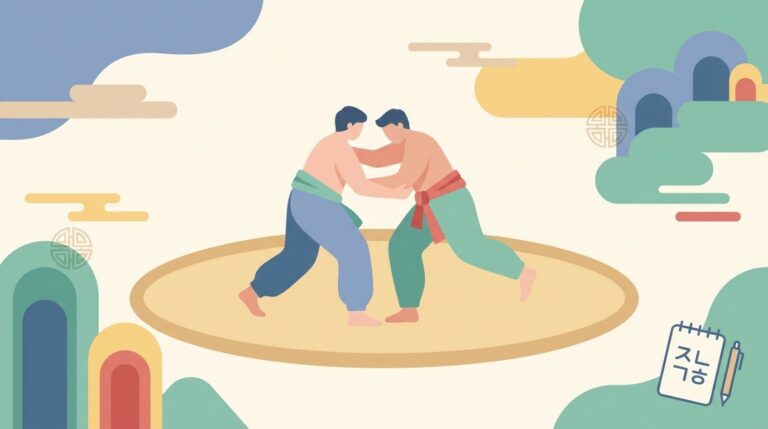
As an advanced (C1) Korean learner, stepping beyond literal vocabulary into deep cultural metaphors is your golden ticket to native-level fluency. Ssireum (씨름), Korea’s UNESCO-recognized traditional wrestling, is not just a sport; it is a rich repository of idioms that Koreans use daily to describe strategy, power dynamics, turnarounds, and heroic resilience. By mastering these expressions, you will unlock the ability to articulate complex tactical situations with flair and natural emotional resonance. Based on feedback from our C1 alumni, learning these metaphors transformed their ability to understand nuance in news broadcasts and business negotiations. Let’s dive into the sand ring together!
Phase 2: 3 Core Expressions Deep-Dive
1. 판을 뒤집다 (Pan-eul dwijipda)
- Pronunciation: [pan-eul dwee-jeep-da] (Think of pan like a frying pan, dwee-jeep like flipping a pancake!)
- Meaning: Literal: To flip the game board or wrestling pit. Nuance: To pull off a dramatic comeback or completely reverse a disadvantageous situation.
- K-Culture Moment: Frequently heard in political commentary during election nights or in sports dramas when an underdog team turns the match around in the final seconds.
- Editor’s Insight: This expression implies that you didn’t just win by a small margin; you fundamentally changed the rules and balance of power through strategy and skill.
- Situation Spectrum: Casual ✅ | Semi-formal ✅ | Formal ✅
- 🤔 Think About It: How does your native language describe a complete reversal of fortune? Does it draw from traditional sports or games?
2. 샅바를 쥐다 (Satba-reul jwida)
- Pronunciation: [sat-ba-reul jwee-da] (sat-bah like soft fabric, jwee-da like squeezing a grip)
- Meaning: Literal: To grip the satba (the fabric strap worn around the waist and thigh). Nuance: To secure decisive leverage or hold the upper hand in negotiations.
- K-Culture Moment: Used in corporate boardrooms when one side secures crucial legal or financial leverage before signing a contract.
- Editor’s Insight: Before a Ssireum match starts, wrestlers spend intense effort getting a deeper, firmer grip on the opponent’s satba. Thus, “샅바 싸움” (satba fight) means the subtle psychological maneuvering before the main battle.
- Situation Spectrum: Casual ✅ | Semi-formal ✅ | Formal ⚠️
- 🤔 Think About It: Why do you think Korean business culture values subtle pre-negotiation leverage over direct immediate confrontation?
3. 천하장사급이다 (Cheonhajangsageub-ida)
- Pronunciation: [cheon-ha-jang-sa-geub-i-da] (chohn-hah under heaven + jang-sah strong man + geub class)
- Meaning: Literal: To be of “Grand Champion under Heaven” caliber. Nuance: Exhibiting monumental strength, unmatched stamina, or extraordinary mental resilience.
- K-Culture Moment: Commonly featured in variety shows when someone displays immense physical strength or handles an overwhelming workload effortlessly.
- Editor’s Insight: The title Cheonhajangsa carries immense nostalgia in Korea, popularized in the 1980s and 90s by legendary champions like Kang Ho-dong. Calling someone or something “천하장사급” confers grand, heroic honor.
- Situation Spectrum: Casual ✅ | Semi-formal ✅ | Formal 🚫
- 🤔 Think About It: What pop-culture or historical titles in your country transition into everyday praise for strength?
Phase 3: Textbook Korean vs. Real Korean
Situation 1: Expressing a sudden turn of events in a business project
- 📖 Textbook Korean: 상황이 매우 유리하게 바뀌었습니다. (The situation has changed very favorably.)
- 🗣️ Real Korean: 이번 결과로 우리가 완전히 판을 뒤집었어요! (With this result, we completely flipped the board!)
- 💡 Why the difference? Native C1 speakers prefer vivid imagery from Ssireum over dry abstract vocabulary to express momentum and excitement.
Situation 2: Discussing contract negotiation leverage
- 📖 Textbook Korean: 협상에서 주도권을 확보해야 합니다. (We must secure the initiative in negotiations.)
- 🗣️ Real Korean: 이번에 확실하게 샅바를 잡고 들어가야 합니다. (We need to go in with a firm grip on the satba this time.)
- 💡 Why the difference? Abstract concepts like “initiative” (주도권) feel distant, whereas physical wrestling metaphors immediately evoke actionable strategy.
Phase 4: K-Culture Deep-Dive & Non-verbal Manners
4-1. Nunchi & Physical Posture in Ssireum Metaphors
In traditional Ssireum, power originates from lower-body stability, grounded balance, and calm eye contact. When using Ssireum metaphors like “샅바를 쥐다” in business or conversational contexts, native Koreans lower their voice pitch, maintain steady eye contact without glaring, and keep posture composed. This embodies the traditional principle of Oeyu-naegang (외유내강 – gentle on the outside, strong on the inside).
4-2. Cultural Code Analysis: Ssireum in Modern Pop Culture
Ssireum is unique because it emphasizes bringing down the opponent without inflicting bodily injury or pain. The goal is balance control, not violence. This philosophy deeply influences Korean social communication—even intense debates aim for clean, decisive victory through tactical leverage rather than personal destruction. You will see this highlighted in K-dramas where traditional values meet modern competition.
Phase 5: Practical Roleplay Scenario
Setting: A high-stakes product strategy meeting at a tech startup in Seoul.
Characters: Alex (You – Senior Director) & Director Min (NPC – Strategic Partner).
- Turn 1 (Director Min): Alex님, 경쟁사가 시장 점유율 70%를 차지하고 있어서 이번 신제품 출시가 쉽지 않겠어요.
(Alex, the competitor holds 70% market share, so launching our new product won’t be easy.) - Turn 2 (Alex): 🎭 [Confidence & Calm smile] 인정합니다. 하지만 초기 사전 예약 반응을 보면 충분히 판을 뒤집을 수 있습니다.
(I admit that. However, looking at early pre-order responses, we can definitely turn the tables.) - Turn 3 (Director Min): 하지만 그쪽에서 가격 인하 정책으로 나올 텐데요?
(But they will likely respond with a price-cutting strategy.) - Turn 4 (Alex): 🎭 [Leaning forward slightly] 마케팅 협력사와의 계약을 통해 독점 유통권을 확보했습니다. 우리가 샅바를 쥐고 있는 셈이죠.
(Through our contract with marketing partners, we secured exclusive distribution rights. We hold the satba, so to speak.) - Turn 5 (Director Min): 오, 그렇군요! 그럼 상대방과의 협상은 어떻게 진행할 계획인가요?
(Oh, I see! Then how do you plan to handle negotiations with them?) - Turn 6 (Alex): 🎭 [Decisive hand gesture] 초반 샅바 싸움에서 기선 제압을 하고, 우리 조건을 유지할 겁니다.
(We will seize the initiative during the initial satba struggle and hold our terms.) - Turn 7 (Director Min): 하하, Alex님의 전략 실행력은 진짜 천하장사급이네요! 믿고 추진해 봅시다.
(Haha, Alex, your strategy execution power is truly Grand Champion level! Let’s trust you and push forward.) - Turn 8 (Alex): 🎭 [Polite bow] 감사합니다. 반드시 기대 이상의 성과를 내겠습니다!
(Thank you. I will certainly produce results beyond expectations!)
🔀 Interactive Branching Choice
When Director Min expresses worry about the competitor’s size in Turn 1, how do you respond?
* Option A: “상대방이 너무 강해서 이기기 힘듭니다.” (Bad: Shows lack of strategic confidence)
* Option B: “사전 예약 반응을 활용해 완전히 판을 뒤집어 보겠습니다!” (Best: Demonstrates C1 natural metaphor usage and proactive leadership)
* Option C: “그냥 가격을 더 낮춰서 싸웁시다.” (Risk: Lacks strategic depth and professional tact)
Phase 6: 10-Second Emotion Shadowing Drill
Practice these sentences out loud, following the pause markers (/) and emotional tone indicators:
- [🔥 당당하고 확신에 차서 / Bold & Confident]
이번 프로젝트로 / 시장의 판을 완전히 뒤집어 보겠습니다!
(Ee-beon deu-ro-jek-teu-ro / si-jang-ui pan-eul wan-jeon-hi dwee-jip-eo bo-get-seum-ni-da!) -
[😎 여유롭고 든든하게 / Relaxed & Reassuring]
상대가 아무리 커도 / 우리가 핵심 샅바를 쥐고 있으니 / 걱정하지 마세요.
(Sang-dae-ga a-mu-ri keo-do / u-ri-ga haek-sim sat-ba-reul jwee-go it-eu-ni / geok-jeong-ha-ji ma-se-yo.) -
[👍 감탄과 찬사를 담아 / Full of Admiration]
위기 상황에서도 당황하지 않는 / 팀장님의 추진력은 / 진짜 천하장사급이에요!
(Wi-gi sang-hwang-e-seo-do dang-hwang-ha-ji an-neun / tim-jang-nim-ui chu-jin-ryeok-eun / jin-jja cheon-ha-jang-sa-geub-i-e-yo!)
Phase 7: K-Culture Mini Dictionary
- 샅바 (Satba) | Noun | The thigh strap used in Ssireum. Metaphorically means key strategic leverage in business and negotiation.
- 벼락치기 (Byeoraktchigi) | Noun | Last-minute cramming or swift execution. Inspired by sudden, lightning-fast moves in sand wrestling.
- 배지기 (Baejigi) | Noun | A fundamental Ssireum technique lifting the opponent by the waist. Used metaphorically for direct, overwhelming arguments that lift and dismantle the opponent’s logic.
- 맞수 (Mat-su) | Noun | An evenly matched opponent or rival. Originates from two wrestlers taking identical grips before a bout.
Phase 8: Traveler’s Survival Kit
Survival Expressions TOP 3
- 판을 뒤집을 방법이 없을까요? (Pan-eul dwijibeul bangbeobi eopseulkayo?) – Is there any way to turn this situation around?
- 샅바 잡는 법 좀 가르쳐 주세요! (Satba jamneun beop jom gareutchyeo juseyo!) – Please show me how to grip the satba! (Useful when attending traditional festival workshops).
- 여기가 천하장사 맛집인가요? (Yeogiga cheonhajangsa matjipingayo?) – Is this the legendary giant-portion gourmet restaurant?
Editor’s Travel Note
When traveling to Korea during major holidays like Chuseok (Autumn Harvest) or Dano Festival, try visiting traditional matches in Gangneung or Yeongam. To locate venue schedules and book tickets easily, make sure to use 네이버 지도 앱 다운로드 to search for “씨름 경기장” or local sports arenas.
Phase 9: “One Step Deeper” (Reflective Essay)
In modern global business, competition is often viewed as a zero-sum elimination match. However, the linguistic heritage of Ssireum reveals a distinctly Korean view of struggle. A Ssireum match cannot begin until both athletes mutually help each other tie and adjust their satba straps. This paradoxical harmony—where respect precedes combat—explains why native Korean idioms prioritize securing moral leverage (샅바를 쥐다) and changing momentum (판을 뒤집다) over raw aggression. True strength (천하장사) in Korean society is defined not merely by victory, but by resilience and maintaining dignity under pressure.
💬 Your Turn: How does your native language reflect traditional sports in everyday business metaphors? Share your thoughts in the comments below!
Phase 10: FAQ & Common Mistakes
Q: Are Ssireum idioms used in formal corporate settings?
A: Yes! While words like “천하장사급” are best kept for casual praise or team encouragement, expressions like “판을 뒤집다” and “샅바 싸움” are frequently used in executive strategy sessions, news editorials, and political reporting.
Q: Is “샅바를 잡다” physically aggressive?
A: Not at all! When used in conversation, it is entirely metaphorical, referring to securing contractual, legal, or psychological advantages.
Q: What is the difference between “판을 뒤집다” and “역전하다”?
A: “역전하다” is a neutral sports term meaning to overtake the lead. “판을 뒤집다” is far more dramatic, implying that the fundamental landscape or rules of the game were overturned.
🚨 Common Mistakes Warning Board
- ❌ Mistake: Using “판을 뒤집다” when literally flipping over a paper on a desk.
👉 Correct Action: Use “종이를 뒤집다” for objects. Reserve “판을 뒤집다” for abstract situations or game boards. - ❌ Mistake: Calling your corporate boss a “천하장사” in an official email report.
👉 Correct Action: Use formal attributes like “탁월한 리더십” (outstanding leadership) in reports, saving “천하장사급” for team dinners. - ❌ Mistake: Mispronouncing satba as sa-ta-ba.
👉 Correct Action: Keep it tight as two syllables: [sat-ba].
Phase 11: Action Mission & Engagement
Action Mission 3-Steps
- 🥉 Bronze: Practice saying “판을 뒤집어요!” out loud 3 times using the shadow drill in Phase 6.
- 🥈 Silver: Leave a comment below using “샅바를 쥐다” in a complete sentence describing your work or study goals.
- 🥇 Gold: Use one Ssireum metaphor when speaking with your Korean friends, tutors, or colleagues this week!
🎮 K-Culture Mission
Watch a clip of Korean variety shows (like Knowing Bros) or news commentary and spot at least one occurrence of “뒤집기” or “샅바”. Post the timestamp in our comment section!
Phase 12: Interactive Quiz Challenge
Question 1: Situation Judgment
Your project is currently behind schedule, but your team developed a game-changing AI feature that will make your product superior to all competitors. Which expression best fits?
* A) 샅바를 놓쳤어요.
* B) 완벽하게 판을 뒤집을 수 있어요.
* C) 그냥 벼락치기 해요.
🔍 Click to view Answer & Explanation
Correct Answer: B) 완벽하게 판을 뒤집을 수 있어요.
Explanation: Introducing a game-changing innovation that turns a disadvantage into a total market advantage is the exact definition of “판을 뒤집다”.
Question 2: Fill in the Blank
협상 상대와의 초기 ______ 싸움에서 밀리지 않는 것이 중요합니다. (It is important not to back down during the initial preliminary negotiations struggle.)
* A) 샅바
* B) 신발
* C) 모자
🔍 Click to view Answer & Explanation
Correct Answer: A) 샅바
Explanation: “샅바 싸움” refers to the crucial preliminary struggle for leverage before the main event.
Question 3: Cultural True or False
Calling a colleague’s work endurance “천하장사급” is an insult in Korea. (True / False)
🔍 Click to view Answer & Explanation
Correct Answer: False
Explanation: It is a high compliment comparing someone’s strength, endurance, or capacity to a legendary Grand Champion wrestler.






