

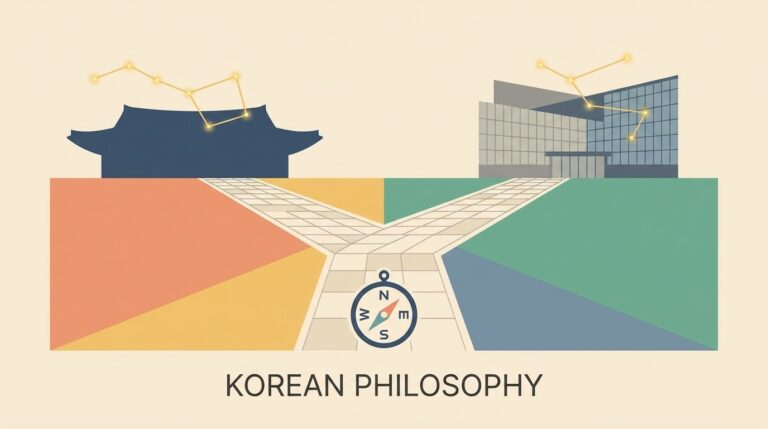
Master Korean Philosophical Debates: Free Will vs. Determinism at a C1 Level
안녕하세요! I’m your Daily Hangul editor, your 10-year local culture navigator. Welcome back to our premium advanced Korean module! Today, we are diving deep into one of the most intriguing intellectual topics: Philosophy and Ethics (철학과 윤리), focusing on Free Will vs. Determinism (자유 의지와 결정론).
Phase 1: Empathy (Storytelling Opening)
Have you ever sat in a trendy late-night cafe in Hongdae or a quiet traditional teahouse in Insadong, watching a intense K-drama like Itaewon Class or Goblin, and found yourself wanting to debate fate versus free choice in Korean?
Many advanced C1 learners tell me: “I know everyday Korean, but when the conversation turns to abstract concepts like fate, determinism, or human autonomy, I get completely tongue-tied!”
It is completely normal to feel intimidated. In Korean, discussing whether our lives are shaped by destiny (운명) or conscious choice (자유 의지) isn’t just about dictionary vocabulary; it involves deep cultural concepts like 팔자 (eight characters of birth/destiny) and 사주 (four pillars of fate). Based on real feedback from C1 level learners, mastering these expressions elevates your Korean from fluent to truly sophisticated and intellectually persuasive.
Phase 2: 3 Core Deep-Dive Expressions
1. 운명을 개척하다 (Un-myeong-eul gae-chyeok-ha-da)
- Pronunciation: [Un-myeong-eul gae-chyeok-ha-da] (Sounds like oon-myeong-eul geh-chyeok-ha-da)
- Meaning: Literal: To pioneer or break open one’s fate. | Actual Nuance: To actively forge one’s own destiny through willpower.
- K-Culture Moment: This expression is iconic in underdog K-Dramas where a main character overcomes societal odds through relentless drive.
- Editor’s Insight: Combining 운명 (fate) with 개척하다 (to pioneer/reclaim) creates a strong, proactive tone of personal agency.
- Situation Spectrum: Casual ⚠️ | Semi-formal ✅ | Formal ✅
- 🤔 Think About It: Does your native language view fate as something passive, or can it be actively carved out like in Korean?
2. 정해진 길을 따르다 (Jeong-hae-jin gil-eul tta-reu-da)
- Pronunciation: [Jeong-hae-jin gil-eul tta-reu-da] (Sounds like jeong-hae-jin geel-eul tta-reu-da)
- Meaning: Literal: To follow a predetermined path. | Actual Nuance: Accepting determinism or societal expectations without resistance.
- K-Culture Moment: Often heard in historical dramas (사극) when characters weigh familial obligations against individual freedom.
- Editor’s Insight: Excellent phrase when explaining deterministic views (결정론적 시각).
- Situation Spectrum: Casual ✅ | Semi-formal ✅ | Formal ✅
- 🤔 Think About It: How does societal expectation influence your concept of a ‘predetermined path’?
3. 스스로의 선택에 달렸다 (Seu-seuro-ui seon-taek-e dal-lyeot-da)
- Pronunciation: [Seu-seuro-ui seon-taek-e dal-lyeot-da] (Sounds like sew-sew-ro-ui seon-taek-ae dahl-lyeot-da)
- Meaning: Literal: It hinges upon one’s own choice. | Actual Nuance: Ultimate autonomy and moral responsibility lie with the individual.
- K-Culture Moment: Used by mentors in modern Korean webtoons and dramas when advising protagonists facing major life dilemmas.
- Editor’s Insight: Using ~에 달렸다 adds a definitive, philosophical weight to your conclusion.
- Situation Spectrum: Casual ✅ | Semi-formal ✅ | Formal ✅
- 🤔 Think About It: Is personal accountability emphasized similarly in your culture’s ethics?
Phase 3: Textbook Korean vs. Real Korean
Situation 1: Expressing belief in Free Will
- 📖 Textbook Korean: 인간에게는 스스로 결정할 수 있는 자유 의지가 존재합니다. (Humans possess free will to decide for themselves.)
- 🗣️ Real Korean: 결국 모든 건 자기 선택에 달린 거죠. (In the end, it really all comes down to your own choice.)
- 💡 Why the difference? Native speakers prefer natural, active phrasing (자기 선택에 달린 것) over stiff nominalizations during discussions.
Situation 2: Expressing Determinism
- 📖 Textbook Korean: 모든 사건은 이미 결정되어 있다는 시각입니다. (It is the viewpoint that all events are already determined.)
- 🗣️ Real Korean: 피할 수 없는 운명이라고 볼 수도 있겠네요. (You could also see it as an inescapable fate.)
- 💡 Why the difference? Abstract philosophical nouns like ‘결정론’ are frequently translated into evocative everyday metaphors like ‘피할 수 없는 운명’.
Phase 4: K-Culture Deep Dive & Non-Verbal Manners
4-1. Nunchi & Gestures during Deep Philosophical Debates
When engaging in high-level intellectual discussions in Korea:
* Eye Contact & Nodding: Maintain earnest eye contact while slowly nodding (고개를 끄덕이다). This signals respect for the speaker’s logic.
* Hand Placement: Placing a hand near your chin or chest while listening demonstrates thoughtful contemplation (숙고).
4-2. Cultural Code: Saju, Destiny, and Korean Modernity
Korea presents a unique philosophical landscape. On one hand, traditions like Saju (사주) and consulting fortune tellers before big life events show a lingering curiosity toward cosmic determinism. On the other hand, Korea’s rapid economic and cultural growth was powered by an intense belief in human effort (노력). Consequently, modern Koreans often hold a nuanced dual view: accepting fate’s starting point, but believing strongly that human willpower determines the final outcome.
Phase 5: Real-World Roleplay Scenario
Setting: A quiet late-night cafe near Yonsei University. You are discussing philosophy over tea with Min-jun (민준), a Korean graduate student.
- 민준: 인간의 삶이 과연 진짜 자유로운 걸까요? 아니면 다 정해져 있는 걸까요?
(Min-jun: Is human life truly free? Or is everything already predetermined?) - Learner (You): 🎭 [Deep thoughtful tone] 글쎄요, 환경의 영향을 무시할 순 없지만 결국 운명을 개척하는 건 개인이라고 봐요.
(Geul-sse-yo, hwang-gyeong-ui yeong-hyang-eul mu-si-hal sun eop-ji-man gyeol-guk un-myeong-eul gae-chyeok-ha-neun geon gae-in-i-ra-go bwa-yo. / Well, we can’t ignore environmental influence, but I believe it is the individual who ultimately forges their destiny.) - 민준: 하지만 우리가 자유 의지라고 믿는 것도 결국 뇌의 화학 작용이나 유전적 결정론일 수 있잖아요?
(Min-jun: But couldn’t what we believe to be free will just be chemical reactions in the brain or genetic determinism?) - Learner (You): 🎭 [Nodding slowly] 일리 있는 말씀이에요. 하지만 그렇다고 해도 선택에 대한 책임은 여전히 남지 않을까요?
(Il-ri in-neun mal-sseum-i-e-yo. Ha-ji-man geu-reot-da-go hae-do seon-taek-e dae-han chaek-im-eun yeo-jeon-hi nam-ji a-neul-kka-yo? / You have a point. But even so, doesn’t moral responsibility for our choices still remain?) - 민준: 책임이라… 결정론적 세계관에서는 책임이라는 개념도 모호해지죠.
(Min-jun: Responsibility… In a deterministic worldview, the concept of responsibility becomes blurred too.) - Learner (You): 🎭 [Slight smile] 그래서 삶이 흥미로운 것 같아요. 스스로의 선택에 달렸다고 믿을 때 삶의 주체성이 생기니까요.
(Geu-rae-seo salm-i heung-mi-ro-un geot ga-ta-yo. Seu-seuro-ui seon-taek-e dal-lyeot-da-go mi-deul ttae salm-ui ju-che-seong-i saeng-gi-ni-kka-yo. / That’s why life is interesting. Because autonomy is born when we believe things depend on our choices.) - 민준: 대단한 식견이시네요! 한국어로 이런 깊은 대화를 나누다니 인상적입니다.
(Min-jun: What an insightful perspective! I’m impressed you can hold such a deep conversation in Korean.) - Learner (You): 🎭 [Polite gesture] 과찬이세요. 민준 씨 덕분에 생각이 더 넓어졌어요.
(Gwa-chan-i-se-yo. Min-jun ssi deok-bu-ne saeng-gak-i deo neol-beo-jyeot-eo-yo. / You flatter me. Thanks to you, my horizon has broadened.)
🔀 Interactive Branching Choice
How would you reply if Min-jun asked: “Do you believe in traditional destiny (팔자)?”
* Option A: 팔자는 미신일 뿐이라 전혀 믿지 않습니다. (Strict rejection)
* Option B: 운명의 틀은 존재할 수 있지만, 그걸 바꾸는 건 개인의 선택에 달렸다고 생각해요. (Balanced C1 response)
* Option C: 사주팔자는 다 진짜예요! (Overly naive)
Feedback:
* Option A (Risk): A bit blunt for a nuanced philosophical discussion.
* Option B (Best): Demonstrates sophisticated vocabulary and cultural empathy!
* Option C (Bad): Lacks intellectual depth for a C1 context.
Phase 6: 10-Second Emotion Shadowing Drill
[🤔 Deeply reflective]환경의 영향도 있지만 / 결국 운명을 개척하는 건 / 자기 자신이에요.
(Hwang-gyeong-ui yeong-hyang-do it-ji-man / gyeol-guk un-myeong-eul gae-chyeok-ha-neun geon / ja-gi ja-sin-i-e-yo.)[😊 Confident & Calm]정해진 길을 따르기보다 / 스스로 선택하는 삶이 / 가치 있다고 생각해요.
(Jeong-hae-jin gil-eul tta-reu-gi-bo-da / seu-seuro seon-taek-ha-neun salm-i / ga-chi it-da-go saeng-gak-hae-yo.)
Phase 7: K-Culture Mini Dictionary
- 팔자 (Palja): Destined fortune calculated by the four pillars of birth time. Used broadly to mean ‘one’s fate’.
- 필연 (Pil-yeon): Inevitability or necessity; something bound to happen regardless of choice.
- 선택권 (Seon-taek-gwon): Right or power of choice; agency.
- 결정론 (Gyeol-jeong-ron): Philosophical determinism.
Phase 8: Traveler’s Survival Kit
Survival Expressions TOP 3
- 생각해 볼 문제네요. (Saeng-gak-hae bol mun-je-nae-yo.) – That’s a thought-provoking topic.
- 보는 관점에 따라 달라요. (Bo-neun gwan-jeom-e tta-ra dal-la-yo.) – It depends on the perspective.
- 충분히 공감합니다. (Chung-bun-hi gong-gam-ham-ni-da.) – I fully relate/agree with your point.
Editor’s Travel Note
When navigating intellectual spots in Seoul—like university book cafes in Sinchon or quiet philosophical bars near Daehangno—use the Naver Map App Download to locate quiet, ambiance-rich spaces perfect for deep late-night conversations.
Phase 9: One Step Deeper (Thinking Question)
In Korean society, the balance between societal harmony (공동체 의식) and personal self-determination (자유 의지) creates a unique dynamic. While young Koreans increasingly prioritize personal choices, respect for circumstances and destiny remains deeply embedded in idioms and mindset.
💬 Your Turn: Do you believe our life path is pre-written or purely self-directed? Share your thoughts in Korean in the comments below!
Phase 10: FAQ & Common Mistakes
Q: What is the difference between 운명 (Unmyeong) and 팔자 (Palja)?
A: 운명 is a general, neutral word for ‘fate’ or ‘destiny’. 팔자 stems specifically from traditional Korean fortune-telling (Saju) and often carries a slightly colloquial or emotional nuance.
Q: How do I say ‘determinism’ vs ‘free will’ naturally in Korean?
A: Use 결정론 (determinism) and 자유 의지 (free will) for formal academic topics, but use 정해진 운명 and 스스로의 선택 in natural conversations.
Q: Is it polite to disagree sharply during a philosophical debate in Korean?
A: Softening phrases like 그 말씀도 맞지만… (That is true as well, but…) or 달리 볼 수도 있지 않을까요? (Couldn’t we look at it differently?) are recommended to maintain harmony while disagreeing.
🚨 Common Mistakes TOP 3
- Mistake: Using ‘자유 생각’ instead of ‘자유 의지’.
- Correct Action: Free will is strictly 자유 의지 (Free Will/Volition).
- Mistake: Direct translation of ‘I forged my destiny’ as ‘운명을 만들었다’.
- Correct Action: Use the advanced verb 운명을 개척했다.
- Mistake: Overusing dictionary term ‘결정론’ in casual chat.
- Correct Action: Use ‘모든 게 정해져 있다’ (Everything is predetermined).
Phase 11: Action Mission & Engagement
- 🥉 Bronze Mission: Read the 3 Core Expressions aloud 3 times.
- 🥈 Silver Mission: Write a 2-sentence opinion on free will in Korean on your social media.
- 🥇 Gold Mission: Use ‘스스로의 선택에 달렸다’ in a real conversation with a Korean friend or tutor.
🎮 K-Culture Mission: Watch a scene in Itaewon Class or Goblin and spot when characters discuss fate versus personal determination!
Phase 12: Interactive Quiz Challenge
Q1. Which phrase means ‘to forge one’s own destiny’?
1) 운명을 따르다
2) 운명을 개척하다
3) 길을 읽다
Q2. Complete the blank: “결국 모든 건 자기 ( ______ )에 달린 거죠.”
Q3. True or False: Modern Koreans never use concepts related to fate (운명/팔자).
Click for Answers & Explanations
- A1: 2) 운명을 개척하다
- A2: 선택 (Choice)
- A3: False – Traditional concepts of fate like Saju and Palja still frequently appear in modern Korean culture and conversation!







