

Phase 1: Empathy (Storytelling Opening)
안녕하세요! 매일한글 에디터입니다.
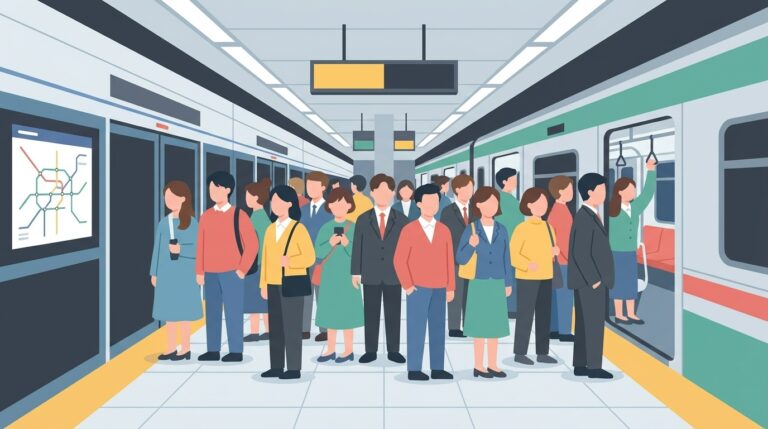
Imagine standing on the platform of Subway Line 9 Express at Express Bus Terminal Station at 8:15 AM. The warning bell rings, lights flash, and as the doors slide open, you are greeted not by empty seats, but by a wall of human shoulders packed like tightly compressed kimchi. Welcome to Korea’s infamous Jigokcheol (지옥철)—the rush-hour ‘Hell Train.’
If you have ever frozen at the subway doors wondering how on earth to ask someone to move, or accidentally got carried past your stop because you couldn’t shout ‘I’m getting off!’ in fluent Korean, you are not alone. Many of our intermediate learners share this exact pain point: you know basic grammar, but in the heat of a chaotic commute, standard textbook phrases feel too stiff, too slow, or downright unnatural.
In this guide, based on real feedback from expats and travelers living in Seoul, you will master natural B2-level phrases, physical etiquette, and emotional tone drills to navigate Seoul’s public transportation like a seasoned local. By the end of this article, you will walk into Gangnam Station at peak rush hour with absolute confidence!
Phase 2: Core Expressions Deep Dive
1. 지옥철 (Jigok-cheol)
- Pronunciation: [Jigok-cheol] (Sounds like “jee-gok-chul” — rapid ‘gok’ with a soft ‘chul’)
- Meaning: “Hell Train” (A compound word of 지옥 [hell] + 지하철 [subway]). Refers to hyper-congested subways during peak rush hours (8:00–9:00 AM / 6:00–7:00 PM).
- K-Culture Moment: You often see this in modern workplace K-dramas like Misaeng or My Liberation Notes, where exhausted characters lean against train doors squeezed between backpacks.
- Editor’s Insight: It is a hyperbolic slang word, but completely ubiquitous. Calling a line “지옥철” shows you understand urban Korean daily life.
- Situation Spectrum: Casual ✅ / Semi-formal ⚠️ / Formal 🚫
- 🤔 Think About It: Why do you think urban Korean society coined such a dramatic term for daily commuting?
2. 저 이번에 내릴게요 (Jeo ibeone naerilgeyo)
- Pronunciation: [Jeo i-beon-e nae-ril-ge-yo] (Rhythm: “Jeo eeb-uhrn-ae nae-reel-gae-yo”)
- Meaning: “I am getting off at this stop.” (Literal: I this-time will-get-off)
- K-Culture Moment: The magic phrase used when you are stuck 3 rows deep away from the subway doors and need people to clear a pathway instantly.
- Editor’s Insight: Standard textbooks teach “내리실 건가요?” (Are you getting off?). However, declaring your action with “저 이번에 내릴게요” is much more proactive and effective in rush hour crowds.
- Situation Spectrum: Casual ✅ / Semi-formal ✅ / Formal ⚠️
- 🤔 Think About It: Notice how Korean speakers state their intention rather than directly asking others to step aside.
3. 발 디딜 틈이 없다 (Bal didil teumi eoptda)
- Pronunciation: [Bal di-dil teum-i eob-tda] (Sounds like “Bahl dee-deel teum-ee eob-ta”)
- Meaning: “There is no room even to step a foot on.” (Idiom: Packed like sardines)
- K-Culture Moment: Often heard on news reports describing major transfer stations like Shindorim, Gangnam, or Hongdae during peak times.
- Editor’s Insight: This is an elegant B2-level idiom. Using it immediately elevates your Korean from basic descriptions to expressive storytelling.
- Situation Spectrum: Casual ✅ / Semi-formal ✅ / Formal ✅
- 🤔 Think About It: Contrast this visual image of “foot space” with how crowding is described in your native language.
Phase 3: Textbook Korean vs. Real Korean
Scenario 1: Asking someone if they are getting off at the upcoming station
- 📖 Textbook Korean: 내리실 예정이십니까? (Naerisil yejeong-isimnikka? – Are you planning to disembark?)
- 🗣️ Real Korean: 이번 역에서 내리세요? (Ibeon yeok-eseo naeriseyo? – Are you getting off at this stop?)
- 💡 Why the difference? Textbook phrasing is excessively formal and slow for fast-paced transit. The real Korean phrase is polite yet prompt, allowing quick physical coordination.
Scenario 2: Asking people to move further inside the train car
- 📖 Textbook Korean: 안쪽으로 이동하여 주십시오. (Anjjok-euro idonghayeo jusipsio. – Please move to the inside.)
- 🗣️ Real Korean: 안쪽으로 좀 들어가 주실게요~ (Anjjok-euro jom deureoga jusilgeyo~ – Could you please step further inside~)
- 💡 Why the difference? Korean train conductors use the soft “-하실게요” grammar pattern to gently nudge commuters without sounding bossy or confrontational.
Phase 4: K-Culture Deep Dive & Non-Verbal Manners
4-1. Nunchi (눈치) & Body Gestures in Jigokcheol
In Korea, non-verbal social etiquette (Nunchi) is as vital as spoken language during commute hours:
1. The Backpack Tuck (백팩 앞으로 매기): Wearing a backpack on your back in Jigokcheol is considered a big faux pas. Hug it to your chest or hold it down near your feet.
2. The Gentle Shoulder Tap: If voice communication is too loud or masked, two light taps on the shoulder followed by a slight head nod towards the exit signals “I need to pass politely.”
3. Gaze Direction: Avoid direct eye contact in crowded cars. Look down at your smartphone or up at the LED digital route displays.
4-2. Cultural Code Analysis: The Express vs. Local Dynamic
Lines like Line 9 operate two types of trains: Express (급행) and Local (일반). The Express skips small stops, cutting travel time in half. Because everyone wants the faster commute, Express trains become extreme Jigokcheol. Understanding this dynamic shows you truly grasp the Korean speed culture—Palli-Palli (8282) in daily transit!
Phase 5: Practical Roleplay Scenario
Setting: A packed Line 2 train approaching Gangnam Station (강남역) during morning rush hour. You (Learner) are blocked by Min-su (NPC Commuter).
- Turn 1 (Min-su): (어깨가 밀리며) 으악, 이번 역 강남역이죠? 사람 진짜 많네…
(Oeag, ibeon yeok Gangnam-yeok-ijyo? Saram jinzza manne…)
🎭 Action: Min-su leans against the door frame, distracted by his smartphone. - Turn 2 (You): 저… 죄송하지만, 이번 역에서 내리세요?
(Jeo… joesonghajiman, ibeon yeok-eseo naeriseyo?)
🎭 Action: You make slight eye contact and raise your voice politely above train noise. - Turn 3 (Min-su): 아, 저 안 내려요. 다음 역에서 내려요.
(A, jeo an naeryeoyo. Da-eum yeok-eseo naeryeoyo.)
🎭 Action: Min-su shifts slightly but remains standing right in front of the exit door. - Turn 4 (You): 아, 그래요? 저 이번에 내릴게요. 잠시만 지나갈게요!
(A, geuraeyo? Jeo ibeone naerilgeyo. Jamsiman jinagalgeyo!)
🎭 Action: You hold your bag to your chest and body-turn slightly sideways. - Turn 5 (Min-su): 아네네! 죄송합니다. 안쪽으로 비켜드릴게요.
(A-ne-ne! Joesonghamnida. Anjjok-euro bikyeodeureilgeyo.)
🎭 Action: Min-su steps inward toward the center aisle to create a narrow pathway. - Turn 6 (You): 감사합니다! 죄송합니다~
(Gamsahamnida! Joesonghamnida~)
🎭 Action: You execute a quick 15-degree head bow while stepping toward the opening doors. - Turn 7 (Min-su): 조심히 내리세요!
(Joshimhi naeriseyo!)
🎭 Action: Min-su holds the crowd behind him back with his arms slightly raised. - Turn 8 (You): (무사히 승강장에 내리며) 휴, 살았다!
(Hyu, saratda!)
🎭 Action: You take a deep breath on the fresh air platform and smile.
🔀 Interactive Choice Point
Scenario: The doors are opening, but someone is standing still in front of you. What do you do?
- Option A: Push forcefully while saying nothing. (Bad)
- Feedback: 🚫 Avoid this! Pushing quietly causes irritation and misunderstandings. Always speak first!
- Option B: Say loudly: “저 이번에 내릴게요! 잠시만요!” while moving sideways. (Best)
- Feedback: ✅ Perfect! Clear, proactive, respectful, and ensures a fast exit.
- Option C: Wait quietly for them to move on their own. (Risk)
- Feedback: ⚠️ High Risk! The subway doors only stay open for 15 seconds. You might miss your stop!
Phase 6: 10-Second Emotion Shadowing Drill
Practicing speed and emotional inflection is crucial for subway situations. Try shadowing these lines!
[😰 Urgently & Clearly]
저 / 이번에 / 내릴게요! / 잠시만요!
(Jeo / ibeone / naerilgeyo! / Jamsimannyo!)-
[😅 Apologetically & Softly]
죄송한데 / 안쪽으로 / 좀 들어갈게요~
(Joesonghande / anjjok-euro / jom deureogalgeyo~) -
[😮 Impressed & Overwhelmed]
와, 오늘 진짜 / 발 디딜 틈이 / 없네!
(Wa, oneul jinzza / bal didil teumi / eoptne!)
Phase 7: K-Culture Mini Dictionary
- 지옥철 (Jigokcheol) | Hell-Train | Used daily on social media or in group chats to complain about morning commuting stress.
- 출퇴근 시간 (Chultoegun Sigan) | Rush Hour | Commute hours (7:30–9:30 AM / 5:30–7:30 PM). Essential for schedule planning.
- 환승역 (Hwanseung-yeok) | Transfer Station | Major hubs like Sindorim or Seoul Station where multiple lines intersect.
- 백팩러 (Backpack-ler) | Backpack Wearer | Slang term referring to commuters who wear bulky bags without taking them off in crowded cars.
Phase 8: Traveler’s Survival Kit
TOP 3 Survival Phrases
- 잠시만요! (Jamsimannyo!) – Excuse me for a second! (Crucial for squeezing through crowds).
- 이번 역에서 내려요? (Ibeon yeok-eseo naeryeoyo?) – Are you getting off at this station?
- 먼저 타실게요! (Meonjeo tasilgeyo!) – Please go ahead and board first!
Editor’s Travel Note
Before tackling the subway, make sure you complete your 네이버 지도 앱 다운로드 (Naver Map App Download). Google Maps often lacks real-time subway car density info in South Korea. Naver Map shows which specific train car number is closest to transfer corridors and how crowded incoming trains are (Sparse / Normal / Crowded / Very Crowded)!
Phase 9: One Step Deeper (Reflective Essay)
In Korean society, the shared struggle of Chultoegun Sigan reflects a deep sense of collective urban resilience. Despite hundreds of strangers being pressed tightly against each other in total silence, order prevails through micro-manners—silent nods, adjusting bags, and yielding space for exits. It highlights how Korean communal awareness operates silently under high-stress conditions.
💬 Your Turn: What is the most memorable or intense public transit experience you have ever had? Leave a comment below and practice using today’s key phrase: “저 이번에 내릴게요!”
Phase 10: FAQ & Common Mistakes
Q: Is it rude to lightly touch someone’s arm or shoulder to move past them?
A: Not at all! In intense rush-hour crowds, light physical contact on the shoulder paired with saying “잠시만요” is standard, expected etiquette.
Q: Should I use formal verb endings like ‘-하십시오’ during subway commutes?
A: No. Highly formal ‘-하십시오’ style sounds unnaturally robotic in transit. Semi-formal ‘아/어-요’ form (e.g., “내릴게요”, “지나갈게요”) is both polite and natural.
Q: What if I lose my balance and bump into someone when the train halts?
A: Say “죄송합니다!” (Joesonghamnida!) immediately with a slight nod. Koreans are very understanding of sudden train stops.
🚨 Common Mistakes TOP 3
- Mistake: Shouting “비켜요!” (Bikyeoyo! – Get out of the way!).
- Correct Action: Say “잠시만 지나갈게요” (Just passing through for a moment).
- Mistake: Standing directly in front of opening doors before passengers step off.
- Correct Action: Wait behind the painted line markings on the platform floor.
- Mistake: Keeping earphones at high volume during congestion.
- Correct Action: Lower audio so you can hear stop announcements and surrounding warnings.
Phase 11: Action Mission & K-Culture Challenge
Action Mission 3-Steps
- 🥉 Bronze: Say “저 이번에 내릴게요” 5 times out loud in front of a mirror with proper emotion.
- 🥈 Silver: Record your voice practicing Phase 6 Emotion Shadowing and check your pacing.
- 🥇 Gold: Use your subway phrases in real life or during an online conversation session with a Korean speaker!
🎮 K-Culture Mission
Watch 1 episode of any office K-drama (e.g., Misaeng or Business Proposal). Spot a scene set inside a Korean subway or train station, and write down in the comments what transit behaviors you observed!
Phase 12: Interactive Quiz Challenge
1. Situation Quiz
You are stuck in the middle of a crowded Line 9 subway car, and your stop is coming up next. What should you say to pass through?
* A) 비켜주세요!
* B) 저 이번에 내릴게요!
* C) 그냥 계세요.
🔍 Click to view Answer & Explanation
Answer: B) 저 이번에 내릴게요!
Explanation: Option B clearly and politely communicates your intention to get off, prompting others to naturally yield space.
2. Fill-in-the-Blank
오늘 출근 시간 지하철은 사람이 너무 많아서 발 ( ___ ) 틈이 없었어요.
* A) 걸을
* B) 디딜
* C) 뛸
🔍 Click to view Answer & Explanation
Answer: B) 디딜
Explanation: The complete idiom is “발 디딜 틈이 없다” (No space to step a foot on).
3. True / False Cultural Quiz
Statement: It is totally fine to wear a bulky backpack on your back in a crowded Korean subway during morning rush hour.
🔍 Click to view Answer & Explanation
Answer: FALSE!
Explanation: You should hold your backpack in front of you or near your feet (백팩 앞으로 매기) to respect personal space in crowded subway cars.







