

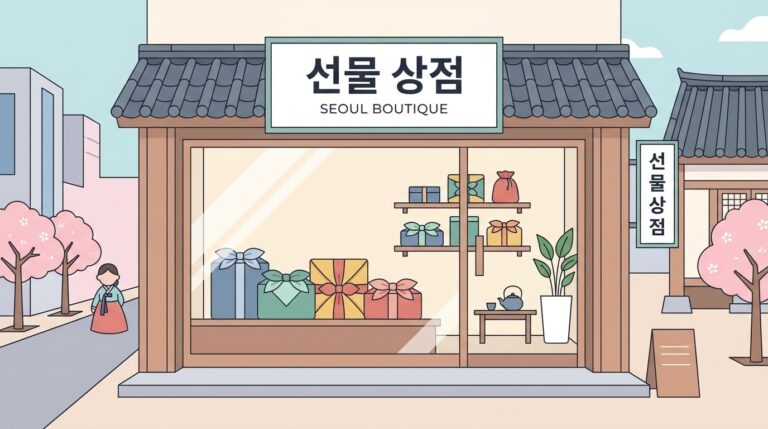
Master Gift Wrapping in Korea: Say “Pojang-hae juseyo” with Confidence!
안녕하세요! I’m your Daily Hangul editor! Imagine walking into a charming boutique in Insadong or a modern lifestyle store in Seongsu. You’ve just picked out the perfect K-beauty set or traditional bookmark for a friend back home. You head to the counter, eager to make it look special, but as the cashier rings it up, your mind goes blank. How do you ask them to wrap it as a gift without getting tongue-tied? Shopping for gifts in Korea is a delightful experience, but asking for wrapping often causes unnecessary anxiety for beginners. Don’t worry! In today’s guide, based on real feedback from over 1,000 Korean learners, you will master the exact beginner-friendly phrases to turn any gift into a beautifully wrapped present. Let’s make your Korean shopping trip seamless and fun!
Phase 2: Core Expressions Deep Dive
1. 포장해 주세요 (Pojang-hae juseyo)
- Pronunciation: [Pojang-hae juseyo] (Sounds like “Poh-jahng hae joo-say-yoh” – rhymes with ‘say yo’!)
- Meaning: “Please wrap it for me.” (Literal: Wrap please)
- K-Culture Moment: You’ll hear this expression constantly at department stores, stationery shops, and souvenir boutiques across Seoul when buying gifts.
- Editor’s Insight: This is your magic master phrase! Whether you want food to go or a gift wrapped, ‘포장 (pojang)’ means packing/wrapping. Adding ‘해 주세요’ politely asks someone to do it for you.
- Situation Spectrum:
- Casual: 포장해 줘 (Pojang-hae jwo) ⚠️
- Semi-formal: 포장해 주세요 (Pojang-hae juseyo) ✅
- Formal: 포장해 주시겠어요? (Pojang-hae jusigesseoyo?) ✅
- Think About It: In your home country, do stores offer free gift wrapping, or do you usually buy wrapping paper separately?
2. 선물용이에요 (Seonmuryong-ieyo)
- Pronunciation: [Seon-mul-yong-i-e-yo] (Sounds like “Sun-mool-yong-ee-ay-yo”)
- Meaning: “It’s for a gift.”
- K-Culture Moment: Used right before asking for wrapping so the clerk knows to remove the price tag or use special gift packaging.
- Editor’s Insight: ‘선물 (seonmul)’ means gift, and ‘용 (yong)’ means ‘for the use of’. Saying this helps the staff instantly understand your intent!
- Situation Spectrum:
- Casual: 선물용이야 (Seonmuryong-iya) 🚫
- Semi-formal: 선물용이에요 (Seonmuryong-ieyo) ✅
- Formal: 선물용입니다 (Seonmuryong-imnida) ✅
- Think About It: Why is letting the cashier know it’s a gift standard practice in Korean customer service?
3. 봉투에 넣어 주세요 (Bongtue neo-eo juseyo)
- Pronunciation: [Bong-tu-e neo-eo juseyo] (Sounds like “Bong-too-eh nuh-uh joo-say-yoh”)
- Meaning: “Please put it in a shopping bag.”
- K-Culture Moment: When shopping at convenience stores or gift shops, staff will ask if you need a paper or plastic bag.
- Editor’s Insight: In Korea, eco-friendly laws mean shopping bags cost a tiny fee (usually 100-500 KRW). Stating this clearly gets you the bag you need.
- Situation Spectrum:
- Casual: 봉투에 넣어 줘 (Bongtue neo-eo jwo) 🚫
- Semi-formal: 봉투에 넣어 주세요 (Bongtue neo-eo juseyo) ✅
- Formal: 봉투에 넣어 주시겠어요? (Bongtue neo-eo jusigesseoyo?) ✅
- Think About It: How does eco-conscious bag charging reflect changing urban consumer habits in Korea?
Phase 3: Textbook Korean vs. Real Korean
Situation 1: Asking for Gift Wrapping
- 📖 Textbook Korean: 이것을 선물 포장 용지로 포장해 주십시오. (Igeoseul seonmul pojang yongjiro pojanghae jusipsio.)
- 🗣️ Real Korean: 이거 선물용으로 포장해 주세요! (Igeo seonmuryong-euro pojang-hae juseyo!)
- 💡 Why the difference? Textbook phrases are often overly formal and verbose. Real Koreans prefer short, clear phrases using ‘선물용’ (for gift use) to sound natural and friendly.
Situation 2: Asking for an Extra Bag
- 📖 Textbook Korean: 쇼핑백을 하나 더 제공해 주실 수 있습니까? (Syo-ping-bae-geul hana deo jegong-hae jusil su isseumnika?)
- 🗣️ Real Korean: 봉투 하나 더 주실 수 있나요? (Bongtu hana deo jusil su innayo?)
- 💡 Why the difference? Directly asking for a bag using ‘주실 수 있나요?’ is polite, quick, and ideal for fast-paced retail interactions.
Phase 4: K-Culture Deep Dive & Non-verbal Manners
4-1. Nunchi & Gestures
When giving or receiving items in Korea (including cash, credit cards, or your wrapped gift), always use two hands (or support your right elbow with your left hand). This simple gesture shows deep respect. Combine it with a slight nod and a warm smile when saying “감사합니다 (Gamsahamnida).”
4-2. Cultural Code Analysis: Gift Presentation in Korea
In Korea, presentation is just as important as the gift itself! Giving an unboxed or unbagged gift can sometimes seem unprepared. Major stores and luxury department stores like Shinsegae or Lotte offer exquisite packaging services, sometimes using traditional fabric wrapping known as Bojagi (보자기). Even fast-fashion and K-beauty shops like Olive Young provide neat gift bags upon request.
Phase 5: Real Roleplay Scenario
Setting: A trendy souvenir shop in Bukchon Hanok Village. You are purchasing a handcrafted tea cup.
- Clerk: 안녕하세요! 계산 도와드릴게요. (Annyeonghaseyo! Gyesan dowadreilgeyo.) — Hello! I can help you check out.
🎭 Smiling at the counter - Learner: 안녕하세요! 이거 선물용이에요. (Annyeonghaseyo! Igeo seonmuryong-ieyo.) — Hello! This is for a gift.
🎭 Pointing gently to the tea cup - Clerk: 아, 선물용이세요? 포장해 드릴까요? (A, seonmuryong-iseyo? Pojang-hae deureilkgayo?) — Ah, a gift? Would you like me to wrap it?
🎭 Holding a gift box - Learner: 네, 포장해 주세요. (Ne, pojang-hae juseyo.) — Yes, please wrap it.
🎭 Nodding politely - Clerk: 리본도 묶어 드릴까요? (Ribondo muk-eo deureilkgayo?) — Shall I tie a ribbon on it too?
🎭 Showing ribbon options - Learner: 네, 리본도 묶어 주세요. (Ne, ribondo muk-eo juseyo.) — Yes, please tie a ribbon too.
🎭 Smiling warmly - Clerk: 봉투도 필요하신가요? 100원이에요. (Bongtudo pil-yohasingayo? Baek-won-ieyo.) — Do you also need a bag? It’s 100 won.
🎭 Holding up a paper bag - Learner: 네, 봉투도 함께 주세요. (Ne, bongtudo hamkke juseyo.) — Yes, please give me a bag too.
🎭 Handing credit card with two hands
🔀 Interactive Branching Point
The cashier asks: “포장 종류가 두 가지인데, 어떤 걸로 하시겠어요?” (We have two wrapping styles, which do you prefer?)
* Choice A: “이걸로해 주세요.” (Igeollo hae juseyo. – Pointing to the pretty one) -> [BEST] Clear, natural, and friendly!
* Choice B: “아무거나.” (Amugeona. – Whatever) -> [BAD] Blunt and rude to retail staff.
* Choice C: Silence and awkward stare -> [RISK] May cause confusion or delay at the counter.
Phase 6: 10-Second Emotion Shadowing Drill
Practice reading these out loud with emotion pauses (/ marks a short pause):
[😊 Bright & Polite]안녕하세요! / 이거 / 선물용이에요. (Annyeonghaseyo! / Igeo / seonmuryong-ieyo.)[🥺 Asking nicely]예쁘게 / 포장해 주세요! (Yeppeuge / pojang-hae juseyo!)[🙏 Thankful & Pleased]감사합니다! / 수고하세요! (Gamsahamnida! / Sugohaseyo!)
Phase 7: K-Culture Mini Dictionary
- 포장 (Pojang) | Packaging / Wrapping | Used for gift wrapping or food takeaway.
- 선물 (Seonmul) | Gift / Present | The core word for any present given to friends or family.
- 봉투 (Bongtu) | Shopping bag / Envelope | Essential when shopping in Korean stores.
- 상자 (Sangja) | Box | Used if you want your gift packaged in a rigid gift box.
Phase 8: Traveler’s Survival Kit
Survival Expressions TOP 3
- 포장해 주세요. (Pojang-hae juseyo.) — Please wrap it. (Pro Tip: Use this at any store!)
- 선물용이에요. (Seonmuryong-ieyo.) — It’s a gift. (Pro Tip: Say this before checkout starts.)
- 가격표 떼어 주세요. (Gagyeokpyo tte-eo juseyo.) — Please remove the price tag. (Pro Tip: Essential for gifts!)
Editor’s Travel Note
When navigating shopping districts like Myeongdong or Seongsu, check store locations using the Naver Map app download. Note that most major retail stores accept mobile card payments and international credit cards, but charging 100 won for shopping bags is legally mandatory across Korea!
Phase 9: One Step Deeper
In Korean culture, packaging is an extension of ‘정’ (Jeong) — affection and warm feeling toward others. Wrapping a gift demonstrates that you put thought, time, and care into honoring the recipient. By asking staff to wrap your purchase, you participate in this beautiful custom of thoughtful giving.
💬 Your Turn: What’s the most memorable gift you’ve bought while traveling? Tell us in the comments below!
Phase 10: FAQ & Common Mistakes
Q: Does gift wrapping cost extra in Korean stores?
A: At department stores and dedicated gift shops, basic gift wrapping is often free or very cheap (1,000–2,000 KRW). Convenience stores do not offer wrapping.
Q: How do I ask to remove the price tag?
A: You can say: “가격표 떼어 주세요” (Gagyeokpyo tte-eo juseyo).
Q: What if I want to wrap items separately?
A: Say: “따로따로 포장해 주세요” (Ttarottaro pojang-hae juseyo).
🚨 Common Mistakes TOP 3
- Saying “싸 주세요” (Ssa juseyo) in a gift store: While ‘싸다’ means wrap, ‘포장해 주세요’ sounds much more natural for gifts.
- Using informal speech: Don’t say “포장해 줘” to clerks. Always keep the polite ‘-요’ ending.
- Forgetting two-hand etiquette: Handing credit cards with one finger/hand can seem dismissive. Always use two hands.
Phase 11: Action Mission
- Bronze Level: Say “포장해 주세요” out loud 3 times in front of the mirror.
- Silver Level: Post a picture of your wrapped gift on Instagram with the hashtag #DailyHangulPojang.
- Gold Level: Use “선물용이에요! 포장해 주세요” during your next trip to Korea or at a local Korean bakery!
🎮 K-Culture Mission: Watch a scene in a K-Drama where characters go shopping. Listen carefully to see if you catch the word “포장 (Pojang)”!
Phase 12: Interactive Quiz Challenge
Question 1 (Scenario): You bought a hand cream for your mother in Korea. What should you say to the cashier to make it gift-ready?
* A) 포장해 주세요 (Pojang-hae juseyo)
* B) 그냥 주세요 (Geunyang juseyo)
* C) 버려 주세요 (Beoryeo juseyo)
Click to view answer & explanation
Correct Answer: A! ‘포장해 주세요’ means ‘Please wrap it for me.’ B means ‘Just give it to me as is,’ and C means ‘Please throw it away.’
Question 2 (True/False): In Korea, it is polite to pass your credit card to the shopkeeper using both hands.
* A) True
* B) False
Click to view answer & explanation
Correct Answer: A (True)! Using two hands demonstrates respect in Korean retail etiquette.







