

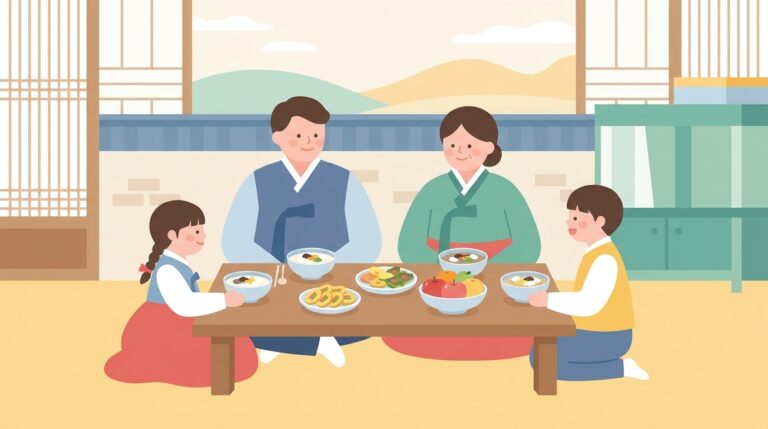
Annyeonghaseyo! This is your Daily Hangul editor. Picture this: It is Chuseok evening in Seoul. The delicious aroma of freshly cooked jeon (savory pancakes) fills the living room, and the dining table is piled high with colorful songpyeon. Everyone is smiling until your well-meaning aunt leans in with a sweet smile and asks: ‘So, when are you getting married? My friend’s child just landed a great job and got engaged!’ You feel your throat tighten and your face warm up. If you’ve ever watched family K-dramas, you know this classic holiday scene all too well. Korean holiday gatherings—whether Seollal or Chuseok—are rooted in deep affection, but they often come packed with ‘jansori’ (잔소리)—affectionate yet invasive nagging about your career, relationship status, or lifestyle choices. Navigating these conversations without being rude or ruining the holiday mood can feel like walking a high-wire. But don’t worry! Drawing from real feedback from our intermediate Korean learners and native insights, this guide will equip you with tactical, polite, and culturally refined B2-level phrasing so you can handle holiday nagging with total grace and confidence.
1. 신경 써 주셔서 감사합니다
- Pronunciation: [Singyeong sseo jusyeoseo gamsahamnida] (Sounds like: seen-gyeong ssuh joo-syuh-suh gahm-sah-hahm-nee-dah)
- Meaning: Direct: ‘Thank you for giving me your attention.’ / Nuance: ‘Thank you for your concern (now let’s move on).’
- K-Culture Moment: Frequently heard in K-dramas when a young professional politely deflects unwelcome unsolicited advice from a senior colleague or relative.
- Editor’s Insight: This is the ultimate weapon of polite boundary-setting. It acknowledges their intent without promising anything or opening a debate.
- Situation Spectrum: Casual 🚫 | Semi-formal ✅ | Formal ✅
- 🤔 Think About It: In your culture, is acknowledging someone’s uninvited advice seen as agreement, or simply as polite politeness?
2. 걱정해 주신 덕분에 잘 준비하고 있어요
- Pronunciation: [Geokjeonghae jusin deokbune jal junbihago issoyo] (Sounds like: guck-jung-hae joo-seen duck-boo-neh jahl joon-bee-hah-go ee-ssuh-yo)
- Meaning: Direct: ‘Thanks to your worry, I am preparing well.’ / Nuance: ‘I appreciate your concern, and I have everything under control.’
- K-Culture Moment: Used by lead characters in modern slice-of-life dramas when elders ask about job interviews or wedding plans.
- Editor’s Insight: Using ‘덕분에’ (thanks to…) frames their nagging as supportive care, making the elder feel respected while reassuring them that you are active.
- Situation Spectrum: Casual ⚠️ | Semi-formal ✅ | Formal ✅
- 🤔 Think About It: How does turning an intrusive question into an expression of gratitude change the emotional power dynamic?
3. 때가 되면 다 잘될 테니 조금만 기다려 주세요
- Pronunciation: [Ttaega doemyeon da jaldoel teni jogumman gidaryeo juseyo] (Sounds like: tteh-gah doeh-myuhn dah jahl-doehl teh-nee joh-goom-mahn gee-dah-ryuh joo-seh-yo)
- Meaning: Direct: ‘When the time comes, all will be well, so please wait a little.’ / Nuance: ‘Everything has its timeline; trust me and give me time.’
- K-Culture Moment: Said during family dinners in K-dramas when older generations press younger ones about settling down.
- Editor’s Insight: It blends respect for elders with a clear demand for patience. It projects calm self-assurance.
- Situation Spectrum: Casual ⚠️ | Semi-formal ✅ | Formal 🚫
- 🤔 Think About It: Why is patience emphasized in Korean social ethics when discussing life milestones?
📖 Textbook Korean vs 🗣️ Real Korean
Situation 1: Responding to questions about your career/marriage status
* 📖 Textbook Korean: 그 질문에는 대답하고 싶지 않습니다. (I do not want to answer that question.)
* 🗣️ 진짜 한국어: 신경 써 주신 덕분에 차근차근 잘 준비하고 있어요! (Thanks to your concern, I am preparing step by step!)
* 💡 왜 다를까?: Direct refusal sounds hostile in Korean family settings. Framing your progress as steady (‘차근차근’) softens the atmosphere.
Situation 2: Changing the subject during nagging
* 📖 Textbook Korean: 다른 이야기를 합시다. (Let’s talk about something else.)
* 🗣️ 진짜 한국어: 그건 그렇고, 이 전(煎) 진짜 맛있는데 어떻게 만드셨어요? (By the way, this jeon is so delicious, how did you make it?)
* 💡 왜 다를까?: Abruptly changing topics is considered blunt. Complimenting holiday food shifts focus to the elder’s skill, immediately lightening the mood.
4-1. Nunchi & Gestures
When dealing with holiday jansori, your posture is 50% of the strategy. Maintain a light, gentle smile and a subtle head nod (고개 끄덕임) while listening. Keep your shoulders relaxed and offer tea or side dishes while responding. Soft eye contact mixed with slight downward tilts signals respect without defensiveness.
4-2. K-Culture Deep Dive
In Korean holiday culture, elders give ‘deokdam’ (덕담 – blessings for the new year/season), but the line between deokdam and jansori often blurs. Elders view asking about your life as an act of relational affection (‘정’ – Jeong), whereas younger generations value individual privacy. Knowing this balance helps you handle nagging with empathy rather than frustration.
Phase 5: Real Roleplay Scenario
Setting: Chuseok dinner at relative’s home. Aunt (이모) passes you delicious songpyeon.
- 이모: 🎭 (송편을 접시에 담아주며)
Frequently Asked Questions (FAQ)
Q: What does "신경 써 주셔서 감사합니다" mean in Korean and how do you pronounce it?
A: In Korean, "신경 써 주셔서 감사합니다" is pronounced [Singyeong sseo jusyeoseo gamsahamnida] and means: Direct: 'Thank you for giving me your attention.' / Nuance: 'Thank you for your concern (now let's move on).'
Q: What does "걱정해 주신 덕분에 잘 준비하고 있어요" mean in Korean and how do you pronounce it?
A: In Korean, "걱정해 주신 덕분에 잘 준비하고 있어요" is pronounced [Geokjeonghae jusin deokbune jal junbihago issoyo] and means: Direct: 'Thanks to your worry, I am preparing well.' / Nuance: 'I appreciate your concern, and I have everything under control.'
Q: What does "때가 되면 다 잘될 테니 조금만 기다려 주세요" mean in Korean and how do you pronounce it?
A: In Korean, "때가 되면 다 잘될 테니 조금만 기다려 주세요" is pronounced [Ttaega doemyeon da jaldoel teni jogumman gidaryeo juseyo] and means: Direct: 'When the time comes, all will be well, so please wait a little.' / Nuance: 'Everything has its timeline; trust me and give me time.'







