

Phase 1: Empathy – When Smoke Fills the Corridor
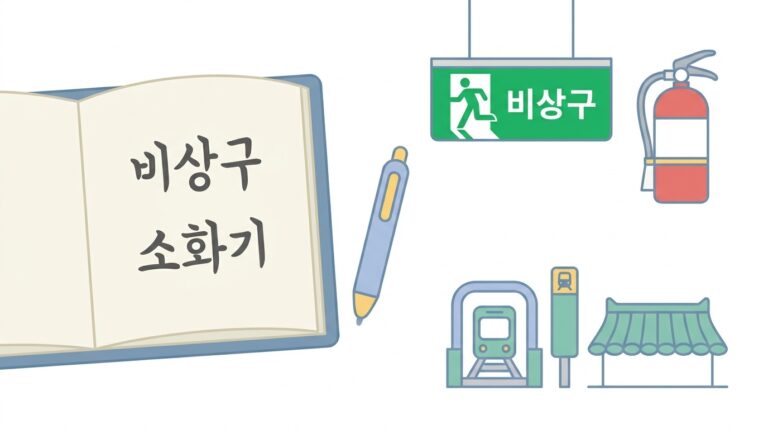
안녕하세요! I’m your Daily Hangul Editor and culture navigator. Imagine this: You’re relaxing in your cozy Seoul officetel after a long day of exploring Hongdae. Suddenly, a piercing alarm rings through the hallway, accompanied by a rapid loudspeaker announcement in Korean. Panic sets in. You open your front door, and a thin haze of smoke is drifting through the corridor. You spot a red cylinder on the wall—a fire extinguisher (소화기)—and the emergency exit sign flashing green (비상구). But when emergency strikes, dictionary Korean disappears from your brain. Emergency protocols in Korea involve specific high-frequency command verbs and rapid passive/active grammatical forms that aren’t usually taught in general language classes.
Navigating safety critical situations in a foreign country requires high-level linguistic instincts and cultural awareness. In Korea, urban density means apartment complexes and multi-story commercial buildings rely heavily on standardized safety announcements and rapid collective evacuation procedures. By mastering C1-level safety terminology and crisis commands today, you transform panic into decisive action. This guide isn’t just about passing a proficiency exam; it is based on feedback from real expats and travelers who faced emergency situations in Korea. Let’s equip you with the exact words that could literally save a life.
Phase 2: Core Expressions Deep Dive
1. 불이야! / 불이 났어요! (Buriya! / Buri nasseoyo!)
- Pronunciation: [Boo-ri-ya! / Boo-ri nas-seog-yo!] (Shout “Boo-ri-ya” like “boo” + “ree” +
Frequently Asked Questions (FAQ)
Q: What does "불이야! / 불이 났어요! (Buriya! / Buri nasseoyo!)" mean in Korean and how do you pronounce it?
A: In Korean, "불이야! / 불이 났어요! (Buriya! / Buri nasseoyo!)" is pronounced [Boo-ri-ya! / Boo-ri nas-seog-yo!] and means: a key conversational Korean expression covered in this lesson.







