

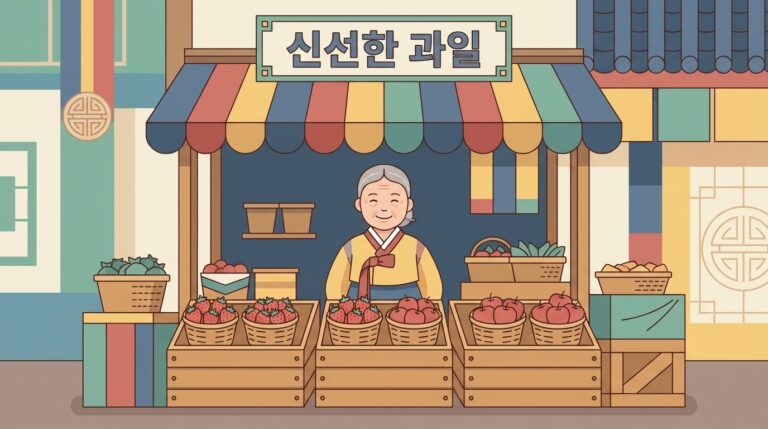
Phase 1: Empathy (Story-driven Opening)
안녕하세요! This is your Daily Hangul editor and your personal Korean culture navigator! Have you ever walked through a bustling traditional Korean market like Mangwon Market or Gwangjang Market? The smell of freshly fried pajeon, the vibrant colors of seasonal fruits, and the energetic shouts of market vendors instantly pull you into the authentic rhythm of everyday Seoul.
Imagine standing in front of a market stall stacked high with bright red strawberries or glistening ginseng root. You want to buy the freshest produce, and you know that in Korea, locally grown produce—known as 국산 (Guksan)—is famous for its high quality and flavor. But suddenly, you freeze. How do you ask the vendor if these delicious items were grown in Korea without sounding like a formal textbook?
Don’t worry! You’re not alone. Many A2-level Korean learners hesitate because they fear using words that sound too stiff or awkward. Based on real learner feedback and my 10 years of navigating Korean street markets, I’ve designed this friendly guide to help you ask about product origins naturally and confidently. By learning just a few simple phrases, you won’t just get the best food—you’ll also connect with friendly market vendors and experience true Korean warmth!
Phase 2: Deep Dive into 3 Core Expressions
1. 국산이에요? (Guk-san-i-e-yo?)
- Pronunciation: [Guk-san-i-e-yo?] (Sounds like “Cook-sahn-ee-eh-yoh?”)
- Meaning: “Is this domestic?” / “Is this grown in Korea?”
- K-Culture Moment: You see a grandmother in a K-drama carefully selecting red chili peppers at a traditional market and asking the vendor if they are local.
- Editor’s Insight: “국산” (Guksan) literally means “product of our country.” It is the most natural word to use when asking about fresh produce, fruits, meat, or agricultural goods!
- Situation Spectrum: Casual (⚠️) | Semi-formal (✅) | Formal (✅)
- 🤔 Think About It: Why do Korean shoppers place such a high value on buying domestic farm produce?
2. 한국산이에요? (Han-guk-san-i-e-yo?)
- Pronunciation: [Han-guk-san-i-e-yo?] (Sounds like “Hahn-gook-sahn-ee-eh-yoh?”)
- Meaning: “Is it made in Korea?”
- K-Culture Moment: You’re shopping for handmade souvenirs, cosmetics, or craft items in Insadong and want to verify their origin.
- Editor’s Insight: While “국산” is ideal for farm goods, “한국산” (Korean-made) is perfect for manufactured products, clothing, and packaged souvenirs.
- Situation Spectrum: Casual (⚠️) | Semi-formal (✅) | Formal (✅)
- 🤔 Think About It: How does asking about origin show respect for local craftsmanship?
3. 이것 직접 재배하신 거예요? (I-geot jik-jeop jae-bae-ha-sin ggeo-ye-yo?)
- Pronunciation: [I-geot jik-jeop jae-bae-ha-sin ggeo-ye-yo?] (Sounds like “Ee-geot jeek-jeop jae-bae-hah-seen gguh-yeh-yoh?”)
- Meaning: “Did you grow this yourself?”
- K-Culture Moment: A scene in a heartwarming countryside drama like Hometown Cha-Cha-Cha, where characters buy vegetables directly from local farm stalls.
- Editor’s Insight: Asking this friendly question serves as a warm compliment to local vendors who harvest their own crops!
- Situation Spectrum: Casual (🚫) | Semi-formal (✅) | Formal (✅)
- 🤔 Think About It: How does complimenting a vendor’s hard work change your shopping interaction?
Phase 3: Textbook Korean vs. Real Korean
Situation 1: Checking if produce is local
- 📖 Textbook Korean: 이것은 대한민국산 제품입니까? (Is this a product of the Republic of Korea?)
- 🗣️ Real Korean: 이거 국산이에요? (Is this domestic?)
- 💡 Why the difference?: Textbook sentences are often written for formal documents. In daily conversation, real shoppers shorten “이것은” to “이거” and use friendly semi-formal endings like “~이에요?”.
Situation 2: Asking where something comes from
- 📖 Textbook Korean: 어디에서 재배했습니까? (Where was this cultivated?)
- 🗣️ Real Korean: 이거 어디 거예요? (Where is this from?)
- 💡 Why the difference?: “어디 거예요?” (Where is it from?) is the most versatile and natural phrase used by native Korean speakers in informal street markets.
Phase 4: K-Culture Deep Dive & Non-verbal Etiquette
4-1. Nunchi (눈치) & Gestures
When asking vendors about their products, open, respectful body language is key! Gently point toward the item using your full open hand rather than a single finger. Maintaining friendly eye contact accompanied by a light head tilt shows warmth and respect.
4-2. Culture Code Analysis: Jeong (정) and Market Culture
Traditional markets in Korea run on Jeong (정)—an invisible bond of affection, generosity, and warmth. When you show genuine interest in a vendor’s produce by asking if it’s domestic (“국산이에요?”), vendors feel proud. Often, this warm interaction leads to 덤 (Deom)—a bonus free item or extra handful of produce added to your bag with a smile!
Phase 5: Real Roleplay Scenario
Setting: Mangwon Market Fruit Stall
Characters: You (A2 Korean Learner) & Imo-nim (Friendly female market vendor)
- You: 안녕하세요! 딸기 정말 신선해 보여요. (🎭 Smiling while pointing to strawberries with an open palm)
(Hello! The strawberries look so fresh.) - Imo-nim: 어서 와요! 오늘 아침에 들어온 싱싱한 딸기야.
(Welcome! These are fresh strawberries that arrived this morning.) - You: 이거 국산이에요?
(Is this domestic / grown in Korea?) - Imo-nim: 그럼! 논산에서 직송된 100% 국산 딸기지!
(Of course! They are 100% domestic strawberries shipped directly from Nonsan!) - You: 와, 대박! 얼마예요?
(Wow, awesome! How much is it?) - Imo-nim: 한 바구니에 만 원이에요.
(It’s 10,000 won for one basket.) - You: 한 바구니 주세요!
(Please give me one basket!) - Imo-nim: 고마워요! 맛있게 먹어요~ 덤으로 귤도 두 개 줄게요! (🎭 Hands over strawberry basket with extra tangerines)
(Thank you! Enjoy! I’ll give you two tangerines as a bonus!)
🔀 Interactive Branching Point
If the vendor asks you if you want anything else, how do you respond politely?
* Choice A: 아니요, 됐어요. (No, I’m fine.)
* Choice B: 감사해요! 이것만 살게요. (Thank you! I’ll just take this.)
* Choice C: 더 주세요! (Give me more!)
Feedback:
* Choice A (Risk): Direct, but can sound slightly abrupt or cold in a friendly market setting.
* Choice B (BEST): Extremely polite, warm, and natural for A2 learners!
* Choice C (Bad): Sounds demanding unless said playfully with established rapport.
Phase 6: 10-Second Emotion Shadowing Drill
Practice saying these sentences aloud with key pauses (/) and natural emotional inflection:
- [😊 Curiously & Politely]
이거 / 국산이에요?
(Is this / domestic?) -
[😋 Excitedly & Admiringly]
와, / 정말 / 신선해 보여요!
(Wow, / it really / looks fresh!) -
[🙏 Warmly & Gratefully]
감사합니다! / 많이 파세요!
(Thank you! / Have a prosperous day selling!)
Phase 7: K-Culture Mini Dictionary
- 국산 (Guksan) | Domestic Product
Refers to agricultural or produce items grown in Korea. Highly prized for freshness. - 덤 (Deom) | Free Bonus / Extra
A free handful of extra items given by traditional market vendors out of warmth and affection. - 이모님 (Imo-nim) | Auntie (Friendly Title)
A warm, respectful term used to address middle-aged female stall owners at markets and casual eateries. - 신선하다 (Sinseon-hada) | To be fresh
An adjective commonly used when admiring fruits, vegetables, or seafood at local markets.
Phase 8: Traveler’s Survival Kit
Survival Phrases TOP 3
- 이거 어디 거예요? (I-geo eo-di ggeo-ye-yo?) — Where is this from?
- Pro Tip: Perfect when shopping for souvenirs or unspecified goods.
- 얼마예요? (Eol-ma-ye-yo?) — How much is it?
- Pro Tip: Essential price check phrase everywhere in Korea.
- 많이 파세요! (Man-i pa-se-yo!) — Sell a lot! (Have a great sales day!)
- Pro Tip: Say this cheerful parting phrase as you leave a market stall to melt any vendor’s heart!
Editor’s Travel Note
Before heading to traditional markets in Seoul, download the Naver Map App Download to find local market locations, operating hours, and subways easily. Most vendors accept credit cards, but keeping a few 10,000 won cash bills handy is great for small purchases and experiencing street food stalls!
Phase 9: “One Step Deeper” (Reflection Question)
In modern supermarkets, origin tags are computer-printed and neutral. However, in Korean traditional markets, asking “국산이에요?” opens up a human connection. It acknowledges the vendor’s connection to local farms and starts a conversation built on trust and shared pride in local produce.
💬 Your Turn: Have you ever visited a traditional food market in another country? How do you check if produce is locally grown where you live? Share your stories in the comments below!
Phase 10: FAQ & Common Mistakes
Q: What is the difference between 국산 (Guksan) and 국내산 (Gungnaesan)?
A: Both mean domestic! However, 국산 usually refers to items 100% grown/raised in Korea, while 국내산 can also include imported raw ingredients that were processed or raised locally in Korea.
Q: Can I use “국산이에요?” when shopping at a modern supermarket like Lotte Mart?
A: Yes, you can! However, supermarkets already have clear origin labels (원산지 표기), so you usually won’t need to ask verbally.
Q: Is bargaining expected in Korean traditional markets?
A: Aggressive bargaining is not common nowadays. Instead of asking for a discount, build rapport politely—you might receive a friendly 덤 (Deom) extra instead!
🚨 Common Mistakes TOP 3
- Mistake: Using formal textbook phrasing like “이것은 한국에서 생산되었습니까?”.
- Correct Action: Use short, natural spoken Korean: “이거 국산이에요?”
- Mistake: Calling market vendors “저기요” (Excuse me) when they are older female stall owners.
- Correct Action: Address middle-aged female vendors warmly as “이모님” (Imo-nim).
- Mistake: Pointing aggressively with a single index finger at produce.
- Correct Action: Gesture politely using an open hand.
Phase 11: Action Mission & Engagement
- Bronze Step: Practice saying “이거 국산이에요?” out loud 3 times with natural rhythm.
- Silver Step: Record yourself doing the Phase 6 Shadowing Drill and listen back to check your pause points.
- Gold Step: On your next trip to Korea, visit a traditional market, ask a vendor “이거 국산이에요?”, and buy a basket of fresh fruit!
🎮 K-Culture Mission: Watch a scene from a food-themed K-drama (like Let’s Eat) and spot how characters talk to local market vendors or restaurant owners!
Phase 12: Interactive Quiz Challenge
Quiz 1: Situation Check
You are at Mangwon Market looking at fresh apples. What is the most natural way to ask if they are grown in Korea?
* A) 이거 한국산 제품입니까?
* B) 이거 국산이에요?
* C) 어디서 만드셨어요?
Click to reveal answer & explanation
Correct Answer: B) 이거 국산이에요?
Explanation: “국산이에요?” is the standard, natural semi-formal expression for asking if agricultural produce is domestic in Korean street markets!
Quiz 2: Fill in the Blank
Complete the natural market phrase: “이거 _______ 거예요?” (Where is this from?)
* A) 국산
* B) 어디
* C) 얼마
Click to reveal answer & explanation
Correct Answer: B) 어디
Explanation: “이거 어디 거예요?” (Where is this from?) is the go-to casual question for checking item origins.
Quiz 3: True or False Culture Quiz
In Korean traditional markets, receiving extra bonus produce from a friendly vendor is called “덤” (Deom).
* A) True
* B) False
Click to reveal answer & explanation
Correct Answer: A) True
Explanation: “덤” (Deom) refers to the free extra items given out of warmth, affection, and market spirit (Jeong)!






