

Phase 1: Empathy & Storytelling
안녕하세요! (Hello!) I’m your Daily Hangul editor and local culture navigator. Imagine this: You are sitting at a cozy cafe in Hongdae, Seoul, enjoying an iced Americano while catching up on your favorite K-Drama on your phone. Suddenly, every smartphone in the room blares a loud, siren-like alert tone in unison! Your heart jumps. It’s a emergency text alert (재난문자) warning about a earthquake (지진) nearby. Moments later, you feel a slight tremor beneath your feet.
In a situation like this, panic is natural, especially when you are in a foreign country and don’t speak fluent Korean. But don’t worry! You don’t need complicated grammar to stay safe. Based on real experiences from foreign residents and travelers in Korea, knowing just a few simple A1-level Korean safety phrases can keep you calm, protected, and connected with those around you. Let’s learn how to navigate an earthquake emergency in Korea with confidence!
Phase 2: Core Expressions Deep Dive
1. 도와주세요! (Do-wa-ju-se-yo!)
- Pronunciation: [Do-wa-ju-se-yo] (Sounds like ‘Doh-wah-joo-seh-yoh’)
- Meaning: Direct Translation: “Please help me!” | Real Nuance: An urgent call for assistance when you need immediate help.
- K-Culture Moment: You often hear this emotional line in disaster movies or emergency scenes in K-Dramas when characters need rescue.
- Editor’s Insight: The ending -세요 (-se-yo) keeps it respectful while expressing urgency. In an emergency, shouting this clearly will get immediate attention from locals.
- Situation Spectrum: Casual ⚠️ | Semi-formal ✅ | Formal ✅
- 🤔 Think About It: Why does Korean keep respectful polite endings like -요 (-yo) even during urgent emergency situations?
2. 괜찮아요? (Gwaen-chan-ah-yo?)
- Pronunciation: [Gwaen-chan-a-yo] (Sounds like ‘Gwen-chan-ah-yo’)
- Meaning: Direct Translation: “Are you okay?” | Real Nuance: Asking about someone’s wellbeing or reassuring others (“I’m okay”).
- K-Culture Moment: Right after a tremor stops, Koreans immediately turn to friends or nearby people and ask, “괜찮아요?”
- Editor’s Insight: Raising your voice tone at the end makes it a question (Are you okay?). Keeping your tone flat makes it an answer (I am okay).
- Situation Spectrum: Casual ⚠️ | Semi-formal ✅ | Formal ✅
- 🤔 Think About It: Isn’t it fascinating how a single word handles both the question and the answer depending on pitch?
3. 대피하세요! (Dae-pi-ha-se-yo!)
- Pronunciation: [Dae-pi-ha-se-yo] (Sounds like ‘Day-pee-hah-seh-yoh’)
- Meaning: Direct Translation: “Please evacuate!” | Real Nuance: Formal instruction to move to a safe shelter.
- K-Culture Moment: This expression appears on emergency text alerts and public loudspeaker broadcasts during natural disasters.
- Editor’s Insight: While building staff or emergency workers might shout this at you, knowing this word helps you react instantly when you hear it announced.
- Situation Spectrum: Casual 🚫 | Semi-formal ⚠️ | Formal ✅
- 🤔 Think About It: Notice how public safety instructions always use formal grammar to maintain calm and order.
Phase 3: Textbook Korean vs. Real Korean
Situation 1: Asking where the emergency exit is
- 📖 Textbook Korean: 비상구가 어디에 있습니까? (Bi-sang-gu-ga eo-di-e it-seum-ni-ka?)
- 🗣️ Real Korean: 비상구 어디예요? (Bi-sang-gu eo-di-ye-yo?)
- 💡 Why the difference? In a fast-moving emergency, native speakers shorten long textbook grammar into quick, clear conversational phrases.
Situation 2: Asking if everyone is okay
- 📖 Textbook Korean: 모두 안전합니까? (Mo-du an-jeon-ham-ni-ka?)
- 🗣️ Real Korean: 다들 괜찮아요? (Da-deul gwaen-chan-ah-yo?)
- 💡 Why the difference? Koreans naturally use 괜찮아요 in everyday life to check safety rather than formal dictionary terms like 안전합니까.
Phase 4: K-Culture Deep Dive & Non-Verbal Etiquette
4-1. Nunchi (눈치) & Safety Gestures
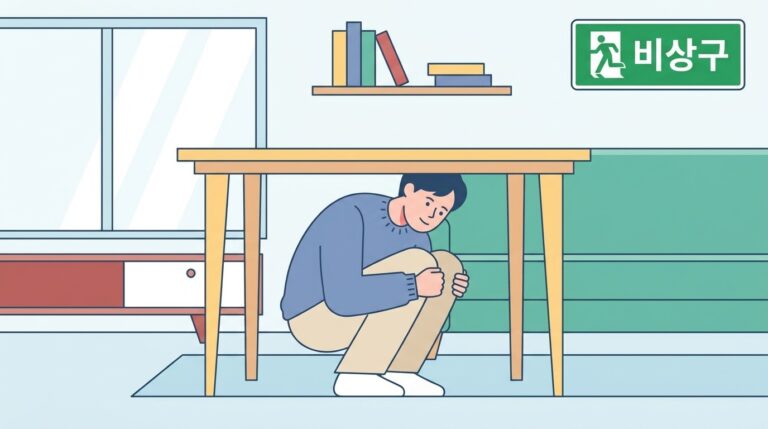
When an earthquake occurs in Korea, pay attention to Nunchi (눈치)—reading the room and environment quickly. If locals duck under tables or cover their heads with bags (머리 보호), follow their lead immediately. When heading outside, exit calmly in line without pushing others.
4-2. Culture Code: Emergency Alerts (재난문자)
Korea has one of the world’s fastest emergency broadcast systems. When a magnitude earthquake happens, every smartphone receives an automated alert (재난문자) with a high-pitched alarm. Even if you cannot read all the detailed Korean text yet, seeing the loud alert means you should pause and look around for safety cues.
Phase 5: Real Roleplay Scenario
Setting: You are at a subway station cafe with your Korean friend Minjun when a minor tremor occurs.
- Turn 1 (Minjun): 🎭 [Looks at buzzing phone with wide eyes] 어? 재난문자 왔어요! (Eo? Jae-nan-mun-ja wat-seo-yo! / Oh? An emergency alert arrived!)
- Turn 2 (You): 🎭 [Looking confused and startled] 무슨 일이에요? (Mu-seun il-i-e-yo? / What’s happening?)
- Turn 3 (Minjun): 🎭 [Feeling the floor shake slightly] 지진이에요! 테이블 밑으로 들어가세요! (Ji-jin-i-e-yo! Te-i-beul mit-eu-ro deu-reo-ga-se-yo! / It’s an earthquake! Get under the table!)
- Turn 4 (You): 🎭 [Quickly ducking under the sturdy table] 네! 민준 씨도 어서요! (Ne! Min-jun ssi-do eo-seo-yo! / Yes! Minjun, you too, hurry!)
- Turn 5 (Minjun): 🎭 [Ducks under next to you] 괜찮아요? 안 다쳤어요? (Gwaen-chan-ah-yo? An da-chyeot-seo-yo? / Are you okay? You didn’t get hurt?)
- Turn 6 (You): 🎭 [Taking a deep breath] 네, 저는 괜찮아요. (Ne, jeo-neun gwaen-chan-ah-yo. / Yes, I am okay.)
- Turn 7 (Minjun): 🎭 [Looking toward the exit after shaking stops] 진동이 멈췄어요. 천천히 밖으로 대피해요. (Jin-dong-i meom-chwot-seo-yo. Cheon-cheon-hi bak-eu-ro dae-pi-hae-yo. / The shaking stopped. Let’s evacuate outside slowly.)
- Turn 8 (You): 🎭 [Nodding and grabbing your bag] 네, 비상구로 가요. (Ne, bi-sang-gu-ro ga-yo. / Yes, let’s go to the emergency exit.)
🔀 Interactive Branching Point
After the tremor stops, building staff points toward the door. What do you do?
* Option A: Panic, scream, and run out as fast as possible pushing people. (Bad Response)
* Option B: Ask calmly “비상구 어디예요?” and walk out in an orderly manner. (Best Response)
* Option C: Stay seated and continue drinking your coffee because the shaking stopped. (Risk Response)
- Feedback:
- Option A (Bad): Running and pushing in crowds during an earthquake creates severe stampede risks.
- Option B (Best): Perfect! Locating the emergency exit calmly keeps you and everyone around you safe.
- Option C (Risk): Aftershocks often follow initial earthquakes. Always evacuate to an open space safely.
Phase 6: 10-Second Emotion Shadowing Drill
Practice saying these out loud with natural rhythm and feeling!
[😱 Panic & Urgent]도와주세요! / 저기요, / 도와주세요! (Do-wa-ju-se-yo! / Jeog-i-yo, / do-wa-ju-se-yo!)[😟 Worried & Caring]괜찮아요? / 어디 / 안 다쳤어요? (Gwaen-chan-ah-yo? / Eo-di / an da-chyeot-seo-yo?)[😌 Relieved & Calm]네, / 저는 / 괜찮아요. (Ne, / jeo-neun / gwaen-chan-ah-yo.)
Phase 7: K-Culture Mini Dictionary
- 재난문자 (Jae-nan-mun-ja) | Emergency Alert Text | Automatic public safety push notifications sent to mobile phones in Korea.
- 지진 (Ji-jin) | Earthquake | The Korean term for ground tremors and seismic activity.
- 대피소 (Dae-pi-so) | Shelter / Evacuation Site | Designated safe locations like school grounds or parks during disasters.
- 비상구 (Bi-sang-gu) | Emergency Exit | Marked exit doors in buildings indicated by green running-man signs.
Phase 8: Traveler’s Survival Kit
Survival Expressions TOP 3
- 지진이에요! (Ji-jin-i-e-yo!) – It’s an earthquake!
- Pro Tip: Use this to alert people around you if you notice tremors first.
- 도와주세요! (Do-wa-ju-se-yo!) – Help me!
- Pro Tip: Call out loudly if trapped or injured.
- 괜찮아요. (Gwaen-chan-ah-yo.) – I’m okay.
- Pro Tip: Use this to reassure responders or friends.
Editor’s Travel Note
For real-time multilingual disaster updates and emergency information, download the official government app Emergency Ready App (안전디딤돌 다운로드). Also, save 119 for emergency medical/fire services and 1330 for the Korea Travel Helpline with English service.
Phase 9: A Step Deeper (Reflection)
In Korean culture, the spirit of mutual care and community cohesion (정, Jeong) shines brightest during unexpected crises. Words like 괜찮아요 are not just simple answers; they represent emotional comfort and reassurance between human beings. When emergencies occur, Koreans naturally look out for neighbors and visitors alike.
💬 Your Turn: Have you ever experienced an emergency alert while traveling abroad? How did you communicate? Share your stories in the comments below!
Phase 10: FAQ & Common Mistakes
Q: What should I do if my phone receives a emergency text in Korean that I can’t read?
A: Look at the icons or copy-paste the alert into translation apps. Usually, if everyone’s phone alarms go off simultaneously, observe surrounding locals and follow building safety staff instructions.
Q: Is 119 available in English in Korea?
A: Yes, calling 119 connects you to emergency services which can loop in translation support services for foreigners.
Q: What is the most important gesture during an earthquake in Korea?
A: Cover your head using a bag, cushion, or hands (머리 보호) and take cover under a sturdy table.
🚨 Common Mistakes Top 3
- ❌ Mistake 1: Using overly complex textbook grammar during an emergency.
- ✅ Correct Action: Keep it short and clear (e.g., “도와주세요!”).
- ❌ Mistake 2: Ignoring automated emergency text alerts on your phone.
- ✅ Correct Action: Always pay attention when loud sirens sound on phones in public.
- ❌ Mistake 3: Using elevators during seismic tremors.
- ✅ Correct Action: Always use stairs and locate the emergency exit (비상구).
Phase 11: Action Mission
- 🥉 Bronze Mission: Practice saying “괜찮아요?” and “도와주세요!” 3 times aloud today.
- 🥈 Silver Mission: Locate the green emergency exit sign (비상구) in the next building or station you visit.
- 🥇 Gold Mission: Bookmark emergency contact numbers (119 & 1330) on your phone!
🎮 K-Culture Mission: Watch a clip of a Korean survival or emergency drama (like D-Day) and spot when characters say “괜찮아요?”.
Phase 12: Interactive Quiz Challenge
❓ Quiz 1: How do you say ‘Please help me!’ in urgent Korean? (Click to expand)
Answer: 도와주세요! (Do-wa-ju-se-yo!)
Explanation: ‘도와주세요’ is the standard polite way to call for assistance in urgent situations.
❓ Quiz 2: Fill in the blank: Emergency exit in Korean is _____구. (Click to expand)
Answer: 비상구 (Bi-sang-gu)
Explanation: ‘비상’ means emergency and ‘구’ means exit/opening.
❓ Quiz 3: True or False? You should use the elevator during an earthquake evacuation. (Click to expand)
Answer: False
Explanation: Always use stairs during earthquakes because power outages can trap you inside elevators.







