

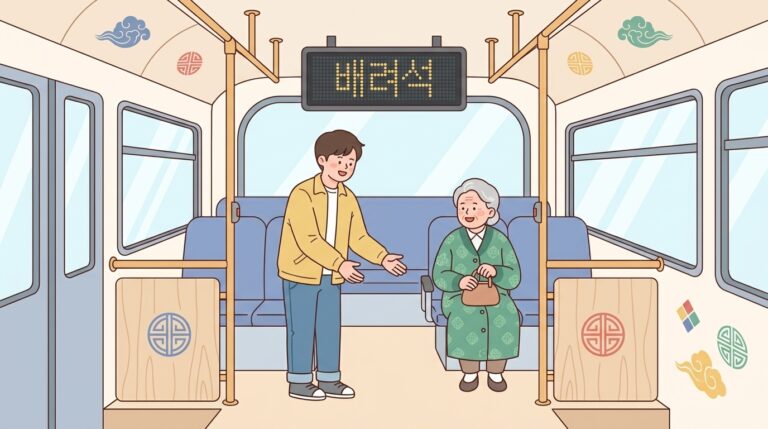
How to Offer Your Bus Seat in Korea Like a Native (Without the Awkwardness!)
안녕하세요! 매일한글 에디터입니다.
Picture this: You are riding the bustling No. 143 bus through Gangnam during evening rush hour. Your feet are aching after a long day of exploring Seoul, and you were lucky enough to grab a vacant seat. Suddenly, an elderly grandmother (할머니) steps onto the bus holding heavy grocery bags. You instantly want to be polite and offer your seat—a core value in Korean society! But suddenly, your brain freezes. “What honorific should I use? Is ‘여기 앉으세요’ too casual? What if I sound rude or awkward?”
If you have ever experienced this wave of transit anxiety, you are definitely not alone! Hundreds of intermediate Korean learners tell us that real-life public etiquette is where textbook grammar meets real-world fear. But here is the good news: mastering just a few warm, natural phrases will turn these tense moments into memorable, heart-warming interactions. Based on real feedback from our Daily Hangul community, this guide will arm you with the exact words, gestures, and cultural nuance needed to handle public transit like a thoughtful Seoul local!
Phase 2: Key Expressions Deep Dive
1. 여기 앉으세요 (Yeogi anjeuseyo)
- Pronunciation: [Yeo-gi an-jeu-se-yo] (Sounds like “Yo-gi” + “un-jew-say-yo”)
- Meaning: Literal: Please sit here. / Real Nuance: “Here, please take this seat!”
- K-Culture Moment: You see this constantly in slice-of-life K-Dramas like Reply 1988—a young student immediately standing up the moment an elder walks onto the bus.
- Editor’s Insight: This is the universal gold standard phrase. It is polite, semi-formal (-세요 ending), and completely foolproof.
- Situation Spectrum: Casual 🚫 / Semi-formal ✅ / Formal ✅
- 🤔 Think About It: In your country, do people verbally offer seats or just stand up silently? How does adding words change the gesture?
2. 제가 내릴 거라서요 (Jega naeril georaseoyo)
- Pronunciation: [Je-ga nae-ril geo-ra-seo-yo] (Sounds like “Jey-gah neh-ril go-rah-suh-yo”)
- Meaning: Literal: Because I am getting off. / Real Nuance: “I’m getting off soon anyway, so please don’t feel burdened to sit!”
- K-Culture Moment: A protagonist offers their seat, and to prevent the elder from feeling guilty, lies gently that their stop is next.
- Editor’s Insight: This is the ultimate peak Korean etiquette! Korean elders often refuse seats because they don’t want to inconvenience youth. Saying you’re getting off removes their psychological burden (부담).
- Situation Spectrum: Casual 🚫 / Semi-formal ✅ / Formal ✅
- 🤔 Think About It: Why does Korean culture value relieving the other person’s emotional guilt during a good deed?
3. 편하게 앉으세요 (Pyeonhage anjeuseyo)
- Pronunciation: [Pyeon-ha-ge an-jeu-se-yo] (Sounds like “Pyeohn-hah-geh un-jew-say-yo”)
- Meaning: Literal: Sit comfortably. / Real Nuance: “Please, make yourself comfortable and sit down.”
- K-Culture Moment: Often said by friendly neighborhood characters on local neighborhood buses (마을버스).
- Editor’s Insight: Best used when you are gesturing toward an empty seat next to you or stepping away to give them plenty of space.
- Situation Spectrum: Casual 🚫 / Semi-formal ✅ / Formal ✅
- 🤔 Think About It: How do comfort and honorifics interlock in Korean daily speech?
Phase 3: Textbook Korean vs. Real Native Korean
Situation 1: Offering your seat
- 📖 Textbook Korean: “이 자리에 앉으십시오.” (Lee ja-ri-e an-jeu-ship-si-o)
- 🗣️ Real Native Korean: “여기 앉으세요!” (Yeo-gi an-jeu-se-yo!)
- 💡 Why the difference?: The formal
-십시오imperative ending sounds like a military command or a public automated broadcast announcements! Native speakers use-세요for warm everyday interactions.
Situation 2: Explaining why you are standing up
- 📖 Textbook Korean: “저는 서서 가겠습니다.” (Jeo-neun seo-seo ga-get-seum-ni-da)
- 🗣️ Real Native Korean: “저 어차피 곧 내려요!” (Jeo eo-cha-pi got nae-ryeo-yo!)
- 💡 Why the difference?: Saying “I will go standing” makes the elder feel bad for taking your seat. Saying “I’m getting off soon anyway” makes them feel relieved and happy to accept.
Phase 4: K-Culture Deep Dive & Non-Verbal Manners
4-1. Nunchi (눈치) & Gestures
In Korea, non-verbal cues are just as important as words! When offering a seat:
1. Eye Contact & Hand Gesture: Catch their eye softly, make a small bow with your head, and extend your open hand toward the seat (palm facing up). Never point with a single finger!
2. The Step-Away Move: After saying “여기 앉으세요”, immediately step away toward the aisle or exit door. If you stay standing right in front of them, they might feel pressured!
4-2. Understanding Priority Seats (노약자석)
On Korean buses and subways, you will notice designated seats marked as 노약자석 (Seats for Elderly, Handicapped, & Pregnant) or pink 임산부 배려석 (Pregnant Women Priority Seats). Even if the bus is completely packed and those seats are empty, locals usually leave them vacant! If you are sitting in a regular seat, offering it to an elder displays deep 경로사상 (respect for elders), a cornerstone of Korean social harmony.
Phase 5: Real-Life Bus Roleplay Scenario
Setting: On the No. 7016 bus bound for Sinchon. The bus jerks suddenly, and an elderly woman carrying market bags steps on.
- You: (Nodding politely) “어머, 할머니! 여기 앉으세요.” (Eomeo, halmeoni! Yeogi anjeuseyo.)
- 🎭 Gesture: Standing up quickly and gesturing softly to your seat with an open palm.
- Elderly Woman: “아이구, 괜찮은데… 학생 앉아 가.” (Aigu, gwaenchanheunde… haksaeng anja ga.)
- 🎭 Gesture: Waving hands gently in modest refusal.
- You: “아니에요, 저 어차피 곧 내려요!” (Anieyo, jeo eochapi got nae-ryeo-yo!)
- 🎭 Gesture: Smiling warmly and taking a step toward the exit door.
- Elderly Woman: “그래요? 그럼 고마워요~” (Geraeyo? Geureom gomawoyo~)
- 🎭 Gesture: Sitting down with a relieved sigh.
- You: “네, 편하게 가세요!” (Ne, pyeonhage gaseyo!)
- 🎭 Gesture: Giving a quick 15-degree head bow.
- Elderly Woman: “복 받아요, 학생!” (Bok badayo, haksaeng!)
- 🎭 Gesture: Smiling brightly at you.
- You: “감사합니다!” (Gamsahambnida!)
- Elderly Woman: (Nods warmly while resting her bags)
🔀 Interactive Decision Point
What should you do if the elder initially says “괜찮아요” (It’s okay)?
* Option A: Sit right back down immediately.
* Feedback (Bad): They were likely just being modest (체면/겸손)! Sitting down instantly makes the interaction awkward.
* Option B: Insist loudly 3 times until they sit.
* Feedback (Risk): Overly pushy. Might draw uncomfortable attention from the whole bus.
* Option C (BEST): Smile, say “저 어차피 곧 내려요!” (I’m getting off soon anyway), and step away gently.
* Feedback (Best!): Perfect Nunchi! Gives them a graceful way to accept without feeling indebted.
Phase 6: 10-Second Emotion Shadowing Drill
Practice saying these lines with native emotion and natural pauses (/ = pause):
[😊 Warm & Welcoming]- “여기 / 앉으세요!” (Yeo-gi / an-jeu-se-yo!)
[🤗 Reassuring & Considerate]- “저 / 어차피 / 곧 내려요!” (Jeo / eo-cha-pi / got nae-ryeo-yo!)
[🙏 Polite & Respectful]- “네 / 편하게 / 가세요!” (Ne / pyeon-ha-ge / ga-se-yo!)
Phase 7: K-Culture Mini Dictionary
- 노약자석 (Noyakjaseok) | Priority Seating for Elderly & Disabled | Located at the front/middle of Korean buses and ends of subway cars.
- 양보하다 (Yangbohada) | To yield / To offer a seat | Combined as ‘자리 양보’ (yielding a seat).
- 배려 (Baeryeo) | Consideration / Thoughtfulness | A praised character trait in Korean social life.
- 눈치 (Nunchi) | Social intuition / Reading the room | The quick ability to sense when someone needs assistance.
Phase 8: Traveler’s Transit Survival Kit
Survival Top 3 Expressions
- “내리실 분 계신가요?” (Naerisil bun gyesingayo?) — Is anyone getting off? (When trapped near bus doors)
- “잠시만요!” (Jamsimanyo!) — Excuse me for a second! (When moving through crowded aisles)
- “감사합니다!” (Gamsahambnida!) — Thank you! (Said to the bus driver when stepping off from the back door)
Editor’s Travel Note
Navigating public transport in Korea is super smooth if you have the right tools! Make sure to install the [Naver Map App Download for Navigation] or check out our guide on [KakaoBus Real-time Transit Tracker Setup] before riding. Remember: Tap your T-Money card when getting ON and OFF to get transfer discounts!
Phase 9: One Step Deeper
Offering a seat in Korea is more than just good manners—it is a micro-reflection of Jeong (정), the collective warmth that holds Korean society together. When you use honorifics like “앉으세요” in public, you aren’t just following grammar rules; you are participating in a shared cultural ritual of mutual care. The next time you step onto a Seoul bus, view honorifics not as strict barriers, but as keys to connecting with real people.
💬 Your Turn: Have you ever offered your seat to someone in Korea or your home country? How did it feel? Share your story in the comments below!
Phase 10: FAQ & Common Mistakes
Q: Can I use “여기 앉아” if I am talking to a child on the bus?
A: Yes! “앉아” is casual language (반말), which is natural when speaking affectionately to young children. However, always stick to “앉으세요” for adults or strangers!
Q: What if an elderly person gets angry when I offer my seat?
A: Occasionally, an active senior might feel offended if they feel you perceive them as “old.” If they decline firmly, simply smile, say “아, 네!” (Ah, okay!), and sit back down without overthinking it.
Q: Is it okay to sit in the pink Pregnant Women Priority seats if no pregnant woman is around?
A: While legally allowed on buses, native cultural etiquette strongly prefers leaving them empty at all times, as pregnant women in early stages may not show visibly.
🚨 Common Mistakes TOP 3
- Mistake: Using formal
-하십시오style on a bus.- Correct Action: Use
-세요style (“여기 앉으세요”).
- Correct Action: Use
- Mistake: Standing right over the person after offering your seat.
- Correct Action: Offer the seat and step away slightly toward the door.
- Mistake: Pointing directly with one finger at the open seat.
- Correct Action: Use an open palm facing upward.
Phase 11: Action Mission & Engagement
Action Mission 3-Steps
- 🥉 Bronze Level: Practice saying “여기 앉으세요, 저 곧 내려요!” out loud 5 times in front of a mirror.
- 🥈 Silver Level: Record your voice shadowing Phase 6 and post it on Instagram tagging
@DailyHangul! - 🥇 Gold Level: Successfully offer your seat using Korean expressions during your next trip to Korea!
🎮 K-Culture Mission: Watch one episode of any modern slice-of-life K-Drama (like Hospital Playlist) and count how many times characters say “앉으세요” or “앉으시죠”!
Phase 12: Interactive Quiz Challenge
Q1. What is the most natural native Korean phrase to lower an elder’s guilt when offering a seat?
* A) “저는 서 있는 것을 좋아합니다.”
* B) “제가 곧 내릴 거라서요!”
* C) “이 자리에 앉아라.”
Click to reveal Answer & Explanation
Correct Answer: B) “제가 곧 내릴 거라서요!”
Explanation: Saying you are getting off soon removes their feeling of emotional burden (부담), making them feel comfortable accepting your kindness!
Q2. True or False: You should point with your index finger when inviting an elderly person to sit down.
Click to reveal Answer & Explanation
Correct Answer: False!
Explanation: Pointing with an index finger is considered impolite in Korea. Always use an open palm with your hand extended softly.







