

Phase 1: 공감 (Empathy)
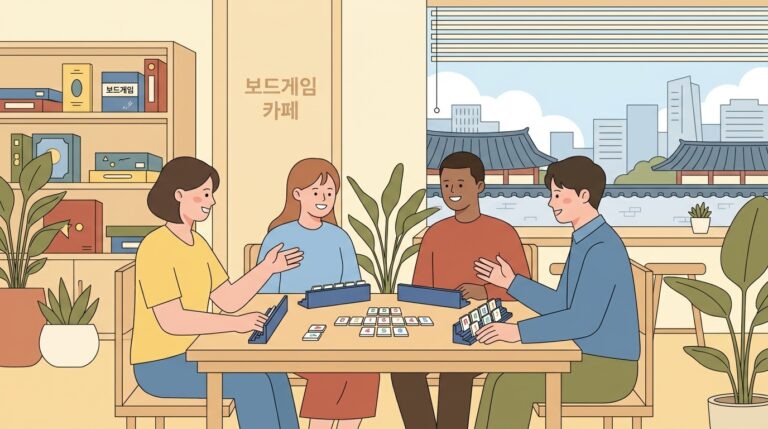
안녕하세요! 매일한글 에디터입니다. Have you ever stepped into a vibrant board game cafe (보드게임 카페) in Hongdae, Sinchon, or Gangnam, surrounded by the lively sound of clacking plastic tiles and cheerful laughter? Among all the popular games, Rummikub holds a special place in Korean board game culture. However, sitting down for a match with Korean native speakers involves much more than simply placing consecutive numbers or matching tile colors. You need high-level strategic Korean to negotiate, comment on dynamic plays, and read the flow of the room.
At the C1 level, board game language isn’t just about fun—it’s a gateway into deep cultural metaphors used in everyday business, social strategy, and media commentary. Drawing from real gaming sessions and feedback from advanced international learners, this guide equips you with sharp, authentic Korean strategy vocabulary so you can lead the conversation and enjoy Rummikub like a native.
Phase 2: 핵심 표현 3선 심층 분석 (Core Expressions)
1. 판을 읽다 (Pan-eul ik-da)
- Pronunciation: Pan-eul ik-da (Pahn-eul eek-dah, like reading the board or the entire situation)
- Meaning: Literally “to read the board,” dynamically “to assess the overarching situation / read the room.”
- K-Culture Moment: Frequently heard on strategic TV shows like ‘The Genius’ (더 지니어스) when players analyze their opponents’ motives: “판을 읽어야 승산이 있어.”
- Editor’s Insight: Advanced speakers use this expression far beyond tabletop games. It applies to business trends, group dynamics, and office politics when deciding your next move.
- Situation Spectrum: Casual ✅ | Semi-formal ✅ | Formal ⚠️
- 🤔 Think About It: How does viewing social contexts as a “판” (board) reflect Korea’s fast-paced, situational decision-making culture?
2. 신의 한 수 (Sin-ui han su)
- Pronunciation: Sin-ui han su (Seen-ui hahn soo, literally a divine move)
- Meaning: Literally “God’s move,” dynamically “a stroke of genius / game-changing masterstroke.”
- K-Culture Moment: Used in sports commentary, esports broadcasts, and K-Dramas whenever a character makes a brilliant play that turns the tables.
- Editor’s Insight: Originating from Baduk (Go), this phrase represents a turn that instantly resolves a complex board arrangement—like breaking a massive tile set in Rummikub to clear your hand.
- Situation Spectrum: Casual ✅ | Semi-formal ✅ | Formal ✅
- 🤔 Think About It: What move in your life or career compares to a move so perfect it felt like a “신의 한 수”?
3. 판을 뒤집다 (Pan-eul dwijip-da)
- Pronunciation: Pan-eul dwijip-da (Pahn-eul dwee-jeep-dah)
- Meaning: Literally “to turn the board over,” dynamically “to completely turn the tables / reverse the situation.”
- K-Culture Moment: Highlight scenes in survival reality shows when an underdog uses a tile manipulation to win in a single turn.
- Editor’s Insight: Note the difference! While “판을 뒤집다” means a brilliant strategic comeback, “판을 엎다” literally means flipping the table in anger.
- Situation Spectrum: Casual ✅ | Semi-formal ✅ | Formal ⚠️
- 🤔 Think About It: How do metaphors of board disruption express dramatic emotional shifts in competitive settings?
Phase 3: 교과서 한국어 vs 진짜 한국어 (Textbook vs Real Korean)
Situation 1: Declaring a Game-Changing Move
- 📖 교과서 한국어: “제가 제 차례에서 규칙을 바꾸어 보겠습니다.” (I will try changing the board arrangement on my turn.)
- 🗣️ 진짜 한국어: “판 한 번 크게 흔들어 볼게요!” (Let me shake up the board big time!)
- 💡 왜 다를까? Korean board game culture favors high-energy, impactful action verbs rather than passive structural descriptions.
Situation 2: Complimenting an Opponent’s Smart Strategy
- 📖 교과서 한국어: “좋은 수입니다. 당신이 이길 것 같군요.” (That is a good move. It seems you will win.)
- 🗣️ 진짜 한국어: “와, 방금 건 진짜 신의 한 수인데?” (Wow, that move just now was a total stroke of genius!)
- 💡 왜 다를까? Friends boost game energy by praising tactical genius using game-slang metaphors.
Phase 4: K-Culture 딥다이브 & 비언어적 매너 (Deep Dive & Non-verbal Manners)
4-1. Nunchi & Gestures
In Korean Rummikub, keeping eye contact (눈치) while evaluating tile sets is essential. Holding your chin with a confident smile (턱을 괴다) signals strategic control. Avoid hovering your hand over tiles indecisively; native players respect quick, decisive board arrangements.
4-2. Culture Code: Korean Board Game Cafes
Modern Korean board game cafes (보드게임 카페) offer private rooms, curated snack menus, and thousands of title selections. They are social playgrounds for university students and colleagues. Demonstrating natural gaming slang makes you an instant favorite in any room.
Phase 5: 실전 롤플레이 시나리오 (Roleplay Scenario)
Setting: Playing an intense round of Rummikub at a board game cafe in Hongdae with your friend Minho.
- Minho: 🎭 (조용히 타일을 내리며) “나 드디어 30점 맞추고 등록했다! 너는 아직 못 나왔지?”
(I finally registered with 30 points! You haven’t made it out yet, right?) - You: 🎭 (패를 숨기며 미소를 짓는다) “기다려 봐. 숨겨둔 카드가 있으니까.”
(Just wait. I have a secret card hidden away.) - Minho: 🎭 (모래시계를가리키며) “타일 가져가라! 시간 초과된다!”
(Draw a tile! Time is running out!) - You: 🎭 (조합을 재빠르게 바꾸며) “자, 판 한 번 크게 흔들어 볼게요!”
(Alright, let me shake up the board big time!) - Minho: 🎭 (눈을 크게 뜨며) “어? 기존 세트를 그렇게 분해한다고?”
(Huh? You’re breaking down the existing set like that?) - You: 🎭 (마지막 타일을 내려놓으며) “이게 바로 신의 한 수지! 조커 활용의 정석이야.”
(This is a divine stroke of genius! A textbook joker play.) - Minho: 🎭 (머리를 긁적이며) “와… 완전히 판을 뒤집었네. 인정한다.”
(Wow… you completely turned the tables. I admit defeat.) - You: 🎭 (손뼉을 치며) “루미큐브는 끝날 때까지 끝난 게 아니야!”
(Rummikub isn’t over until it’s over!)
🔀 Interactive Choice:
Minho is taking over two minutes on his turn. What do you say?
* Option A: “천천히 해, 생각할 시간 필요하지?”
* Option B: “야, 1분 지났다! 장고 끝에 악수 둔다 했다?”
* Option C: “그냥 아무 타일이나 하나 가져가.”
Feedback:
- Option A (Bad): Too polite for a competitive board game setting; misses playful social dynamic.
- Option B (Best): Uses a famous Korean gaming proverb (장고 끝에 악수 둔다) while keeping the mood fun and lively!
- Option C (Risk): Sounds overly blunt and slightly impatient.
Phase 6: 10초 감정 섀도잉 드릴 (Emotion Shadowing Drill)
- [😊 기쁘고 신나게] 자, / 판 한 번 / 크게 / 흔들어 볼게요!
(Ja, / pan han beon / keu-ge / heun-deul-eo bol-ge-yo!) - [😲 놀라움과 찬사] 와, / 방금 건 / 진짜 / 신의 한 수인데?
(Wa, / bang-geum geon / jin-jja / sin-ui han su-in-de?) - [😎 승리감에 차서] 루미큐브는 / 끝날 때까지 / 끝난 게 아니야!
(Ru-mi-kyu-beu-neun / kkeut-nal ttae-kka-ji / kkeut-nan ge a-ni-ya!)
Phase 7: K-Culture 미니 사전 (Mini Dictionary)
- 등록 (Deung-rok) | Initial Meld | The initial 30-point tile set required to enter a Rummikub match.
- 장고 (Jang-go) | Prolonged Thinking | Originating from Baduk, taking a long time to deliberate over a move.
- 조커 (Jo-keo) | Wildcard / Joker | Metaphorically used for a secret weapon or key individual.
- 판돈 (Pan-don) | Game Stakes | Used figuratively to describe high-stakes investments or crucial career choices.
Phase 8: 여행자를 위한 생존 키트 (Survival Kit)
Top 3 Expressions:
- 루미큐브 할 줄 아세요? (Ru-mi-kyu-beu hal jul a-se-yo?) – Do you know how to play Rummikub?
- 모래시계 다 돌아갔어요! (Mo-rae-si-gye da dol-a-gat-seo-yo!) – The hourglass timer has run out!
- 한 판 더 해요! (Han pan deo hae-yo!) – Let’s play one more round!
Editor’s Travel Note:
When exploring Seoul, easily locate board game spots using the Naver Map Application. Simply search for “보드게임 카페” to find premium venues with private tables and beverage packages.
Phase 9: 한 발 더 깊이 (One Step Deeper)
Korean board game culture blends competitive strategy with warm social connection (정). While winning is exciting, creating shared laughter using proverbs like “장고 끝에 악수 둔다” forms closer bonds. Board game cafes offer a rare relaxed environment in Korea where age hierarchies temporarily take a backseat to strategic gaming fun.
💬 Your Turn: Have you ever used gaming metaphors to describe real-life decisions? Share your thoughts in the comments below!
Phase 10: FAQ & 오해 방지 (FAQ & Common Mistakes)
Q: What is the difference between 판을 뒤집다 and 판을 엎다?
A: ‘판을 뒤집다’ means strategically turning the tables to win. ‘판을 엎다’ means physically or emotionally flipping the table in frustration.
Q: How do I playfully tell a friend they are overthinking their move?
A: Say “장고 끝에 악수 둔다!” which translates to “Overthinking leads to a bad move.” It is a classic proverb used lightheartedly among friends.
Q: Can I use ‘신의 한 수’ in business context?
A: Yes! It is widely used in business news and office discussions to describe a master stroke or brilliant executive decision.
🚨 Common Mistakes:
- Mistake: Saying “내가 카드를 체인지한다” for tile manipulation.
- Correct Action: Use “조합하다” (to combine) or “판을 흔들다” (to shake up the board).
- Mistake: Saying “30점 안 된다” abruptly when starting.
- Correct Action: Say “아직 등록 못 했어요” (I haven’t registered yet).
- Mistake: Confusing “판” (board/situation) with “판돈” (gambling stakes).
- Correct Action: Use “판” when discussing game strategy or context.
Phase 11: 액션 미션 & 참여 유도 (Action Missions)
- Bronze Mission: Read aloud the 3 core expressions using proper emotion tags.
- Silver Mission: Post a game victory photo on SNS with the caption “오늘의 신의 한 수!”.
- Gold Mission: Visit a Korean board game cafe and declare “등록했어요!” during a live game.
- 🎮 K-Culture Mission: Watch a strategic show like ‘The Devil’s Plan’ or ‘The Genius’ and spot game strategy vocabulary!
Phase 12: 인터랙티브 퀴즈 챌린지 (Quiz Challenge)
-
What does “신의 한 수” mean?
See Answer & Explanation
A stroke of genius or divine masterstroke. It originates from Baduk (Go) commentary.
-
Fill in the blank: “시간 오래 끌지 마! 장고 끝에 _____ 둔다 했어!”
See Answer & Explanation
악수 (bad move). The proverb warns that overthinking often results in mistakes.
-
True or False: “판을 엎다” is a polite compliment for a comeback victory.
See Answer & Explanation
False! “판을 엎다” means flipping the board in rage. Use “판을 뒤집다” to compliment a strategic turnaround.






