

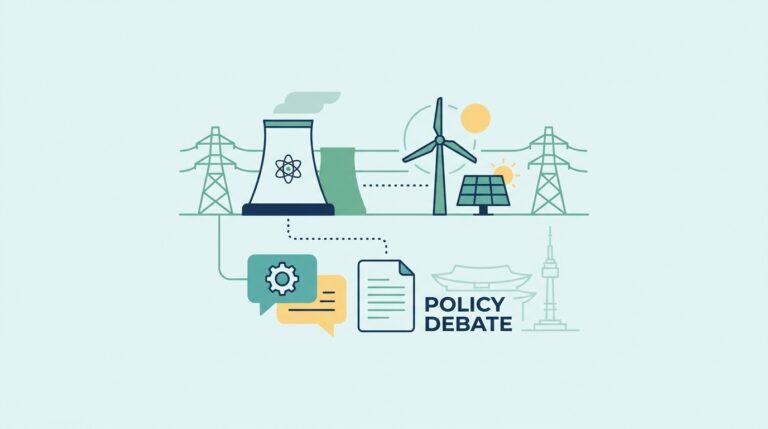
Phase 1: Empathy
안녕하세요! This is your Daily Hangul editor and cultural navigator back with another deep dive into high-level Korean discourse. Have you ever tuned into a late-night debate show like SBS Nightline or JTBC Ssulzun, or perhaps scanned the opinion columns of The Korea Herald and Chosun Ilbo, only to feel completely overwhelmed by the intense political jargon surrounding Korea’s power grid? You are not alone! Even advanced learners working at the C2 level often find themselves stumped when debates shift from light everyday conversations to complex macroeconomic policy and geopolitical strategy.
Imagine sitting in a high-level executive meeting in Yeouido or listening to a panel of experts discuss Korea’s green energy transition. Someone brings up “탈원전 정책 폐기” (Scrapping the nuclear phase-out policy) and the urgent need for “원전 생태계 복원” (Restoring the nuclear energy ecosystem). The conversation moves fast, packed with nuanced historical context, economic fears, and international trade strategy regarding nuclear export deals in Europe. Missing a single idiomatic nuance can make you feel disconnected from the real conversation.
Mastering these sophisticated discussions is not just about memorizing policy buzzwords; it is about grasping the underlying cultural mindset of Korea’s rapid industrial drive, security priorities, and public debate etiquette. Our C2 learners who mastered this module reported a massive surge in confidence when participating in professional forums, academic seminars, and civic policy discussions in Seoul. Let’s conquer this top-tier debate topic together today!
Phase 2: Deep Dive into 3 Core Expressions
1. 탈원전 정책을 폐기하다 (Tal-won-jeon jeong-chaeg-eul pye-gi-ha-da)
- Pronunciation: [tal-won-jeon jeong-chaek-eul pye-gi-ha-da] (Sounds like tahl-won-jeon + jung-chaek-ul + pye-gee-hah-dah)
- Meaning: Literally “To discard the nuclear phase-out policy.” In professional nuance, it signifies a total reversal of previous state energy policy back toward nuclear reliance.
- K-Culture Moment: Frequently used by news anchors on KBS News 9 when breaking stories on policy shifts between political administrations.
- Editor’s Insight: The word ‘폐기’ (pye-gi) is much stronger than just ‘취소’ (cancellation). It carries a formal legal and institutional weight, implying that a policy is permanently decommissioned or scrapped.
- Situation Spectrum: Casual 🚫 | Semi-formal ⚠️ | Formal ✅
- 🤔 Think About It: How does your country balance long-term environmental safety with immediate energy security during power crises?
2. 원전 생태계를 복원하다 (Won-jeon saeng-tae-gye-reul bok-won-ha-da)
- Pronunciation: [won-jeon saeng-tae-gye-reul bong-won-ha-da] (Note the nasalization where bok-won sounds like bong-won)
- Meaning: Literally “To restore the nuclear energy ecosystem.” It refers to revitalizing the entire supply chain, research institutes, small manufacturers, and workforce.
- K-Culture Moment: Heard during corporate press conferences held by major industrial heavyweights like Doosan Enerbility or KEPCO.
- Editor’s Insight: Using ‘생태계’ (ecosystem) outside biology is extremely common in high-level Korean business discourse to emphasize interconnected supplier networks.
- Situation Spectrum: Casual 🚫 | Semi-formal ⚠️ | Formal ✅
- 🤔 Think About It: Is ‘ecosystem’ used in your native language to describe industrial supply chains, or do you use words like ‘infrastructure’?
3. 기저발전의 안정성을 확보하다 (Gi-jeo-bal-jeon-ui an-jeong-seong-eul hak-bo-ha-da)
- Pronunciation: [gi-jeo-bal-jeon-ui an-jeong-seong-eul hak-bbo-ha-da] (Tense ‘pp’ sound in hak-bo)
- Meaning: Literally “To secure the stability of baseload power generation.”
- K-Culture Moment: Spoken by policy analysts arguing against power grid blackout risks during extreme summer heatwaves in Seoul.
- Editor’s Insight: C2 speakers stand out when using ‘기저발전’ (baseload power) rather than simple terms like ‘기본 전력’ (basic electricity).
- Situation Spectrum: Casual 🚫 | Semi-formal ⚠️ | Formal ✅
- 🤔 Think About It: Why is reliable electricity generation tied so strongly to national competitiveness in fast-paced economies like Korea?
Phase 3: Textbook Korean vs. Real Native Korean
Situation 1: Expressing policy reversal in formal debate
- 📖 Textbook Korean: 정부가 이전 원자력 정책을 취소했습니다. (The government cancelled the previous nuclear energy policy.)
- 🗣️ Real Native Korean: 정부가 탈원전 기조를 전면 수정하고 원전 생태계 복원에 속도를 내고 있습니다. (The government is completely revising its nuclear phase-out stance and accelerating the restoration of the nuclear energy ecosystem.)
- 💡 Why is it different? Native policy experts prefer dynamic phrases like ‘기조를 수정하다’ (revise policy stance) and ‘속도를 내다’ (accelerate speed) over plain verbs like ‘취소하다’.
Situation 2: Emphasizing the importance of energy supply stability
- 📖 Textbook Korean: 전기가 부족하면 산업에 큰 문제가 생깁니다. (If electricity is lacking, big problems occur in industry.)
- 🗣️ Real Native Korean: 전력 수급의 불확실성을 해소하지 못하면 첨단 산업의 경쟁력이 크게 흔들릴 수밖에 없습니다. (If we fail to resolve power supply uncertainty, high-tech industrial competitiveness will inevitably suffer.)
- 💡 Why is it different? C2 discourse relies on formal Sino-Korean nouns like ‘수급’ (supply and demand), ‘불확실성’ (uncertainty), and double negatives like ‘~할 수밖에 없다’ (inevitably must).
Phase 4: K-Culture Deep Dive & Non-Verbal Manners
4-1. Nunchi & Gestures in Formal Policy Debates
When debating policy in Korea, posture and tone reflect your political maturity. Never point directly at an opponent with a single index finger when disagreeing on sensitive issues like nuclear energy. Instead, hold your hands loosely together or gesture with an open palm. Maintain calm eye contact, nod slightly while the other party speaks to show active listening (Gyeong-cheong), and use softening clauses like “말씀하신 취지에는 공감하지만…” (While I empathize with the intent of your statement…) before presenting counter-data.
4-2. Culture Code: The Energy-Industrial Nexus
Why is energy policy so intensely debated in Korea? Korea imports over 90% of its energy resources. The surge in semiconductor megafabs and AI data centers in Gyeonggi Province requires enormous, uninterrupted electricity. Thus, nuclear power is viewed not merely as an environmental question, but as a critical pillar of national security and economic survival.
Phase 5: Real-World Roleplay Scenario
Setting: A policy symposium breakout session at the COEX Convention Center in Gangnam. You are discussing energy policy with Dr. Min, a senior researcher at a energy economics think tank.
Dialogue (8 Turns)
- Dr. Min: 이번 정부의 탈원전 정책 폐기 결정에 대해 어떻게 생각하십니까? (What are your thoughts on the administration’s decision to scrap the nuclear phase-out policy?)
- [I-beon jeong-bu-ui tal-won-jeon jeong-chaek pye-gi gyeol-jeong-e dae-hae eo-tteo-ke saeng-gak-ha-sim-ni-ka?]
- 🎭 Action: Adjusts spectacles, looking at you with professional curiosity.
- You: 에너지 안보와 탄소중립 달성을 위해서는 원전 생태계 복원이 불가피한 선택이었다고 봅니다.
- [Ae-neo-ji an-bo-wa tan-so-jung-nip dal-seong-eul wi-hae-seo won-jeon saeng-tae-gye bok-won-i bul-ga-pi-han seon-taek-i-eot-da-go bom-ni-da.]
- (I believe restoring the nuclear ecosystem was an inevitable choice to achieve energy security and carbon neutrality.)
- 🎭 Action: Maintaining direct eye contact while nodding calmly.
- Dr. Min: 하지만 원전 안전성과 방사성 폐기물 처리 문제는 여전히 해결해야 할 과제 아닌가요?
- [Ha-ji-man won-jeon an-jeon-seong-wa bang-sa-seong pye-gi-mul cheo-ri mun-je-neun yeo-jeon-hi hae-gyeol-hae-ya hal gwa-je a-nin-ga-yo?]
- (However, aren’t nuclear safety and radioactive waste disposal still issues that must be solved?)
- 🎭 Action: Tilts head slightly, presenting a reasonable counter-argument.
- You: 맞습니다. 그렇기 때문에 차세대 원전 기술 개발과 주민 수용성 확보가 병행되어야 합니다.
- [Mat-seum-ni-da. Geu-reoh-gi ttae-mu-ne cha-se-dae won-jeon gi-sul gae-bal-gwa ju-min su-yong-seong hak-bo-ga byeong-haeng-deo-yeo-ya ham-ni-da.]
- (Correct. That is precisely why next-generation nuclear tech development must go hand-in-hand with securing local community acceptance.)
- 🎭 Action: Gesture with open palm to emphasize balanced progress.
- Dr. Min: SMR(소형모듈원자로) 같은 신기술이 대안이 될 수 있다고 보시는군요?
- [SMR ga-teun sin-gi-sul-i dae-an-i doel su it-da-go bo-si-neun-gun-yo?]
- (So you see new technologies like SMRs as a viable alternative?)
- 🎭 Action: Writes down a note on his tablet with an approving nod.
- You: 네, 기존 원전의 한계를 극복하고 수출 경쟁력을 강화하는 핵심 동력이 될 것입니다.
- [Ne, gi-jon won-jeon-ui han-gae-reul geuk-bok-ha-go su-chul gyeong-jaeng-ryeog-eul gang-hwa-ha-neun heok-sim dong-ryeok-i doel geos-im-ni-da.]
- (Yes, it will serve as a key driver to overcome existing limitations and boost export competitiveness.)
- 🎭 Action: Speaking with steady, persuasive confidence.
- Dr. Min: 깊이 있는 분석이시네요. 글로벌 공급망 재편 속에서 한국의 역할이 기대됩니다.
- [Gip-i in-neun bun-seog-i-si-ne-yo. Geul-ro-beol gong-geub-mang jae-pyeon sok-e-seo han-guk-ui yeok-hal-i gi-dae-doem-ni-da.]
- (That is a deep analysis. I look forward to Korea’s role amid global supply chain restructuring.)
- 🎭 Action: Smiles warmly and offers a firm handshake.
- You: 네, 건설적인 논의를 이어갈 수 있어서 뜻깊은 자리였습니다.
- [Ne, geon-seol-jeog-in no-ni-reul i-eo-gal su it-seo-seo tteut-gip-eun ja-ri-yeos-seum-ni-da.]
- (Yes, it has been a meaningful opportunity to engage in constructive discussion.)
- 🎭 Action: Slightly bowing head in high-level courtesy.
🔀 Interactive Choice Point
When Dr. Min asks about public safety concerns in Turn 3, how do you respond?
* Option A: “Safety isn’t important right now because electricity bills are rising too fast!” (방사능 문제보다 지금 전기 요금 올랐으니까 일단 원전 돌아가게 해야죠!)
* Option B: “Correct. That is precisely why next-generation nuclear tech development must go hand-in-hand with securing local community acceptance.” (맞습니다. 그렇기 때문에 차세대 원전 기술 개발과 주민 수용성 확보가 병행되어야 합니다.)
* Option C: “I don’t really care about nuclear energy, solar energy is much better anyway.” (저는 원전 잘 모르겠고 그냥 태양광이 더 나은 것 같아요.)
Feedback:
* Option A (Risk): Too aggressive and dismisses public risk factor. Dismissing safety in official meetings undermines your professionalism.
* Option B (Best): Demonstrates sophisticated C2 analytical thinking, balancing technological advancement with public policy acceptance.
* Option C (Bad): Completely derails the discussion topic and shows a lack of preparation for executive-level discourse.
Phase 6: 10-Second Emotion Shadowing Drill
Practice these high-level rhetorical rhythm patterns with natural pausing (/) and emotional weight:
- [🧐 Firm & Analytical]
탈원전 정책 폐기는 / 단순한 정치적 선언이 아니라 / 국가 산업 경쟁력을 좌우하는 / 중대한 정책 전환입니다.
(Tal-won-jeon jeong-chaek pye-gi-neun / dan-sun-han jeong-chi-jeok seon-eon-i a-ni-ra / guk-ga san-eop gyeong-jaeng-ryeog-eul jwa-u-ha-neun / jung-dae-han jeong-chaek jeon-hwan-im-ni-da.) -
[💡 Persuasive & Visionary]
원전 생태계의 복원과 함께 / 차세대 SMR 기술을 선점한다면 / 글로벌 에너지 시장을 / 주도할 수 있습니다.
(Won-jeon saeng-tae-gye-ui bok-won-gwa ham-kke / cha-se-dae SMR gi-sul-eul seon-jeom-han-da-myeon / geul-ro-beol ae-neo-ji si-jang-eul / ju-do-hal su it-seum-ni-da.) -
[🤝 Softening & Diplomatic]
안전성에 대한 우려를 / 충분히 공감하며 / 주민과의 소통을 통한 / 수용성 확보가 우선되어야 합니다.
(An-jeon-seong-e dae-han u-ryeo-reul / chung-bun-hi gong-gam-ha-myeo / ju-min-gwa-ui so-tong-eul tong-han / su-yong-seong hak-bo-ga u-seon-deo-yeo-ya ham-ni-da.)
Phase 7: K-Culture Mini Dictionary
- 기저발전 (Gijeo-baljeon)
- Translation: Baseload Power Generation
- Usage: Essential power source running 24/7 to cover minimum electric demand. Crucial term in energy sector reports.
- 주민 수용성 (Jumin Suyongseong)
- Translation: Local Resident Acceptance
- Usage: Social permission from residents living near power plants or radioactive waste sites. A key buzzword in Korean public policy.
- 전력 수급 (Jeonryeok Su-geup)
- Translation: Electricity Supply and Demand
- Usage: Used constantly during summer/winter peak grid demand seasons in public utility broadcasts.
- K-원전 (K-Wonjeon)
- Translation: Korean-model Nuclear Reactors / Korean Nuclear Export Brand
- Usage: Refers to exported technologies like APR1400 built in Barakah (UAE) or bid projects in the Czech Republic.
Phase 8: Traveler’s & Business Survival Kit
TOP 3 Professional Survival Phrases
- 정책의 연속성이 필요합니다.
- [Jeong-chaek-ui yeon-sok-seong-i pil-yo-ham-ni-da.]
- Pro Tip: Use this to suggest policy stability across administrative shifts.
- 공급망 정상화가 시급합니다.
- [Gong-geub-mang jeong-sang-hwa-ga si-geub-ham-ni-da.]
- Pro Tip: Ideal when emphasizing vendor chain recovery.
- 에너지 믹스 재편이 논의되고 있습니다.
- [Ae-neo-ji mik-seu jae-pyeon-i no-ni-doe-go it-seum-ni-da.]
- Pro Tip: High-level phrase describing the balanced mix of nuclear, renewable, and gas sources.
Editor’s Travel & Tech Note
Navigating business conferences in South Korea requires modern digital integration. Make sure to download the Naver Map Application for real-time navigation around Yeouido’s financial center and Sejong Government Complex. For corporate news updates, set up keyword alerts on the Naver News Portal using search terms like 원전 생태계 or 전력 수급 계획.
Phase 9: One Step Deeper (Thought Piece)
In Korean policy discourse, language often reflects a delicate balance between 명분 (Myeong-bun – moral legitimacy) and 실리 (Sil-li – practical benefit). The debates surrounding nuclear policy illustrate this dynamic clearly: environmental advocates emphasize myeong-bun regarding safety and future generations, while industrial strategists champion sil-li regarding export power and economic competitiveness. Understanding how native speakers weigh moral reasoning against pragmatic national benefit will elevate your C2 fluency from grammatically accurate to culturally perceptive.
💬 Your Turn: Do policy debates in your home country prioritize myeong-bun (moral/ideological stance) or sil-li (pragmatic outcome)? Share your thought in Korean in the comments below!
Phase 10: FAQ & Common Mistakes
Q: What is the exact difference between 탈원전 (Tal-won-jeon) and 감원전 (Gam-won-jeon)?
A: 탈원전 refers to complete nuclear phase-out or complete abolition over time, whereas 감원전 refers to a partial reduction or gradual scaling down of reliance on nuclear energy without complete elimination.
Q: Can I use the word ‘폐기’ when talking about personal items or bad habits?
A: Generally no. ‘폐기’ is reserved for legal documents, official policies, physical decommissioned machinery, or hazardous waste. For personal habits, use ‘버리다’ or ‘개선하다’.
Q: Is ‘원전’ an abbreviation?
A: Yes! 원전 (Won-jeon) is the standard everyday abbreviation for 원자력 발전소 (Won-ja-ryeok Bal-jeon-so – Nuclear Power Plant). In debates, ‘원전’ is widely used even in formal speeches.
🚨 Common Mistakes Alert!
- ❌ Mistake: “정부가 탈원전을 취소했어요.” (Sounds overly informal/colloquial for policy analysis).
- ✅ Correct Action: Use formal Sino-Korean verbs: “정부가 탈원전 정책 폐기를 공식화했습니다.” (The government formalized the scrapping of the nuclear phase-out policy.)
- ❌ Mistake: Confusing ‘발전’ (Electricity Generation) with ‘발전’ (Development/Progress).
- ✅ Correct Action: Rely on context: ‘전력 발전’ means power generation, whereas ‘경제 발전’ means economic development.
Phase 11: Action Mission
- 🥉 Bronze Mission: Read the Phase 6 Shadowing Drill aloud 3 times, focusing on smooth pauses at
/marks. - 🥈 Silver Mission: Write a 2-sentence comment using the term ‘원전 생태계’ or ‘에너지 안보’ and post it below.
- 🥇 Gold Mission: Search a recent Korean news article about energy policy, identify 3 Sino-Korean terms, and explain their nuance to a study partner.
🎮 K-Culture Mission: Watch a news debate segment on YouTube from KBS or YTN on Korean energy policy. Listen for how many times the speakers say ‘수급’ (supply/demand) and ‘복원’ (restoration)!
Phase 12: Interactive Quiz Challenge
Question 1 (Contextual Vocabulary)
Complete the sentence: “에너지 안보를 강화하고 공급망을 재건하기 위해 원전 ______ 복원이 추진되고 있다.”
* A) 생태계
* B) 분위기
* C) 인프라
Question 2 (True or False)
In formal Korean policy debates, using strong index finger pointing toward an opponent is considered a sign of assertive leadership.
* True / False
🔍 Click here to reveal Answers & Explanations
- Q1 Answer: A) 생태계 (Ecosystem). The full standard collocation is 원전 생태계 복원.
- Q2 Answer: False! Direct finger-pointing is considered impolite. Open palm gestures and softening phrases are preferred.







