

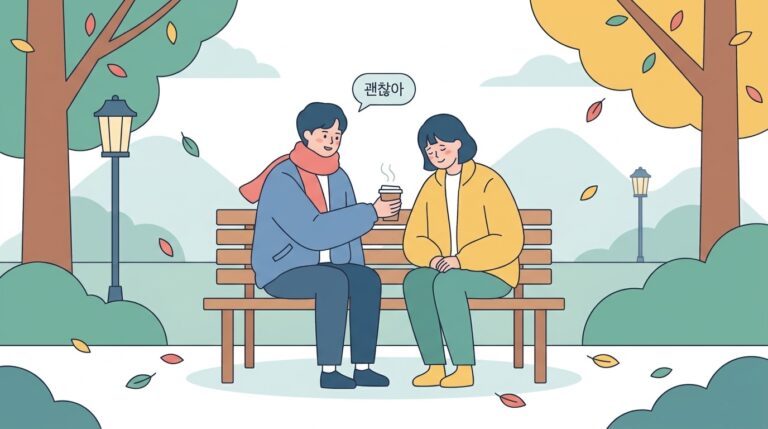
Phase 1: 공감 (Empathy)
안녕하세요! 매일한글 에디터입니다. 😊
Have you ever been in a situation where a close Korean friend had a terrible day—maybe they broke up with a partner, failed an important job interview, or lost a beloved pet—and you wanted to comfort them, but didn’t know what to say?
Standard dictionary phrases like “슬퍼하지 마세요” (Don’t be sad) can sound surprisingly cold or robotic in real life. In Korea, there is a warm proverb that encapsulates our approach to hardship: “슬픔을 나누면 반이 된다” (A sorrow shared is a sorrow halved).
When someone you care about is hurting, you don’t need to give grand advice or fix their problems. In Korean culture, true comfort is about showing up, validating their emotional pain, and letting them know they aren’t carrying the burden alone. Today, we’ll explore warm, natural, B1-level expressions that will help you become the comforting friend everyone loves to lean on.
Phase 2: 핵심 표현 3선 (Top 3 Key Expressions)
1. 힘내세요 / 힘내
- Pronunciation: [Him-nae-seyo] / [Him-nae] (Sounds like “Him” + “nay” + “say-yo”)
- Meaning: “Hang in there” / “Be strong.” (Literal: Gather your strength)
- K-Culture Moment: In K-Dramas, when a protagonist feels crushed by work, their closest coworker hands them a warm canned coffee, looks them in the eye, and quietly says, “힘내.”
- Editor’s Insight: While it’s very encouraging, be careful not to overuse it when someone is deeply grieving. Forcing someone to “be strong” when they just need to cry can feel slightly burdensome.
- Situation Spectrum: Casual: 힘내! (✅) / Semi-formal: 힘내세요 (✅) / Formal: 힘내하십시오 (⚠️)
- 🤔 Think About It: Why do you think Koreans encourage friends to “gather strength” rather than just saying “cheer up”?
2. 마음이 아프네요 / 마음이 아파
- Pronunciation: [Mae-um-i a-peu-ne-yo] (Sounds like “May-oom-ee ah-pue-nay-yo”)
- Meaning: “My heart aches for you” / “I feel so sad hearing this.”
- K-Culture Moment: Used when hearing unfortunate news about a friend’s personal loss or struggle.
- Editor’s Insight: This expression displays deep empathetic resonance. It tells the other person, “Your pain echoes in my own heart,” without invading their personal space.
- Situation Spectrum: Casual: 마음이 아파 (✅) / Semi-formal: 마음이 아프네요 (✅) / Formal: 마음이 아픕니다 (✅)
- 🤔 Think About It: How does sharing emotional vulnerability help ease another person’s sorrow in your culture?
3. 언제든 연락해
- Pronunciation: [Eon-je-deun yeol-lak-hae] (Sounds like “Eon-jay-deun yol-lahk-hae”)
- Meaning: “Call or message me anytime.”
- K-Culture Moment: Spoken at a bus stop late at night after listening to a friend vent over hot soup or tea.
- Editor’s Insight: This phrase signals that your door is always open. It is the ultimate pledge of availability and loyalty in Korean friendship.
- Situation Spectrum: Casual: 언제든 연락해 (✅) / Semi-formal: 언제든 연락하세요 (✅) / Formal: 언제든지 연락주십시오 (✅)
- 🤔 Think About It: Is offering availability “anytime” a literal commitment in your home country, or a polite farewell?
Phase 3: 교과서 한국어 vs 진짜 한국어 (Textbook vs. Real Korean)
Situation 1: Responding to a friend who failed an interview
- 📖 교과서 한국어: 슬퍼하지 마세요. (Don’t be sad.)
- 🗣️ 진짜 한국어: 속상하겠다. 맛있는 거 먹으러 가자. (You must be so upset. Let’s go eat something delicious.)
- 💡 왜 다를까? Koreans validate feelings first (“속상하겠다”) and offer warmth through shared food rather than telling someone how to regulate their emotions.
Situation 2: Supporting someone going through a tough time
- 📖 교과서 한국어: 당신을 도와줄게요. (I will help you.)
- 🗣️ 진짜 한국어: 내가 옆에 있어 줄게. (I’ll be right here by your side.)
- 💡 왜 다를까? Korean culture values relational presence (“being together”) over transactional or practical assistance.
Phase 4: K-Culture 딥다이브 & 비언어적 매너 (Deep Dive & Non-Verbal Manners)
4-1. Nunchi (눈치) & Gestures
When comforting someone in Korea, lower your vocal pitch and slow down your speaking pace. A soft nod, a gentle hand on the shoulder, or silently handing them a tissue speaks louder than words. Avoid overly bright smiles, energetic cheering, or intrusive questions.
4-2. Culture Code: Food as Comfort
In Korean culture, care is expressed through food. When a friend goes through sadness, native speakers rarely ask empty questions like “How can I help?”. Instead, they send a coffee coupon via KakaoTalk, bring hot soup (국밥), or pull them out for a quiet meal. Shared meals create a safe, warm space to unlock heavy emotions.
Phase 5: 실전 롤플레이 시나리오 (Real Roleplay Scenario)
Setting: You are sitting with your close Korean friend, Minjun, at a quiet café. Minjun looks pale and downcast.
- You: [🥺 따뜻하고 걱정스러운 목소리로] 민준아, 무슨 일 있어? 얼굴이 안 좋아 보여.
(Minjun-a, mu-seun il is-seo? Eol-gul-i an jo-ha beo-yeo.)
[Minjun, is something wrong? You don’t look well.] - Minjun: [😔 고개를 숙이며] 응… 우리 집 강아지가 어제 하늘나라로 갔어.
(Eung… u-ri jip gang-a-ji-ga eo-je ha-neul-na-ra-ro gat-seo.)
[Yeah… my dog passed away yesterday.] - You: [😢 진심으로 아파하며] 정말? 세상에… 마음이 너무 아프다. 괜찮아?
(Jeong-mal? Se-sang-e… mae-um-i neo-mu a-peu-da. Gwaen-chan-ah?)
[Really? Oh no… My heart aches so much. Are you okay?] - Minjun: [눈시울이 붉어지며] 아직 실감이 안 나. 집에 가면 항상 반겨줬는데…
(A-jik sil-gam-i an na. Jib-e ga-myeon hang-sang ban-gyeo-jwon-neun-de…)
[It still doesn’t feel real. He always greeted me when I came home…] - You: [🤲 어깨를 살짝 토닥이며] 얼마나 슬플지 감도 안 와. 마음껏 울어도 돼.
(Eol-ma-na seul-peul-ji gam-do an wa. Mae-um-kkeot u-reo-do dwae.)
[I can’t even imagine how sad you must be. It’s okay to cry as much as you need.] - Minjun: [고개를 끄덕이며] 고마워… 이야기하니까 좀 낫다.
(Go-ma-wo… i-ya-gi-ha-ni-kka jom nat-da.)
[Thanks… Talking about it makes me feel a bit better.] - You: [☕ 따뜻한 캔커피를 건네며] 힘내려고 애쓰지 마. 내가 옆에 있어 줄게.
(Him-nae-ryeo-go ae-sseu-ji ma. Nae-ga yeop-e is-seo jul-ge.)
[Don’t force yourself to be strong. I’ll stay right by your side.] - Minjun: [작은 미소를 지으며] 진짜 고마워, 친구야.
(Jin-jja go-ma-wo, chin-gu-ya.)
[Thank you so much, my friend.]
🔀 Interactive Choice: What will you say next?
- Option A: “잊으려고 노력해 봐! 다른 강아지 입양할래?” (Try to forget it! Want to adopt another dog?)
- Option B: “오늘 밤에 맛있는 거 먹자. 힘들면 언제든 연락해.” (Let’s eat something good tonight. Call me anytime if it’s tough.)
- Option C: “울지 마, 남자가 왜 울어?” (Don’t cry, why is a man crying?)
Feedback:
* Option A (Risk 🚫): Too fast! Trying to replace a lost loved one invalidates their grief.
* Option B (Best ✅): Perfect! Offers practical warmth through food and leaves the emotional door open without pressure.
* Option C (Bad 🚫): Imposes gender stereotypes and suppresses emotional expression.
Phase 6: 10초 감정 섀도잉 드릴 (10-Sec Emotion Shadowing Drill)
Pay attention to pauses (/) and adopt the indicated emotion:
- [🥺 진심으로 공감하며] 마음이 / 너무 / 아프네요.
(Mae-um-i / neo-mu / a-peu-ne-yo.) - [🫂 따뜻하고 다정하게] 내가 / 옆에 / 있어 줄게.
(Nae-ga / yeop-e / is-seo jul-ge.) - [☕ 담담하지만 든든하게] 힘들 때 / 언제든 / 연락해.
(Him-deul ttae / eon-je-deun / yeon-rak-hae.)
Phase 7: K-Culture 미니 사전 (Mini Dictionary)
- 위로 (Wi-ro) | Consolation / Comfort | The act of comforting someone in distress.
- 속상하다 (Sok-sang-ha-da) | To feel upset / heart-broken | Expresses deep inner distress caused by unfortunate events.
- 기프티콘 (Gi-peu-ti-kon) | KakaoTalk Mobile Gift Voucher | Frequently sent to friends to offer small tokens of support like coffee or cake.
- 정 (Jeong) | Deep affection / Bond | The foundational Korean cultural affection that binds people together during grief.
Phase 8: 여행자를 위한 생존 키트 (Traveler’s Survival Kit)
Survival Expressions:
- 괜찮으세요? (Gwaen-chan-eu-se-yo?) – Are you alright?
- 힘내세요! (Him-nae-seyo!) – Hang in there!
- 도움이 필요하면 말씀해 주세요. (Do-um-i pil-yo-ha-myeon mal-sseum-hae ju-se-yo.) – If you need help, please let me know.
Editor’s Travel Note:
If you want to meet up with a friend to comfort them over a meal, use the Naver Map App Download to search for cozy local spots. Sending a warm drink voucher via KakaoTalk is also a wonderful way to cheer up a friend remotely.
Phase 9: 한 발 더 깊이 (One Step Deeper)
In Korean culture, grief is rarely considered a private burden that should be hidden. Instead, sharing sorrow is viewed as a natural process that deepens human connection (Jeong). When you tell a friend “내가 옆에 있어 줄게” (I’ll be right by your side), you are giving them the ultimate reassurance: You don’t have to face this world alone.
💬 Your Turn: How do people share sorrow and offer comfort in your culture? Leave a comment below and let’s talk!
Phase 10: FAQ & 오해 방지 (FAQ & Common Mistakes)
Q: Can I say “힘내세요” to someone who lost a family member?
A: While well-intentioned, “힘내세요” can feel slightly light during deep mourning. Instead, use respectful formal condolences such as “삼가 고인의 명복을 빕니다” (May the deceased rest in peace) or “마음 잘 추스르시기 바랍니다” (Please take care of your heart).
Q: What is the difference between “슬퍼요” and “속상해요”?
A: “슬퍼요” means general sadness (e.g., watching a sad film), whereas “속상해요” implies personal distress or heart-ache caused by a specific situation that didn’t go as hoped.
Q: Is sending a digital coffee gift appropriate when someone is sad?
A: Yes! Sending a KakaoTalk gifticon with a short message like “생각나서 보냈어, 힘내!” (Thought of you, stay strong!) is a very popular Korean way to express care.
🚨 Common Mistakes TOP 3:
- Saying “울지 마세요” (Don’t cry!): Invalidates emotion. Correct Action: Say “마음껏 울어도 돼요” (It’s okay to cry as much as you need).
- Giving unsolicited solutions: “You should just do X.” Correct Action: Listen quietly and say







