

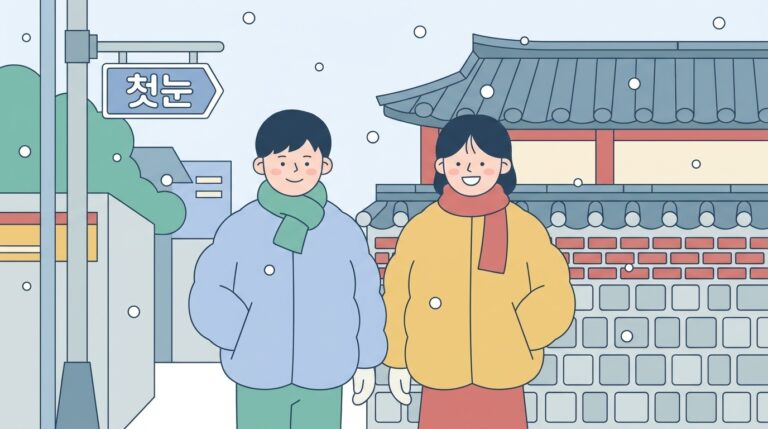
Why Making Promises on the First Snow in Korea Means Everything
Phase 1: Empathy (Opening Story)
안녕하세요! 매일한글 에디터입니다. (Hello! This is your Daily Hangul Chief Editor.)
Have you ever watched a K-Drama where the lead characters suddenly freeze, look up at the sky as the very first white flakes begin to dance through the chilly air, and whisper softly: “When the first snow falls, let’s meet right here”?
In Korea, the arrival of the first snow (첫눈 – Cheotnun) is far more than a simple meteorological event. It is an emotional milestone wrapped in romantic urban legends, youthful nostalgic desires, and solemn vows. According to Korean folklore and modern pop culture, any wish made during the first snow comes true, and if you watch the first snowfall with someone you like, true love will blossom! But as an intermediate (B2) learner, navigating the subtle linguistic nuances of making, confirming, or playfully teasing someone about a “first snow promise” can feel confusing. Are you being casually friendly, or are you accidentally confessing your deep hidden romantic love?
Don’t worry! This guide is crafted directly from real student feedback and real-world interactions in Seoul. By the end of this post, you’ll master intermediate conversational native phrases, decode subtle emotional context, and gain the cultural confidence to handle winter promises like a true local!
Phase 2: Core Expressions Deep Dive
1. 첫눈 오면 꼭 만나자 (Cheotnun omyeon kkok mannaja)
- Pronunciation: [Cheot-nun o-myeon kkok man-na-ja] (Sounds like “Chut-noon oh-myeon kkohk mahn-nah-jah”)
- Meaning: “Let’s definitely meet when the first snow falls.”
- K-Culture Moment: Seen repeatedly in Korean dramas like Goblin or Reply 1988, where characters make pacts to meet at iconic spots like Namsan Tower when snow drops.
- Editor’s Insight: The adverb ‘꼭’ (kkok) is the secret sauce here. It elevates a soft suggestion to an affectionate, earnest commitment without sounding overly business-like.
- Situation Spectrum: Casual ✅ | Semi-formal ⚠️ | Formal 🚫
- 🤔 Think About It: Does your native culture link seasonal weather changes to personal promises or confessions? Why do you think Koreans associate snow with emotional purity?
2. 첫눈의 설렘 (Cheotnun-ui seollem)
- Pronunciation: [Cheot-nun-ui seol-lem] (Sounds like “Chut-noon-ui seol-lem”)
- Meaning: “The fluttering excitement of the first snow.”
- K-Culture Moment: Often used in K-Pop winter comeback song lyrics and Instagram captions accompanying photos of snow-dusted cafes.
- Editor’s Insight: ‘설렘’ (seollem) describes that pleasant heart-pounding sensation you get before a date or a long-awaited trip. Pairing it with ‘첫눈’ highlights emotional anticipation.
- Situation Spectrum: Casual ✅ | Semi-formal ✅ | Formal ⚠️
- 🤔 Think About It: How is ‘seollem’ different from general happiness? How would you translate this specific emotional warmth into your language?
3. 약속을 지키다 (Yaksok-eul jikida)
- Pronunciation: [Yak-sok-eul ji-ki-da] (Sounds like “Yahk-sohk-eul jee-kee-dah”)
- Meaning: Literal: “To guard/keep a promise.” Real Nuance: “Fulfilling a vow made to someone you value.”
- K-Culture Moment: Used when someone shows up at the promised spot despite terrible icy traffic or sub-zero temperatures.
- Editor’s Insight: In intermediate Korean grammar, combining this with ‘-기로 하다’ (decide to) shows strong personal determination.
- Situation Spectrum: Casual ✅ | Semi-formal ✅ | Formal ✅
- 🤔 Think About It: In Korean culture, keeping informal social promises (‘약속’) is critical for building ‘정’ (Jeong – deep emotional bond). How important are casual weather promises in your country?
Phase 3: Textbook Korean vs. Real Native Korean
Situation 1: Proposing to hang out during snowfall
- 📖 Textbook Korean: 첫눈이 내리면 우리 같이 만납시다. (When first snow falls, let us meet together.)
- 🗣️ Real Native Korean: 첫눈 오면 무조건 만나는 거다! (When first snow comes, we are DEFINITELY meeting, okay?!)
- 💡 Why the difference? Native speakers under 30 use high-energy emphatic words like ‘무조건’ (no matter what) and ending structures like ‘-는 거다’ to create playfulness and warmth.
Situation 2: Adjusting time because snow started earlier than expected
- 📖 Textbook Korean: 눈이 오니까 약속 시간을 변경해도 될까요? (Since it snows, may we change the appointment time?)
- 🗣️ Real Native Korean: 대박, 눈 온다! 우리 약속 좀 당길까? (OMG, it’s snowing! Shall we pull up our meeting time earlier?)
- 💡 Why the difference? Dynamic real-time events in Korea spark spontaneous action. Using ‘당기다’ (to pull forward/advance time) shows authentic native fluency.
Phase 4: K-Culture Deep Dive & Non-verbal Manners
4-1. Nunchi (눈치) & Body Gestures
When discussing or celebrating the first snow with Korean friends:
* Eye Contact & Sky Gazing: Instead of staring continuously at your phone screen while talking, step outside, glance up at the snow together, and hold out your gloved palms.
* Warm Exhalations: Cupping your hands together and blowing warm air (“하~”) while smiling signals excitement and vulnerability.
* Nuance Reading (Nunchi): If a friend says, “첫눈 오는데 뭐해?” (What are you doing when it’s first snow?), they might be subtly dropping a hint to invite you out! Read between the lines.
4-2. Culture Code Analysis
Why is first snow so romantic in Korean pop culture? Historically, winter in Korea was harsh and quiet. The first snow signaled the official arrival of winter’s beauty. In modern media, snow covers urban grime in pure white, symbolizing a clean slate or an unblemished promise. This is why romantic K-dramas consistently frame first snow confessions as unforgettable, life-changing moments.
Phase 5: Interactive Roleplay Scenario
Setting: A warm café in Hongdae with large glass windows. Outside, tiny snow particles start falling. You are sitting with your Korean close friend, Minjun (민준).
- Turn 1 (Minjun): 헐, 대박! 밖을 봐, 첫눈 내린다! (Heol, daebak! Bakk-eul bwa, cheotnun naerinda!) 🎭 Points enthusiastically at the glass window with wide eyes
- Translation: Wow, crazy! Look outside, the first snow is falling!
- Turn 2 (You): 진짜네! 날씨는 추운데 눈 보니까 기분 좋다. (Jinjjane! Nalssineun chuundeun nun bonikka gibun jotda.) 🎭 Smile brightly and cup your warm mug
- Translation: It really is! It’s cold, but seeing snow makes me feel great.
- Turn 3 (Minjun): 너 한국에서 첫눈 오면 뭐 해야 하는지 알고 있어? (Neo Hangug-eoseo cheotnun omyeon mwo haeya haneunji algo isseo?) 🎭 Tilts head playfully with a curious smirk
- Translation: Do you know what you are supposed to do when the first snow falls in Korea?
- Turn 4 (You): 그럼! 좋아하는 사람한테 약속 신청해야 하는 거잖아. (Geureom! Joha-haneun saram-hante yaksok sincheong-haeya haneun geobjana.) 🎭 Winks lightly
- Translation: Of course! You’re supposed to ask out someone you like for a promise.
- Turn 5 (Minjun): 오~ 눈치 빠른데? 그럼 우리도 다음 첫눈 날 만나기로 약속할까? (O~ nunchi ppareunde? Geureom urido daeum cheotnun nal mannagi-ro yaksok-halka?) 🎭 Laughs and extends a pinky finger
- Translation: Oho~ quick on your feet! Then shall we promise to meet on the next first snow day too?
- Turn 6 (You): 좋아, 약속! 도장 꾹 찍고 복사까지 하자. (Joha, yaksok! Dojang kkug jjig-go boksa-kkaji haja.) 🎭 Hooks pinky, presses thumbs together, and swipes palms to ‘copy’
- Translation: Deal, promise! Press the stamp hard and copy it too.
- Turn 7 (Minjun): 완벽해! 이제 약속 안 지키면 반칙이다? (Wanbyeok-hae! Ije yaksok an jikimyeon banchig-ida?) 🎭 Gives a friendly shoulder tap
- Translation: Perfect! Now if you break the promise, that’s cheating, okay?
- Turn 8 (You): 걱정 마, 무슨 일이 있어도 꼭 지킬게! (Geokjeong ma, museun iri isseodo kkok jikilge!) 🎭 Nods with a confident and trustworthy expression
- Translation: Don’t worry, no matter what happens, I’ll definitely keep it!
🔀 Interactive Choice Point
Minjun asks: “다음 첫눈 날도 우리 만나서 맛있는 거 먹을까?” How do you respond?
* Choice A: “좋아! 첫눈 올 때 무조건 다시 모이는 거다.” (Best: Highly energetic, uses intermediate phrasing correctly)
* Choice B: “글쎄요, 그날 바쁠 수도 있어요.” (Bad: Too formal and cold, ruins the romantic warmth)
* Choice C: “우리는 결혼해야 합니다.” (Risk: Way too intense! Confuses a friendly snow promise with a marriage proposal)
Phase 6: 10-Second Emotion Shadowing Drill
Practice pronouncing these sentences with appropriate pitch and emotional modulation!
[😊 Excitement & Joy]첫눈이 오니까 / 진짜 설레는 것 같아! (Cheotnun-i onikka / jinjja seolle-neun geot gata!)[🥺 Playful Fondness]우리 첫눈 오면 / 꼭 만나기로 약속했잖아! (Uri cheotnun omyeon / kkok mannagi-ro yaksok-haetjana!)[😎 Confident Determination]무슨 일이 있어도 / 그 약속은 내가 꼭 지킬게. (Museun iri isseodo / geu yaksok-eun naega kkok jikilge.)
Phase 7: K-Culture Mini Dictionary
- 첫눈 (Cheotnun) | Noun | The first fallen snow of the season. Symbolizes pure beginnings and romance.
- 손가락 걸고 약속 (Songgarak geolgo yaksok) | Phrase | Pinky promising. Often followed by ‘도장’ (stamp) and ‘복사’ (copy).
- 낭만 (Nangman) | Noun | Romance or poetic sentimentality. Frequently used to describe winter vibes in Seoul.
- 핑계 (Pinggye) | Noun | An excuse. Used playfully: “눈 온다는 핑계로 얼굴 한번 더 보는 거지!” (Using snow as an excuse to see your face once more!)
Phase 8: Traveler’s Survival Kit
Survival Phrases TOP 3
- 눈 오는데 따뜻하게 입고 나와! (Nun onende tatteuthage ipgo nawa!)
- Pro Tip: Use this when meeting someone on a snowy day to show thoughtful caring.
- 첫눈 기념으로 사진 찍자! (Cheotnun ginyeom-euro sajin jjikja!)
- Pro Tip: Great phrase to break the ice and capture a cozy photo together.
- 길이 미끄러우니까 조심해서 와. (Giri mikkeureounikka josim-haeseo wa.)
- Pro Tip: A very practical native expression when transport slows down due to snow.
Editor’s Travel Note
Navigating Seoul in winter requires quick updates. Before stepping out into a snowstorm to meet your friends, check real-time subway delays and walking routes using the Naver Map app download guide. Always keep a rechargeable hand warmer (핫팩) in your jacket pocket!
Phase 9: A Step Deeper (Cultural Reflection)
In western individualistic traditions, winter weather is often seen merely as an inconvenience or an aesthetic backdrop. In Korea, however, shared seasonal experiences reflect the deep-rooted spirit of ‘정’ (Jeong) and collective emotion. Assigning deep personal commitments to an unpredictable event like the “first snow” reflects a poetic desire to anchor human relationships within the flow of nature. It turns an ordinary cold day into a shared lifelong memory.
💬 Your Turn: What seasonal phenomenon in your home country brings people together like the first snow in Korea? Leave a comment below and share your story!
Phase 10: FAQ & Common Mistakes
Q: Is making a first snow promise only reserved for romantic couples?
A: Not at all! While K-dramas emphasize romantic confessions, best friends, siblings, and close coworkers frequently make lighthearted first snow promises to grab hot drinks, eat delicious street food (like Bungeoppang), or go drinking together.
Q: What happens if it snows while we are asleep at night?
A: If the first snow falls overnight, Koreans still count it! People often wake up, take photos of the morning snow dust, and text their friends: “어제 첫눈 봤어?” (Did you see yesterday’s first snow?).
Q: Can I use this phrase with my boss or business clients?
A: It is better to avoid it. Making promises based on the first snow carries personal emotional intimacy. Stick to standard business winter greetings like “추운 날씨에 건강 유의하세요” (Please take care of your health in this cold weather).
🚨 Common Mistakes Warning Board
- ❌ Mistake 1: Saying “첫눈을 약속해요” (Translates literally to “I promise the first snow”).
- ⭕ Correct Action: Say “첫눈 오면 만나기로 약속해요” (I promise to meet when the first snow falls).
- ❌ Mistake 2: Using overly stiff formal endings with close friends like “첫눈이 오면 저와 접선하십시오.”
- ⭕ Correct Action: Keep it warm with “첫눈 오면 꼭 보자!”
- ❌ Mistake 3: Forgetting the pinky gesture when making the vow in person.
- ⭕ Correct Action: Always extend your pinky finger playfully to seal the Korean promise gesture ritual!
Phase 11: Action Mission & Engagement
- 🥉 Bronze Mission (Self Practice): Say out loud 3 times: “첫눈 오면 무조건 만나는 거다!”
- 🥈 Silver Mission (SNS Sharing): Post a picture of winter weather on Instagram or X with the caption: “첫눈의 설렘 ❄️ #매일한글 #DailyHangul”
- 🥇 Gold Mission (Real Life Application): Send a text message to your Korean friend: “이번 겨울에 눈 오면 같이 떡볶이 먹으러 가자!”
🎮 K-Culture Spotter Mission: Watch one episode of any winter K-drama and spot the moment characters react to snowfall. Write down what phrase they used in the comments!
Phase 12: Interactive Quiz Challenge
Test your knowledge before you go!
1. Situation Judgment: What is the best phrase to say to a close friend when snow starts falling outside the cafe?
* A) 첫눈 오니까 당장 나갑시다.
* B) 와, 첫눈 온다! 우리 맛있는 거 먹으러 갈까?
* C) 눈이 오므로 운전을 자제하십시오.
Click to reveal Answer & Explanation
Answer: B
Explanation: Option B matches the enthusiastic, intermediate native conversational tone appropriate for friends!
2. Fill-in-the-blank: “무슨 일이 있어도 약속은 꼭 _______.” (I will definitely keep the promise no matter what.)
* A) 지킬게
* B) 버릴게
* C) 잊을게
Click to reveal Answer & Explanation
Answer: A
Explanation: ‘지키다’ means to keep/guard a promise. ‘지킬게’ is the informal future tense form.
3. True or False: In Korea, first snow promises can only be made if you are officially dating someone.
Click to reveal Answer & Explanation
Answer: FALSE
Explanation: Close friends and family members also enjoy first snow traditions and make casual promises together!







