

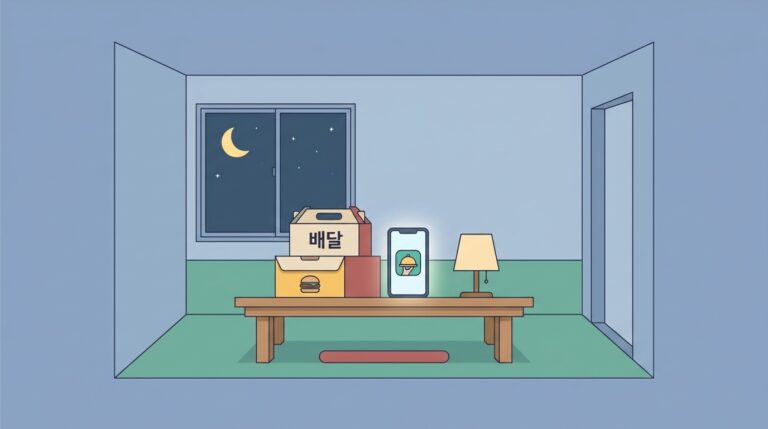
Phase 1: Empathy – The Midnight Snack Dilemma
안녕하세요! 매일한글 에디터입니다. (Hello! I’m the lead editor at Daily Hangul.) Imagine this scene: It’s 11:30 PM in Seoul. You’ve spent a long, exciting day exploring Hongdae or catching up on work in your cozy studio apartment. Suddenly, your roommate opens their phone, swipes through a delivery app, and looks at you with sparkling eyes: “치킨 시켜 먹을까?” (Should we order fried chicken?). The aroma of spicy tteokbokki, crispy fried chicken, and hot shin ramyun almost floats through your mind. Korea’s vibrant 야식 (Late-night snack) culture is legendary—delivery drivers zoom through the neon streets 24/7. However, indulging every midnight can quickly lead to 야식 증후군 (Night Eating Syndrome), leaving you bloated, sluggish, and regretful the next morning! Many of our international learners tell us that while they love joining late-night foodie hangouts, they struggle to say no or explain why they want to skip late-night meals politely without ruining the social vibe. Today, based on feedback from over 500 B1-level learners, we’re giving you the exact toolkit to navigate Korea’s midnight food cravings like a pro!
Phase 2: 3 Core Expressions Deep Dive
1. 야식 당겨요 (Yasic dang-gyeo-yo)
- Pronunciation: [Yah-sik dang-gyeo-yo] (Sounds like “yah-sick” + “tangerine” without the ‘rine’ + “gyeo-yo”)
- Meaning: Literal: “Late-night snack is pulling me.” | Nuance: “I’m really craving a late-night snack right now!”
- K-Culture Moment: Seen in almost every K-Drama office scene where colleagues work overtime and someone sighs, “아, 야식 당기는데…” (Ah, I’m craving a midnight snack…).
- Editor’s Insight: The verb ‘당기다’ literally means ‘to pull’. In conversational Korean, saying something ‘당긴다’ means a food item is strongly pulling your appetite.
- Situation Spectrum: Casual ✅ | Semi-formal ✅ | Formal 🚫
- 🤔 Think About It: Does your native language express food cravings as an active external force pulling you, or as an internal desire?
2. 밤늦게 먹으면 속 안 좋아요 (Bam-neut-ge meog-eu-myeon sok an jo-a-yo)
- Pronunciation: [Bam-neuk-geh meog-eu-myeon sok-an-jo-ah-yo] (Think of “bam” like night, “sok” sounding like “sock”)
- Meaning: Literal: “If I eat late at night, my inside is not good.” | Nuance: “If I eat late at night, it upsets my stomach / gives me indigestion.”
- K-Culture Moment: When friends offer you extra ramen at 1 AM, this is your polite shield to decline without sounding rude.
- Editor’s Insight: Koreans use ‘속’ (inside/stomach) to describe digestive discomfort. Saying ‘속 안 좋아요’ is soft, polite, and universally understood as a health boundary.
- Situation Spectrum: Casual ✅ | Semi-formal ✅ | Formal ✅
- 🤔 Think About It: Why is mentioning physical digestive comfort often accepted as the most polite excuse in Korean social settings?
3. 야식 증후군 조심해야 해요 (Yasic jeung-hu-gun jo-sim-hae-ya hae-yo)
- Pronunciation: [Yah-sik jeung-hoo-goon joh-sim-hae-yah hae-yo]
- Meaning: Direct translation: “We need to be careful of Night Eating Syndrome.”
- K-Culture Moment: Frequently used on Korean health variety shows like My Little Old Boy or I Live Alone when celebrities try to stop themselves from ordering food after midnight.
- Editor’s Insight: Using semi-medical terms playfully like ‘야식 증후군’ adds humor to self-control, making your refusal lighthearted rather than buzzkill.
- Situation Spectrum: Casual ✅ | Semi-formal ✅ | Formal ⚠️
- 🤔 Think About It: How does humor play a key role in easing tension when turning down social invitations in Korea?
Phase 3: Textbook Korean vs. Real Native Korean
Situation 1: Saying “I am craving fried chicken right now.”
- 📖 Textbook: 저는 지금 치킨이 먹고 싶습니다. (Jeo-neun ji-geum chi-kin-i meog-go sip-seub-ni-da.)
- 🗣️ Real Native: 아, 지금 치킨 완전 당기네요! (A, ji-geum chi-kin wan-jeon dang-gi-ne-yo!)
- 💡 Why different? B1 speakers move beyond stiff textbook grammar like
-고 싶습니다. Natives use ‘완전’ (totally) and ‘당기다’ (crave) to show enthusiastic emotion.
Situation 2: Declining late-night food gently.
- 📖 Textbook: 밤에는 음식 먹는 것을 사양하겠습니다. (Bam-e-neun eum-sik meog-neun geos-eul sa-yang-ha-ges-seub-ni-da.)
- 🗣️ Real Native: 지금 먹으면 내일 얼굴 부어서 안 돼요~ (Ji-geum meog-eu-myeon nae-il eol-gul bueo-seo an dwae-yo~)
- 💡 Why different? Textbook refusals sound like formal business rejections! Giving a humorous personal reason—like “my face will swell tomorrow!” (얼굴 부어요)—is friendly and relatable.
Phase 4: K-Culture Deep Dive & Non-Verbal Manners
4-1. Nunchi & Gestures for Refusal
When turning down a late-night snack offered by an older friend or colleague, don’t just say “아니요” (No). Instead:
1. Hand Gesture: Place one or both hands lightly over your stomach and gently wave your hands side-to-side.
2. Expressive Apology: Slightly tilt your head and smile apologetically while saying “아, 너무 먹고 싶은데…” (Ah, I really want to eat, but…).
3. Nunchi Tip: In Korea, showing that you wish you could join them preserves harmony (jeong), even if you can’t eat.
4-2. Culture Code: Delivery Apps & The “Face Swelling” Myth?
Korea has perfected delivery culture with apps like Baemin and Yogiyo. Ordering food at 2 AM is effortless. However, Koreans frequently worry about “얼굴 부음” (facial puffiness/swelling) caused by sodium-heavy foods like ramen eaten late at night. That’s why drinking green tea or milk after eating midnight ramen is a legendary Korean life hack!
Phase 5: Real Roleplay Scenario
Setting: 11:45 PM in the shared living room of a university dormitory in Seoul.
Characters: You (B1 Learner) & Minho (Your Korean friend who loves late-night food).
- Minho: 야,출출한데 야식으로 족발 시켜 먹을까?
(Ya, chul-chul-han-de ya-sik-eu-ro jok-bal si-kyeo meog-eul-kka?)
“Hey, I’m a bit peckish, should we order pig’s feet as a late-night snack?”
🎭 Action: Holding phone showing food app with an excited grin. -
You: 족발이요? 우와, 진짜 맛있겠어요!
(Jok-bal-i-yo? U-wa, jin-jja mas-it-ges-seo-yo!)
“Jokbal? Wow, that sounds so delicious!”
🎭 Action: Looking at the food photo on his screen with admiration. -
Minho: 그치? 같이 먹자! 내가 배달비 낼게.
(Geu-chi? Gat-i meog-ja! Nae-ga bae-dal-bi nael-ge.)
“Right? Let’s eat together! I’ll pay the delivery fee.” -
You: 아… 너무 당기는데, 저는 참아야 할 것 같아요.
(A… neo-mu dang-gi-neun-de, jeo-neun cham-a-ya hal geos gat-a-yo.)
“Ah… I’m so tempted, but I think I should hold back.” -
Minho: 왜~? 오늘 스트레스 많이 받았잖아! 한 입만 먹어!
(Wae~? O-neul seu-teu-re-seu man-i bad-at-jan-ah! Han ip-man meog-eo!)
“Why~? You were so stressed today! Just have one bite!” -
You: 밤늦게 먹으면 속 안 좋고, 야식 증후군 생길까 봐 조심하는 중이에요.
(Bam-neut-ge meog-eu-myeon sok an jo-go, ya-sik jeung-hu-gun saeng-gil-kka bwa jo-sim-ha-neun joung-i-e-yo.)
“If I eat late, my stomach hurts, and I’m trying to be careful of night eating syndrome.” -
Minho: 아하, 야식 증후군! 하긴, 건강이 먼저지. 그럼 나 혼자 소자 시킬게!
(A-ha, ya-sik jeung-hu-gun! Ha-gin, geon-gang-i meon-jeo-ji. Geu-reom na hon-ja so-ja si-kil-ge!)
“Aha, night eating syndrome! True, health comes first. Then I’ll just order a small size for myself!” -
You: 고마워요! 대신 내일 점심은 맛있는 거 같이 먹어요!
(Go-ma-wo-yo! Dae-sin nae-il jeom-sim-eun mas-it-neun geo gat-i meog-eo-yo!)
“Thank you! Instead, let’s eat something delicious together for lunch tomorrow!”
🔀 Interactive Choice Point
How will you respond when Minho insists “한 입만 먹어!” (Just one bite)?
* Option A: “싫어요. 절대 안 먹어요.” (No. I will never eat it.)
* ❌ Bad: Too harsh and blunt! It creates uncomfortable tension.
* Option B: “아, 너무 당기는데 속이 안 좋아서 참을게요. 내일 같이 맛있는 거 먹어요!”
* 🏆 Best: Acknowledges craving, states reason politely, and suggests an alternative future plan!
* Option C: “그럼 한 입만 먹고 자야겠어요.”
* ⚠️ Risk: Friendly, but you fell into the late-night snack trap! Goodbye sleep quality!
Phase 6: 10-Second Emotion Shadowing Drill
Practice speaking with natural cadence and realistic emotion!
[🥺 아쉽고 애교 섞어서 - Expressing tragic reluctance]
아… / 진짜 / 완전 당기는데… / 참아야 돼요.
(A… / jin-jja / wan-jeon dang-gi-neun-de… / cham-a-ya dwae-yo.)-
[😊 정중하고 걱정스럽게 - Soft refusal with digestive reason]
밤늦게 먹으면 / 속 안 좋아서 / 오늘은 패스할게요!
(Bam-neut-ge meog-eu-myeon / sok an jo-ah-seo / o-neul-eun pae-seu-hal-ge-yo!)
Phase 7: K-Culture Mini Dictionary
- 야식 (Yasic) | Late-night snack | Refers to any meal eaten past 10 PM. Popular items include chicken, jokbal, and tteokbokki.
- 야식 증후군 (Yasic Jeung-hu-gun) | Night Eating Syndrome | A modern condition where one gets intense food cravings late at night due to stress or habit.
- 속풀이 (Sok-puri) | Soothing the stomach | Eating gentle foods (like soup or porridge) to relieve indigestion or hangovers.
- 얼굴 부음 (Eol-gul Bueom) | Facial swelling | The noticeable bloating of the face the next morning after consuming salty late-night food.
Phase 8: Traveler’s Survival Kit
TOP 3 Survival Phrases
- 1. 배달 돼요? (Bae-dal dwae-yo?) – “Do you deliver?”
- Pro Tip: Use this at small restaurants late at night.
- 2. 속 편한 메뉴 추천해 주세요. (Sok pyeon-han me-nyu chu-cheon-hae ju-se-yo.) – “Please recommend a menu that is easy on the stomach.”
- 3. 지금 먹으면 내일 부어요! (Ji-geum meog-eu-myeon nae-il bueo-yo!) – “If I eat now, I’ll swell up tomorrow!” (A fun icebreaker refusal).
Editor’s Travel Note
When navigating Korea at night, download essential apps beforehand. You can check restaurant operating hours using the Naver Map App download guide. If you do overindulge in late-night snacks, head to a convenience store like GS25 or CU and buy 컨디션 (Condition) or 유산균 (Probiotics) to calm your digestion!
Phase 9: One Step Deeper – Humanistic Insight
In Korean culture, food is the primary medium for building bond and affection (jeong). Eating together late at night isn’t merely about nutrition; it’s about unwinding together after a exhausting workday. When someone invites you to join their 야식, they are inviting you into their comfort zone. Declining food can feel like declining connection if done abruptly. However, by validating their invitation (“I really crave it too!”) and gently expressing personal wellness reasons, you preserve social warmth while maintaining healthy boundaries.
💬 Your Turn: What is your favorite late-night craving food in your country? Have you ever experienced Night Eating Syndrome? Tell us in the comments below!
Phase 10: FAQ & Common Mistakes
Q: Is it considered rude to say no to late-night delivery snacks with Korean roommates?
A: Not at all! As long as you soft-frame your answer (e.g., mentioning your stomach comfort or health) rather than giving a flat “No,” Koreans respect health boundaries.
Q: What does ‘속 안 좋다’ mean exactly?
A: It literally translates to “inside is not good,” but it is the most natural way to say you have indigestion, bloating, or stomach discomfort.
Q: What are light Korean late-night alternatives if I MUST eat something?
A: Look for 곤약 떡볶이 (Konjac Tteokbokki) or 두부 김치 (Tofu Kimchi) at convenience stores! They are lower in calories and sodium.
🚨 Common Mistakes TOP 3
- Saying “안 먹어요!” (I won’t eat!): Sounds overly aggressive.
- 👉 Correct Action: Say “저는 괜찮아요, 많이 드세요!” (I’m okay, please enjoy!).
- Using formal dictionary verbs like ‘사양합니다’: Sounds like a robotic press release.
- 👉 Correct Action: Use natural expressions like “속이 부대껴서 참을게요.”
- Forgetting body language: Standing stiff while refusing feels cold.
- 👉 Correct Action: Smile, rub your tummy lightly, and express slight disappointment.
Phase 11: Action Missions
- 🥉 Bronze Mission: Practice saying “밤늦게 먹으면 속 안 좋아요” out loud 3 times in front of a mirror!
- 🥈 Silver Mission: Post a picture of your favorite late-night tea on Instagram and caption it in Korean using “야식 대신 차 한 잔!” (A cup of tea instead of late-night snacks!).
- 🥇 Gold Mission: Next time a friend asks to order late-night food, politely refuse using Option B from our roleplay!
🎮 K-Culture Mission: Watch a video on YouTube or a K-Drama where characters eat midnight ramen, and spot if anyone worries about “얼굴 부음” (facial swelling)!
Phase 12: Interactive Quiz Challenge
Q1. How do you naturally say “I’m craving fried chicken” in B1 Korean?
a) 치킨을 주문해야 합니다.
b) 치킨이 완전 당기네요!
c) 치킨을 안 먹겠습니다.
🔍 Click to see Answer & Explanation
Answer: b) 치킨이 완전 당기네요!
Explanation: ‘당기다’ is the authentic native expression for food cravings!
Q2. Fill in the blank: “밤늦게 먹으면 ____ 안 좋아요.” (If I eat late at night, my stomach hurts/is unwell.)
🔍 Click to see Answer & Explanation
Answer: 속
Explanation: ‘속’ refers to inside/stomach in Korean physical health contexts.
Q3. True or False: In Korea, drinking green tea or milk after midnight ramen is a popular hack to reduce facial swelling.
🔍 Click to see Answer & Explanation
Answer: True!
Explanation: Potassium in milk and antioxidant properties in green tea are believed to help flush out sodium bloating!







