

Refund Wrongs with Zero Stress! Master Advanced Korean Consumer Rights
Phase 1: Empathy (Story-telling Opening)
안녕하세요! I’m your Daily Hangul editor, your 10-year local culture navigator in Seoul!
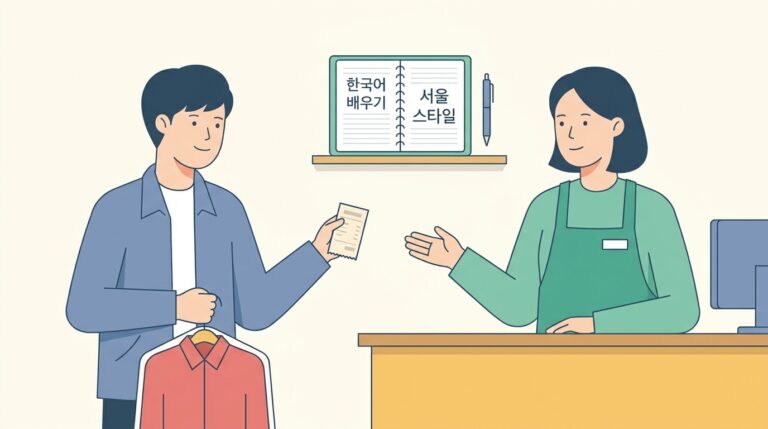
Picture this: You just bought a stylish, high-end designer coat at a trendy boutique in Seongsu-dong for 280,000 KRW. You return to your hotel room, excitedly unbox it, and immediately notice a visible seam tear along the inner lining. The next morning, you head back to the store with your receipt. You politely show the tear, but the young store assistant bows nervously and says: “죄송하지만 저희 매장은 교환 및 환불이 불가능합니다.” (I’m sorry, but our store does not allow exchanges or refunds.)
Your heart sinks. In an unfamiliar country, asserting your rights during a commercial dispute can feel overwhelming. Should you raise your voice? Should you just cut your losses and walk away?
In Korean culture, handling disputes smoothly requires a refined linguistic touch. Getting angry or yelling often backfires, causing store staff to shut down or label you as a rude ‘black consumer’ (블랙컨슈머). On the flip side, being overly passive means losing your hard-earned money.
Today, we are unlocking C1-level Korean conflict resolution phrases specifically tailored for consumer damage relief and refunds. Grounded in real-life experiences and feedback from hundreds of advanced Korean learners, this guide will equip you with diplomatic, highly authoritative language. By the end of this lesson, you will know exactly how to stand your ground calmly, invoke consumer protection principles gracefully, and turn customer service friction into a smooth, successful resolution!
Phase 2: Deep Dive into 3 Core C1 Korean Expressions
1. 규정에 따라 환불해 주셨으면 합니다 (Gyu-jeong-e tta-ra hwan-bul-hae ju-syeos-seum ham-ni-da)
- Pronunciation: [Gyu-jeong-e tta-ra hwan-bool-hae joo-syeos-seum hahm-nee-da] (Pronounce ‘규정에’ like ‘gooey-jong-eh’, keeping your tone steady and calm)
- Meaning: Literal: “I wish you would refund according to regulations.” | Nuance: “I would appreciate it if you could process a refund in compliance with consumer protection rules.”
- K-Culture Moment: Seen in K-Dramas like Agency or Search: WWW when sharp, professional protagonists address store policy pushback without escalating emotional tension.
- Editor’s Insight: By explicitly mentioning 규정에 따라 (according to regulations), you subtly pivot the conversation away from an interpersonal argument with the store clerk to established legal standards.
- Situation Spectrum: Casual 🚫 | Semi-formal ⚠️ | Formal ✅
- 🤔 Think About It: In your home culture, do consumers usually appeal to store regulations or demand to speak to high-level management directly?
2. 제품 자체의 결함이라 소비자 피해 구제를 신청하려 합니다 (Je-pum ja-che-ui gyeol-ham-i-ra so-bi-ja pi-hae gu-je-reul sin-cheong-ha-ryeo ham-ni-da)
- Pronunciation: [Jeh-poom jah-cheh-ui gyeol-hahm-ee-rah so-bee-jah pee-hae goo-jeh-reul seen-cheong-hah-ryeo hahm-nee-da]
- Meaning: Literal: “Since it is a defect of the product itself, I intend to apply for consumer damage relief.”
- Nuance: “Because this is an inherent product defect, I plan to escalate this to the Consumer Protection Agency if we cannot resolve it here.”
- K-Culture Moment: Used in high-stakes retail disputes or consumer protection news segments when customers highlight statutory rights over seller resistance.
- Editor’s Insight: Using 소비자 피해 구제 (consumer damage relief) Signals that you are familiar with Korea’s official consumer protection framework (1372 Consumer Counseling Center).
- Situation Spectrum: Casual 🚫 | Semi-formal ⚠️ | Formal ✅
- 🤔 Think About It: How does referencing an official government agency affect consumer disputes in your country?
3. 원만한 해결을 위해 보상안을 제시해 주시겠습니까? (Won-man-han hae-gyeol-eul wi-hae bo-sang-an-eul je-si-hae ju-si-ges-seum-ni-ka?)
- Pronunciation: [Won-mahn-hahn hae-gyeol-eul wee-hae boh-sahng-ahn-eul jeh-see-hae joo-see-get-seum-nee-kah?]
- Meaning: Literal: “Would you present a compensation plan for an amicable resolution?”
- Nuance: “Could you offer a fair alternative solution so we can resolve this matter amicably?”
- K-Culture Moment: Frequently utilized in office dramas and business negotiations when seeking win-win compromises.
- Editor’s Insight: The phrase 원만한 해결 (amicable resolution) demonstrates high cultural intelligence (눈치). It shows you are open to constructive dialogue rather than seeking conflict.
- Situation Spectrum: Casual 🚫 | Semi-formal ⚠️ | Formal ✅
- 🤔 Think About It: Is prioritizing mutual harmony expected during customer service negotiations in your native culture?
Phase 3: Textbook Korean vs. Real Korean
Situation 1: Requesting a refund for a defective product at a store counter
- 📖 교과서 한국어: 이 옷이 고장 났으니 돈을 돌려주세요. (This clothing is broken so give me back money.)
- 🗣️ 진짜 한국어: 상품에 하자 건이 있어서 환불 처리 부탁드립니다. (There is a defect issue with the item, so I kindly request refund processing.)
- 💡 왜 다를까? C1 level Korean moves away from childish words like “고장 났다” (for clothes) and uses professional retail terms like 하자 건 (defect issue) and formal passive requests like 환불 처리 부탁드립니다.
Situation 2: Requesting to speak with a store manager firmly
- 📖 교과서 한국어: 사장님 나와서 사과하세요. (Owner come out and apologize.)
- 🗣️ 진짜 한국어: 담당 책임자분과 직접 이야기 나누고 싶습니다. (I would like to speak directly with the manager in charge.)
- 💡 왜 다를까? Demanding an owner to apologize sounds emotional and aggressive. Requesting the 담당 책임자 (responsible supervisor) isolates authority professionally and calmly.
Phase 4: K-Culture Deep Dive & Non-verbal Etiquette
4-1. Nunchi (눈치) & Gesture Etiquette
When resolving conflicts in Korea, posture and voice tone carry 50% of your message’s weight:
* Eye Contact & Voice Level: Maintain steady, calm eye contact. Avoid raising your pitch or speaking too fast. Lowering your tone slightly conveys authority and self-control.
* Two-Handed Presentation: Always hand over the defective item, receipt, and credit card using both hands (두 손으로 내밀기). This non-verbal respect signals that your complaint is about the product, not a personal attack on the staff.
4-2. Cultural Code Analysis
Korea highly values respect for service employees’ 감정 노동 (emotional labor). Publicly causing a scene (갑질) is strongly condemned socially. However, Korean businesses deeply respect customers who cite the 1372 Consumer Counseling Center (1372 소비자상담센터) or official consumer guidelines. Showing that you know your legal rights without losing your temper commands immediate respect.
Phase 5: Real-Life Roleplay Scenario
- Setting: A high-end lifestyle boutique in Seongsu-dong.
- Characters:
- Alex (C1 Learner): Bought a defective wool knit sweater.
- Manager (Store Supervisor): Polite but strictly adhering to store policy.
8-Turn Conversation Script
- Alex: 저기요, 어제 여기서 구입한 니트인데요. 봉제 부분에 하자가 있어서 왔습니다.
(Excuse me, I bought this knit sweater here yesterday. I came back because there is a defect in the stitching.)
🎭 Hands over the shopping bag neatly with both hands. - Manager: 아, 고객님. 저희 매장은 할인 품목에 대해 교환이나 환불이 불가능합니다.
(Ah, customer. Our store policy does not allow exchanges or refunds on discounted items.)
🎭 Bows head apologetically with hands crossed in front. - Alex: 하지만 구매 당시에 봉제 불량에 대한 사전 안내는 받지 못했습니다.
(However, at the time of purchase, I was not informed about any stitching defects.)
🎭 Points gently and specifically to the unraveled seam. - Manager: 영수증 하단에도 교환·환불 불가라고 명시되어 있어서요…
(It is also explicitly stated at the bottom of the receipt that exchanges and refunds are not allowed…)
🎭 Taps the small printed text at the bottom of the receipt. - Alex: 소비자 분쟁 해결 기준에 따르면 제품 결함 시 환불 조치가 원칙으로 알고 있습니다.
(According to Consumer Dispute Resolution Standards, a refund is the rule in the case of product defects.)
🎭 Maintains a calm tone and direct eye contact. - Manager: (당황하며) 아… 잠시만요. 매장 규정과 상충해서 대표님께 확인해 보겠습니다.
(Flustered: Ah… hold on a moment. Since this conflicts with store rules, let me check with our director.)
🎭 Steps back to make a quick phone call. - Manager: 고객님, 확인해 보니 제품 하자 건이 맞아서 바로 환불 처리해 드리겠습니다.
(Customer, upon checking, it is indeed a product defect, so we will process the refund immediately.)
🎭 Bows respectfully and takes the credit card. - Alex: 신속하고 정확하게 처리해 주셔서 감사합니다. 좋은 하루 되세요.
(Thank you for handling it quickly and accurately. Have a great day.)
🎭 Smiles politely and takes the receipt.
🔀 Interactive Branching Points
When the manager claims “Discounted items cannot be refunded,” what is your best response?
* Option A (Best): “소비자원에 접수하기 전에 매장 선에서 원만하게 해결하고 싶습니다.” (I would like to resolve this amicably at the store level before contacting the Consumer Agency.) -> Feedback: Perfect! Clear, authoritative, yet polite.
* Option B (Bad): “야, 사장 나와! 이거 당장 경찰에 신고할 거야!” (Hey, call the owner! I’m calling the police right now!) -> Feedback: Unprofessional. Police do not intervene in civil refund disputes, and shouting damages your credibility.
* Option C (Risk): “아… 그렇군요. 그럼 어쩔 수 없죠. 그냥 갈게요.” (Ah… I see. Then nothing can be done. I’ll just leave.) -> Feedback: You forfeit your rights despite having a valid legal defect claim!
Phase 6: 10-Second Emotion Shadowing Drill
Practice these sentence rhythms with proper pauses (/) and emotional inflection:
[😐 침착하고 단호하게 - Calm & Firm]
규정에 따라 / 환불 조치를 / 진행해 주셨으면 합니다.
(Gyu-jeong-e tta-ra / hwan-bul jo-chi-reul / jin-haeng-hae ju-syeos-seum ham-ni-da.)-
[🤝 신사적이고 비즈니스적인 톤 - Gentlemanly & Professional]
원만한 해결을 위해 / 합리적인 보상안을 / 제시해 주시겠습니까?
(Won-man-han hae-gyeol-eul wi-hae / hap-ri-jeok-in bo-sang-an-eul / je-si-hae ju-si-ges-seum-ni-ka?)
Phase 7: K-Culture Mini Dictionary
- 소비자원 (So-bi-ja-won | Korea Consumer Agency):
The government organization that mediates consumer complaints and protects buyer rights in South Korea. - 하자 (Ha-ja | Defect / Fault):
Refers specifically to physical flaws or defects in purchased merchandise or services. - 영수증 지참 (Yeong-su-jeung Ji-cham | Bringing Receipt):
The essential policy requirement in Korea for processing any store transaction changes. - 감정 노동 (Gam-jeong No-dong | Emotional Labor):
A widely recognized social concept acknowledging the mental stress faced by customer service workers.
Phase 8: Traveler’s Survival Kit
TOP 3 Survival Phrases for Refunds
- 하자 건으로 환불 요청합니다. (Ha-ja geon-eu-ro hwan-bul yo-cheong-ham-ni-da.)
Pro Tip: Use this immediately at the cash register to set a clear professional tone. - 담당 책임자분 연결 부탁드립니다. (Dam-dang chaek-im-ja-bun yeon-gyeol bu-tak-deu-rim-ni-da.)
Pro Tip: Use when part-time staff (알바생) do not have the authorization to process refunds. - 영수증과 결제 카드가 있습니다. (Yeong-su-jeung-gwa gyeol-je ka-deu-ga is-seum-ni-da.)
Pro Tip: Always bring the physical card used for payment along with the receipt.
Editor’s Travel Note
Always save store locations on your Naver Map App Download before visiting. Most modern brands also offer digital support via KakaoTalk Customer Care channels. If you face language barriers in person, presenting your purchase history through their official app messenger often leads to instant resolution!
Phase 9: One Step Deeper (Cultural Reflection)
In Korean business interactions, there is a fascinating interplay between traditional social harmony and modern legal awareness. While personal relationships (정) once dictated compromises, today’s retail climate relies on codified standards established by the Fair Trade Commission. When you articulate your rights using precise C1 terminology, you bridge the gap between being a respectful foreigner and a knowledgeable modern consumer. Showing respect for the staff’s dignity while holding firm on legal standards is the ultimate hallmark of high cultural fluency.
💬 Your Turn: Have you ever experienced a sticky refund situation while traveling abroad? How did you navigate the legal or cultural differences? Share your thoughts in the comments below!
Phase 10: FAQ & Avoiding Misunderstandings
Q: What if I accidentally lost my paper sales receipt?
A: You can provide proof of purchase using your credit card approval SMS, mobile banking transaction record, or store membership points purchase history.
Q: Is a store’s “No Refund” (환불 불가) notice legally binding if the item has a genuine flaw?
A: No. Under Korean Consumer Protection Law, individual store policies cannot override statutory consumer rights regarding defective goods (하자).
Q: What is the official helpline if a store flatly refuses to process a legitimate defect refund?
A: You can call the Korea Consumer Counseling Hotline at 1372 or request assistance online via the Korea Consumer Agency portal.
🚨 Common Mistakes TOP 3 & Correct Actions
- ❌ Mistake 1: Raising your voice or using casual speech (반말) when upset.
- ✅ Correct Action: Stick strictly to formal honorifics (
하십시오체/해요체). A cold, polite tone commands far more respect in Korea.
- ✅ Correct Action: Stick strictly to formal honorifics (
- ❌ Mistake 2: Forgetting the original payment method.
- ✅ Correct Action: In Korea, refunds must be credited back to the exact same credit/debit card used during purchase.
- ❌ Mistake 3: Saying “I just don’t like it” when the item actually has a structural defect.
- ✅ Correct Action: Clearly distinguish between a simple change of mind (단순 변심) and a product flaw (제품 하자).
Phase 11: Action Mission
- 🥉 Bronze Mission: Record yourself reciting core phrase #1 (
규정에 따라 환불해 주셨으면 합니다) 3 times with a calm, assertive tone. - 🥈 Silver Mission: Share your practice recording or write your own sample refund dialogue on social media using
#DailyHangulC1! - 🥇 Gold Mission: On your next trip to Korea, practice asking about store return policies (
환불 규정이 어떻게 되나요?) at a retail outlet! - 🎮 K-Culture Mission: Watch a retail dispute scene in a modern Korean workplace drama (e.g., One Dollar Lawyer) and spot the term 소비자원 or 하자!
Phase 12: Interactive Quiz Challenge
Test your knowledge with this C1 conflict resolution challenge!
- Situation Quiz: Which phrase is most appropriate when requesting a manager calmly?
a) 야, 책임자 끌고 와!
b) 담당 책임자분과 직접 이야기 나누고 싶습니다.
c) 그냥 다 필요 없고 돈이나 줘. -
Fill-in-the-blank: “제품 자체의 ______이라 소비자 피해 구제를 신청하려 합니다.” (Choose the word for defect)
a) 하자
b) 유행
c) 자랑 -
True or False: Under Korean Consumer Law, store notices saying “No Refunds” can override statutory rights for damaged items. (True / False)
Click to reveal answers!
- 1. Answer: b) 담당 책임자분과 직접 이야기 나누고 싶습니다. (It is professional and authoritative without being abusive.)
- 2. Answer: a) 하자 (하자 means product defect/flaw.)
- 3. Answer: False! (Statutory rights for defective items override private store policy notices.)







