

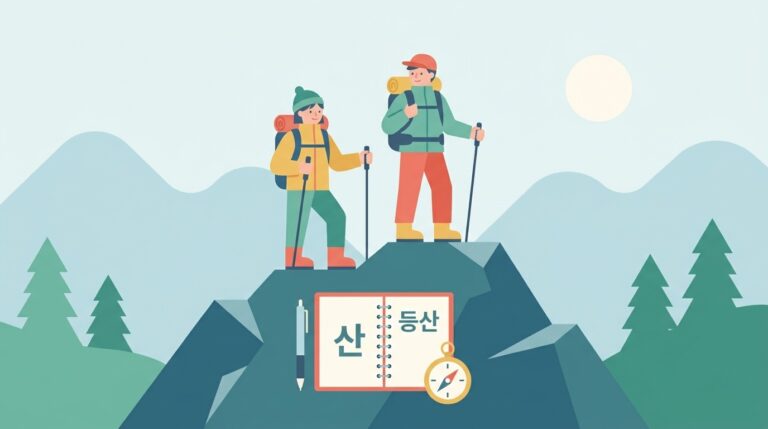
Phase 1: Empathy (Storytelling Intro)
안녕하세요! 매일한글 에디터입니다. (Hello! This is your Daily Hangul Editor!)
Have you ever planned a casual weekend walk up Seoul’s Bukhansan mountain, wearing your everyday sneakers and a basic hoodie, only to feel like you accidentally walked onto a professional Everest expedition set? If so, you are definitely not alone!
In South Korea, hiking isn’t just exercise—it is a full-blown fashion show and a display of top-tier gear. From neon Gore-Tex jackets and high-tech trekking poles to color-coordinated hiking shoes, Koreans take their mountain gear extremely seriously. But when you want to compliment someone’s high-end gear or playfully tease a friend who bought $500 boots for a 30-minute walk, textbook Korean phrases like “등산복이 좋습니다” (Your hiking clothes are good) just won’t cut it.
By mastering authentic B2-level outdoor expressions, you will instantly bridge the gap between being a tourist and looking like a seasoned local hiker. This guide is built on real conversations from mountain trails across Korea, giving you the natural slang and cultural context to banter confidently on the peak!
Phase 2: Key Expressions Deep Dive
1. 장비빨 (Jangbi-ppal)
- Pronunciation: [Jang-bi-ppal] (Rhymes with “Jang-bee” + “pal” with a hard ‘p’)
- Meaning: Literal: “Equipment buff/power.” Actual: Relying heavily on high-end gear to perform better or look good.
- K-Culture Moment: Commonly heard on Korean variety shows when a guest shows up with professional gear for a simple game, prompting everyone to laugh.
- Editor’s Insight: The suffix -빨 (ppal) signifies an effect or advantage gained from an external factor (e.g., 조명빨 = good lighting effect). Calling someone’s success 장비빨 is a playful jab that their high-end gear is doing 90% of the work!
- Situation Spectrum:
- Casual: ✅
- Semi-formal: ⚠️
- Formal: 🚫
- 🤔 Think About It: Why do you think Korean outdoor culture emphasizes having top-tier equipment even for short beginner trails?
2. 풀착장 (Pul-chakjang)
- Pronunciation: [Pul-chak-jang] (Pronounced like “Full” + “chack” + “jahng”)
- Meaning: Literal: “Full outfit setup.” Actual: Dressed head-to-toe in a specific complete attire or high-end brand set.
- K-Culture Moment: Used when someone arrives at the trail entrance wearing matching brand jacket, pants, gloves, visor, and boots.
- Editor’s Insight: 풀 (Pul) comes from the English word “Full,” combined with 착장 (Chakjang), meaning attire. It implies that no detail was spared.
- Situation Spectrum:
- Casual: ✅
- Semi-formal: ✅
- Formal: 🚫
- 🤔 Think About It: Is it common in your country to dress in full specialized gear for light recreational activities?
3. 장비는 프로급 (Jangbi-neun pro-geup)
- Pronunciation: [Jang-bi-neun pro-geup] (Feels like “Jang-bee-neun pro-goop”)
- Meaning: Literal: “Equipment is pro-level.” Actual: Having professional-grade gear despite beginner or intermediate hiking skills.
- K-Culture Moment: Used self-deprecatingly when showing off expensive equipment before struggling on a mild incline.
- Editor’s Insight: This expression reflects the Korean value of playful humility. Admitting your gear is pro-level before your skills catch up diffuses any potential boastfulness.
- Situation Spectrum:
- Casual: ✅
- Semi-formal: ✅
- Formal: ⚠️
- 🤔 Think About It: How does self-deprecating humor help build friendship when joining a new hobby group in Korea?
Phase 3: Textbook Korean vs. Real Korean
Scenario 1: Reacting to a friend’s shiny new expensive hiking gear
- 📖 교과서 한국어: 비싼 등산 장비를 많이 사셨네요. (You bought a lot of expensive hiking equipment.)
- 🗣️ 진짜 한국어: 와, 오늘 완전 풀착장으로 오셨네요! (Wow, you showed up in full gear today!)
- 💡 왜 다를까?: The textbook phrase sounds dry and overly literal. Using 풀착장 adds friendly excitement and acknowledges the effort put into the outfit.
Scenario 2: Explaining why someone easily climbed a steep trail
- 📖 교과서 한국어: 좋은 신발 덕분에 잘 오르는 것 같아요. (I think you climb well thanks to good shoes.)
- 🗣️ 진짜 한국어: 역시 등산은 장비빨이지! (As expected, hiking is all about the gear!)
- 💡 왜 다를까?: The real Korean phrase uses humor and trail slang to compliment the gear while keeping the mood light and fun.
Phase 4: K-Culture Deep Dive & Non-verbal Manners
4-1. Nunchi & Trail Gestures
When hiking in Korea, eye contact accompanied by a light head nod and a cheerful greeting like “안녕하세요!” (An-nyeong-ha-se-yo!) is standard trail etiquette. However, when noticing someone’s high-end gear, avoid staring directly at brand logos for too long. Instead, perform a quick glance from head to toe, nod approvingly, and hit them with a light compliment like “멋지시네요!” (Looking stylish!).
4-2. Culture Code: Outdoor Pride and Post-Hike Rewards
In Korea, hiking fashion is a major social status symbol and self-expression medium. Vibrant colors like neon pink, bright orange, and electric blue are preferred for both safety and aesthetics. But the ultimate reward of Korean outdoor culture isn’t just reaching the summit—it is the 뒷풀이 (Dwit-puri / Post-hike gathering) at the bottom of the mountain! Enjoying 해물파전 (Pajeon) and chilled 막걸리 (Makgeolli) while wearing your 풀착장 attire is the true essence of Korean trail culture.
Phase 5: Real-life Roleplay Scenario
Setting: At the entrance of Bukhansan Mountain. Minsu meets his friend Hyunwoo who showed up wearing top-tier outdoor brand gear.
- 1. 현우: 민수 씨, 오래 기다렸죠? 오늘 산행 기대되네요!
(Minsu, have you been waiting long? I’m excited for today’s hike!)
🎭 Adjusting his high-end trekking poles with a confident smile. - 2. 민수: 와, 현우 씨! 머리부터 발끝까지 완전 풀착장이네요?
(Wow, Hyunwoo! You’re completely fully geared up from head to toe!)
🎭 Looking up and down in amazement. - 3. 현우: 하하, 이번에 등산화랑 재킷 새로 좀 맞췄습니다.
(Haha, I bought a new matching set of hiking boots and jacket this time.)
🎭 Patting his new waterproof jacket playfully. - 4. 민수: 역시 등산은 장비빨이라는 말이 맞나 봐요. 진짜 멋집니다!
(I guess the saying ‘hiking is all about the gear’ is true. You look really cool!)
🎭 Giving a big thumbs up. - 5. 현우: 실력은 초보인데 장비는 프로급이라 좀 쑥스럽네요.
(My skills are beginner level, but my equipment is pro-level, so I’m a bit embarrassed.)
🎭 Laughing nervously while scratching the back of his neck. - 6. 민수: 걱정 마세요! 오늘 등산 속도도 프로급일 것 같은데요?
(Don’t worry! I feel like your climbing speed will be pro-level today too!)
🎭 Tapping his own boots lightly. - 7. 현우: 일단 정상 올라가서 막걸리 한잔할 생각에 신납니다.
(Anyway, I’m just excited to drink a glass of Makgeolli once we hit the summit.)
🎭 Pointing toward the mountain peak enthusiastically. - 8. 민수: 좋습니다! 그럼 장비빨 믿고 출발해 볼까요?
(Sounds great! Shall we trust the gear power and head out?)
🎭 Adjusting his backpack straps and stepping forward.
🔀 Interactive Choice Point
How would you respond if a hiker compliments your shiny new hiking boots on the trail?
- Choice A: “네, 아주 비싼 신발입니다.” (Yes, these are very expensive shoes.)
- Choice B: “감사해요! 사실 완전 장비빨이에요, 하하.” (Thank you! Honestly, it’s totally gear buff, haha.)
- Choice C: “그쪽 신발보다 제 것이 훨씬 좋습니다.” (Mine are much better than your shoes.)
Feedback:
* Choice A (Risk): Sounds overly blunt and money-focused, making the atmosphere slightly awkward.
* Choice B (Best): Perfect B2 conversational response! Shows humble self-awareness mixed with natural trail humor.
* Choice C (Bad): Unnecessarily aggressive and violates mountain social manners.
Phase 6: 10-Second Emotion Shadowing Drill
Practice these lines out loud with exact rhythm and pauses (/) to master natural tone!
- [😊 Expressing admiration with excitement]
“와! / 오늘 진짜 / 머리부터 발끝까지 / 풀착장이시네요!”
(Wa! / Oneul jin-jja / meo-ri-bu-teo bal-kkeut-kka-ji / pul-chak-jang-i-si-ne-yo!) -
[😂 Playfully teasing a friend]
“실력은 초보인데 / 장비는 프로급이라 / 약간 쑥스럽네요!”
(Sil-ryeok-eun cho-bo-in-de / jang-bi-neun pro-geup-i-ra / yak-gan ssuk-sseu-reop-ne-yo!) -
[😎 Confident banter]
“역시 / 한국 산행은 / 장비빨이 8할이지! / 가봅시다!”
(Yeok-si / han-guk san-haeng-eun / jang-bi-ppal-i pal-har-i-ji! / Ga-bop-si-da!)
Phase 7: K-Culture Mini Dictionary
-
등산회 (Deung-san-hoe) | Hiking Club / Mountain Group
- Meaning: Community clubs organized by coworkers, alumni, or neighbors to hike together regularly. A huge pillar of adult social life in Korea.
- 풀착장 (Pul-chakjang) | Full Outfit Setup
- Meaning: Wearing a complete head-to-toe coordinated set of technical clothing or matching brand wear for a specific sport.
- 장비빨 (Jangbi-ppal) | Equipment Buff
- Meaning: Achieving better performance, style, or confidence primarily due to high-quality gear rather than personal skill.
- 뒷풀i (Dwit-puri) | Post-Event Gathering
- Meaning: The official after-party (usually featuring food and drinks) held after completing an event like a hike, marathon, or seminar.
Phase 8: Traveler’s Survival Kit
Top 3 Survival Expressions for the Mountain Trail
- “정상까지 얼마나 걸려요?” (Jeong-sang-kka-ji eol-ma-na geol-ryeo-yo?)
- How long does it take to get to the summit?
- Pro Tip: Locals will almost always answer “Just 10 more minutes!” even if it takes an hour!
- “사진 한 장만 찍어주실 수 있나요?” (Sa-jin han jang-man jjeik-eo-ju-sil su in-na-yo?)
- Could you take a picture of me?
- “하산 길은 어디예요?” (Ha-san gi-reun eo-di-ye-yo?)
- Which way is the trail heading down?
Editor’s Travel Note
Before heading to mountains like Bukhansan or Seoraksan, download the Naver Map navigation app on your phone. It provides accurate visual hiking path contours, trail difficulty markers, and real-time transit routes back to city centers!
Phase 9: A Step Deeper (Cultural Reflection)
In Korean culture, hobbies are rarely pursued half-heartedly. Preparing for an activity like hiking by investing in proper outfits and high-grade gear reflects respect for the activity and the mountain community. It also provides a feeling of belonging when entering group settings like a local 등산회. Owning good gear isn’t just about showing off; it represents enthusiasm and readiness for shared experiences.
💬 Your Turn: What outdoor fashion trends exist in your country? Do people prefer high-tech gear or casual athletic wear when hiking? Share your thoughts in the comments below!
Phase 10: FAQ & Common Mistakes
Q: Can I use “장비빨” in business or formal language?
A: No. 장비빨 contains the slang suffix -빨, making it suitable only for informal, casual, or friendly semi-formal conversations. In formal business meetings, use “우수한 장비의 효과” (the effect of excellent equipment).
Q: Is it rude to tell someone they have “장비빨”?
A: If said with a warm smile among friends, it is viewed as playful banter. However, saying it to a superior or stranger could sound dismissive of their actual athletic ability, so use it with friendly peers!
Q: Does “풀착장” apply only to outdoor hiking clothes?
A: Not at all! You can use 풀착장 for golf attire, gym workout gear, camping setups, or even stylish formal suits.
🚨 Common Mistakes Warning Board
- Mistake: Saying “등산 옷이 매우 비싸네요!” directly to a stranger.
- Correct Action: Use light compliments like “오늘 멋지게 입으셨네요!” (You look great today!).
- Mistake: Confusing 하산 (going down the mountain) with 등산 (climbing up).
- Correct Action: Remember: 등산 (Deung-san) = Up, 하산 (Ha-san) = Down.
- Mistake: Pronouncing 장비빨 with a soft ‘p’ sound like [Jang-bi-pal].
- Correct Action: Emphasize the double consonant 빨 with a strong, tense [Ppal] sound.
Phase 11: Action Mission & Engagement
Action Mission 3-Step Challenge
- 🥉 Bronze: Practice pronouncing 풀착장 and 장비빨 3 times in front of a mirror with the emotion shadowing cadence!
- 🥈 Silver: Post a photo of your everyday outdoor outfit or shoes on social media with the caption: “오늘도 완벽한 풀착장! #매일한글”
- 🥇 Gold: Use “장비는 프로급이에요!” in your next conversation with a Korean friend or teacher when discussing hobbies!
🎮 K-Culture Mission
Watch a outdoor episode of a Korean variety show (like Running Man or I Live Alone). Spot at least one moment where cast members comment on each other’s hiking outfits or gear!
Phase 12: Interactive Quiz Challenge
Test your knowledge from today’s lesson!
Question 1 (Situation Analysis): You want to playfully compliment a friend who bought top-tier branded gear for a light 20-minute park walk. Which phrase fits best?
* A) 아주 오래된 옷이네요.
* B) 와, 완전히 장비는 프로급이네요!
* C) 산에서 길을 잃었어요.
👉 Click to reveal Answer & Explanation
Correct Answer: B) 와, 완전히 장비는 프로급이네요!
Explanation: This phrase humorously highlights their top-tier equipment in a friendly manner.
Question 2 (Fill in the Blank): Complete the sentence: “오늘 머리부터 발끝까지 브랜드 옷으로 맞춰 입어서 완전 ( ____ )이야!”
* A) 풀착장
* B) 하산
* C) 막걸리
👉 Click to reveal Answer & Explanation
Correct Answer: A) 풀착장
Explanation: 풀착장 refers to wearing a complete head-to-toe coordinated set of clothing.
Question 3 (True or False): In Korea, calling your friend’s hiking performance “장비빨” is always a severe insult that ruins friendships.
* A) True
* B) False
👉 Click to reveal Answer & Explanation
Correct Answer: B) False
Explanation: Among friends, 장비빨 is common lighthearted banter used to tease someone whose gear is better than their skill level!







