

안녕하세요! 매일한글 에디터입니다. Welcome back to another fun lesson with Daily Hangul!
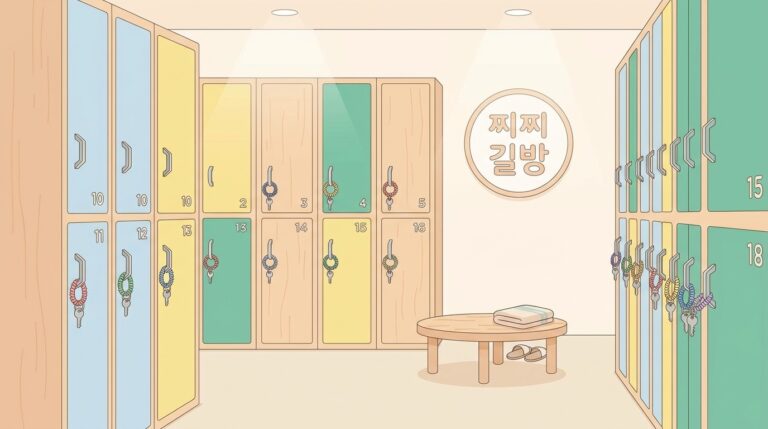
Imagine this: You have had a long day exploring the bustling streets of Seoul. Your feet are aching, and you decide to experience an iconic Korean relaxation ritual—visiting a Jjimjilbang (찜질방, Korean sauna). You head inside, exchange your shoes, and receive a small rubber key band wrapped around your wrist. This key opens your shoe cabinet and locker, and doubles as an electronic wallet for snacks like cold Sikhye (sweet rice drink) and baked eggs!
Suddenly, you stand in front of locker #204. You tap your wrist key… but nothing happens. The red light flashes. Or worse, you glance at your wrist after taking a relaxing soak, and your key is missing! Panic sets in. How do you explain this to the front desk without knowing complex Korean?
Don’t worry! Today, we are mastering the simple, essential Korean phrases you need when dealing with locker keys at a Korean spa. Built from real feedback from beginner learners, this guide will make sure you navigate the locker room like a seasoned local!
Phase 2: Key Expressions Deep Dive
1. 키 (Ki) / 열쇠 (Yeolsoe)
- Pronunciation: [Ki / Yeol-soe] (Think of ‘Ki’ like the English word ‘Key’, and ‘Yeolsoe’ sounds like ‘YAWL-say’)
- Meaning: Key (Locker Key / Electronic Wristband)
- K-Culture Moment: In Korean saunas, people refer to the locker wristband as either ‘키’ (Key) or ‘열쇠’ (Yeolsoe).
- Editor’s Insight: While ‘열쇠’ is the traditional Korean word for key, almost everyone at a modern spa simply says ‘키’ (Ki).
- Situation Spectrum:
- Casual: ✅
- Semi-formal: ✅
- Formal: ✅
- 🤔 Think About It: Why do you think modern Korean uses both English loanwords like ‘키’ and traditional words like ‘열쇠’ at the same time?
2. 안 열려요 (An yeollyeoyo)
- Pronunciation: [An yeol-ryeo-yo] (Sounds like ‘Ahn yawl-ryaw-yo’)
- Meaning: It doesn’t open. (Literal: Not opening)
- K-Culture Moment: You are standing in your towel in front of your locker, tapping your key, but the door stays locked.
- Editor’s Insight: ‘안’ (An) means ‘not’, and ‘열려요’ (Yeollyeoyo) means ‘opens’. Combining them creates a super handy beginner phrase for anything stuck!
- Situation Spectrum:
- Casual: ⚠️ (Use ‘안 열려’ with friends)
- Semi-formal: ✅ (Perfect for talking to staff)
- Formal: 🚫
- 🤔 Think About It: In English, we say “It won’t open,” giving intent to the door. Korean focuses on the state of the door not opening. Isn’t that neat?
3. 잃어버렸어요 (Ireobeoryeosseoyo)
- Pronunciation: [I-reo-beor-yeos-seo-yo] (Sounds like ‘E-raw-beor-yaws-saw-yo’)
- Meaning: I lost it.
- K-Culture Moment: Realizing your wrist key slipped off in the hot tub and asking the front desk staff for help.
- Editor’s Insight: This is a combination of ‘잃다’ (to lose) and ‘버리다’ (to complete an action). It expresses a feeling of regret over losing something.
- Situation Spectrum:
- Casual: ⚠️
- Semi-formal: ✅
- Formal: 🚫
- 🤔 Think About It: Korean past-tense verb endings are longer because they convey both time and politeness toward the listener.
Phase 3: Textbook Korean vs. Real Korean
Situation 1: Telling staff your locker key isn’t working
- 📖 Textbook Korean: 라커룸 열쇠가 작동하지 않습니다. (Rakeorum yeolsoega jakdonghaji anseumnida.)
- 🗣️ Real Korean: 키가 안 돼요. (Kiga an dwaeyo.)
- 💡 Why the difference?: Locals rarely use long formal sentences like ‘작동하지 않습니다’ (does not operate). A simple ‘안 돼요’ (doesn’t work) is fast, natural, and friendly!
Situation 2: Asking where to place the key when paying
- 📖 Textbook Korean: 열쇠를 어디에 센싱해야 합니까? (Yeolsoereul eodie sensinghaeya hamnikka?)
- 🗣️ Real Korean: 키 여기 찍어요? (Ki yeogi jjigeoyo?)
- 💡 Why the difference?: ‘찍다’ (jjikda) literally means ‘to stamp’ or ‘to tap’. At a spa counter, people always say ‘찍다’ when tapping an electronic key band.
Phase 4: K-Culture Deep Dive & Non-Verbal Manners
4-1. Nunchi & Gestures
When your key doesn’t work, don’t keep banging on the locker door! Instead, show ‘Nunchi’ (social awareness):
1. Take off your wristband key.
2. Gently hold it up toward a staff member while making eye contact.
3. Tilt your head slightly and say: “저기요, 키가 안 돼요.” (Jeogiyo, kiga an dwaeyo / Excuse me, the key isn’t working).
4-2. Culture Code: The All-in-One Wristband
In Korean Jjimjilbangs, cash and credit cards stay in your locker. Your wristband key contains an RFID chip. You tap it to buy snacks, get a massage, or pay for scrubs. You pay the total bill at the main exit counter when you leave. Losing this key means someone else could theoretically use your tab, which is why alerting staff quickly is super important!
Phase 5: Real-Life Roleplay Scenario
Setting: You are at the reception desk inside the sauna locker room. You are wearing a towel and holding a key that won’t open locker #105.
Characters: You (A1 Learner), Staff (Sauna Ajumma / Manager)
- Turn 1 (Staff): 안녕하세요! 무슨 일 있으세요?
(Annyeonghaseyo! Museun il isseuseyo?)
🎭 Looking over politely from the desk.
“Hello! Is something wrong?” -
Turn 2 (You): 저기요, 키가 안 돼요.
(Jeogiyo, kiga an dwaeyo.)
🎭 Holding up your key wristband with a puzzled look.
“Excuse me, the key isn’t working.” -
Turn 3 (Staff): 몇 번이세요? Key 번호 말해주세요.
(Myeot beon-iseo-yo? Key beonho malhaejuseyo.)
🎭 Reaching out her hand to inspect the key band.
“What number is it? Please tell me the key number.” -
Turn 4 (You): 백오 번이에요.
(Baek-o beon-ieyo.)
🎭 Pointing to number 105 printed on the key band.
“It’s number 105.” -
Turn 5 (Staff): 아, 이거 태그 다시 해볼게요. 잠시만요.
(A, igeo taegeu dasi haebolgeyo. Jamsimanyo.)
🎭 Resetting the digital system on her counter screen.
“Ah, let me try re-tagging this. One moment.” -
Turn 6 (You): 네, 감사합니다.
(Ne, gamsahamnida.)
🎭 Nodding slightly with a smile of relief.
“Yes, thank you.” -
Turn 7 (Staff): 자, 이제 다시 대보세요! 돼요!
(Ja, ije dasi daeboseyo! Dwaeyo!)
🎭 Handing back the wristband key with a bright smile.
“Here, try tapping it again! It works now!” -
Turn 8 (You): 와, 돼요! 감사합니다!
(Wa, dwaeyo! Gamsahamnida!)
🎭 Tapping the key successfully and smiling warmly.
“Wow, it works! Thank you!”
🔀 Interactive Choice Point
What if you dropped your key somewhere in the hot tub? What should you say?
- Option A: “키 없어요!” (Ki eopseoyo! / No key!)
- Option B: “저기요, 키 잃어버렸어요.” (Jeogiyo, ki ireobeoryeosseoyo. / Excuse me, I lost my key.)
- Option C: “너 키 갖다줘.” (Neo ki gatdajwo. / Bring me key.)
Feedback:
* Best Choice – Option B: Super polite, clear, and perfectly natural for an A1 learner!
* Risk – Option A: Understandable, but sounds very blunt like a small child.
* Bad Choice – Option C: Uses rude informal language (‘너’) to staff. Avoid this!
Phase 6: 10-Second Emotion Shadowing Drill
Practice saying these aloud with the tagged emotion and pauses (/):
[🥺 Confused & Needing Help]
저기요… / 키가 / 안 돼요.
(Jeogiyo… / kiga / an dwaeyo.)-
[😊 Relieved & Happy]
열렸어요! / 감사합니다!
(Yeollyeosseoyo! / gamsahamnida!) -
[😰 Worried & Apologetic]
죄송해요, / 키를 / 잃어버렸어요.
(Joesonghaeyo, / kireul / ireobeoryeosseoyo.)
Phase 7: K-Culture Mini Dictionary
- 찜질방 (Jjimjilbang): Korean-style unisex sauna equipped with hot stone rooms, sleeping areas, and food counters.
- 신발장 (Sinbaljang): Shoe locker located at the entrance. Your shoe key number usually matches your clothes locker number!
- 식혜 (Sikhye): A traditional sweet rice beverage served ice-cold in giant plastic jugs at saunas.
- 수건 (Sugeon): Towel. At most Korean spas, small face towels are provided at the entrance.
Phase 8: Traveler’s Survival Kit
Top 3 Survival Phrases
- 이거 안 열려요. (Igeo an yeollyeoyo.) – This won’t open.
- 키 어디에 찍어요? (Ki eodie jjigeoyo?) – Where do I tap my key?
- 도와주세요! (Dowajuseyo!) – Please help me!
Editor’s Travel Note
When heading to a local spa, use the Naver Map Navigation App to search for nearby Jjimjilbangs. Always keep your wristband key on your wrist or ankle while bathing so it doesn’t float away in the tubs!
Phase 9: A Step Deeper
Korean saunas run on an incredible system of high mutual trust. Even though hundreds of people leave their belongings in lockers secured by a simple rubber wristband key, theft inside a Jjimjilbang is extremely rare. Understanding how keys and payment wristbands work gives you a firsthand peek into Korea’s high-trust, cashless convenience culture.
💬 Your Turn: Have you ever visited a public bath or sauna in your home country? How does key access work there compared to Korea? Share your thoughts in the comments below!
Phase 10: FAQ & Common Mistakes
Q: What if my locker number and shoe locker number don’t match?
A: In almost all modern Korean saunas, your entrance ticket assigns one number that works for both your shoe cabinet and your clothing locker. If they don’t match, double-check your key tag!
Q: Can I pay with cash inside the sauna bath area?
A: No, cash is not accepted inside the bath or lounge areas. You must tap your wrist key for all purchases and settle the bill at the main exit desk.
Q: What happens if I truly lose my key band?
A: Tell the front desk immediately (“키 잃어버렸어요”). Staff will check the master system, lock your account to prevent unauthorized snack buys, and help you find it or issue a replacement.
🚨 Common Mistakes TOP 3
- Mistake: Pushing the key hard into electronic locks.
Correct Action: Gently tap the smooth face of the key band against the electronic sensor circle. - Mistake: Leaving the key band on the edge of the hot tub pool.
Correct Action: Keep it wrapped firmly around your wrist or ankle at all times. - Mistake: Saying informal Korean like “키 안돼” to adult sauna staff.
Correct Action: Always add ‘요’ at the end (“키가 안 돼요”) to stay polite.
Phase 11: Action Mission
- 🥉 Bronze Mission: Repeat “키가 안 돼요” out loud 3 times right now.
- 🥈 Silver Mission: Save this blog post and practice naming your key in Korean before your next spa trip!
- 🥇 Gold Mission: Visit a Korean Jjimjilbang on your travel, tap your key band to buy Sikhye, and thank the staff with “감사합니다!”
🎮 K-Culture Mission: Next time you watch a Korean drama with a sauna scene (like Crash Landing on You), look out for the colored wristbands on the characters’ arms!
Phase 12: Interactive Quiz Challenge
Question 1: How do you tell staff that your key is not opening the locker?
- A) 키가 진짜 좋아요. (Kiga jinja joayo.)
- B) 키가 안 돼요. (Kiga an dwaeyo.)
- C) 키 주세요. (Ki juseyo.)
Click to reveal answer
Correct Answer: B) 키가 안 돼요. (Kiga an dwaeyo.)
Explanation: ‘안 돼요’ means ‘doesn’t work’ or ‘isn’t working’, making it the perfect phrase when your key fails to open your locker!
Question 2: True or False?
You should pay cash directly to the snack seller inside the sauna lounge.
Click to reveal answer
Correct Answer: False!
Explanation: You tap your RFID key wristband for all food and services inside, then pay the combined bill at the exit counter.







