

Phase 1: Empathy (Storytelling Opening)
안녕하세요! I’m your Daily Hangul Editor.
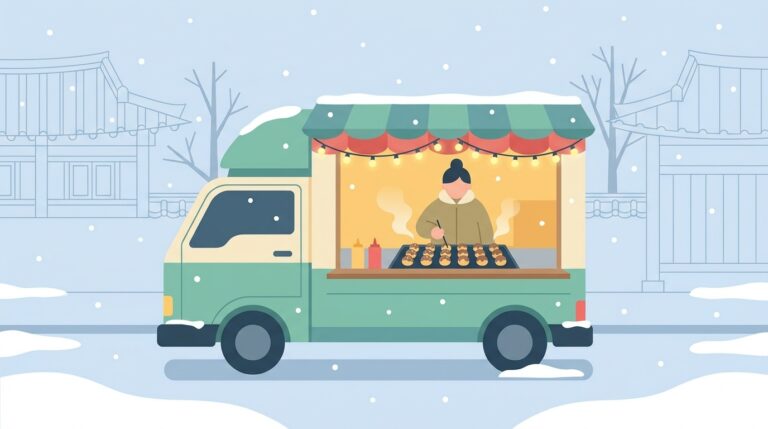
Picture this: It is 10 PM on a crisp, freezing Seoul winter night. You are walking back to your hotel after a long day of sightseeing, shivering as the icy wind nips at your nose. Suddenly, a golden beam of light catches your eye at the corner of the street—it’s a steaming street Takoyaki truck (타코야키 트럭)! The irresistible aroma of grilled batter, savory octopus, and rich brown sauce drifts through the winter air. A small crowd of locals is huddled around, holding warm paper boxes.
You walk over, eager to warm up with these crispy-on-the-outside, melt-in-your-mouth snacks. But as you approach, panic sets in! The menu lists spicy flavors, original sauces, and toppings you don’t fully recognize. Do you need cash? Can you ask for half spicy and half original? How long will it take?
Don’t worry! Ordering street food in Korea isn’t just about survival—it’s a cozy, heart-warming cultural experience. Today, based on real feedback from intermediate learners like you, we are going to master the exact phrases, subtle etiquette, and cultural nuances so you can confidently order at any Korean street food truck like a true insider!
Phase 2: Deep Dive into 3 Key Expressions
1. 반반으로 주세요 (Ban-ban-eu-ro ju-se-yo)
- Pronunciation: [Ban-ban-eu-ro ju-se-yo] (Sounds like “Barn-barn-oo-roh joo-say-yo”)
- Meaning: “Please give me half and half.”
- K-Culture Moment: You’ll hear this constantly at fried chicken spots (양념반 후라이드반) and street food stalls when people can’t decide between original (순한맛) and spicy (매운맛) flavors.
- Editor’s Insight: The word 반 (ban) means “half.” Doubling it to 반반 (ban-ban) creates a rhythmic, cute, and clear way to request a 50/50 mix. Adding the particle ~으로 (-eu-ro) indicates the method or selection.
- Situation Spectrum:
- Casual (친구끼리): 반반으로 줘 (Ban-ban-eu-ro jwo) ✅
- Semi-formal (길거리 점원): 반반으로 주세요 (Ban-ban-eu-ro ju-se-yo) ✅
- Formal (격식있는 자리): 반반으로 부탁드립니다 (Ban-ban-eu-ro bu-tak-deu-rim-ni-da) ⚠️ (A bit too formal for a street truck, but polite!)
- 🤔 Think About It: In many Western countries, mixing flavors in a single small order might incur an extra charge or annoy the chef. Why do you think Korean food culture embraces the “half-and-half” (반반) concept so seamlessly across street food and major franchises?
2. 얼마나 기다려야 돼요? (Ol-ma-na gi-da-ryeo-ya dwae-yo?)
- Pronunciation: [Ol-ma-na gi-da-ryeo-ya dwae-yo?] (Sounds like “All-mah-nah gee-dah-ryuh-yah dway-yo?”)
- Meaning: “How long do I need to wait?”
- K-Culture Moment: Takoyaki is cooked fresh in batches on cast-iron grills. If you arrive right when a fresh batch is finishing, it takes 30 seconds; if a new batch just started, it might take 10 minutes.
- Editor’s Insight: Instead of asking “Is it ready?”, asking “얼마나 기다려야 돼요?” shows that you understand the cooking process and respect the vendor’s time while managing your own schedule in the cold.
- Situation Spectrum:
- Casual: 얼마나 기다려야 돼? (Ol-ma-na gi-da-ryeo-ya dwae?) ✅
- Semi-formal: 얼마나 기다려야 돼요? (Ol-ma-na gi-da-ryeo-ya dwae-yo?) ✅
- Formal: 얼마나 기다려야 합니까? (Ol-ma-na gi-da-ryeo-ya ham-ni-ka?) 🚫 (Too rigid for street food stalls)
- 🤔 Think About It: Korean culture values speed (“Ppallli-ppalli”), yet street food lovers willingly wait in freezing weather for fresh food. How does context change expectations of time in daily life?
3. 계좌이체 되나요? (Gye-jwa-i-che dwae-na-yo?)
- Pronunciation: [Gye-jwa-i-che dwae-na-yo?] (Sounds like “Gyeh-jwa-ee-cheh dway-nah-yo?”)
- Meaning: “Can I pay via bank transfer?”
- K-Culture Moment: Korean street food trucks often display a printed piece of paper with a bank account number (계좌번호). Young Koreans rarely carry cash and transfer money instantly using mobile banking apps.
- Editor’s Insight: If you don’t have cash, don’t walk away! Showing your phone and asking “계좌이체 되나요?” is completely standard in Korea today.
- Situation Spectrum:
- Casual: 계좌이체 돼? (Gye-jwa-i-che dwae?) ✅
- Semi-formal: 계좌이체 되나요? (Gye-jwa-i-che dwae-na-yo?) ✅
- Formal: 계좌이체 가능합니까? (Gye-jwa-i-che ga-neung-ham-ni-ka?) ⚠️ (A bit polite, but usable)
- 🤔 Think About It: How does high digital integration in daily micro-transactions reflect trust and technological convenience in Korean society?
Phase 3: Textbook Korean vs. Real Korean
Situation 1: Choosing your favorite flavor combination
- 📖 교과서 한국어: 매운 맛과 순한 맛을 섞어서 주십시오. (Mae-un mat-gwa sun-han mat-eul seok-geo-seo ju-sip-si-o.)
- 🗣️ 진짜 한국어: 매콤한 맛이랑 오리지널 반반으로 해주세요! (Mae-kom-han mat-i-rang o-ri-ji-neol ban-ban-eu-ro hae-ju-se-yo!)
- 💡 왜 다를까? Textbook Korean uses strict imperative forms like ~주십시오 (-ju-sip-si-o). Real native speakers at B2 level use descriptive tone (~해 주세요) and conversational connector ~이랑 (-i-rang) along with natural adjectives like 매콤하다 (pleasantly spicy) instead of just 매운 맛.
Situation 2: Asking for extra bonito flakes (가쓰오부시)
- 📖 교과서 한국어: 가쓰오부시를 많이 추가해 줄 수 있습니까? (Ga-sseu-o-bu-si-reul man-i chu-ga-hae jul su it-seum-ni-ka?)
- 🗣️ 진짜 한국어: 가쓰오부시 좀 넉넉히 올려주실 수 있나요? (Ga-sseu-o-bu-si jom neok-neok-hi ol-ryeo-ju-sil su in-na-yo?)
- 💡 왜 다를까? Instead of the mechanical word 추가 (addition), Koreans frequently use natural adverbs like 넉넉히 (generously) or 듬뿍 (heavily sprinkled) when customizing street food toppings!
Phase 4: K-Culture Deep Dive & Non-Verbal Manners
4-1. Nunchi (눈치) & Gestures at the Truck
- The Phone Screen Flex: When paying via bank transfer (계좌이체), after sending the money, tilt your phone screen towards the vendor with a soft nod so they can see the confirmation screen. You don’t even need to interrupt their cooking!
- The Steam Dodge: Takoyaki is served scalding hot. It is considered polite street etiquette to step slightly away from the truck counter before taking your first bite, avoiding blowing hot steam onto other waiting customers.
- Two-Handed Receive: When receiving your steaming box or toothpick, hold out both hands gently to show respect and gratitude.
4-2. Cultural Code: The Korean Street Food Ecosystem
While Takoyaki originated in Osaka, Japan, street food trucks in Korea have transformed it into a uniquely local winter tradition. Korean Takoyaki trucks often travel between residential neighborhoods, setting up near subway station exits on specific days of the week. Apps like 가슴속3천원 (3,000 Won in My Heart) have emerged purely so locals can track street vendors selling winter treats like Takoyaki, Bungeoppang (fish pastry), and Hotteok (sweet pancakes)!
Phase 5: Real-Life Roleplay Scenario
Setting: A chilly winter evening outside Sinchon Station Exit 3. A steaming Takoyaki food truck operated by a friendly vendor (사장님) is surrounded by hungry university students.
Dialogue (8 Turns)
- 사장님: 어서 오세요! 몇 알 해 드릴까요? 8알, 12알 있어요. (E-seo o-se-yo! Myeot al hae deu-ril-kka-yo? Pal-al, sip-i-al it-seo-yo.)
- Translation: Welcome! How many pieces would you like? We have 8 or 12 pieces.
- 🎭 Action: Smarts off steam from the iron grill and smiles brightly.
- You: 12알짜리로 주세요. 혹시 반반도 되나요? (Sip-i-al-jja-ri-ro ju-se-yo. Hok-si ban-ban-do dwae-na-yo?)
- Translation: 12 pieces, please. By any chance, can I do half and half?
- 🎭 Action: Holds up two fingers politely while shivering slightly in the cold.
- 사장님: 그럼요! 어떤 맛으로 섞어 드릴까? 오리지널, 매운맛, 치즈맛 있어요. (Geu-reom-yo! Eot-teon mas-eu-ro seok-geo deu-ril-kka? O-ri-ji-neol, mae-un-mat, chi-jeeu-mat it-seo-yo.)
- Translation: Of course! Which flavors should I mix? We have Original, Spicy, and Cheese.
- 🎭 Action: Points with tongs to the three condiment bottles.
- You: 오리지널이랑 매운맛 반반으로 해주세요! 가쓰오부시도 듬뿍 부탁드려요. (O-ri-ji-neol-i-rang mae-un-mat ban-ban-eu-ro hae-ju-se-yo! Ga-sseu-o-bu-si-do deum-ppuk bu-tak-deu-ryeo-yo.)
- Translation: Original and spicy half-and-half, please! And lots of bonito flakes, please.
- 🎭 Action: Nods enthusiastically with a warm smile.
- 사장님: 오케이! 지금 새로 굽고 있어서 5분 정도 걸리는데 괜찮아요? (O-kei! Ji-geum sae-ro gup-go it-seo-seo o-bun jeong-do geol-ri-neun-de gwaen-chan-ah-yo?)
- Translation: Okay! I’m grilling a fresh batch right now, so it takes about 5 minutes. Is that okay?
- 🎭 Action: Flipping round batter balls rapidly with sharp iron picks.
- You: 네, 괜찮습니다! 천천히 해주세요. 계좌이체로 계산해도 되죠? (Ne, gwaen-chan-seum-ni-da! Cheon-cheon-hi hae-ju-se-yo. Gye-jwa-i-che-ro gye-san-hae-do dwae-jo?)
- Translation: Yes, that’s fine! Take your time. I can pay by bank transfer, right?
- 🎭 Action: Takes out mobile phone to prepare bank transfer app.
- 사장님: 네! 여기 앞에 계좌번호 적혀 있어요. 5,000원입니다~ (Ne! Yeo-gi ap-e gye-jwa-beon-ho jeok-hyeo it-seo-yo. O-cheon-won-im-ni-da~)
- Translation: Yes! The account number is written right here in front. That’ll be 5,000 won~
- 🎭 Action: Points to a laminated sign on the front of the food truck.
- You: 입금했어요! 따뜻할 때 빨리 먹어야겠어요. 감사합니다! (Ip-geum-haet-seo-yo! Tta-tteut-hal ttae ppal-ri meok-eo-ya-get-seo-yo. Gam-sa-ham-ni-da!)
- Translation: Money sent! I should eat them fast while they’re hot. Thank you!
- 🎭 Action: Shows confirmation screen on phone and receives hot box with two hands.
🔀 Interactive Choice Point
Situation: You want to pay, but you don’t have Korean cash and your foreign credit card isn’t accepted at street stalls.
* Option A: Say nothing, look embarrassed, and walk away silently without buying.
* Option B: Point to your phone and ask politely: “혹시 계좌이체나 카카오페이 되나요?” (Hok-si gye-jwa-i-che-na ka-ka-o-pe-i dwae-na-yo?)
* Option C: Shout in English: “Do you take Visa or Mastercard?”
Feedback:
* Option A (Bad): You miss out on delicious food, and the vendor might feel confused!
* Option B (Best): Perfect! Most street stalls have KakaoPay QR codes or bank account details ready for quick digital payment.
* Option C (Risk): Small street vendors in Korea rarely have international card terminals. You might cause awkward communication distress.
Phase 6: 10-Second Emotion Shadowing Drill
Master your native intonation with these emotion-infused practice sentences!
[😊 Excitement & Cravings]- 오리지널이랑 / 매운맛 / 반반으로 해주세요!
- (O-ri-ji-neol-i-rang / mae-un-mat / ban-ban-eu-ro hae-ju-se-yo!)
[🥺 Cold & Eager]- 얼마나 / 기다려야 돼요? / 너무 추워요~
- (Ol-ma-na / gi-da-ryeo-ya dwae-yo? / neo-mu chu-wo-yo~)
[👍 Friendly & Reassuring]- 계좌이체 / 완료했어요! / 많이 파세요~
- (Gye-jwa-i-che / wan-ryeo-haet-seo-yo! / man-i pa-se-yo~)
Phase 7: K-Culture Mini Dictionary
- 계좌이체 (Gye-jwa-i-che) | Bank Transfer | Direct peer-to-peer digital payments via banking apps; essential for street markets in South Korea.
- 가쓰오부시 (Ga-sseu-o-bu-si) | Bonito Flakes | Thinly shaved dried skipjack tuna flakes that dance on top of hot Takoyaki from heat steam.
- 겉바속촉 (Geot-ba-sok-chok) | Crispy Outside, Soft Inside | Acronym for 겉은 바삭하고 속은 촉촉하다. The ultimate slang word to describe perfectly cooked street food textures!
- 타세권 (Ta-se-gwon) | Takoyaki Safety Zone | Play on words combining Takoyaki + 역세권 (subway station zone). Used by locals to brag that their neighborhood has a Takoyaki truck nearby!
Phase 8: Traveler’s Survival Kit
Top 3 Street Food Survival Phrases
- 이거 엄청 뜨거워요? (I-geo eom-cheong tteu-geo-wo-yo?)
- Is this super hot?
- Pro Tip: Takoyaki holds heat inside the batter center. Always poke a small hole with your toothpick first!
- 소시지 말고 문어 맞죠? (So-si-ji mal-go mun-eo mat-jjo?)
- It’s octopus inside, not sausage, right?
- Pro Tip: Useful if you have dietary preferences or want to double-check ingredients.
- 포장해 주세요! (Po-jang-hae ju-se-yo!)
- Please pack it to go!
- Pro Tip: Ensures they tie your sauce container or box securely in a plastic bag for carrying.
Editor’s Travel Note
Before heading out on your winter street food hunt, make sure to check out our guides for mobile setup: utilize the Naver Map app download to locate busy nightlife streets, and prepare payment tools via the T-money card balance check guide to ensure smooth travel across local neighborhoods!
Phase 9: “One Step Deeper” (Reflection Essay)
In many Western cultures, street vendors rely almost strictly on physical cash or credit card readers. However, Korea’s rapid transformation into a cashless society has birthed a unique hybrid culture: even tiny popup tents and mobile food trucks display printed bank account numbers on cardboard signs. This system operates on an incredible bedrock of mutual trust between buyer and seller. Customers voluntarily show their transfer confirmation screens, and vendors trust buyers without demanding strict identity verification. It reveals how modern technology and community trust coexist on cold Korean street corners.
💬 Your Turn: Have you ever bought food using direct bank transfer or app payment in your country? What street food would you love to try on a freezing night in Seoul? Share your thoughts in the comments below!
Phase 10: FAQ & Common Mistakes
Q: Can I use foreign credit cards at street food trucks in Korea?
A: Generally, no. Most mobile street food trucks operate without card terminals. It is best to carry around 10,000 won in cash or use local bank transfers/KakaoPay if you have a local account.
Q: What if I bite into Takoyaki immediately after buying it?
A: Be careful! Takoyaki traps burning steam inside its soft dough core. Even if the outside feels warm, the octopus inside can burn your mouth. Wait 1–2 minutes or split it open slightly with a toothpick before eating.
Q: Is it rude to eat street food while walking down the street in Korea?
A: While not strictly illegal, Koreans generally prefer standing near the food truck or finding a designated bench/spot to eat rather than walking through crowded streets while holding hot food.
🚨 Common Mistakes Warning Board
- ❌ Mistake 1: Calling the vendor “저기요” (Jeo-gi-yo) continuously when standing right in front of them.
- ✅ Correct Action: Use “사장님” (Sa-jang-nim – boss/owner) warmly to get their attention!
- ❌ Mistake 2: Pouring extra sauce yourself from vendor bottles.
- ✅ Correct Action: Politely request “소스 많이 뿌려주세요” (So-seuman-i ppu-ryeo-ju-se-yo) so the vendor can apply it safely.
- ❌ Mistake 3: Throwing away your used paper box in random residential recycling bins.
- ✅ Correct Action: Return your trash to the food truck’s designated waste bag or take it with you until you find a public waste bin.
Phase 11: Action Mission & Engagement
Action Mission: 3 Steps to Mastery
- 🥉 Bronze: Record yourself saying “반반으로 주세요” (Ban-ban-eu-ro ju-se-yo) with natural emotion three times.
- 🥈 Silver: Watch a K-drama scene featuring street food and spot how characters pay or interact with the vendor!
- 🥇 Gold: Visit a local Korean supermarket or street truck in your city and order your food using Korean phrases!
🎮 K-Culture Mission: Find a K-pop idol vlog or K-drama scene where characters say “겉바속촉” (crispy outside, soft inside) or visit a winter street stall. Take a screenshot or share the scene name in the comments!
Phase 12: Interactive Quiz Challenge
Test your knowledge before hitting the streets of Seoul!
- Scenario Question: You want 6 spicy takoyaki and 6 original takoyaki in a 12-piece box. What should you say?
- A) 12알 오리지널만 주세요.
- B) 12알 반반으로 해주세요.
- C) 매운맛으로 다 주세요.
- Fill in the Blank: “How long do I need to wait?” -> 얼마나 _________ 돼요?
- A) 기다려야
- B) 먹어야
- C) 보아야
- True or False: In Korea, it is standard practice to refer to street food truck owners politely as “사장님” (Sa-jang-nim).
- (True / False)
Click to reveal answers & explanations!
- 1. Answer: B (12알 반반으로 해주세요 – Half spicy, half original!)
- 2. Answer: A (기다려야 come from 기다리다 which means to wait.)
- 3. Answer: True (Calling shop owners or street vendors “사장님” shows respectful warmth in Korean service culture!)







