Demystifying Korean Plastic Recycling Symbols: A Native Guide to Eco-Friendly Living in Korea
Phase 1: Empathy (Storytelling Opening)
안녕하세요! 매일한글 에디터입니다. (Hello! This is your Daily Hangul Editor.)
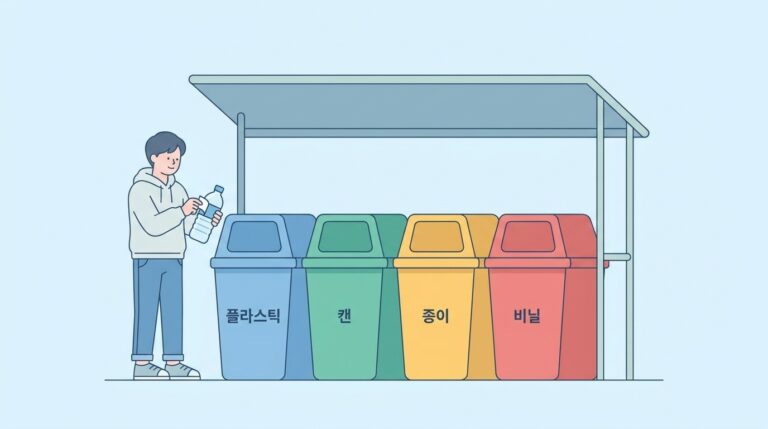
Picture this: You have just finished a delicious takeout meal from a trendy restaurant in Seongsu-dong or enjoyed an iced Americano from a local café. You walk over to the waste station in your apartment complex or near a subway entrance, carrying an empty plastic container, a lid, a straw, and a drink cup. You look at the recycling bins, expecting a simple plastic bin, but instead, you are confronted with a precise sorting station and tiny triangular arrows stamped into the plastic featuring Korean characters like 페트 (PET), 플라스틱 (Plastic), PP, PS, or even 아더 (OTHER).
Then comes the moment of hesitation: Should I rinse this oily tteokbokki tray before throwing it in? Does this plastic lid go in the same bin as the clear bottle? Why does the apartment building security guard (경비아저씨) keep an eye on how people sort their trash?
If you have ever felt confused or anxious about making a recycling faux pas in South Korea, you are not alone! South Korea boasts one of the highest municipal waste recycling rates in the world, backed by strict local laws and strong community standards. Mastering 플라스틱 재질별 분류 기호 (Plastic Recycling Symbols by Material Type) is not just an practical necessity—it is a fast-track pass to living like a respectful, eco-conscious local.
In this guide, curated from real-life experiences of long-term expats and feedback from advanced Korean learners, you will learn sophisticated Korean vocabulary to navigate plastic separation effortlessly, speak with natural fluency, and understand the cultural ethos behind Korea’s impressive waste management culture.
Phase 2: Core Expressions Deep Dive
1. 내용물을 비우고 헹궈서 배출해야 해요.
- Pronunciation: [Nae-yong-mul-eul bi-u-go heng-gwo-seo bae-chul-hae-ya hae-yo.] (Phonetic vibe: “Nay-yong-mool-ool bee-oo-go heng-gwo-suh bae-chool-hae-yah hae-yo”)
- Meaning: “You need to empty the contents, rinse it, and then dispose of it.”
- K-Culture Moment: You will hear this advice constantly on community broadcasts in residential apartments or see it printed on public eco-posters. When ordering food delivery (배달음식), Koreans habitually rinse out containers before putting them out for collection.
- Editor’s Insight: 배출하다 (to discharge/dispose) is a formal legal/administrative term used for municipal waste regulations. Pair it with 비우다 (to empty) and 헹구다 (to rinse) to sound remarkably polished and articulate.
- Situation Spectrum:
- Casual: 내용물 비우고 씻어서 버려. (✅)
- Semi-formal: 내용물을 비우고 헹궈서 배출해야 해요. (✅)
- Formal: 내용물을 비우고 헹군 후 배출하여 주시기 바랍니다. (✅)
- 🤔 Think About It: How does your home country treat unwashed recyclable materials compared to Korea’s emphasis on clean waste collection?
2. 표시된 재질 기호를 확인해 보세요.
- Pronunciation: [Pyo-si-doen jae-jil gi-ho-reul hwa-gin-hae beo-se-yo.] (Phonetic vibe: “Pyoh-si-dwen jae-jeel gee-ho-reul hwah-geen-hae buh-seh-yoh”)
- Meaning: “Please check the marked material symbol.”
- K-Culture Moment: Seen frequently in eco-documentaries or YouTube vlogs demonstrating how to properly separate multi-material products (like a plastic bottle with a vinyl label and a plastic cap).
- Editor’s Insight: 재질 (material type) is a crucial C1-level noun. Instead of using generic words like 종류 (kind) or 타입 (type), using 재질 instantly elevates your command of everyday technical Korean.
- Situation Spectrum:
- Casual: 여기 적힌 재질 기호 좀 봐봐. (✅)
- Semi-formal: 표시된 재질 기호를 확인해 보세요. (✅)
- Formal: 제품 하단에 표시된 재질 기호를 확인하시기 바랍니다. (✅)
- 🤔 Think About It: Why is paying attention to material codes considered an active form of civic mindfulness in modern Korean urban spaces?
3. 이건 라벨을 떼고 플라스틱으로 분류하세요.
- Pronunciation: [I-geon ra-bel-eul tte-go pleu-la-seu-tig-eu-ro bun-ryu-ha-se-yo.] (Phonetic vibe: “Ee-gun rah-bell-ool tteh-goh pleu-lah-seuh-teeg-eu-roh boon-ryoo-hah-seh-yoh”)
- Meaning: “Remove the label from this one and classify it as plastic.”
- K-Culture Moment: Korea instituted a mandatory strict regulation requiring clear PET water bottles (투명 페트병) to have their plastic film labels completely peeled off before disposal.
- Editor’s Insight: Notice the verb 떼다 (to peel off / remove). In casual speech, people say 라벨 뜯다 or 라벨 떼다. 분류하다 (to classify/sort) shows an advanced level of precision.
- Situation Spectrum:
- Casual: 이거 비닐 라벨 떼고 플라스틱에 버려. (✅)
- Semi-formal: 이건 라벨을 떼고 플라스틱으로 분류하세요. (✅)
- Formal: 비닐 라벨을 제거한 후 플라스틱류로 분류해 주십시오. (✅)
- 🤔 Think About It: Notice how Korean packaging designs recently added pre-cut tear lines (절취선) on labels specifically to assist consumers in peeling them off!
Phase 3: Textbook Korean vs. Real Native Korean
Situation 1: Asking how to properly separate a coffee cup with multiple parts
- 📖 Textbook Korean: “플라스틱 컵은 어디에 버려야 합니까?” (Where should I throw away the plastic cup?)
- 🗣️ Real Native Korean: “이 컵, 뚜껑이랑 빨대는 따로 분리해서 버려야 돼요?” (For this cup, do I need to separate the lid and straw individually?)
- 💡 Why the difference? Native Koreans rarely ask where to throw a whole item without acknowledging its component materials. A coffee setup includes a paper sleeve, a plastic straw (usually general waste or hard plastic), a plastic cup, and an ice-filled lid. Native expressions naturally address these component parts.
Situation 2: Inquiring about composite plastics labeled as ‘OTHER’ (아더)
- 📖 Textbook Korean: “이 용기는 재활용이 가능한 재질입니까?” (Is this container a recyclable material?)
- 🗣️ Real Native Korean: “이거 ‘아더(OTHER)’라고 적혀 있는데, 일반 쓰레기예요, 재활용이에요?” (This has ‘OTHER’ written on it—is it general trash or recyclable?)
- 💡 Why the difference? In Korean recycling systems, composite plastics marked as ‘OTHER’ (아더—a blend of multiple plastic layers) are often sorted into general trash (일반 쓰레기) or vinyl recycling (비닐류) depending on local district guidelines. Native speakers directly name the symbol tag (아더) when asking for clarification.
Phase 4: K-Culture Deep Dive & Non-Verbal Etiquette
4-1. Nunchi (눈치) & Recycling Zone Etiquette
In Korean apartment complexes, Sunday evening or Thursday morning is often designated as 분리수거 날 (Recycling Day). Here is how to navigate it with proper Nunchi:
* Observe First: Before dropping your bag, take 3 seconds to look at what others have placed in each hamper. Clear plastic bottles (투명 페트) are separated from colored or opaque plastic (일반 플라스틱).
* The Flattening Gesture: Crushing plastic bottles and stomping on cardboard boxes before discarding them is a silent mark of courtesy to the apartment building staff (경비원 선생님).
* Greeting the Site Manager: If an apartment manager is assisting at the recycling depot, a quick eye contact paired with a slight bow and a friendly “수고하십니다!” (Thank you for your hard work!) goes a very long way.
4-2. Culture Code: The Rise of ‘Zero Waste’ & Transparent PET Laws
In recent years, Korean pop culture and reality shows (such as I Live Alone / 나 혼자 산다) frequently showcase celebrities meticulously peeling labels and washing delivery containers. South Korea strictly enforces the separate collection of 투명 페트병 (Transparent PET bottles) because high-purity clear PET can be recycled into high-value synthetic clothing fibers. Mixing a colored soda bottle into a transparent PET bag is considered a major breach of local rules!
Phase 5: Real-World Roleplay Scenario
Setting: Sunday morning at an apartment recycling zone (분리수거장) in Mapo-gu, Seoul.
Characters:
* You (C1 Learner): A resident wanting to sort complex takeout plastic materials correctly.
* Min-jun (민준): A friendly eco-conscious Korean neighbor holding a box of crushed containers.
“`
[1] You: 안녕하세요! 혹시 배달 용기에 ‘OTHER’라고 쓰여 있는데, 이것도 플라스틱으로 버리면 되나요?
(An-nyeong-ha-se-yo! Hok-si bae-dal yong-gi-e ‘OTHER’-ra-go sseu-yeo in-neun-de, i-geot-do pleu-la-seu-tig-eu-ro beo-ri-myeon doe-na-yo?)
Frequently Asked Questions (FAQ)
Q: What does "내용물을 비우고 헹궈서 배출해야 해요." mean in Korean and how do you pronounce it?
A: In Korean, "내용물을 비우고 헹궈서 배출해야 해요." is pronounced [Nae-yong-mul-eul bi-u-go heng-gwo-seo bae-chul-hae-ya hae-yo.] and means: "You need to empty the contents, rinse it, and then dispose of it."
Q: What does "표시된 재질 기호를 확인해 보세요." mean in Korean and how do you pronounce it?
A: In Korean, "표시된 재질 기호를 확인해 보세요." is pronounced [Pyo-si-doen jae-jil gi-ho-reul hwa-gin-hae beo-se-yo.] and means: "Please check the marked material symbol."
Q: What does "이건 라벨을 떼고 플라스틱으로 분류하세요." mean in Korean and how do you pronounce it?
A: In Korean, "이건 라벨을 떼고 플라스틱으로 분류하세요." is pronounced [I-geon ra-bel-eul tte-go pleu-la-seu-tig-eu-ro bun-ryu-ha-se-yo.] and means: "Remove the label from this one and classify it as plastic."