

Phase 1: Empathy (Story Opening)
안녕하세요! 매일한글 에디터입니다. Welcome back to another lesson with your favorite Korean culture navigator!
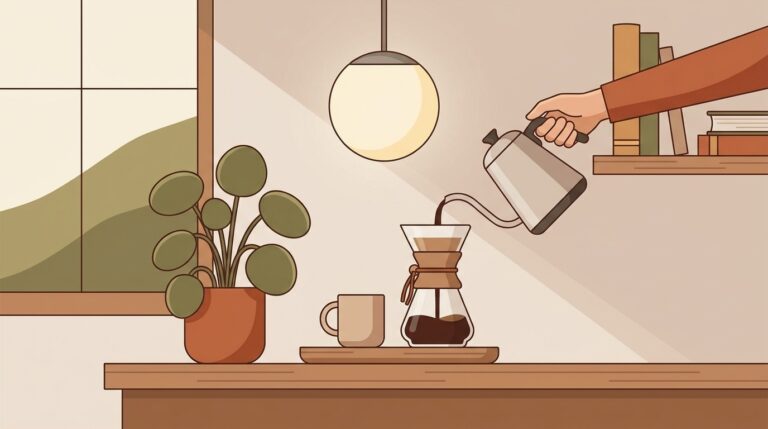
Have you ever scrolled through Instagram or YouTube and stumbled upon those incredibly soothing, aesthetic Korean home cafe vlogs? The sound of ice clinking against glass, espresso pouring smoothly over frothy milk, and a perfectly toasted pastry sitting on a pastel tray. Korea’s love for coffee goes far beyond just grabbing a quick caffeine fix on your way to work—it has evolved into a full-blown artistic lifestyle known as ‘홈카페’ (Home Cafe).
Many of our B1 intermediate learners tell us: “I know how to order an Iced Americano at Starbucks in Seoul, but when my Korean friends talk about brewing coffee at home, using trendy aesthetic slang, or describing roast profiles, I freeze up!”
If you have felt that disconnect between classroom textbook Korean and the actual cozy coffee banter used by locals, this guide was built specifically for you. Based on real student feedback and curated by our editorial team, this module will help you express your coffee tastes, host a trendy home cafe session, and sound like a natural Korean local!
Phase 2: Deep Dive into 3 Core Expressions
1. 취향 저격 (Chwi-hyang jeo-gyeok)
- Pronunciation: [Chwi-hyang jeo-gyeok] (Sounds like “chee-hyang jaw-gyock”)
- Meaning: Literal: “Targeting/Sniper-shooting one’s taste” | Actual Nuance: “Right up my alley” or “Hits the spot perfectly.”
- K-Culture Moment: You often hear this in vlog titles when someone finds the exact cute coffee glass or roast bean profile they’ve been searching for: “오늘 발견한 원두, 완전 취향 저격!”
- Editor’s Insight: Combining ‘취향’ (taste/preference) and ‘저격’ (sniping), this expression vividly describes the exact moment something hits your personal aesthetic or taste buds.
- Situation Spectrum:
- Casual: ✅
- Semi-formal: ✅
- Formal: ⚠️ (Use ‘적절합니다’ or ‘마음에 듭니다’ in formal business presentations)
- 🤔 Think About It: In English, we say “This is so me!” or “Right up my alley.” How does comparing taste to a “sniper shot” change the energy of your expression?
2. 감성 터지다 (Gam-seong teo-ji-da)
- Pronunciation: [Gam-seong teo-ji-da] (Sounds like “gahm-seung tuh-jee-dah”)
- Meaning: Literal: “Sensibility/Aesthetic bursts out” | Actual Nuance: “Overflowing with aesthetic vibes” or “So atmospheric.”
- K-Culture Moment: Used whenever lighting, jazz background music, and a freshly poured latte come together to create that quintessential Korean cozy room atmosphere.
- Editor’s Insight: ‘감성’ (emotional aesthetic/vibe) is the heart of modern Korean youth culture. When combined with ‘터지다’ (to burst), it describes an overwhelming abundance of mood.
- Situation Spectrum:
- Casual: ✅
- Semi-formal: ⚠️
- Formal: 🚫
- 🤔 Think About It: Is there a single word in your native language that captures both mood, aesthetic design, and nostalgic feeling like ‘감성’ does?
3. 홈카페를 차리다 (Hom-ka-pe-reul cha-ri-da)
- Pronunciation: [Hom-ka-pe-reul cha-ri-da] (Sounds like “home-kah-peh-reul chah-ree-dah”)
- Meaning: Literal: “To set up / prepare a home cafe” | Actual Nuance: “To host/set up a cute home cafe spread.”
- K-Culture Moment: When hosting friends over on a Sunday afternoon, Koreans love to present drip coffee, homemade syrups, and neat dessert platters while saying “오늘 우리 집에서 홈카페 차렸어!”
- Editor’s Insight: The verb ‘차리다’ is traditionally used for preparing a full Korean meal (밥상을 차리다). Using it with ‘홈카페’ elevates home coffee making into a full dining experience.
- Situation Spectrum:
- Casual: ✅
- Semi-formal: ✅
- Formal: ⚠️
- 🤔 Think About It: Why do you think modern Koreans prefer bringing the cafe culture into their private living rooms instead of just meeting outside?
Phase 3: Textbook Korean vs. Real Korean
Situation 1: Describing your morning coffee routine
- 📖 Textbook Korean: “저는 아침마다 커피를 만듭니다.” (I make coffee every morning.)
- 🗣️ Real Korean: “저는 아침마다 집에서 커피 내려 마셔요.” (I drip/brew and drink coffee at home every morning.)
- 💡 Why the difference? Native speakers rarely use the general verb ‘만들다’ (to make) for coffee. They prefer ‘내리다’ (to drip/brew) to show the actual brewing process, making your Korean sound far more natural.
Situation 2: Praising someone’s cozy setup
- 📖 Textbook Korean: “방 분위기가 아주 좋습니다.” (The room atmosphere is very good.)
- 🗣️ Real Korean: “조명이랑 음악 덕분에 완전 감성 미쳤는데요?” (Thanks to the lighting and music, the aesthetic is totally insane!)
- 💡 Why the difference? While ‘분위기가 좋다’ is grammatically accurate, young Koreans naturally use ‘감성 미쳤다’ (crazy good vibe) to express genuine admiration for curated indoor spaces.
Phase 4: K-Culture Deep Dive & Non-verbal Manners
4-1. Nunchi (눈치) & Gestures: Serving Home Cafe Coffee
When serving coffee to guests in your Korean home cafe setup:
1. Two-Handed Courtesy: Always pass the coffee cup or glass tray using both hands, or support your right elbow with your left hand. This demonstrates respect and care.
2. The Aesthetic Pause: Before taking the first sip, it is polite to admire the drink visually. Say “와, 예뻐서 못 마시겠어요!” (Wow, it’s so pretty I can’t even drink it!). It shows appreciation for your host’s effort.
4-2. Culture Code: The Rise of ‘홈카페’ & ‘얼죽아’
Why are Koreans so obsessed with home cafes? In densely populated urban areas like Seoul, home cafes represent a personal sanctuary. Coupled with the iconic cultural phenomenon ‘얼죽아’ (Eol-juk-ah: short for “Iiced Americano even if I freeze to death”), Koreans love customizing their cold brews with specialized ice molds, stylish glass containers, and hand-drip setups at home to achieve maximum comfort and style.
Phase 5: Real-Life Roleplay Scenario
Setting: You have invited your Korean friend, Minji (민지), to your apartment. You are preparing a hand-drip coffee with freshly ground beans.
- Minji: 와, 집안에 커피 향기 진짜 좋다! 오늘 무슨 원두야?
(Woah, the coffee aroma inside your home is so good! What beans are these today?) - You: [🎭 Smiling, pointing to the bean bag] 이번에 새로 산 고소한 원두야. 완전 네 취향 저격일걸?
(These are nutty beans I newly bought. I bet they’ll totally hit your taste spot!) - Minji: 정말? 나 고소한 맛 좋아하는 거 어떻게 알고! 홈카페 제대로 차렸네.
(Really? How did you know I love nutty flavors! You really set up a legit home cafe here.) - You: [🎭 Handing over a neatly styled glass with two hands] 잔도 일부러 이쁜 걸로 골랐어. 음악이랑 어울리지?
(I specially picked out a pretty glass too. Matches well with the music, right?) - Minji: 조명에 잔까지… 오늘 감성 진짜 미쳤다! 사진부터 찍어야겠어.
(The lighting, the glass… the aesthetic today is seriously insane! I gotta take a photo first.) - You: [🎭 Laughing gently] 천천히 찍어! 사진 다 찍으면 마셔봐.
(Take your time! Try a sip once you’re done taking photos.) - Minji: [Takes a sip] 와, 산미도 적당하고 대박이다. 바리스타 해도 되겠는데?
(Wow, the acidity is just right, awesome. You could totally be a barista!) - You: 과찬이야~ 자주 놀러오면 맛있는 커피 계속 내려줄게!
(You flatter me~ Come over often and I’ll keep brewing delicious coffee for you!)
🔀 Interactive Branching Point
Minji takes out her phone to film a short video of your home cafe setup for her Instagram Story. How do you respond?
- Option A: “사진 찍지 말고 그냥 마셔! 식어.” (Don’t take photos, just drink! It gets cold.)
- Option B: “예쁘게 찍어서 나도 태그해줘! 감성 넘치게 나왔으면 좋겠다.” (Take a pretty picture and tag me! Hope it turns out super aesthetic.)
- Option C: “안 돼, 집이 지저분해서 촬영 금지야.” (No way, my house is messy so shooting is forbidden.)
Feedback:
* Option A (Bad): 🚫 A bit too blunt! Taking photos is a core part of Korean home cafe culture. Rejecting it abruptly ruins the visual fun.
* Option B (BEST): ✅ Perfect! You embrace the ‘감성’ culture, encourage sharing, and build a fun rapport using relevant home cafe vocabulary.
* Option C (Risk): ⚠️ While self-deprecating humor is fine, shutting down her excitement entirely might create an awkward mood (갑분싸).
Phase 6: 10-Second Emotion Shadowing Drill
Practice speaking these aloud with natural tone and pauses marked by /:
[😊 Proud & Excited]- Korean: 오늘 우리 집에서 / 홈카페 차렸는데 / 놀러 올래?
- Romanization: O-neul u-ri ji-be-seo / hom-ka-pe cha-ryeon-neun-de / nol-leo ol-lae?
- English: I set up a home cafe at my place today / wanna come over?
[☕ Cozy & Aesthetic]- Korean: 잔이랑 조명 덕분에 / 완전 감성 터진다!
- Romanization: Ja-ni-rang jo-myeong deok-bu-ne / wan-jeon gam-seong teo-jin-da!
- English: Thanks to the glass and lighting / it’s overflowing with aesthetic vibes!
[😍 Delighted]- Korean: 이 원두 / 고소한 맛이라서 / 딱 내 취향 저격이야.
- Romanization: I won-du / go-so-han ma-si-ra-seo / ttak nae chwi-hyang jeo-gyeok-i-ya.
- English: These coffee beans / have a nutty flavor / so it hits my taste spot perfectly.
Phase 7: K-Culture Mini Dictionary
- 얼죽아 (Eol-juk-ah)
- Translation: Frozen iced coffee lover (Short for “얼어 죽어도 아메리카노”).
- Usage: Used to describe someone who drinks Iced Americano even during sub-zero winters in Seoul.
- 홈카페 (Hom-ka-pe)
- Translation: Home Cafe.
- Usage: Refers to making aesthetic coffee and desserts at home, complete with stylish glassware and chill background beats.
- 감성 (Gam-seong)
- Translation: Vibe / Aesthetic mood / Emotional warmth.
- Usage: Essential for describing trendy cafes, interior lighting, music, and cozy settings.
- 원두 (Won-du)
- Translation: Roasted coffee beans.
- Usage: Used when discussing coffee taste profiles (e.g., 고소한 원두 – nutty beans, 산미 있는 원두 – fruity/acidic beans).
Phase 8: Survival Kit for Coffee Lovers
Survival Expressions TOP 3
- 산미 적고 고소한 걸로 주세요.
- Romanization: San-mi jeok-go go-so-han geol-ro ju-se-yo.
- Pro Tip: Use this when buying coffee beans in Korea if you dislike sour/acidic notes and prefer deep, nutty coffee.
- 디카페인 원두도 있나요?
- Romanization: Di-ka-pe-in won-du-do in-na-yo?
- Pro Tip: Essential if you want to enjoy a late-night home cafe session without caffeine jitters.
- 이 잔 홈카페용으로 딱이다!
- Romanization: I jan hom-ka-pe-yong-eu-ro ttak-i-da!
- Pro Tip: Say this when shopping for cute glassware at lifestyle shops like Daiso or Butter in Korea.
Editor’s Travel Note
Planning to buy authentic Korean roaster beans for your home cafe setup? Check local roast houses in Seongsu-dong or Yeonnam-dong. You can easily navigate to top-rated specialty roasters by preparing with the [Naver Map App Download] prior to your trip to Seoul.
Phase 9: “One Step Deeper” (Cultural Reflection)
In modern Korea, the rise of home cafe culture reflects a deeper shift toward ‘소확행’ (Small but Certain Happiness). Amid fast-paced urban lives, spending 15 minutes carefully dripping coffee, choosing a special glass cup, and putting on soft jazz music is a meaningful ritual of self-care. It transforms a simple beverage into a comforting emotional escape inside one’s personal living space.
💬 Your Turn: What does your dream home cafe setup look like? Have you ever tried brewing Korean-style iced coffee at home? Share your thoughts in the comments below!
Phase 10: FAQ & Common Mistakes
Q: What is the difference between ‘분위기’ (bun-wi-gi) and ‘감성’ (gam-seong)?
A: ‘분위기’ refers to general atmosphere or mood (e.g., formal atmosphere, lively mood). ‘감성’ specifically refers to emotional, artistic, and aesthetic feelings tailored to personal taste and trendy styling.
Q: Can I use ‘취향 저격’ in formal business settings?
A: It is a slang-adjacent expression best suited for casual conversations, social media, and semi-formal catch-ups. For formal business scenarios, use expressions like “제 기호에 잘 맞습니다” or “매우 만족스럽습니다.”
Q: How do I express that I like fruitier coffee beans in Korean?
A: You can say “저는 산미가 있는 원두를 좋아해요” (I like beans with acidity/fruity notes).
🚨 Common Mistakes TOP 3
- Mistake: Saying “커피를 만들어요” when brewing hand-drip coffee.
- Correct Action: Say “커피를 내려요” (I brew/drip coffee).
- Mistake: Saying “집 카페” instead of the natural term.
- Correct Action: Use the standard trendy term “홈카페”.
- Mistake: Translating “Iced Americano” word-for-word in casual conversation.
- Correct Action: Native speakers frequently abbreviate it to “아아” (A-A) or reference the cultural term “얼죽아”.
Phase 11: Action Missions
- Bronze Mission: Read the Phase 6 Shadowing Drill sentences aloud 3 times focusing on natural pauses.
- Silver Mission: Post a photo of your coffee cup on Instagram or X with the caption: “오늘 우리 집 홈카페 차렸어요 ☕ #매일한글 #홈카페”
- Gold Mission: Tell a Korean friend or your language partner about your coffee preference using “취향 저격” and “산미/고소한 맛” in a full sentence.
🎮 K-Culture Mission: Watch a modern Korean lifestyle vlog on YouTube and write down every time you see or hear the word ‘감성’ or ‘내리다’!
Phase 12: Interactive Quiz Challenge
Question 1 (Situation Judgment)
Your Korean friend brought you a bag of coffee beans that match your exact favorite flavor. What is the most natural casual response?
* A) 아주 만듭니다!
* B) 와, 완전 내 취향 저격이야!
* C) 식당 분위기가 좋습니다.
🔍 Click to view Answer & Explanation
Correct Answer: B) 와, 완전 내 취향 저격이야!
Explanation: ‘취향 저격’ is the perfect authentic expression when someone hits your exact preference!
Question 2 (Fill-in-the-Blank)
아침마다 집에서 핸드드립 커피를 ________ 마셔요. (dripping/brewing)
* A) 내려
* B) 만들어
* C) 씻어
🔍 Click to view Answer & Explanation
Correct Answer: A) 내려
Explanation: The verb ‘내리다’ is used when dripping or brewing coffee in Korean.
Question 3 (True or False Culture Quiz)
‘얼죽아’ means drinking hot coffee only during hot summer days. (T/F)
🔍 Click to view Answer & Explanation
Correct Answer: False
Explanation: ‘얼죽아’ stands for “얼어 죽어도 아메리카노” (Iced Americano even if I freeze to death), meaning drinking iced coffee during freezing winters!







