

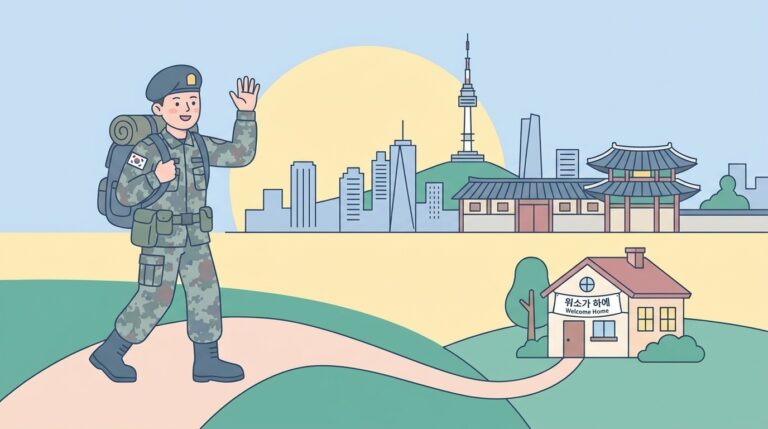
Phase 1: Empathetic Opening
안녕하세요! I’m your Daily Hangul Editor, your trusted 10-year local culture navigator!
Have you ever been hanging out with Korean friends, enjoying a nice meal, when suddenly the conversation turns to boot camps, military rations, or strict command hierarchies? You might notice the guys nodding intensely, laughing over shared memories, or debating who had a tougher time during their service. If you’ve watched K-dramas like D.P. or followed news about your favorite K-Pop idols enlisting, you already know that compulsory military service (징병제 – jingbyeongje) is a defining aspect of life for South Korean men.
For many non-native Korean learners at the B2 level, discussing military service can feel tricky. You want to ask respectful questions, understand the slang, and grasp why this experience forms such a deep bond among Koreans—without causing awkwardness or breaking social etiquette. Today, based on real feedback from intermediate learners, we are decoding the language, etiquette, and social nuances surrounding Korean military culture. By the end of this guide, you’ll be able to navigate these conversations like a true insider!
Phase 2: Key Expressions Analysis
1. 군대 다녀오다 (gun-dae da-nyeo-o-da)
- Pronunciation: [gun-dae da-nyeo-o-da] (Sounds like “Goon-dae dah-nyeo-oh-dah”)
- Meaning: Literal: “To go to and return from the army.” / Nuance: “To complete one’s military service.”
- K-Culture Moment: In a talk show, an MC asks a young male actor who just turned 28, “혹시 군대 다녀오셨나요?” (Have you already served in the military?)
- Editor’s Insight: Instead of using technical verbs like 복무하다 (to serve duty), native speakers almost always use the natural phrasing 군대 다녀오다 when talking in casual or semi-formal settings.
- Situation Spectrum:
- Casual: ✅
- Semi-formal: ✅
- Formal: ⚠️ (Use ‘군 복무를 마치다’ in official interviews)
- 🤔 Think About It: Why do you think Korean society uses the gentle verb phrase “go and return” (다녀오다) for compulsory military service rather than harsh words like “fight” or “enlist”?
2. 군대 썰 (gun-dae sseol)
- Pronunciation: [gun-dae sseol] (Sounds like “Goon-dae sseol”)
- Meaning: Literal: “Military story/tale.” / Nuance: “Funny, bizarre, or dramatic stories from one’s military days.”
- K-Culture Moment: Friends are sitting at a Pocha (street pub). After a few drinks, someone says, “또 군대 썰 시작이다!” (Here goes another military story!)
- Editor’s Insight: ‘썰’ comes from 설설 (storytelling/talking). ‘군대 썰’ is a famous internet and conversational trope in Korea. Everyone knows that once a Korean guy starts unlocking his 군대 썰, the conversation won’t end anytime soon!
- Situation Spectrum:
- Casual: ✅
- Semi-formal: ⚠️
- Formal: 🚫
- 🤔 Think About It: Does your culture have a specific genre of shared storytelling that brings people of the same generation together?
3. 전역하다 (jeon-yeok-ha-da)
- Pronunciation: [jeon-yeo-ka-da] (Sounds like “Jeon-yeo-kah-dah”)
- Meaning: Literal: “To transition to reserve service.” / Nuance: “To be discharged from the military.”
- K-Culture Moment: Fans gather with banners outside a military base entrance as a famous actor steps out in uniform, smiles, and says, “오늘 전역했습니다!” (I was discharged today!)
- Editor’s Insight: Do not confuse 제대하다 (informal/common term for discharge) with 전역하다 (formal/standard term). Both mean discharge, but 전역하다 is widely used in news, official announcements, and polite speech.
- Situation Spectrum:
- Casual: ✅
- Semi-formal: ✅
- Formal: ✅
- 🤔 Think About It: Why is military discharge celebrated so grandly in South Korea compared to many other countries?
Phase 3: Textbook Korean vs. Real Korean
Situation 1: Asking if someone completed military service
- 📖 Textbook Korean: “대한민국 남성으로서 군 복무를 완료하셨습니까?” (Did you complete military service as a South Korean male?)
- 🗣️ Real Korean: “혹시 군필이세요?” or “군대 다녀오셨어요?”
- 💡 Why the difference?: The textbook version sounds like an official military tribunal or government audit! In modern Korean society, ‘군필’ (person who completed military service) is the neat, standard adjective used in real conversations.
Situation 2: Teasing a friend who talks about the army too much
- 📖 Textbook Korean: “군대 이야기를 그만 말씀해 주십시오.” (Please stop speaking about the military.)
- 🗣️ Real Korean: “아, 또 군대 얘기야? 뇌절이다 진짜!”
- 💡 Why the difference?: Close Korean friends love to playfully tease someone who keeps repeating military stories. ‘뇌절’ is a trendy modern slang word meaning ‘overdoing something repeatedly.’
Phase 4: K-Culture Deep Dive & Mannerisms
4-1. Nunchi (눈치) & Gestures
When Koreans talk about military experiences, pay attention to the atmosphere:
1. The Salute (충성 / 필승): You might see guys playfully doing a military salute when saying goodbye or showing respect. Never salute disrespectfully to an actual active-duty soldier in uniform, but among friends, it can be a humorous gesture.
2. Active Listening: If a Korean friend shares a difficult military story, nodding sympathetically (맞아, 고생했네) shows great emotional intelligence (눈치).
4-2. Culture Code Analysis
- The Legend of Choco Pie: In military boot camp, training is physically exhausting and sweet treats are strictly restricted. Sweet snacks like Choco Pie become symbols of comfort and camaraderie. That’s why Choco Pie ads in Korea heavily feature warmth and friendship (情 – Jeong).
- Military Dramas: Shows like D.P. (Deserter Pursuit) resonated deeply with viewers because they showed the raw reality of conscription, prompting nationwide discussions on societal duty and mental health.
Phase 5: Interactive Roleplay Scenario
Setting: A cozy cafe in Hongdae. You are chatting with your Korean friend Minsu (민수) and his friend Jijoon (지준), who was recently discharged from the military.
- Turn 1 (Minsu): 어, 지준아! 전역한 지 얼마 안 됐지? 오랜만이다!
(Eo, Jijun-a! Jeon-yeok-han ji eol-ma an dwaet-ji? O-raen-man-i-da!)
“Hey Jijoon! It hasn’t been long since you were discharged, right? Long time no see!” -
Turn 2 (Jijoon): 🎭 (Proudly touching his short haircut) 응, 이제 한 달 됐어. 사회의 공기가 너무 좋다!
(Eung, i-je han dal dwaes-seo. Sa-hoe-ui gong-gi-ga neo-mu jo-tha!)
“Yeah, it’s been a month now. Fresh civilian air feels amazing!” -
Turn 3 (You): 지준 씨, 전역 축하드려요! 군 생활 많이 힘들지 않으셨어요?
(Jijun ssi, jeon-yeok chu-kha-deu-ryeo-yo! Gun saeng-hwal ma-ni him-deul-ji an-eu-syeos-seo-yo?)
“Jijoon, congratulations on your discharge! Wasn’t military life very hard?” -
Turn 4 (Jijoon): 🎭 (Laughing warmly) 처음에는 힘들었는데, 다 사람 사는 곳이라 적응되더라고요.
(Cheo-eum-e-neun him-deul-eon-deu-ne, da sa-ram sa-neun gos-i-ra jeok-eung-doe-deo-ra-go-yo.)
“It was tough at first, but people live there too, so I adapted.” -
Turn 5 (Minsu): 지준이 특공대 나왔잖아. 또 군대 썰 풀면 밤새워야 해.
(Ji-jun-i teuk-gong-dae na-wat-ja-na. Tto gun-dae sseol pul-myeon bam-sae-wo-ya hae.)
“Jijoon was in the special forces. If he starts unraveling military tales, we’ll be here all night.” -
Turn 6 (You): [Your Turn to Choose! See Branching Point Below]
-
Turn 7 (Jijoon): 🎭 (Eyes lighting up with excitement) 와, 관심 가져주셔서 감사합니다! 그럼 군대 PX 이야기부터 해볼까요?
(Wa, gwan-sim ga-jyeo-ju-syeo-seo gam-sa-ham-ni-da! Geu-reom gun-dae PX i-ya-gi-bu-teo hae-bol-kka-yo?)
“Wow, thanks for showing interest! Shall we start with story about the PX store then?” -
Turn 8 (Minsu): 🎭 (Sighing playfully) 아, 오늘 집에 다 갔다!
(A, o-neul ji-be da gat-da!)
“Ah, looks like we aren’t going home tonight!”
🔀 Interactive Branching Point (Turn 6)
Choose your response to Turn 5:
- Option A: “우와, 특공대요? 군대 이야기 들려주세요! 흥미로워요.”
- Option B: “군대 이야기는 좀 지루한데 다른 얘기 해요.”
- Option C: “충성! 고생 많으셨습니다!”
Feedback:
* Option A (BEST): Excellent choice! Showing genuine curiosity builds great rapport without crossing personal boundaries.
* Option B (BAD): A bit too abrupt! Bluntly dismissing a conversation topic can make the mood awkward.
* Option C (RISK): Funny among close friends, but saluting someone you just met might seem overly theatrical or dramatic!
Phase 6: 10-Second Emotion Shadowing Drill
Practice reading these sentences aloud with exact emotional cadence. Use / as pause indicators!
[😊 Proud and Happy]
저 이번 주에 / 드디어 / 전역합니다!
(Jeo i-beon ju-e / deu-di-eo / jeon-yeok-ham-ni-da!)
“I am finally / being discharged / this week!”-
[🥺 Sympathetic and Warm]
추운 날씨에 / 군대에서 / 고생 많으셨겠어요.
(Chu-un nal-ssi-e / gun-dae-e-seo / go-saeng ma-neu-syeos-ges-seo-yo.)
“In such cold weather / serving in the army / you must have worked so hard.” -
[🤣 Playful and Teasing]
또 군대 썰이야? / 그 얘기는 / 벌써 세 번째라고!
(Tto gun-dae sseol-i-ya? / Geu i-ya-gi-neun / beol-ssoe se beon-jae-ra-go!)
“Another military story? / That tale / is already the third time!”
Phase 7: K-Culture Mini Dictionary
- 입대 (Iptae) | Enlistment | Entering boot camp to begin military duty.
- 전역 (Jeonyeok) | Discharge | Official completion of active military service.
- 군필 (Gunpil) | Military-completed | A person who has fulfilled their mandatory military service.
- 짬밥 (Jjambap) | Military cafeteria meal / Experience | Slang referring to military cafeteria food, or idiomatically referring to seniority/experience at work.
Phase 8: Traveler’s Survival Kit
Survival Expressions TOP 3
- “군대 잘 다녀오세요!” (Go and serve safely!) – Used when wishing someone well before enlistment.
- “고생 많으셨어요.” (You worked hard.) – A polite compliment when someone mentions their past service.
- “PX에서 뭐 제일 많이 드셨어요?” (What did you eat most at the military store?) – A fun conversation starter!
Editor’s Travel Note
When navigating Korean cities or military-adjacent area express buses, accurate navigation is essential. Be sure to check the [Naver Maps app download] for real-time transit routes across South Korea.
Phase 9: A Deeper Look (Insight Essay)
In South Korea, compulsory service is more than a legal obligation; it is a shared cultural rite of passage that shapes social dynamics, workplace bonding, and interpersonal relationships. Because almost all young men serve roughly 18 months together, it creates a unique sense of camaraderie (동지애). Understanding military culture provides deeper insights into Korean values of team hierarchy, discipline, and mutual empathy.
💬 Your Turn: Does your country have mandatory military service or a similar shared societal rite of passage? How does it affect language and culture in your home country? Share your thoughts in the comments below!
Phase 10: FAQ & Common Mistakes
Q: Is it rude to ask a Korean man if he has served in the military?
A: Not at all! Asking casual questions like “군대 다녀오셨어요?” is standard conversational small talk among adults. However, avoid digging into sensitive medical exemptions unless they bring it up first.
Q: Can women use military terms like ‘짬밥’ or ‘군대 썰’?
A: Yes! These terms have entered common slang used by everyone in daily life, television shows, and offices.
Q: What is the difference between 입대 (Iptae) and 입대 예정 (Iptae Yejeong)?
A: ‘입대’ means the act of enlisting today or in general, while ‘입대 예정’ means someone has received their military draft date and is scheduled to enlist in the near future.
🚨 Common Mistakes TOP 3
- Mistake: Using military commands like “필승!” (Victory!) to your boss at work.
- Correct Action: Stick to standard office greetings like “안녕하십니까!”
- Mistake: Calling active soldiers “군대 아저씨” (Military Uncle) as an adult.
- Correct Action: Use “군인 아저씨” only if you are a young child writing a letter; adults say “군인 분들” respectfully.
- Mistake: Confusing ‘전역’ (Discharge) with ‘퇴사’ (Resigning from a company job).
- Correct Action: Use ‘전역’ for military discharge and ‘퇴사’ for leaving a civilian job.
Phase 11: Action Missions
- 🥉 Bronze Mission: Record yourself pronouncing “군대 다녀오셨어요?” 3 times with standard Korean intonation.
- 🥈 Silver Mission: Watch a short clip of a Korean variety show featuring military topics and spot the word ‘전역’.
- 🥇 Gold Mission: Use the phrase “고생 많으셨어요!” in a context with a Korean friend when discussing past hard work.
🎮 K-Culture Mission: Watch an episode of the Korean drama D.P. or Crash Landing on You and identify 2 military terms mentioned in the subtitles!
Phase 12: Interactive Quiz Challenge
Q1. Situation Judgment
Your Korean friend mentions he is entering boot camp next week. What is the most natural and warm thing to say?
* A) 전역 축하해요!
* B) 군대 잘 다녀오세요! 고생 많으시겠어요.
* C) 뇌절하지 마세요!
🔍 Click to view Answer & Explanation
Correct Answer: B
Explanation: Option B (“Go and serve safely! You’ll work hard.”) is the standard warm wish. Option A is for discharge (end of service), and Option C is teasing slang.
Q2. Fill in the Blank
Complete the sentence: “민수 씨는 군 복무를 마친 ( _____ )입니다.”
* A) 짬밥
* B) 군필
* C) 입대
🔍 Click to view Answer & Explanation
Correct Answer: B
Explanation: ‘군필’ refers to someone who has completed military service.
Q3. True or False
True or False: The word ‘군대 썰’ can be used in official business contract meetings in South Korea.
🔍 Click to view Answer & Explanation
Correct Answer: False
Explanation: ‘썰’ is casual conversational slang. Use ‘군 복무 경험’ or official terms in formal business settings.







