

Phase 1: Empathy & Storytelling
안녕하세요! 매일한글 에디터입니다. (Hello! I’m your lead editor at Daily Hangul!)
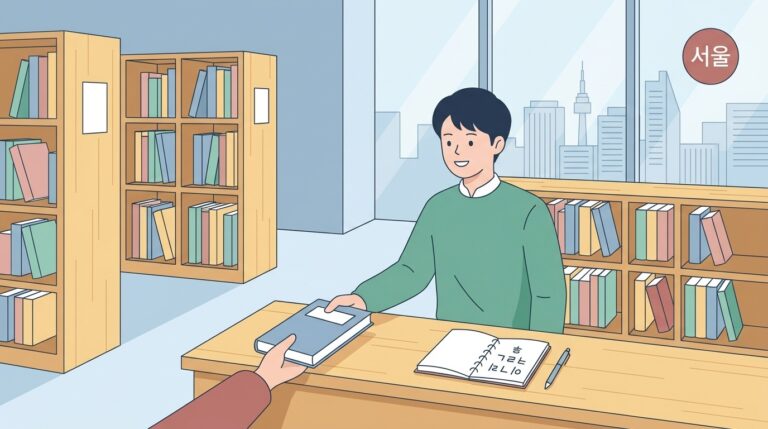
Have you ever stepped into a quiet Korean public library—like the iconic Namsan Public Library overlooking Seoul or a cozy neighborhood library in Mapo—found a wonderful book or Korean comic, and suddenly felt a wave of anxiety at the checkout desk? You hold the book in your hands, the librarian looks up at you with a warm smile, and your mind goes completely blank. Do you say “I want book” or try to recite a complex sentence from a textbook?
You are not alone! Many of our A2-level Korean learners tell us that interacting in quiet, formal public spaces feels twice as intimidating as ordering coffee at a lively cafe. But here is the good news: borrowing a book in Korea requires only a few clear, polished phrases. Based on real feedback from international residents and students in Korea, this guide will turn that quiet library moment into a confident, smooth experience. Let’s make your next library visit totally stress-free!
Phase 2: Key Expressions Deep Dive
1. 이 책 대출해 주세요. (I’d like to check out this book, please.)
- Pronunciation: [I chaek dae-chul-hae ju-se-yo] (Sounds like: Ee check day-chool-hae joo-say-yo)
- Meaning: “Please check out this book for me.” (대출 means borrowing/checkout).
- K-Culture Moment: Seen in classic cozy Korean drama scenes where characters hand over a stack of novels at the local community library.
- Editor’s Insight: While beginners often use 빌려주세요 (Please lend me), the official and standard word used at library counters in Korea is 대출 (checkout/borrowing).
- Situation Spectrum: Casual 🚫 | Semi-formal ✅ | Formal ✅
- 🤔 Think About It: Why do Korean public services prefer Sino-Korean words like 대출 (대/貸 + 출/出) over native Korean verbs in official settings?
2. 도서관 회원증 있어요. (I have a library card.)
- Pronunciation: [Do-seo-gwan hwe-won-jeung it-seo-yo] (Sounds like: Doh-suh-gwan hway-won-jung eat-saw-yo)
- Meaning: “I have a library membership card.”
- K-Culture Moment: Tapping a digital library card on a smartphone screen at the automated counter.
- Editor’s Insight: Most Korean libraries now accept digital library cards via mobile apps or KakaoTalk membership cards alongside physical cards!
- Situation Spectrum: Casual ⚠️ | Semi-formal ✅ | Formal ✅
- 🤔 Think About It: How does the seamless integration of digital IDs in Korea shape everyday interactions at public utilities?
3. 반납일이 언제예요? (When is the due date?)
- Pronunciation: [Ban-nap-ir-i eon-je-ye-yo?] (Sounds like: Bahn-nahb-ee-ree un-jay-yuh-yo?)
- Meaning: “When is the return date?” (반납 means returning items).
- K-Culture Moment: Asking the staff while checking the stamped receipt or receipt slip.
- Editor’s Insight: Adding -예요 makes your question polite yet natural for beginner A2 speakers.
- Situation Spectrum: Casual ⚠️ | Semi-formal ✅ | Formal ✅
- 🤔 Think About It: In Korean, dates are structured from largest unit to smallest (Year-Month-Day). How does this reflect systemic thinking?
Phase 3: Textbook Korean vs. Real Korean
Situation 1: Asking to check out a book
- 📖 Textbook Korean: 저는 이 책을 대출하기를 원합니다. (I desire to check out this book.)
- 🗣️ Real Korean: 이 책 대출하고 싶어요. / 이 책 대출해 주세요. (I’d like to check this out, please.)
- 💡 Why is it different? Native speakers rarely use overly literal phrasing like “~하기를 원합니다” in real life. Polite ending ~해 주세요 is much more natural and friendly.
Situation 2: Asking when to return the book
- 📖 Textbook Korean: 반납 기한을 말씀해 주시겠습니까? (Would you kindly inform me of the return deadline?)
- 🗣️ Real Korean: 언제까지 반납해야 돼요? (By when do I need to return this?)
- 💡 Why is it different? While textbook Korean overuses formal honorific suffixes, everyday library interactions rely on clear, concise, standard polite Korean (~해야 돼요).
Phase 4: K-Culture Deep Dive & Non-verbal Manners
4-1. Nunchi (눈치) & Gestures
When handing over your books and library card to the staff:
1. Two-handed etiquette: Always place your library card or smartphone on the counter using both hands (or holding your right elbow gently with your left hand).
2. Slight Head Bow: Give a quick 15-degree head bow when approaching the counter and when saying 감사합니다 (Thank you) upon receiving your books.
4-2. Culture Code: Digital Libraries & Silent Courtesy
Korean public libraries are models of efficiency and quiet courtesy. Many modern libraries in Seoul feature automated self-checkout kiosks (자구대출반납기). However, if you are an international resident using a physical desk, staff appreciate quick and concise communication so as not to disturb the quiet atmosphere.
Phase 5: Real-Life Roleplay Scenario
Setting: Mapo Public Library Desk.
NPC: Friendly Staff Member (직원)
- Staff: 안녕하세요! 책 대출해 드릴까요?
(An-nyeong-ha-se-yo! Chaek dae-chul-hae deu-ril-kka-yo?)
[Hello! Shall I check out these books for you?]
🎭 Hands welcomingly open over counter -
Learner: 네, 이 책 대출해 주세요.
(Ne, i chaek dae-chul-hae ju-se-yo.)
[Yes, please check out this book.]
🎭 Placing book gently on counter with both hands -
Staff: 네, 회원증 보여주시겠어요?
(Ne, hwe-won-jeung bo-yeo-ju-si-get-seo-yo?)
[Sure, could you show me your library card?] -
Learner: 여기 도서관 회원증 있어요.
(Yeo-gi do-seo-gwan hwe-won-jeung it-seo-yo.)
[Here is my library card.]
🎭 Showing barcode on smartphone screen -
Staff: 네, 확인되었습니다. 2주 동안 빌리실 수 있어요.
(Ne, hwa-gin-doe-eot-seum-ni-da. I-ju dong-an bil-li-sil su it-seo-yo.)
[Yes, confirmed! You can borrow it for 2 weeks.] -
Learner: 감사합니다. 반납일이 정확히 언제예요?
(Gam-sa-ham-ni-da. Ban-nap-ir-i jeong-hwag-hi eon-je-ye-yo?)
[Thank you. When exactly is the return date?] -
Staff: 10월 24일까지 반납하시면 됩니다.
(Si-wol i-sip-sa-il-kka-ji ban-nap-ha-si-myeon doem-ni-da.)
[You just need to return it by October 24th.] -
Learner: 알겠습니다. 수고하세요!
(Al-get-seum-ni-da. Su-go-ha-se-yo!)
[Understood. Thank you for your work!]
🔀 Interactive Choice Point
The librarian asks for your membership card, but you left your physical card home and only have your phone screen screenshot.
- Option A: Throw your hands up and say “카드 없어요, 그냥 해주세요” (No card, just do it).
- Option B: Point to your phone and politely ask: “모바일 회원증도 돼요?” (Does a mobile member card work?)
- Option C: Silently bow and walk away without saying anything.
Feedback:
* Option A (BAD/RISK): Impolite! Demand-based language can cause discomfort in Korean customer settings.
* Option B (BEST): Perfect A2 strategy! 모바일 회원증도 돼요? shows polite inquiry and initiative.
* Option C (BAD): Avoidable! Korean library staff are eager to help if you ask simply.
Phase 6: 10-Second Emotion Shadowing Drill
Practice reading these out loud with natural pauses (/) and emotional tone:
[😊 Friendly & Polite]
안녕하세요! / 이 책 / 대출해 주세요.
(An-nyeong-ha-se-yo! / I chaek / dae-chul-hae ju-se-yo.)-
[🥺 Inquiringly]
실례지만… / 반납일이 / 언제예요?
(Sil-rye-ji-man… / Ban-nap-ir-i / eon-je-ye-yo?) -
[😄 Grateful]
네! / 감사합니다. / 수고하세요!
(Ne! / Gam-sa-ham-ni-da. / Su-go-ha-se-yo!)
Phase 7: K-Culture Mini Dictionary
- 대출 (Dae-chul) | Checkout / Borrowing
Used specifically for borrowing books or official loans. Example: 대출 기간 (Borrowing period). - 반납 (Ban-nap) | Return
Returning borrowed property. Example: 반납함 (Book return drop box). - 연체 (Yeon-che) | Overdue status
If a book is late, your account gets 연체. You cannot borrow books for the number of days you were late! - 회원증 (Hwe-won-jeung) | Membership Card
Your ID card for library services, either physical card or mobile QR barcode.
Phase 8: Traveler’s Survival Kit
Top 3 Fast Expressions
- 이 책 빌릴 수 있어요? (Can I borrow this book?)
- 반납함이 어디에 있어요? (Where is the book return drop box?)
- 연체료 있어요? (Is there an overdue fee?)
Editor’s Travel Note
Before visiting local libraries, download the Naver Map App for Route Navigation. Search for ‘도서관’ (Library) to locate public libraries nearby. Most public libraries offer free Wi-Fi, air conditioning, and quiet reading lounges open to visitors!
Phase 9: One Step Deeper
Public libraries in Korea represent a deeply rooted civic culture of mutual respect. In Korean society, shared spaces require quiet mindfulness called 타인에 대한 배려 (consideration for others). Notice how librarian interactions are soft-spoken and efficient. By learning proper library terms, you aren’t just borrowing a book—you are actively participating in Korean community life with cultural respect.
💬 Your Turn: Have you ever visited a library in Korea or your hometown? What was your experience? Share in the comments below!
Phase 10: FAQ & Common Mistakes
Q: Can foreigners get a public library card in Korea?
A: Yes! Foreign residents with an Alien Registration Card (ARC) or Residence Certificate can register at most municipal public libraries in Korea.
Q: What if the library is closed when I want to return a book?
A: You can use the unmanned book drop box (무인 반납함) usually located near the main entrance of the library.
Q: Is there an overdue fine for late books in Korea?
A: Usually public libraries in Korea do not charge money for late books. Instead, your borrowing privileges are suspended for the exact number of days your book was overdue.
🚨 Common Mistakes Warning Board
- Mistake: Using 사다 (to buy) instead of 대출하다 (to borrow).
- Correct Action: Say 대출해 주세요 at library counter, not 사고 싶어요.
- Mistake: Speaking in high volume at the counter.
- Correct Action: Lower your voice pitch to maintain library quiet atmosphere.
- Mistake: Handing cards with one hand casually.
- Correct Action: Use two hands to hand over your library card or phone.
Phase 11: Action Missions
- 🥉 Bronze Mission: Practice saying “이 책 대출해 주세요” 3 times out loud in front of a mirror.
- 🥈 Silver Mission: Save a screenshot of a mobile library membership QR code on your phone.
- 🥇 Gold Mission: Visit a local Korean library, find a book, and successfully check it out speaking only Korean!
🎮 K-Culture Mission: Watch a scene in a Korean university drama (like Cheese in the Trap) and spot characters using library desks or self-checkout machines!
Phase 12: Interactive Quiz Challenge
Question 1: What is the correct term for checking out a library book in Korean?
1) 환불
2) 대출
3) 결제
🔍 Click to view Answer & Explanation
Answer: 2) 대출 (Dae-chul)
Explanation: 대출 means checking out/borrowing books. 환불 is refund and 결제 is payment!
Question 2: Fill in the blank: “반납일이 _____예요?” (When is the return date?)
1) 누구
2) 어디
3) 언제
🔍 Click to view Answer & Explanation
Answer: 3) 언제 (Eon-je)
Explanation: 언제 means ‘when’. The full sentence means “When is the return date?”
Question 3: True or False: You should use both hands when handing your library card to staff.
🔍 Click to view Answer & Explanation
Answer: TRUE!
Explanation: Handing objects with both hands is a essential polite gesture in Korean culture.






