

Understanding “Jeong” (情) Through Korea’s Iconic Choco Pie Ads
Phase 1: Empathy & Storytelling
안녕하세요! 매일한글 에디터입니다. Have you ever received an unexpected gift from a Korean friend or street vendor—like an extra dumpling, a free drink, or a warm piece of advice when you looked lost? In Korea, there is a deep, intangible emotional bond called Jeong (情) that connects people, even complete strangers.
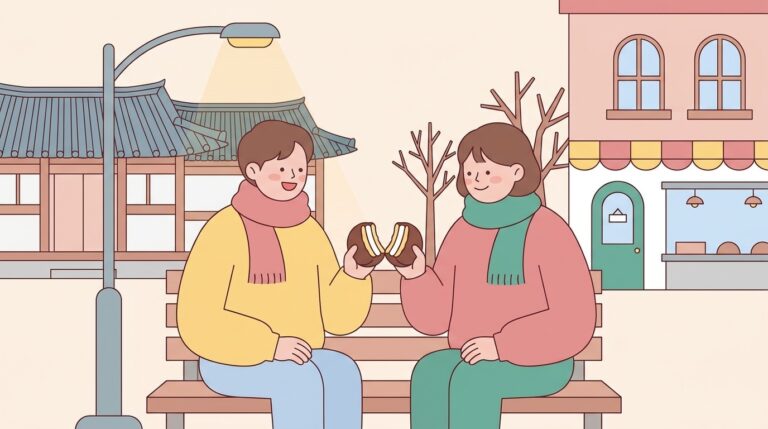
If you’ve watched classic Korean commercials, you’ve likely seen the legendary Orion Choco Pie ads featuring the single Chinese character 情 (정). One famous ad shows a young boy quietly slipping a Choco Pie into his bus driver’s pocket to show gratitude. No grand speeches, no theatrical displays—just a soft chocolate treat carrying unspoken warmth. For many intermediate learners, understanding Jeong is the turning point where textbook Korean transforms into genuine cultural fluency. This guide brings you practical expressions and cultural insights so you can recognize, receive, and express Jeong naturally!
Phase 2: Core Expressions Breakdown
1. 정이 들다 (Jeong-i deul-da)
- Pronunciation: [Jeong-ee deul-da] (Sounds like “Jung-e” + “dul-da”)
- Meaning: Literal: “Jeong enters” / Actual: To grow fond of someone or something over time.
- K-Culture Moment: In Korean dramas, characters who start off as enemies often end up saying this after going through shared hardships together.
- Editor’s Insight: Unlike falling in love instantly, Jeong-i deul-da describes a quiet, cumulative warmth that sneaks up on you.
- Situation Spectrum: Casual ✅ | Semi-formal ✅ | Formal ⚠️
- 🤔 Think About It: Is there a concept in your culture that describes affection built purely on shared time rather than initial attraction?
2. 마음만이라도 고마워요 (Ma-eum-man-i-ra-do go-ma-wo-yo)
- Pronunciation: [Mah-eum-mah-ni-rah-do go-mah-wo-yo]
- Meaning: Literal: “Even just your heart/intention, I’m thankful” / Actual: “It’s the thought that counts!”
- K-Culture Moment: Offered when someone tries to help you or offers you a treat like a Choco Pie, but you politely decline while acknowledging their kindness.
- Editor’s Insight: It balances politeness with warmth, ensuring the giver feels appreciated without feeling burdened.
- Situation Spectrum: Casual ⚠️ | Semi-formal ✅ | Formal ✅
- 🤔 Think About It: How do you decline a gesture of kindness in your language without making the other person feel rejected?
3. 덤으로 주셨어요 (Deom-eu-ro ju-syeos-seo-yo)
- Pronunciation: [Deom-eu-ro joo-syuhs-seo-yo] (Sounds like “Dome-oo-ro”)
- Meaning: Literal: “They gave it as Deom” / Actual: “They gave it to me as a free bonus extra!”
- K-Culture Moment: Vendors at traditional markets (or cozy neighborhood shops) sliding an extra treat into your bag with a quiet smile.
- Editor’s Insight: Deom is the physical manifestation of Jeong. It’s not a corporate promotional discount, but a human gift.
- Situation Spectrum: Casual ✅ | Semi-formal ✅ | Formal 🚫
- 🤔 Think About It: Why do small unscripted freebies feel so much warmer than official store coupons?
Phase 3: Textbook Korean vs Real Korean
Situation 1: Expressing gratitude for a small surprise treat
- 📖 Textbook: 선물해 주셔서 정말 감사합니다. (Thank you very much for giving me a present.)
- 🗣️ Real Korean: 와, 이런 걸 다 챙겨 주시고… 진짜 정이 넘치시네요! (Wow, you didn’t have to prepare this… You’re truly so full of Jeong!)
- 💡 Why the difference?: Real Korean highlights the caring attitude (챙기다) and the emotional bond (정) rather than treating the gesture like a formal exchange.
Situation 2: Declining a neighbor’s generous food gift gently
- 📖 Textbook: 저는 괜찮으니 안 주셔도 됩니다. (I am okay so you do not need to give it to me.)
- 🗣️ Real Korean: 마음만으로도 너무 감사해요, 항상 챙겨 주셔서 힘이 돼요! (I am so thankful just for your warm thought, caring for me always gives me strength!)
- 💡 Why the difference?: Simply saying “I’m okay” sounds cold; affirming their care preserves the warm social connection.
Phase 4: K-Culture Deep Dive & Non-verbal Manners
4-1. Nunchi & Gestures of Jeong
When sharing treats like a Choco Pie in Korea:
* Two-Handed Delivery: Handing over even a small snack with both hands (or touching your forearm with your free hand) signals respect and genuine warmth.
* Soft Eye Contact & Nods: A humble head tilt while receiving a deom (extra bonus) demonstrates humility.
* Nunchi Tip: If a colleague leaves a snack on your desk while you’re away, don’t just send a text message—say a warm word in person later!
4-2. Culture Code: The Choco Pie Commercial Legacy
In 1989, Orion launched the famous “Jeong” campaign. Instead of boasting about chocolate taste or price, the commercials focused on quiet acts of caring: a student giving a pie to a school guard, or a soldier sharing a snack with a buddy. This embedded Choco Pie into the Korean consciousness as a symbol of unspoken affection.
Phase 5: Real Roleplay Scenario
Scenario: You are visiting your neighborhood small market shop, and the friendly store owner (Imo / Auntie) slips an extra Choco Pie into your bag.
- Owner: 손님, 오늘 날씨 추운데 이것 좀 먹으면서 가요. (Dear customer, it’s cold today, take this to eat on your way.)
- You: 🎭 (Surprised and touched, holding the bag with two hands) 어머, 초코파이네요! 이거 저 주시는 거예요? (Oh, a Choco Pie! Are you giving this to me?)
- Owner: 그럼요! 단골인데 덤으로 하나 더 챙겨주는 거지. (Of course! You’re a regular, so I’m giving an extra bonus.)
- You: 🎭 (Smiling warmly, lowering head slightly) 와, 사장님 진짜 정이 넘치세요! (Wow, boss, you really have so much Jeong!)
- Owner: 별것도 아닌데 뭘. 매일 고생 많아요. (It’s nothing at all. You work hard every day.)
- You: 🎭 (Placing hand gently on chest) 마음만으로도 감사한데, 맛있게 잘 먹을게요! (I’m grateful just for the thought, but I’ll enjoy eating it!)
- Owner: 그래요, 힘내요! (Sure, stay strong!)
- You: 🎭 (Waving politely with a big smile) 감사합니다! 조심히 계세요! (Thank you! Take care!)
🔀 Interactive Choice Point
How will you respond when the owner gives you the free extra snack?
* Option A: “이거 공짜예요? 얼마예요?” (Is this free? How much is it?)
* Option B: “마음만으로도 감사해요, 맛있게 먹을게요!” (I’m grateful just for the thought, I’ll eat it deliciously!)
* Option C: “저는 다이어트 중이라 안 먹어요.” (I am on a diet so I won’t eat it.)
Feedback:
* Option A [Risk]: Asking “Is it free?” treats a warm emotional gesture like a suspicious transaction!
* Option B [Best]: Perfectly acknowledges the sentiment (마음) while accepting the kindness gracefully!
* Option C [Bad]: Rejecting flatly ruins the warm atmosphere and makes the owner feel awkward.
Phase 6: 10-Second Emotion Shadowing Drill
[🥺 Warm and Touched]
마음만으로도 / 너무 감사해요! / 잘 먹을게요.
(Ma-eum-man-eu-ro-do / neo-mu gam-sa-hae-yo! / jal meok-geul-ge-yo.)-
[😊 Cheerful and Grateful]
와, / 덤으로 주신 거예요? / 사장님 최고!
(Wa, / deom-eu-ro ju-sin geo-ye-yo? / sa-jang-nim choe-go!) -
[🥰 Fond and Nostalgic]
함께 지내다 보니 / 정말 정이 많이 들었어요.
(Ham-kke ji-nae-da bo-ni / jeong-mal jeong-i man-i deul-eoss-eo-yo.)
Phase 7: K-Culture Mini Dictionary
- 정 (Jeong / Warm Attachment): The unique Korean emotional connection formed through shared time, mutual care, and practical kindness.
- 덤 (Deom / Free Extra): Extra goods given freely by sellers out of goodwill rather than promotional obligation.
- 챙겨주다 (Chaeng-gyeo-ju-da / To Look After Someone): Acts of paying attention to someone’s well-being, like offering food or checking up on them.
- 단골 (Dan-gol / Regular Customer): A frequent patron of a business who often develops a Jeong-based relationship with the owner.
Phase 8: Survival Kit for Travelers
Survival Top 3 Phrases
- 이거 덤이에요? (Is this an extra bonus?) – Use when a vendor gives you something extra.
- 정말 정이 많으시네요! (You are so full of warm Jeong!) – Use to compliment a helpful local.
- 따뜻한 마음 감사해요. (Thank you for your warm heart.) – Perfect for thanking someone for kindness.
Editor’s Travel Note
When exploring traditional markets like Gwangjang Market or local neighborhood eateries, experiencing Jeong is easy if you show warmth first. Try using the Naver Map App Download to locate authentic neighborhood markets rather than tourist-heavy zones. Carrying cash or small change also helps when buying from elderly vendors!
Phase 9: One Step Deeper
Korean Jeong isn’t always logical or clean-cut. Unlike Western concepts of friendship bounded by clear personal space, Jeong can sometimes feel slightly intrusive because it stems from viewing others as part of one’s extended community. Giving a Choco Pie or an extra side dish isn’t about the monetary value—it is an affirmation that “we are connected.” Understanding this shift allows you to move from viewing Korean social behavior as overly polite or overly personal, and instead see it as a warm web of human care.
💬 Your Turn: Have you ever experienced a moment of Jeong in Korea or in your home country? Share your story in the comments below!
Phase 10: FAQ & Common Mistakes
Q: Is Jeong the same thing as love (사랑)?
A: No! Sarang (love) is often romantic or passionate, whereas Jeong is a quiet, comfortable emotional attachment that grows over time through shared experiences.
Q: Can I give a single Choco Pie as a gift, or is that too cheap?
A: In Korean culture, sharing a snack like a Choco Pie is about the heart (마음), not the money. Giving a snack casually to a coworker with a friendly note is seen as a sweet gesture of Jeong.
Q: How do I know if someone is showing Jeong or just being professional?
A: Professional courtesy follows standard script lines. Jeong usually involves unscripted personal care, such as asking if you’ve eaten (밥 먹었어요?) or giving an extra side dish (덤).
🚨 Common Mistakes
- ❌ Mistake 1: Saying “얼마예요?” (How much is it?) when a shopkeeper gives you Deom.
👉 Correct Action: Smile and say “마음만으로도 감사해요, 잘 먹을게요!” - ❌ Mistake 2: Expecting Jeong immediately upon meeting someone.
👉 Correct Action: Remember that Jeong-i deul-da takes time and shared interactions. - ❌ Mistake 3: Refusing food gifts abruptly because you are full.
👉 Correct Action: Express gratitude first before explaining politely.
Phase 11: Action Missions
- 🥉 Bronze Mission: Practice saying “정과 마음만이라도 감사해요” out loud 3 times with warm emotion.
- 🥈 Silver Mission: Share a photo of your favorite Korean snack on social media using #DailyHangul #JeongCulture.
- 🥇 Gold Mission: Next time you visit a local Korean grocery store or restaurant, thank the host using “정말 따뜻하게 챙겨주셔서 감사합니다!”
🎮 K-Culture Mission: Watch a classic Korean commercial or drama scene featuring Choco Pie and spot how characters express affection without saying “I love you”.
Phase 12: Interactive Quiz Challenge
Q1. What is the best phrase to express that you’ve grown attached to someone over time?
A) 정이 들었어요
B) 값이 싸요
C) 계산해 주세요
See Answer & Explanation
Answer: A
‘정이 들었어요’ means “I have grown fond of you / Jeong has entered.”
Q2. True or False: “Deom” (덤) is a discount coupon issued by official corporate stores.
See Answer & Explanation
Answer: False
‘Deom’ refers to extra treats or items given freely by vendors out of human warmth and generosity!







