

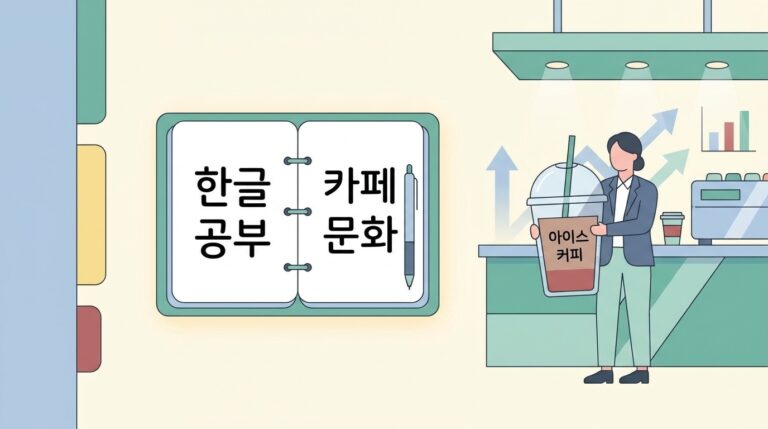
Master Korean Business & Coffee Culture: The Secrets Behind Low-Cost, Massive-Volume Coffee Franchises
안녕하세요! 매일한글 에디터입니다. Welcome back to another deep dive into Korean language and culture! Have you ever walked down a street in Seoul—say, near Gangnam or Yeouido during the peak lunch rush—and noticed a endless queue outside mega-sized coffee shops selling a giant 24oz Iced Americano for just 1,500 KRW (roughly $1.10)? You might wonder: How on earth do these places survive, let alone generate substantial profits?
If you are an advanced learner aiming for native-level proficiency (C2), understanding simple coffee orders isn’t enough anymore. To truly grasp contemporary Korean society, business dynamics, and modern urban lifestyle, you need to understand terms like 박리다매 (high-volume, low-margin sales), 회전율 (turnover rate), and 부자재 마진 (subsidiary material margins).
Today, we are unpacking the intricate economic ecosystem and nuanced business Korean behind Korea’s ultra-low-cost, high-volume coffee franchise boom. By mastering these C2-level terms and business idioms, you won’t just speak fluent Korean—you’ll understand the economic mindset driving everyday life in modern Korea. Let’s jump right in!
Phase 2: Key Expressions Analysis (C2 Business & Culture)
1. 박리다매로 승부를 보다 (Bak-ri-da-mae-ro seung-bu-reul bo-da)
- Pronunciation: [Bak-ri-da-mae-ro seung-bu-reul bo-da] (Sounds like “Bahk-ree-dah-mae-roh seung-boo-reul boh-dah”)
- Meaning: Literal: To bet everything on small margins and large sales volume. / Nuance: To rely on a high-volume, low-margin strategy to dominate the market.
- K-Culture Moment: Commonly used in business news and startup meetings when discussing franchise business models like Mega Coffee, Paik’s Coffee, or Compose Coffee.
- Editor’s Insight: ‘박리다매’ (薄利多賣) is a four-character idiom (사자성어). Pairing it with ‘승부를 보다’ (to make a decisive move/gamble) emphasizes a aggressive corporate strategy to survive fierce competition.
- Situation Spectrum: Casual 🚫 | Semi-formal ⚠️ | Formal ✅
- 🤔 Think About It: How does your home country’s coffee market balance low pricing against rising inflation and real estate rents?
2. 회전율을 극대화하다 (Hoe-jeon-yureul geuk-dae-hwa-hada)
- Pronunciation: [Hoe-jeon-yureul geuk-dae-hwa-hada] (Sounds like “Way-jeon-yoo-reul geuk-dae-hwah-hah-dah”)
- Meaning: Literal: To maximize table turnover rate. / Nuance: To optimize operational speed and customer flow so products sell rapidly in tight timeframes.
- K-Culture Moment: Franchise operators designing kiosk layouts and pick-up zones specifically to eliminate seating and encourage rapid takeaway during lunch breaks.
- Editor’s Insight: High turnover rate (‘회전율’) is the lifeblood of low-cost franchises. In Korean business contexts, ‘극대화하다’ is preferred over simple words like ‘높이다’ to signal high-level analytical precision.
- Situation Spectrum: Casual 🚫 | Semi-formal ⚠️ | Formal ✅
- 🤔 Think About It: In Korea, taking away coffee immediately after lunch is an unwritten corporate culture ritual. How does this compare to European or North American sit-down coffee breaks?
3. 부자재 및 가맹비 수익 구조 (Bu-ja-jae mit ga-maeng-bi su-ik gu-jo)
- Pronunciation: [Bu-ja-jae mit ga-maeng-bi su-ik gu-jo] (Sounds like “Boo-jah-jae meet gah-maeng-bee soo-eek goo-joh”)
- Meaning: Literal: Revenue structure based on raw/subsidiary materials and franchise fees. / Nuance: The HQ’s business model where main profits come from selling syrup, cups, and beans to franchisees rather than end-consumer sales.
- K-Culture Moment: Used when franchise headquarters explain their financial health to investors or prospective franchise owners (가맹점주).
- Editor’s Insight: Understanding ‘부자재’ (subsidiary materials) shows deep insight into supply chain logistics in Korean franchising.
- Situation Spectrum: Casual 🚫 | Semi-formal ⚠️ | Formal ✅
- 🤔 Think About It: Is it ethical for franchise headquarters to mark up essential supply costs to individual franchise owners? Where is the balance?
Phase 3: Textbook Korean vs. Real Korean
Situation 1: Explaining how a cheap coffee shop makes money
- 📖 Textbook Korean: 이 카페는 커피 가격이 싸서 손님이 많이 와야 돈을 법니다. (This cafe sells cheap coffee so it needs many customers to make money.)
- 🗣️ Real Korean: 여기는 전형적인 박리다매 구조라, 테이크아웃 회전율이 안 나오면 남는 게 없어요. (This place has a classic high-volume low-margin structure; if takeaway turnover drops, there’s virtually no margin left.)
- 💡 Why the difference?: C2 speakers use precise economic terminology (‘박리다매 구조’, ‘회전율’) and natural colloquial idioms (‘남는 게 없다’ = no margin/profit left).
Situation 2: Discussing headquarters profit models
- 📖 Textbook Korean: 본사는 매장주들에게 재료를 팔아서 이익을 냅니다. (Headquarters makes profit by selling ingredients to store owners.)
- 🗣️ Real Korean: 본사는 가맹점 음료 매출보다 원두랑 부자재 공급 마진에서 수익을 챙기는 셈이죠. (In essence, HQ draws its main profit from supply margins on beans and packaging rather than retail drink sales.)
- 💡 Why the difference?: ‘수익을 챙기다’ and ‘~는 셈이다’ capture analytical deduction in native business discussions.
Phase 4: K-Culture Deep Dive & Non-Verbal Manners
4-1. Nunchi (눈치) & Order Protocol in Mega-Volume Franchise Cafes
When visiting a low-cost franchise in South Korea during peak office hours (12:00 PM – 1:30 PM), fast-paced spatial etiquette (눈치) is crucial:
* Kiosk Speed: Stand close to the touch screen, have your mobile wallet or card ready in hand, and make your selection in under 10 seconds. Hesitating at the screen during peak lunch hour creates visible impatience in the line behind you.
* Pick-up Etiquette: Hold your receipt with the order number visible toward the barista. Once called, grab your cup quickly and step to the side so the workflow continues unimpeded.
4-2. Cultural Insight: Coffee as Modern Korean ‘Fuel’
In Korea, low-cost mega-sized coffee (often referred to as 대용량 가성비 커피) serves a fundamentally different purpose than artisanal boutique cafes. It is functional caffeine intake—fuel for the high-intensity workplace culture. Known affectionately as ‘직장인의 생명수’ (office workers’ water of life), these 24oz cups embody the efficiency-driven ‘빨리빨리’ (hurry-hurry) culture.
Phase 5: Interactive Business Roleplay Scenario
Setting: A business strategy meeting between Min-jun (Franchise Analyst) and Sarah (International Retail Consultant) at a corporate coffee franchise HQ in Seoul.
- 민준: 서라 씨, 최근 저가 커피 브랜드들의 기세가 무서운데, 이 수익 구조가 지속 가능할까요?
(Min-jun: Sarah, low-cost coffee brands are growing at a frightening pace lately. Do you think this profit structure is sustainable?) - 서라: 🎭 [차트를 지목하며] 글쎄요. 임대료와 인건비가 지속적으로 오르는 상황에서 박리다매 모델은 한계가 명확하지 않을까요?
(Sarah: 🎭 [Pointing at a chart] Well, with rent and labor costs constantly rising, doesn’t a high-volume low-margin model have obvious limits?) - 민준: 맞습니다. 그래서 본사 차원에서는 키오스크 도입으로 인건비를 절감하고 회전율을 극대화하고 있죠.
(Min-jun: Exactly. That’s why at the HQ level, they cut labor costs via kiosks and maximize turnover.) - 서라: 🎭 [고개를 끄덕이며] 하지만 매장 단위 매출만으로는 가맹점주의 수익성이 악화될 위험이 크잖아요.
(Sarah: 🎭 [Nodding] But from a store perspective, isn’t there a high risk of franchise owners’ margins deteriorating?) - 민준: 바로 그 점 때문에 본사는 부자재 마진과 신메뉴 로열티로 수익 축을 다변화하는 중입니다.
(Min-jun: Precisely because of that, HQ is diversifying its revenue sources into supply markups and new menu royalties.) - 서라: 결국 본사만 이득을 보고 가맹점주에게 부담이 전가되는 구조가 될 수도 있겠네요.
(Sarah: In the end, it could become a structure where only HQ profits while the burden shifts to store owners.) - 민준: 🎭 [진지한 표정으로] 정확한 지적이십니다. 상생 방안이 마련되지 않으면 브랜드 가치 훼손으로 이어질 겁니다.
(Min-jun: 🎭 [With a serious expression] Spot-on observation. Without win-win solutions, it will lead to brand value damage.) - 서라: 한국 시장의 커피 소비 트렌드 변화를 좀 더 면밀히 분석해볼 필요가 있겠어요.
(Sarah: We definitely need to analyze shifts in Korean coffee consumption trends more closely.)
🔀 Interactive Decision Point
How should Sarah respond to Min-jun’s analysis on franchise burden?
- Choice A: “네, 맞아요. 저도 매일 1,500원짜리 커피만 마셔요.” (Casual, off-topic statement)
- Choice B: “가맹점주와의 상생 협약(Win-win agreement) 없이 출점 수만 늘리는 건 사상누각에 불과합니다.” (C2 level business critique)
- Choice C: “저가 커피는 맛이 없으니까 고급화 전략으로 바꿔야 합니다.” (Over-generalized statement)
Feedback:
* Choice A (Bad): Shifts a strategic business conversation into irrelevant personal trivia.
* Choice B (Best): Uses advanced business vocabulary (‘상생 협약’, ‘사상누각’ – house of cards) perfectly aligned with C2 business discussions.
* Choice C (Risk): Ignores the fundamental market positioning of low-cost franchises and misses the analytical context.
Phase 6: 10-Second Emotion Shadowing Drill
Practice reading these business statements with accurate native intonation and professional emotional cadence:
[🧐 분석적이고 냉철하게]
임대료 상승률을 감안하면 / 테이크아웃 회전율 없이는 / 손익분기점을 맞추기 어렵습니다.
(Considering rent increases / without takeaway turnover / meeting the break-even point is difficult.)-
[💡 확신에 찬 목소리로]
본사의 수익원은 / 음료 판매보다 / 부자재 공급 마진에서 나온다고 봐야죠.
(The HQ’s revenue source / rather than drink sales / should be seen as coming from supply margins.) -
[😟 우려와 신중함을 담아]
출점 경쟁이 심화되면 / 결국 가맹점주 간 제살깎아먹기가 될 수밖에 없습니다.
(If store competition intensifies / in the end / it inevitably becomes zero-sum self-cannibalization among owners.)
Phase 7: K-Culture Mini Dictionary
-
가성비 (Ga-seong-bi) | Price-to-Performance Ratio
Usage: Extremely frequent in modern Korean retail. Refers to getting maximum volume and acceptable quality for a minimal price. -
제살깎아먹기 (Je-sal-kkak-a-meok-gi) | Self-Cannibalization / Cutthroat Competition
Usage: Used in business contexts to describe fierce internal market saturation where franchisees split the same customer base. -
손익분기점 (Son-ik-bun-gi-jeom) | Break-Even Point (BEP)
Usage: Crucial financial term used when discussing how many cups of 1,500-won coffee a cafe must sell daily to cover fixed expenses. -
상생 경영 (Sang-saeng Gyeong-yeong) | Win-Win / Mutual Prosperity Management
Usage: Public relations and corporate governance term describing ethical policies between franchise headquarters and small business owners.
Phase 8: Traveler & Professional Survival Kit
TOP 3 Essential Phrases
- “테이크아웃으로 할게요, 샷 추가해 주세요.” (I’ll take it out, add an extra shot please.)
Pro Tip: Mega-sized coffee drinks are large, so asking for ‘샷 추가’ (extra shot) keeps the caffeine density high. - “스마트오더로 미리 주문하고 올게요.” (I’ll order in advance via the smart app.)
Pro Tip: Skipping kiosk lines by ordering through brand apps before arriving at the cafe. - “영수증은 버려주세요.” (Please throw away the receipt.)
Pro Tip: Standard swift gesture after tapping your card at the counter.
Editor’s Travel Note
Before heading to urban business centers in Seoul, download local navigation tools like Naver Map App Download to easily check store operating hours and smart order options. To experience low-cost coffee ecosystems like a local, order during the 12:15 PM peak rush and observe how baristas pump out over 100 drinks per hour with military precision!
Phase 9: One Step Deeper (Cultural Reflection)
The high-volume, ultra-low-cost coffee model in South Korea is not merely a retail trend; it reflects the high-density efficiency and rapid pace of urban Korean working culture. Coffee has evolved from a luxury social experience into a functional daily essential that sustains long work hours and intense daily schedules. While consumers enjoy unprecedented convenience and affordability, this business model places heavy physical strain on baristas and intense financial pressure on individual store owners competing in saturated neighborhoods.
💬 Your Turn: Is low-cost, high-volume fast retail common in your country’s food and beverage industry? How do independent cafes compete against mega franchise networks where you live? Share your thoughts in the comments below!
Phase 10: FAQ & Common Mistakes
Q: Why is iced coffee (아아) popular in Korea even during freezing winter months?
A: Known as ‘죽어도 아아’ (Ice Americano even if I freeze to death), this trend stems from fast-paced lifestyle habits where people prefer drinks they can consume instantly without waiting for them to cool down, especially after hot meals.
Q: Do franchise owners actually make money selling 1,500 KRW coffee?
A: Yes, but only through immense volume. Margin per cup is low (often around 10-15% net after labor, rent, and platform fees), requiring stores to sell hundreds of cups daily to remain profitable.
Q: Is it polite to sit in a low-cost franchise cafe with a laptop for hours?
A: Generally frowned upon unless the store is empty. Because these businesses rely strictly on table turnover or takeaway, occupying limited seating with a 1,500-won drink creates friction with store operators.
🚨 Common Mistakes TOP 3
- Mistake: Using informal ‘싸다’ (cheap) in professional business presentations.
Correct Action: Replace with refined terms like ‘가격 경쟁력이 높다’ (highly price-competitive) or ‘저가형 비즈니스 모델’ (low-cost business model). - Mistake: Confusing ‘매출’ (Gross Revenue) with ‘순이익’ (Net Profit) when analyzing franchise reports.
Correct Action: Always specify ‘매출액’ vs ‘순이익률’ when discussing store profitability. - Mistake: Saying ‘손님이 빨리 나가야 해요’ in business meetings.
Correct Action: Frame it professionally as ‘고객 회전율을 촉진해야 합니다’ (We need to stimulate customer turnover rate).
Phase 11: Action Mission
- Bronze Mission: Record yourself saying “박리다매 구조와 높은 회전율이 핵심입니다” with natural business cadence.
- Silver Mission: Watch a Korean economic news clip on franchise business models and write down 3 technical terms used by analysts.
- Gold Mission: Leave a comment in native business Korean summarizing your analysis of low-cost franchise strategies!
🎮 K-Culture Mission: Next time you watch a modern office K-Drama (like Misaeng or Agency), spot scenes where characters grab giant takeaway iced coffees during lunch hour and identify the franchise brand logo!
Phase 12: Interactive Quiz Challenge
Question 1: Situation Analysis
Which Korean economic idiom best describes selling a massive volume of items at a very low individual profit margin?
* A) 다다익선 (Da-da-ik-seon)
* B) 박리다매 (Bak-ri-da-mae)
* C) 고진감래 (Go-jin-gam-rae)
Click to view Answer & Explanation
Answer: B) 박리다매 (薄利多賣)
* Explanation: ‘박리다매’ means small profit margins compensated by high sales volume. Option A means “the more the better,” and Option C means “sweetness comes after bitterness.”
Question 2: Fill in the Blank
저가 커피 전문점은 음료 자체의 마진보다 가맹점에 제공하는 ________ 공급 마진이 본사 수익의 큰 비중을 차지합니다.
* A) 부자재 (Subsidiary materials)
* B) 부동산 (Real estate)
* C) 유니폼 (Uniforms)
Click to view Answer & Explanation
Answer: A) 부자재
* Explanation: Franchise HQs generate consistent revenue by supplying essential operational items like specialized cups, syrups, straws, and packaging materials (‘부자재’) to store owners.
Question 3: Culture True/False
True or False: Low-cost Korean coffee franchises encourage customers to sit for hours studying with laptops because seat occupancy raises brand reputation.
Click to view Answer & Explanation
Answer: False!
* Explanation: Low-cost franchise models depend entirely on high turnover (‘회전율’) and takeaway orders to offset low price points. Long table stays lower profitability for small store owners.






