

Phase 1: Empathy (Story-driven Opening)
안녕하세요! 매일한글 에디터입니다. (Hello! This is your Daily Hangul Editor.)
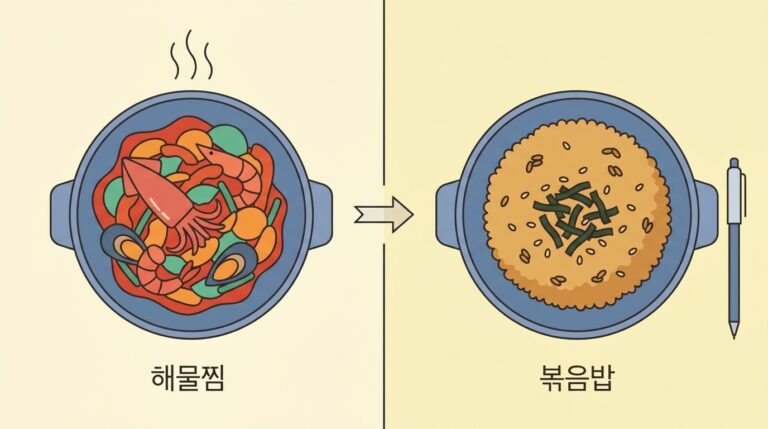
Imagine this: You are sitting with your Korean friends at a bustling seafood restaurant in Seoul. In front of you is a massive, crimson plate of Haemul-jjim (해물찜)—spicy steamed seafood brimming with tender squid, octopus, crab, and crunchy bean sprouts. The seafood is mostly gone, but a rich, fiery, aromatic sauce coats the hot plate.
Your friends look at each other with satisfied grins, and someone whispers the ultimate Korean dining ritual: “Shall we fry the rice now?”
You want to take the initiative and call over the server to order that divine, savory fried rice cooked right in the leftover sauce. But suddenly, your mind goes blank. Do I leave the sauce? How do I ask them to make it extra crispy at the bottom? Is it weird to ask for extra seaweed?
Don’t worry! This is one of the most common culinary hurdles intermediate (B2) Korean learners face. You know basic food vocabulary, but navigating the nuances of real-time Korean dining culture—especially the legendary transition to Bokkeumbap (볶음밥)—requires natural, context-rich expressions. Based on real feedback from our Daily Hangul learners, mastering this single moment will instantly make you feel like a true Seoul insider. Let’s dive in!
Phase 2: Deep Dive into 3 Key Expressions
1. 밥 볶아 주세요 (Bap bokk-a ju-se-yo)
- Pronunciation: [bap bok-ah joo-seh-yo] (Sounds like “bap” + “boke” + “ah” + “joo-seh-yo”)
- Meaning: Direct: “Please fry rice.” | Nuance: “We’re ready for the ultimate fried rice finish using our leftover sauce!”
- K-Culture Moment: In K-dramas like Weightlifting Fairy Kim Bok-joo, characters finish their main dish and enthusiastically raise their hands to call out this exact line to transition to the carbohydrate finale.
- Editor’s Insight: As a B2 learner, you should know that you can specify the number of portions right before the verb. For example: “밥 두 개만 볶아 주세요” (Bap du gae-man bokk-a ju-se-yo = Please fry just two portions of rice).
- Situation Spectrum: Casual ✅ | Semi-formal ✅ | Formal ⚠️
- 🤔 Think About It: Why do Koreans often refer to fried rice at the end of a savory meal as “K-dessert” (한국인의 디저트)? What does this reveal about how food courses are structured in Korea compared to your home country?
2. 양념 좀 남겨둘까요? (Yangnyeom jom namgyeodulkkayo?)
- Pronunciation: [yang-nyeom jom nam-gyeo-dool-kka-yo?]
- Meaning: Direct: “Should I leave some sauce?” | Nuance: “How much sauce do you need from our plate to make the fried rice?”
- K-Culture Moment: When the server comes over with a bowl of rice and seaweed, you naturally ask this while holding your spoon, ready to ladle excess sauce into a side bowl.
- Editor’s Insight: The intermediate grammar pattern -ㄹ/을까요? expresses thoughtful consideration and asks for the listener’s preference. Using 남겨두다 (to leave behind) shows high context fluency.
- Situation Spectrum: Casual ✅ | Semi-formal ✅ | Formal ✅
- 🤔 Think About It: Korean dining is inherently communal. How does proactively asking about shared sauce build a sense of warmth (Jeong) at the table?
3. 누룽지 만들어 먹게 바짝 익혀 주세요 (Nurungji mandeureo meokge bajjat ikhyeo juseyo)
- Pronunciation: [nu-rung-ji man-deu-reo meok-ge bat-jjak ik-hyeo joo-seh-yo]
- Meaning: Direct: “Please cook it thoroughly so we can make scorched rice.” | Nuance: “Please let it sit on the heat long enough to get that crispy, delicious bottom layer!”
- K-Culture Moment: Foodies in Korean YouTube vlogs always wait patiently for the sizzle sound, letting the rice flatten on the hot iron pan to form golden Nurungji.
- Editor’s Insight: 바짝 is an adverb describing something done thoroughly or to a crisp. Pair it with 익히다 (to cook/heat up) for culinary precision.
- Situation Spectrum: Casual ✅ | Semi-formal ✅ | Formal ⚠️
- 🤔 Think About It: In many Western cuisines, burnt or scorched food is considered a mistake. Why is crispy scorched rice (Nurungji) celebrated as a texture peak in Korean gastronomy?
Phase 3: Textbook Korean vs. Real Native Korean
Situation 1: Ordering fried rice after finishing the seafood
- 📖 Textbook Korean: “해물찜을 다 먹었으니 밥을 볶아 주십시오.” (Haemul-jjim-eul da meog-eoss-euni bap-eul bokk-a ju-sip-si-o.)
- 🗣️ Real Native Korean: “이모님, 여기 밥 두 개만 볶아 주세요!” (Imo-nim, yeogi bap du gae-man bokk-a ju-se-yo!)
- 💡 Why the difference? Textbook phrasing uses heavy, formal imperatives like 주십시오. In real Korean eateries, calling the friendly owner or server 이모님 (literally “maternal aunt”, used affectionately for female restaurant staff) creates an instant warm connection.
Situation 2: Expressing love for the crispy rice at the bottom of the pan
- 📖 Textbook Korean: “냄비 바닥에 붙은 밥이 매우 맛있습니다.” (Naembi badag-e but-eun bap-i mae-u mas-iss-seub-nida.)
- 🗣️ Real Native Korean: “역시 바닥 긁어 먹는 게 진짜 꿀맛이죠!” (Yeoksi badak geulgeor meokneun ge jinja kkul-mat-i-jyo!)
- 💡 Why the difference? Native speakers use colorful slang like 꿀맛 (honey taste = delicious) and specific action verbs like 긁어 먹다 (to scrape and eat) to express sensory culinary joy.
Phase 4: K-Culture Deep Dive & Non-Verbal Etiquette
4-1. Nunchi (눈치) & Gestures at the Dining Table
- Eye Contact & Table Call: Look for a call button on the side of the table first. If there isn’t one, make polite eye contact with the server and raise your hand slightly while saying “이모님~” in a melodic tone.
- The Pan Courtesy: When the server brings the frying ingredients, gently move your spoon and chopsticks off the pan rim to give them space to work.
- Patience Gesture: After the server flattens the rice across the pan, do not stir it immediately! The unwritten rule of Korean fried rice is letting it sizzle untouched for 1 to 2 minutes on low heat.
4-2. Cultural Code: The Sacred “K-Dessert” (한국인의 후식)
In modern K-Food culture, meals like Haemul-jjim, Dak-galbi (spicy stir-fried chicken), and Samgyeopsal (pork belly) are never truly finished until fried rice hits the pan. Koreans jokingly call bokkeumbap the real dessert. The concentrated umami of the seafood sauce mixed with toasted sesame oil, shredded seaweed (Gim), and kimchi creates a crescendo that ties the entire meal together.
Phase 5: Real-Life Roleplay Scenario
Setting: A popular Haemul-jjim spot in Sindang-dong, Seoul. You are dining with your friends, and the server (이모님) approaches your table.
- Turn 1 (Server): 🎭 Looking at your nearly empty dish
“손님, 해물 다 드셨어요? 더 드실 거예요?”
(Sonnim, haemul da deusyeosseoyo? Deo deusal geoyeyo? / Dear guests, are you finished with the seafood? Would you like more?) -
Turn 2 (You): 🎭 Smiling and pointing gently at the remaining sauce
“네, 다 먹었어요! 이모님, 여기 밥 두 개만 볶아 주세요.”
(Ne, da meog-eoss-eoyo! Imo-nim, yeogi bap du gae-man bokk-a ju-se-yo. / Yes, we’re all done! Auntie, please fry two portions of rice for us here.) -
Turn 3 (Server): 🎭 Nodding briskly while grabbing a bowl of rice and seaweed
“네~ 양념 조금만 남기고 접시 치워드릴게요.”
(Ne~ yangnyeom jogeum-man namgigo jeopsi chiwo-deureilgeyo. / Sure~ I’ll leave just a little sauce and clear the big plate.) -
Turn 4 (You): 🎭 Holding your water glass out of the way
“아, 양념 좀 따로 더 남겨둘까요?”
(A, yangnyeom jom ttaro namgyeodulkkayo? / Ah, should I save some sauce on the side for ourselves?) -
Turn 5 (Server): 🎭 Pouring rice and sesame oil into the sizzling pan
“그럼요! 싱거우면 더 얹어 드세요. 김가루 많이 넣어드릴까?”
(Geureomyo! Singgeowumyeon deo eonjeo deuseyo. Gimgaru mani neoeo-deureilkka? / Of course! If it’s too bland, you can add more. Should I put plenty of seaweed flakes?) -
Turn 6 (You): 🎭 Nodding enthusiastically
“네, 김가루 많이 주시면 감사해요! 그리고 누룽지 만들어 먹게 바짝 익혀 주세요.”
(Ne, gimgaru mani jusimyeon gamsa-haeyo! Geurigo nurungji mandeureo meokge bajjat ikhyeo ju-se-yo. / Yes, we’d love lots of seaweed flakes! And please make it extra crispy so we can get scorched rice.) -
Turn 7 (Server): 🎭 Flattening the rice across the pan with a spatula
“알겠어요~ 1분만 기다렸다가 불 끄고 드세요!”
(Al-gaess-eoyo~ il-bun-man gidaryeottaga bul kkeugo deuseyo! / Got it~ Wait just 1 minute, then turn off the heat and enjoy!) -
Turn 8 (You): 🎭 Holding up your spoon with a grin
“감사합니다! 맛있게 먹겠습니다!”
(Gamsa-hamnida! Mas-itge meok-geoss-seumnida! / Thank you! We will enjoy the meal!)
🔀 Interactive Branching Point
When the server asks in Turn 5: “김가루 많이 넣어드릴까?” (Should I put lots of seaweed flakes?), how do you respond?
- Option A: “네, 김가루 많이 주시면 감사해요!”
- Result (BEST): Perfect! You show enthusiasm for key Korean toppings while maintaining polite B2 grammar.
- Option B: “아니요, 그냥 밥만 볶아 주세요.”
- Result (BAD): While grammatically correct, skipping seaweed flakes deprives you of essential flavor harmony in Korean bokkeumbap!
- Option C: “Can you speak English please?”
- Result (RISK): Breaks the natural flow and immersive cultural experience at local Korean eateries where English might be limited.
Phase 6: 10-Second Emotion Shadowing Drill
Practice saying these high-frequency phrases with authentic native emotion!
[😊 Excitingly & Loudly]
이모님! / 여기 밥 두 개만 / 볶아 주세요!
(Imo-nim! / Yeogi bap du gae-man / bokk-a ju-se-yo!)-
[🥺 Eagerly & Expectantly]
누룽지 만들어 먹게 / 바짝 / 익혀 주세요!
(Nurungji mandeureo meokge / bajjat / ikhyeo ju-se-yo!) -
[😋 Delighted & Satisfied]
역시 해물찜 마무리는 / 볶음밥이죠!
(Yeoksi haemul-jjim mamuri-neun / bokkeumbap-i-jyo!)
Phase 7: K-Culture Mini Dictionary
-
해물찜 (Haemul-jjim)
- Translation: Spicy Braised Seafood
- Usage: A iconic Korean sharing dish packed with bean sprouts, octopus, shrimp, and aromatic gochugaru sauce.
- 볶음밥 (Bokkeumbap)
- Translation: Fried Rice
- Usage: The essential finale of any Korean grilled or braised pan meal, cooked live at the dining table.
- 누룽지 (Nurungji)
- Translation: Scorched / Crispy Rice
- Usage: The golden, crunchy layer formed at the bottom of hot stone bowls or metal pans. Cherished for its aromatic nuttiness.
- 김가루 (Gimgaru)
- Translation: Shredded Seasoned Seaweed Flakes
- Usage: The ultimate savory topper that adds saltiness and umami to dishes like fried rice and cold noodles.
Phase 8: Traveler’s Survival Kit
Survival Expressions TOP 3
- “치즈 추가할 수 있나요?” (Chijeu chuga-hal su itnayo?) — Can we add cheese topping?
- “남은 양념은 포장해 주세요.” (Nameun yangnyeom-eun pojang-hae ju-se-yo.) — Please pack the remaining sauce/food to go.
- “불 조절은 어떻게 해요?” (Bul jojeol-eun eotteohke haeyo?) — How do I adjust the stove flame?
Editor’s Travel Note
When hunting down authentic Haemul-jjim spots in Seoul, skip generic search engines. Open the Naver Map app for Korean foodies and search for “해물찜 맛집”. Check customer photos to ensure they serve table-side fried rice. Most local seafood places accept all standard international credit cards, so no need to carry huge amounts of cash!
Phase 9: One Step Deeper (Reflection)
In Korean culinary philosophy, food is rarely an individual, isolated experience. Shared dishes like Haemul-jjim culminate in a shared pan of fried rice, symbolizing unity at the table. Everyone scrapes from the same hot plate, sharing the crispy nurungji down to the last grain. This practice reflects Jeong (정)—the deep bond formed through shared everyday experiences.
💬 Your Turn: Have you ever experienced a communal finishing dish like Korean bokkeumbap? What’s your favorite food memory in Korea so far? Share your thoughts in the comments below!
Phase 10: FAQ & Common Mistakes
Q: Should I eat all the seafood before ordering fried rice?
A: No! In fact, leaving 2-3 spoonfuls of thick sauce along with some bean sprouts or small seafood pieces will make your fried rice much more flavorful.
Q: Is it rude to scrape the bottom of the pan loudly with my metal spoon?
A: Not at all! The sound of scraping nurungji off the pan is considered music to the ears of Korean restaurant owners—it means you thoroughly enjoyed the food!
Q: What if I don’t want my fried rice too spicy?
A: You can ask the server to use less sauce: “양념 적게 넣어서 볶아 주세요” (Yangnyeom jeokge neoeoseo bokk-a ju-se-yo).
🚨 Common Mistakes Warning Board
- Mistake 1: Stirring the rice immediately after the server flattens it.
- Correct Action: Let it sit undisturbed for at least 1 minute on medium-low heat to form that crispy bottom layer!
- Mistake 2: Scraping off all the leftover sauce into the trash.
- Correct Action: Keep a small side bowl of leftover sauce to drizzle over your fried rice if you want extra flavor.
- Mistake 3: Using overly formal grammatical endings like ~습니다 with busy restaurant servers.
- Correct Action: Use polite conversational Korean ending in ~요 (e.g., 볶아 주세요).
Phase 11: Action Mission & Engagement
Action Mission 3-Step Challenge
- 🥉 Bronze Level: Practice saying “이모님, 밥 두 개만 볶아 주세요!” out loud 3 times with excitement.
- 🥈 Silver Level: Snap a photo of fried rice at a Korean restaurant and post it on Instagram tagging
@DailyHangulwith the caption “마무리는 역시 볶음밥!” - 🥇 Gold Level: Order bokkeumbap entirely in Korean without switching to English during your next Korean dining trip!
🎮 K-Culture Mission
Watch an episode of the Korean variety show Tasty Guys (맛있는 녀석들) or a Korean food vlog. Count how many times they say “밥 볶아 주세요” or “누룽지” during a braised/grilled meal!
Phase 12: Interactive Quiz Challenge
Quiz 1: Situation Judgment
You finished your Haemul-jjim and want to order fried rice for 3 people with extra crispy bottom. What should you say?
* A) 밥 세 개만 볶아 주시고, 바짝 익혀 주세요.
* B) 해물찜 더 주시고, 불을 꺼 주세요.
* C) 밥 세 개 포장해 주세요.
🔍 Click to reveal Answer & Explanation
Correct Answer: A
Explanation: Option A correctly uses 밥 세 개만 볶아 주시고 (Please fry 3 portions of rice) and requests crispy texture with 바짝 익혀 주세요 (Please cook thoroughly/crisp it up).
Quiz 2: Fill-in-the-Blank
Fill in the missing Korean word:
“누룽지 만들어 먹게 _____ 익혀 주세요!” (Please cook it crisp/thoroughly so we can make scorched rice!)
* A) 천천히 (Slowly)
* B) 바짝 (Thoroughly/Crisply)
* C) 크게 (Largely)
🔍 Click to reveal Answer & Explanation
Correct Answer: B
Explanation: 바짝 is the iconic native adverb used when asking for fried rice to be crisped up at the bottom of the pan.
Quiz 3: True / False Cultural Quiz
Statement: In Korea, it is considered bad etiquette to leave rice stuck to the bottom of the pan to sizzle into nurungji.
* [ ] True
* [ ] False
🔍 Click to reveal Answer & Explanation
Correct Answer: False
Explanation: Creating nurungji (scorched rice) at the bottom of the pan is a beloved dining tradition in Korean food culture!







