

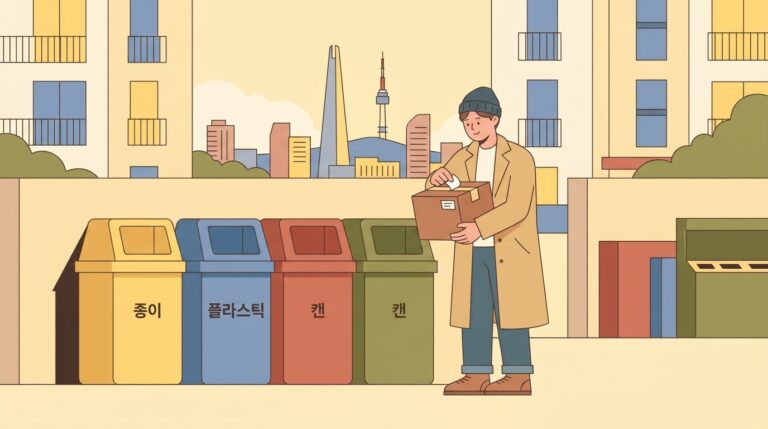
Phase 1: 공감 (Storytelling Opening)
안녕하세요! 매일한글 에디터입니다. Korea is undeniably a paradise for online shopping and lightning-fast parcel delivery. From Coupang’s overnight Dawn Delivery to CJ Logistics, receiving boxes right outside your front door is an everyday routine. However, have you ever caught yourself casually flattening a cardboard box and tossing it directly into the apartment recycling station with your full name, phone number, and exact home address plainly visible on the shipping label (운송장)?
For high-level Korean speakers living in Korea, navigating daily safety etiquette is just as crucial as master-level vocabulary. Leaving your shipping label intact opens the door to serious privacy breaches, including doxxing (신상 털기), voice phishing scams, and unwanted stalking. Today, we are diving deep into the sophisticated language and essential cultural nuances surrounding parcel privacy protection in Korea. Based on real feedback from expats living in Seoul, mastering these expressions will elevate your practical Korean to native-level fluently while keeping your personal data bulletproof!
Phase 2: 핵심 표현 3선 심층 분석
1. 운송장을 떼다 [Un-song-jang-eul tte-da]
- Pronunciation: [Un-song-jang-eul tte-da] (Pronounce ‘떼다’ like ‘tte-da’, with a strong, crisp double ‘tt’ sound similar to the ‘t’ in ‘stop’).
- Meaning: Literally “To tear off the waybill/shipping label.” In native conversation, it refers to completely peeling or shredding the barcode sticker from a parcel before disposal.
- K-Culture Moment: Seen frequently in K-dramas where characters meticulously shred their delivery sticker before stepping out to the recycling area.
- Editor’s Insight: While textbook terms use ‘제거하다’ (to remove), natives almost exclusively use ‘떼다’ (to peel/detach) or ‘찢다’ (to tear up) when handling boxes.
- Situation Spectrum: Casual ✅ | Semi-formal ✅ | Formal ⚠️
- 🤔 Think About It: How does the physical act of removing data stickers reflect Korea’s hyper-dense residential culture where trash is collected in shared community spaces?
2. 개인정보를 먹칠하다 [Gae-in-jeong-bo-reul meok-chil-ha-da]
- Pronunciation: [Gae-in-jeong-bo-reul meok-chil-ha-da] (Sounds like ‘meok-cheel-ha-da’, combining ‘meok’ [black ink] and ‘chil’ [paint]).
- Meaning: Literally “To paint over personal information with black ink.” Figuratively, it means using a privacy roller, marker, or stamp to obscure confidential data.
- K-Culture Moment: Popularized by convenience store items like dark privacy stamps sold specifically for parcel labels.
- Editor’s Insight: Be careful! ‘먹칠하다’ can also mean ‘to tarnish someone’s reputation’ (e.g., 얼굴에 먹칠하다). Context is key: on a delivery box, it means blacking out your address.
- Situation Spectrum: Casual ✅ | Semi-formal ✅ | Formal ⚠️
- 🤔 Think About It: Is blacking out personal data common in your home country, or do people rely more on shredders?
3. 신상 털리는 것을 방지하다 [Sin-sang teol-ri-neun geos-eul bang-ji-ha-da]
- Pronunciation: [Sin-sang teol-ri-neun geos-eul bang-ji-ha-da] (Emphasis on ‘teol-ri-neun’, sounding like ‘tol-ri-neun’ with a quick rolled ‘r/l’).
- Meaning: “To prevent your personal identity/data from being exposed or doxxed.”
- K-Culture Moment: Often heard on Korean tech blogs, safety YouTube channels, and apartment safety broadcast announcements.
- Editor’s Insight: ‘신상’ is a slang contraction of ‘신상 정보’ (personal information/identity), and ‘털리다’ means ‘to get stripped/looted’. Together, ‘신상 털리다’ is the exact equivalent of getting doxxed or exposed.
- Situation Spectrum: Casual ✅ | Semi-formal ⚠️ | Formal 🚫
- 🤔 Think About It: Why has the informal term ‘신상 털기’ entered everyday vocabulary in ultra-connected digital societies like South Korea?
Phase 3: 교과서 한국어 vs 진짜 한국어
Situation 1: Advice on discarding delivery boxes
* 📖 교과서 한국어: 택배 상자의 개인정보 운송장을 제거한 후 버리십시오. (Please remove the personal information shipping label of the parcel box before discarding it.)
* 🗣️ 진짜 한국어: 택배 박스 버릴 때 운송장 꼭 떼고 버리세요. (Make sure you peel off the shipping label when throwing away parcel boxes.)
* 💡 왜 다를까? Native speakers prefer the active verb ‘떼다’ (peel off) over ‘제거하다’ (remove) and use ‘택배 박스’ instead of the rigid ‘택배 상자’.
Situation 2: Warning a friend about privacy risks
* 📖 교과서 한국어: 개인정보가 유출되면 범죄에 악용될 위험이 있습니다. (If personal information leaks, there is a risk of it being misused for crime.)
* 🗣️ 진짜 한국어: 송장 안 가리고 버리면 신상 다 털려요! (If you throw it away without covering the waybill, your whole identity will get exposed!)
* 💡 왜 다를까? C2-level casual speech uses ‘송장’ (short for 운송장), ‘가리다’ (cover), and ‘신상 털리다’ (get doxxed) to express real-world urgency concisely.
Phase 4: K-Culture 딥다이브 & 비언어적 매너
4-1. 눈치(Nunchi) & Gestures
When standing at your apartment complex’s recycling station (분리수거장), you will often see Koreans using key rings, box cutters, or scissors to rip off parcel stickers right before flattening the boxes. If you leave a label intact, building security guards (경비원 아저씨) or neighbors might quietly point at the label or hand you a pair of scissors. The polite gesture is to nod slightly, say “아, 감사합니다!” and immediately tear the barcode across the middle. Ripping the barcode vertically or horizontally ensures it cannot be scanned.
4-2. Cultural Code Analysis
Korea’s delivery ecosystem is among the fastest worldwide. However, this hyper-efficiency creates vast physical mounds of cardboard boxes in apartment recycling depots every week. Because garbage collection points are public and accessible to anyone entering the apartment grounds, Korean society has developed an implicit civic responsibility around privacy management. Privacy roller stamps (개인정보 보호 스탬프) are top-selling items on Daiso and Coupang, showing how high-tech delivery meets micro-privacy habits.
Phase 5: 실전 롤플레이 시나리오
Setting: Apartment recycling center on a Sunday afternoon. You are flattening a large box. Mr. Kim, the meticulous building manager, approaches.
- Turn 1 (Mr. Kim): 저기 입주민님, 혹시 그 박스 그냥 버리시려는 건가요? (Jeo-gi ip-ju-min-nim, hok-si geu bak-seu geu-nyang beo-ri-si-ryeo-neun geon-ga-yo?)
- 🎭 Politely stopping you while gesturing at the box sticker
- Turn 2 (You): 네, 상자 납작하게 접어서 분리수거함에 넣으려고요! (Ne, sang-ja nap-jak-ha-ge jeob-eo-seo bun-ri-su-geor-ham-e neo-heu-ryeo-go-yo!)
- 🎭 Smiling confidently thinking you prepared the box well
- Turn 3 (Mr. Kim): 박스 접으신 건 잘하셨는데, 여기 붙은 운송장을 안 떼셨어요. (Bak-seu jeob-eu-sin geon jal-ha-syeot-neun-de, yeo-gi but-eun un-song-jang-eul an tte-syeos-seo-yo.)
- 🎭 Pointing closely at the phone number printed on the label
- Turn 4 (You): 아! 운송장을 안 가리고 그냥 버리면 안 되나요? (A! Un-song-jang-eul an ga-ri-go geu-nyang beo-ri-myeon an doe-na-yo?)
- 🎭 Looking puzzled and concerned
- Turn 5 (Mr. Kim): 요즘 세상이 흉흉해서 전화번호랑 주소 그대로 노출되면 신상 털려요. (Yo-jeum se-sang-i hyung-hyung-hae-seo jeon-hwa-beon-ho-rang ju-so geu-dae-ro no-chul-doe-myeon sin-sang teol-ryeo-yo.)
- 🎭 Speaking earnestly with a serious facial expression
- Turn 6 (You): 그렇군요. 이름이랑 바코드 부분을 찢어서 버려야겠네요. (Geu-reot-gun-yo. I-reum-i-rang ba-ko-deu bu-bun-eul jjij-eo-seo beo-ryeo-ya-get-nae-yo.)
- 🎭 Nodding in agreement and reaching for the label
- Turn 7 (Mr. Kim): 맞아요. 손으로 안 떼어지면 이 칼로 운송장 가운데를 가로질러 긁어내세요. (Ma-ja-yo. Son-eu-ro an tte-eo-ji-myeon i kal-ro un-song-jang ga-eun-de-reul ga-ro-jil-ler geulg-eo-nae-se-yo.)
- 🎭 Handing you a small utility knife safely
- Turn 8 (You): 깔끔하게 떼어냈습니다. 신경 써 주셔서 정말 감사합니다! (Kkal-kkeum-ha-ge tte-eo-nae-sseum-ni-da. Sin-gyeong sseo ju-syeo-seo jeong-mal gam-sa-ham-ni-da!)
- 🎭 Showing the clean box and bowing slightly
🔀 인터랙티브 분기점 (Interactive Choice)
How do you respond when a neighbor reminds you about your waybill sticker?
* Choice A: “아, 몰랐어요! 운송장 바로 떼서 개인정보 안 보이게 처리할게요.” (Best Choice)
* Choice B: “박스 어차피 재활용할 건데 그냥 버려도 되지 않나요?” (Risk Choice)
* Choice C: “알아서 할 테니까 신경 끄세요.” (Bad Choice)
Feedback:
* Choice A (Best): Demonstrates high cultural awareness, active listening, and polite modern phrasing. Building relations upgraded!
* Choice B (Risk): Sounds dismissive of security concerns, potentially making you seem uninformed about urban safety norms.
* Choice C (Bad): Highly rude! Using ‘신경 끄세요’ (mind your own business) will break apartment harmony instantly.
Phase 6: 10초 감정 섀도잉 드릴
[😨 걱정스럽고 경각심 있게]/ 운송장 안 떼고 버리면 / 개인정보 다 털려요! /
(Un-song-jang an tte-go beo-ri-myeon / gae-in-jeong-bo da teol-ryeo-yo!)[💡 깨달았다는 듯이]/ 아, 바코드랑 전화번호를 / 스탬프나 먹칠로 가려야 하는군요! /
(A, ba-ko-deu-rang jeon-hwa-beon-ho-reul / seu-taem-peu-na meok-chil-ro ga-ryeo-ya ha-neun-gun-yo!)[😊 정중하고 확신에 차서]/ 운송장 깔끔하게 떼어냈으니까 / 이제 안심하고 분리수거할게요. /
(Un-song-jang kkal-kkeum-ha-ge tte-eo-nae-sseu-ni-kka / i-je an-sim-ha-go bun-ri-su-geo-hal-ge-yo.)
Phase 7: K-Culture 미니 사전
- 운송장 (Un-song-jang) | Waybill / Delivery Label | The adhesive receipt on courier packages containing tracking numbers, barcodes, sender/recipient addresses, and contact info.
- 신상 털기 (Sin-sang teol-gi) | Doxxing / Personal Data Leakage | The act of unauthorized digging up and broadcasting an individual’s private background info online or offline.
- 분리수거 (Bun-ri-su-geo) | Waste Sorting & Recycling | Korea’s strict waste separation system requiring specific disposal of paper, vinyl, plastic, and cardboard.
- 문앞 배송 (Mun-ap baesong) | Front Door Delivery | Leaving packages directly in front of apartment doors, a common delivery method in safe, high-density Korean housing.
Phase 8: 여행자를 위한 생존 키트
Survival Expressions TOP 3
- “운송장 떼는 테이프 어디 있어요?” (Un-song-jang tte-neun te-i-peu eo-di is-seo-yo?) – Where is the tool/tape to tear off shipping labels?
- “개인정보 가리는 스탬프 팔아요?” (Gae-in-jeong-bo ga-ri-neun seu-taem-peu pal-a-yo?) – Do you sell privacy protection stamps?
- “송장 번호 잘라서 버려야 돼요.” (Song-jang beon-ho jal-la-seo beo-ryeo-ya dwae-yo.) – You need to cut off the tracking number before throwing it away.
Editor’s Travel Note
When residing in short-term rentals or Airbnb apartments in Seoul, check out the neighborhood layout using the 네이버 지도 앱 다운로드. Locate nearby Daiso or convenience stores to buy a multi-purpose box tape cutter or dark marker. If recycling boxes on designated garbage nights, ensure paper packaging tape (종이 테이프) and waybill stickers are separated thoroughly from pure cardboard.
Phase 9: 한 발 더 깊이 (생각 질문)
South Korea boasts one of the lowest crime rates in the world, allowing people to leave laptops unattended in cafes or deliveries outside apartment doors for days. Paradoxically, the culture surrounding digital privacy on shipping labels is exceptionally hyper-vigilant. This duality stems from the high density of high-rise living and sophisticated voice-phishing (보이스피싱) schemes that utilize stolen real names and order details. Privacy preservation on parcel labels is not merely about fear; it reflects a shared social etiquette to maintain public security and mutual trust.
💬 Your Turn: How are delivery labels handled in your home country? Do people routinely shred them, or is it common to toss boxes as they are? Share your thoughts in the comments below!
Phase 10: FAQ & 오해 방지
Q: 운송장이 잘 안 떼어지는데 어떻게 하나요?
A: If the sticker adhesive is too strong to peel by hand, use a key, coin, or scissors to heavily score and scratch through the barcode and personal details, or paint over them using a dark oily marker or privacy roller.
Q: 주소는 빼고 이름이랑 전화번호만 가리면 되나요?
A: It is safest to destroy the entire label including the tracking number (송장 번호) and barcode, as scammers can trace full order details using just barcode scanner apps or logistics tracking queries.
Q: 비닐 포장재나 택배 봉투에 붙은 운송장도 떼어야 하나요?
A: Yes! Plastic courier bags (택배 봉투) must have vinyl labels cut out or peeled before placing the bags into plastic/vinyl recycling bins, as mixed materials impede the recycling process.
🚨 Common Mistakes TOP 3
- ❌ Mistake 1: Tossing boxes intact believing doorstep delivery safety equals trash depot safety.
- 👉 Correct Action: Always peel, tear, or mark over the sticker regardless of how safe your neighborhood feels.
- ❌ Mistake 2: Relying on basic water-based pens to black out glossy label stickers.
- 👉 Correct Action: Water-based ink rubs off easily on glossy stickers! Use an oil-based permanent marker (유성 네임펜) or privacy stamp.
- ❌ Mistake 3: Throwing boxes into paper recycling without removing plastic packaging tape.
- 👉 Correct Action: Remove both the shipping label sticker and clear plastic tape before flattening boxes.
Phase 11: 액션 미션 & 참여 유도
Action Mission 3-Steps
- 🥉 Bronze: Inspect your current delivery boxes at home and practice peeling off 1 label cleanly.
- 🥈 Silver: Use an oil-based pen or roller stamp to obscure personal information on a parcel sticker, snap a photo, and share it on your study SNS.
- 🥇 Gold: Use the phrase “운송장 꼭 떼고 버리세요” in a real Korean conversation with a friend or neighbor.
🎮 K-Culture Mission
Watch a modern Korean vlog or slice-of-life drama scene involving unboxing (언박싱). Spot whether the person removes or blurs out the courier sticker, and note down what tools they use!
Phase 12: 인터랙티브 퀴즈 챌린지
Q1. (Situation Judgment) 택배 박스를 분리수거할 때 가장 바람직한 행동은 무엇인가요?
1) 운송장을 그대로 둔 채 상자만 펴서 버린다.
2) 유성 마커나 스탬프, 찢기 등을 통해 운송장의 개인정보와 바코드를 가린 후 버린다.
3) 이름만 볼펜으로 대충 지우고 버린다.
Q2. (Fill-in-the-blank) 택배 상자에 붙은 개인정보 스틱커를 한국어로 ‘운____’이라고 합니다.
Q3. (True / False) 한국에서는 운송장의 바코드만 남아있어도 물류 조회를 통해 개인정보를 추적할 수 있으므로 바코드도 훼손해야 한다.
🔍 정답 및 해설 보기 (Click to expand)
- Q1 정답: 2번 / Explanation: To prevent privacy leaks and doxxing (신상 털기), you should completely peel, shred, or black out personal information and barcodes.
- Q2 정답: 송장 (전체 단어: 운송장) / Explanation: The parcel tracking sticker is called ‘운송장’ or shortened to ‘송장’.
- Q3 정답: True (O) / Explanation: Barcodes contain digital tracking strings; damaging the barcode prevents unauthorized scanning.







