

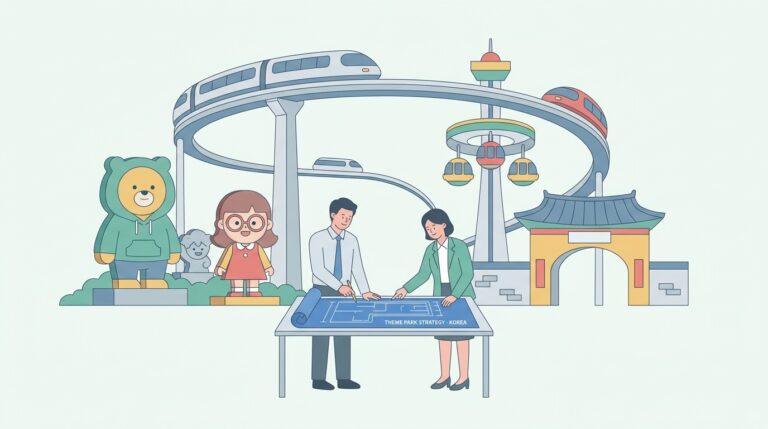
Mastering Korea’s Theme Park IP Strategy & Renewal Jargon Like an Industry Insider
Phase 1: Empathy & Storytelling Opening
안녕하세요! 매일한글 에디터입니다. Welcome back to Daily Hangul! Have you ever walked through Lotte World or Everland and noticed how seamlessly they transform older rides into immersive pop-culture wonderlands? A few years ago, theme parks relied purely on thrill rides. Today, Korea’s leisure industry thrives on intellectual property (IP) tie-ins—bringing webtoons, K-pop worldviews, and iconic drama sets into real-world physical spaces. If you’re working in executive leisure management, entertainment branding, or simply discussing business strategy with Korean partners at a C2 level, standard textbook Korean won’t cut it. You need the sophisticated, nuanced corporate vocabulary that industry leaders use during high-stakes strategic pitch meetings. Our learners frequently tell us that bridging the gap between casual Korean and executive-level strategic terminology is their biggest barrier. Today, we’re unlocking the secret playbook of Korean theme park IP renewal strategies so you can speak with authority, cultural depth, and complete confidence.
Phase 2: Deep Dive into 3 Core Advanced Expressions
1. IP를 재해석하다 (IP-reul Jae-hae-seok-ha-da)
- Pronunciation: [ee-pee-reul jae-hae-seuk-ha-da] (Sounds like “e-p rule” followed by “JAE-hae-seok-ha-da”)
- Meaning: Literally “To reinterpret Intellectual Property.” In executive business contexts, it refers to creatively reinventing existing narrative assets for a new experiential medium.
- K-Culture Moment: Used extensively when Korean theme parks take popular Kakao Webtoons or Hybe artist universe lore and rebuild physical attraction zones around them.
- Editor’s Insight: Beyond simply “using an asset,” ‘재해석하다’ signals executive originality—showing that your team isn’t just copying an existing story, but elevating it into a multi-sensory leisure experience.
- Situation Spectrum: Casual (🚫) | Semi-formal (✅) | Formal (✅)
- 🤔 Think About It: How does your native language distinguish between basic content licensing and creative reinterpretation in corporate branding?
2. 세계관을 확장하다 (Se-gye-gwan-eul Hwak-jang-ha-da)
- Pronunciation: [se-gye-gwan-eul hwak-jang-ha-da] (Rhythmic flow: “Say-gyuh-gwan-eul Hwak-jang-ha-da”)
- Meaning: Literally “To expand the narrative universe/worldview.”
- K-Culture Moment: K-pop groups like AESPA or BTS have deep story worldviews (세계관). Theme parks leverage these lore structures during seasonal renewals to offer immersive ARG (Augmented Reality Game) quests.
- Editor’s Insight: ‘세계관’ is the ultimate buzzword in modern Korean leisure marketing. Using this word shows you understand modern Korean fandom culture and consumer engagement strategy.
- Situation Spectrum: Casual (⚠️) | Semi-formal (✅) | Formal (✅)
- 🤔 Think About It: Why has the concept of “fandom lore” become essential for offline physical leisure platforms in Korea?
3. 집객력을 극대화하다 (Jip-gaek-ryeok-eul Geuk-dae-hwa-da)
- Pronunciation: [jip-ggaek-ryeong-eul geuk-dae-hwa-da] (Note the assimilation: ‘집객력’ sounds like ‘집깩렦’)
- Meaning: Literally “To maximize visitor-drawing power/foot-traffic traction.”
- K-Culture Moment: Boardroom meetings at Korean resort conglomerates discussing whether to invest billions in a new IP ride renewal.
- Editor’s Insight: This is top-tier C2 business vocabulary. Replacing vague phrases like “손님을 많이 모으다” (gather many guests) with “집객력을 극대화하다” instantly elevates your credibility in strategic presentations.
- Situation Spectrum: Casual (🚫) | Semi-formal (⚠️) | Formal (✅)
- 🤔 Think About It: How does executive Korean prioritize quantifiable business metrics through dense Sino-Korean noun compounds?
Phase 3: Textbook Korean vs. Real Native Korean
Situation 1: Explaining a Park Renewal Plan
- 📖 Textbook Korean: 캐릭터를 사용해서 테마파크를 바꾸고 있습니다. (Chaeraekteo-reul sayonghaeseo temapakeu-reul bakkugo isseumnida. – We are changing the theme park using characters.)
- 🗣️ Real Native Korean (C2 Executive): 트렌디한 IP와 컬래버레이션하여 파크 공간을 대대적으로 리뉴얼하는 추세입니다. (Teurendihan IP-wa keollaeboreisyeon-hayeo pakeu gonggan-eul daedaejeog-euro rinyueol-haneun chuse-imnida. – We are aggressively renewing park spaces through strategic IP collaborations.)
- 💡 Why the Difference? C2 native professionals blend loanwords like ‘컬래버레이션’ (collaboration) and ‘리뉴얼’ (renewal) with formal Sino-Korean nouns like ‘추세’ (trend) to reflect modern leisure industry vocabulary.
Situation 2: Discussing Foot Traffic & ROI
- 📖 Textbook Korean: 새 기구를 만들면 손님이 많이 올 것입니다. (Sae gigureul mandeurmyeon sonnimgi mani ol geosimnida. – If we build a new ride, many guests will come.)
- 🗣️ Real Native Korean (C2 Executive): 몰입형 체험존을 구축해 차별화된 집객력을 확보할 것으로 기대됩니다. (Molip-hyeong chae-heom-jon-eul guchuk-hae chabyeol-hwa-doen jip-gaek-ryeok-eul hak-bo-hal geos-euro gidae-doemnida. – By constructing an immersive experiential zone, we expect to secure differentiated visitor traction.)
- 💡 Why the Difference? Executive discussions require precision. Terms like ‘몰입형 체험존’ (immersive experiential zone) and ‘집객력 확보’ (securing foot-traffic traction) demonstrate business acumen.
Phase 4: K-Culture Deep Dive & Non-Verbal Etiquette
4-1. Executive Nunchi & Presentation Gestures
When pitching an IP renewal strategy to Korean board members, maintaining refined Nunchi (눈치 – situational tact) is key. Avoid aggressive hand movements. Instead, use open-palm gestures when referencing slides or architectural models. Maintaining a calm, confident tone while slightly lowering your voice when emphasizing key ROI metrics conveys gravitas (무게감).
4-2. Cultural Code: The Fandom-to-Theme Park Ecosystem
Korea’s theme park renewals aren’t just cosmetic refurbs—they represent cross-media convergence. When Lotte World partnered with Webtoon IPs or Everland created pop-up universes for K-pop fan bases, they tapped into 팬덤 경제 (Fandom Economy). Korean consumers visit theme parks not just for thrills, but to experience physical touchpoints of their favorite digital narratives. Understanding this cultural synergy is vital for any leisure industry strategist working in Korea.
Phase 5: Practical Executive Roleplay Scenario
Setting: Boardroom at a top-tier Korean resort operator in Seoul.
Characters:
* Min-jun (민준): Senior Director of Strategic Planning (Executive Director)
* You (학습자): Chief IP Strategy Consultant (C2 Korean Speaker)
Dialogue
- 민준: 🎭 (서류를 살피며 진지한 표정으로) 이번 3분기 테마파크 리뉴얼 건 말입니다. 기존 유시설의 노후화가 심각한데, 어떤 IP 전략을 구상 중이신가요?
(Min-jun: (Looking through papers with a serious expression) Regarding the Q3 theme park renewal project—our existing rides are showing significant aging. What IP strategy are you envisioning?) -
You: 🎭 (차분하게 화면을 지목하며) 단순한 시설 보수가 아닌, 글로벌 인기 웹툰 IP를 재해석하여 공간 전체를 테마화하는 안을 제안합니다.
(You: (Calmly pointing at the screen) Rather than simple facility maintenance, I propose reinterpreting a globally popular webtoon IP to thematicize the entire space.) -
민준: 🎭 (흥미로운 듯 고개를 끄덕이며) 웹툰 IP라… 팬덤의 집객력은 검증되었지만, 주 고객층인 가족 단위 방문객에게도 어필할 수 있을까요?
(Min-jun: (Nodding with interest) A webtoon IP… While fandom attraction is proven, will it appeal to our primary family demographics as well?) -
You: 🎭 (미소를 지으며 확신에 찬 어조로) 네, 연령대별 몰입형 체험존을 다각화하여 브랜드 세계관을 확장하면 가족 고객의 체류 시간도 자연스럽게 늘어납니다.
(You: (Smiling, with a confident tone) Yes. By diversifying immersive experiential zones for different age groups to expand the brand worldview, stay duration for family guests will naturally increase.) -
민준: 🎭 (턱을 괴고 생각에 잠기며) 세계관 확장이라… 팝업스토어 및 F&B와의 연계 시너지는 어떻게 도모할 계획입니까?
(Min-jun: (Resting chin on hand, lost in thought) Expanding the worldview… How do you plan to foster cross-promotional synergies with pop-up stores and F&B?) -
You: 🎭 (손사래를 살짝 치며 자신감 있게) 한정판 굿즈 입점과 테마 메뉴 개발을 동시에 진행하여 객단가를 극대화할 전략을 수립했습니다.
(You: (Gesturing subtly with confidence) We have established a strategy to maximize average spend per customer by introducing limited-edition merchandise alongside themed F&B menus.) -
민준: 🎭 (만족스러운 표정으로 보드마카를 집어 들며) 좋습니다! 기획안의 논리적 구조가 훌륭하군요. 바로 이사회 발표용 장표 작성으로 들어갑시다.
(Min-jun: (With a satisfied expression, picking up a marker) Excellent! The logical structure of this proposal is superb. Let’s move straight to drafting slides for the board meeting.) -
You: 🎭 (정중하게 고개를 숙이며) 감사합니다. 기대 이상의 시너지 성과를 도출하도록 철저히 준비하겠습니다.
(You: (Bowing politely) Thank you. I will thoroughly prepare to deliver synergy results that exceed expectations.)
🔀 Interactive Choice Points
At Turn 4, Min-jun asks about family demographic appeal. How do you respond?
* Option A: “가족 고객은 무시하고 팬덤에만 집중해야 수익이 납니다.” (Ignore family guests and focus only on fandom for revenue.)
* Option B: “연령대별 몰입형 체험존을 다각화하여 브랜드 세계관을 확장하면 가족 고객의 체류 시간도 늘어납니다.” (Diversify immersive experiential zones by age group to expand the worldview and boost family stay duration.)
* Option C: “글쎄요, 가족들은 그냥 맛있는 거나 먹으면 되지 않을까요?” (Well, wouldn’t families just be happy eating good food?)
Feedback:
* Option A (Bad): Risk of alienating core revenue streams. Shows a lack of strategic balance in Korean resort management.
* Option B (Best!): Perfect C2 executive response! Addresses demographic balance using high-level concepts like ‘세계관 확장’ and ‘체류 시간 증가’.
* Option C (Risk): Highly unprofessional tone in a formal corporate setting.
Phase 6: 10-Second Emotion Shadowing Drill
Practice speaking with the strategic confidence of a Korean corporate executive. Pay attention to pauses (/) and emotional milestones.
[😊 Confident & Persuasive]
단순한 / 시설 보수가 아닌 / 글로벌 인기 IP를 재해석하여 / 공간 전체를 / 테마화하는 안을 / 제안합니다.
(Dan-sun-han / si-seol bo-su-ga a-nin / geul-ro-beol in-gi IP-reul jae-hae-seok-ha-yeo / gong-gan jeon-che-reul / te-ma-hwa-ha-neun an-eul / je-an-ham-ni-da.)-
[💼 Professional & Decisive]
몰입형 체험존을 / 구축하여 / 차별화된 집객력을 / 확보할 것으로 / 기대됩니다.
(Mol-ip-hyeong chaeh-eom-jon-eul / gu-chuk-ha-yeo / cha-byeol-hwa-doen jip-gaek-ryeok-eul / hak-bo-hal geos-euro / gi-dae-doem-ni-da.)
Phase 7: K-Culture Mini Dictionary
- 세계관 (Se-gye-gwan) | Narrative Lore / Worldview
Usage: Originally a philosophical term (Weltanschauung), now vital in leisure branding to describe an IP’s overarching story universe. - 팝업스토어 (Pop-up Store) | Temporary Experiential Retail Space
Usage: Essential retail strategy in Korean park renewals to test IP popularity before permanent ride construction. - 집객력 (Jip-gaek-ryeok) | Visitor-Attraction Capability / Foot Traffic Draw
Usage: Crucial KPI metric used in feasibility studies and investment proposals across Korean leisure real estate. - 입점하다 (Ip-jeom-ha-da) | To Open a Store / Register a Vendor in a Facility
Usage: Used when referring to premium retail or F&B brands taking space within themed attraction zones.
Phase 8: Survival Kit for Leisure Executives & Travelers
Executive Top 3 Survival Phrases
- 리뉴얼 방향성을 재검토해 봅시다. (Li-nyu-eol bang-hyang-seong-eul jae-geom-to-hae bop-si-da.) — Let’s re-examine the renewal direction.
Pro Tip: Use when steering a meeting away from a risky IP strategy. - 타겟층의 반응을 모니터링해야 합니다. (Ta-get-cheong-ui ban-eung-eul mo-ni-teo-ring-hae-ya ham-ni-da.) — We need to monitor our target demographic’s feedback.
Pro Tip: Shows a data-driven approach during creative pitch reviews. - 시너지 효과를 도모할 수 있습니다. (Si-neo-ji hyo-gwa-reul do-mo-hal su is-seum-ni-da.) — We can foster significant strategic synergy.
Pro Tip: Perfect concluding remark for cross-departmental proposals.
Editor’s Travel & Business Note
When navigating theme park locations or inspecting commercial real estate in Korea, download Naver Map Application rather than standard Western map apps for precise building layouts and transit times. To analyze current IP pop-up trends before your park pitch, visit Seongsu-dong or Yeouido’s The Hyundai Seoul to see live consumer engagement firsthand.
Phase 9: A Step Deeper — The Cultural Philosophy of Korean Leisure Spaces
In Korean society, physical space is rarely static; it is dynamic and narrative-driven. The rapid cycle of theme park renewals reflects Korea’s hyper-fast adoption of cultural trends and deep engagement with digital IP. Unlike Western parks that may keep classic rides unchanged for decades, Korean consumers expect constant novelty and immersion. Integrating IP into theme parks is not merely a marketing gimmick—it is an acknowledgment that modern identity and leisure are inextricably linked to shared digital cultural experiences.
💬 Your Turn: What classic theme park ride in your home country would you transform using a local webtoon or movie IP? Share your ideas in the comments below!
Phase 10: FAQ & Common Mistakes
Q: What is the difference between ‘콜라보’ and ‘IP 재해석’?
A: ‘콜라보’ (Collaboration) is a casual umbrella term for any brand partnership (e.g., placing a character logo on a cup). ‘IP 재해석’ (IP Reinterpretation) implies deep structural and creative adaptation of storytelling lore into physical ride design or themed environments.
Q: Can I use the word ‘세계관’ in formal business presentations?
A: Absolutely! In modern Korean business culture, ‘세계관’ has evolved from fan jargon into an executive corporate strategic term used by entertainment and leisure conglomerates.
Q: How do I express ROI without sounding overly aggressive in Korean?
A: Instead of saying “돈을 많이 벌 것입니다” (We will make a lot of money), use refined business expressions like “수익성 제고 및 객단가 상승 효과가 기대됩니다” (We expect enhanced profitability and increased spend per customer).
🚨 Common Mistakes Warning Board
- Mistake: Overusing literal translations like “지적재산권 전략” in conversational pitch meetings.
Correct Action: Use the natural acronym ‘IP 전략’ (e.g., “IP 전략을 수립하다”). - Mistake: Pronouncing ‘집객력’ strictly letter-by-letter as [Jip-Gaek-Ryeok].
Correct Action: Apply nasal assimilation sound rules: pronounce it naturally as [집깩렦 / Jip-ggaek-ryeong]. - Mistake: Addressing executive team members by their first names in formal proposals.
Correct Action: Always attach full titles, such as ‘이사님’ (Director) or ‘본부장님’ (General Manager).
Phase 11: Action Mission & Engagement Challenge
- Bronze Mission: Practice saying “집객력을 극대화하다” 3 times out loud with natural sound assimilation.
- Silver Mission: Leave a comment below introducing your favorite Korean webtoon or drama IP in one formal sentence.
- Gold Mission: Create a 30-second voice memo proposing an IP renewal idea for an existing amusement park using at least two expressions from Phase 2.
🎮 K-Culture Mission: Watch a video news clip about Everland or Lotte World’s latest seasonal renewal. Spot how many times the news presenter uses the words ‘IP’, ‘세계관’, or ‘리뉴얼’!
Phase 12: Interactive Quiz Challenge
Test your executive C2 Korean skills below!
1. Which expression best replaces “손님이 많이 오게 만들다” in a formal presentation?
a) 손님을 당기다
b) 집객력을 극대화하다
c) 사람을 많이 부르다
2. True or False: ‘세계관’ is considered inappropriate slang in Korean corporate leisure boardrooms.
3. Fill in the blank:
글로벌 인기 IP를 __________ (reinterpreting) 공간 전체를 테마화했습니다.
🔍 Click here for Answers & Explanations
- Answer: b) 집객력을 극대화하다 — This is the correct C2 executive Sino-Korean phrase for maximizing visitor traffic.
- Answer: False — ‘세계관’ is widely accepted and praised as a strategic brand lore term in modern Korean leisure marketing.
- Answer: 재해석하여 — Complete sentence: “글로벌 인기 IP를 재해석하여 공간 전체를 테마화했습니다.”







