

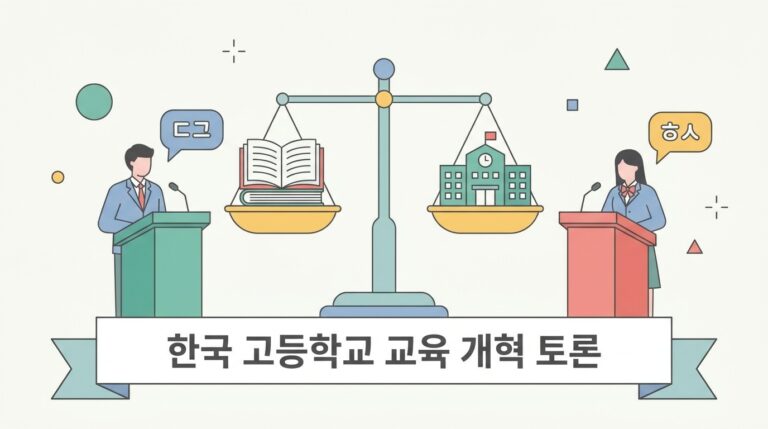
Navigating Korea’s Elite High School Debate: Advanced Korean for Social Issues
Phase 1: Empathy (Story-Driven Opening)
안녕하세요! 매일한글 에디터입니다. (Hello! I’m your Daily Hangul editor.)
Imagine sitting in a sleek café in Gangnam, sipping an iced Americano, while listening to two Korean parents passionately discussing the future of their teenage children. You hear terms like 특목고 (specialized high schools) and 자사고 (autonomous private high schools) flying around, accompanied by heavy sighs and intense debates about educational fairness versus academic excellence. Korea’s college entrance system (입시 제도) isn’t just about grades; it’s a high-stakes cultural phenomenon that shapes society, politics, and daily conversations.
For advanced Korean learners (C1 Level), understanding these social debates is crucial. You aren’t just learning vocabulary anymore; you are unlocking the ability to discuss complex social policies, express nuanced opinions, and truly understand the socio-economic dynamics of modern South Korea. Based on real feedback from our advanced learners, diving into educational controversies is the ultimate stepping stone to sounding like a educated native speaker. Let’s master this topic together seamlessly!
Phase 2: Deep Dive into 3 Key Expressions
1. 형평성에 어긋나다 (Hyeongpyeongseong-e eogeonnada)
- Pronunciation: [Hyeong-pyeong-seong-e eo-geonnada] (Sounds like “hyung-pyung-sung-eh uh-gun-nah-dah”)
- Meaning: Literal: To go against fairness / Nuance: To violate the principle of equity or equal opportunity.
- K-Culture Moment: Seen frequently in Korean news debates and educational K-Dramas like SKY Castle when parents argue about privileged educational track access.
- Editor’s Insight: 형평성 refers to systemic equity, not just superficial fairness (공정함). You use this when criticizing structural privileges.
- Situation Spectrum: Casual 🚫 | Semi-formal ⚠️ | Formal ✅
- 🤔 Think About It: Does your home country prioritize equal educational outcomes or individualized academic freedom?
2. 찬반양론이 팽팽하다 (Chanbanyangron-i paengpaenghada)
- Pronunciation: [Chan-ban-yang-ron-i paeng-paeng-ha-da] (Sounds like “chan-ban-yang-ron-ee paeng-paeng-ha-dah”)
- Meaning: Literal: Pros and cons are taut / Nuance: Public opinion is fiercely split right down the middle.
- K-Culture Moment: Used by news anchors on KBS or JTBC when covering the government’s policy shifts regarding high school abolition.
- Editor’s Insight: 팽팽하다 comes from a pulled rope in tug-of-war. It beautifully captures a tense, unresolved political standoff.
- Situation Spectrum: Casual 🚫 | Semi-formal ⚠️ | Formal ✅
- 🤔 Think About It: What current debate in your society has a 50/50 split as intense as Korea’s high school reforms?
3. 교육의 다양성을 저해하다 (Gyo-yug-ui dayangseong-eul jeohaehada)
- Pronunciation: [Gyo-yug-ui da-yang-seong-eul jeo-hae-ha-da] (Sounds like “gyo-yoog-ui dah-yahng-sung-eul juh-hae-hah-dah”)
- Meaning: Literal: To impede educational diversity / Nuance: To undermine or stifle specialized, varied learning tracks.
- K-Culture Moment: Often quoted by pro-private school associations in newspaper editorials advocating for student choice.
- Editor’s Insight: 저해하다 is a highly formal verb used in policy discussions to mean “hinder” or “undermine.”
- Situation Spectrum: Casual 🚫 | Semi-formal ⚠️ | Formal ✅
- 🤔 Think About It: How does standardized education balance with fostering unique student talents in your culture?
Phase 3: Textbook Korean vs. Real Korean
Situation 1: Expressing that people have very different opinions
- 📖 교과서 한국어: 사람들의 의견이 서로 다릅니다. (People’s opinions are different from each other.)
- 🗣️ 진짜 한국어: 찬반 여론이 아주 팽팽하게 맞서고 있어요. (Opinions are fiercely split right down the middle.)
- 💡 왜 다를까? C1 level Korean requires sophisticated vocabulary like 찬반 여론 (pros/cons public opinion) and metaphoric verbs like 맞서다 (stand against) to articulate complex social issues.
Situation 2: Saying a school system creates unfair advantages
- 📖 교과서 한국어: 이 제도는 불공평합니다. (This system is unfair.)
- 🗣️ 진짜 한국어: 교육 기회의 형평성을 저해한다는 지적이 끊이지 않아요. (Pointed criticisms persist that it undermines educational equity.)
- 💡 왜 다를까? In formal Korean discourse, passive construct phrases (~한다는 지적이 있다) sound much more objective and analytical than simple adjectives.
Phase 4: K-Culture Deep Dive & Non-Verbal Manners
4-1. Nunchi & Gestures in Academic Debates
When discussing sensitive social topics like education equity (입시) in Korea, maintaining 눈치 (Nunchi) is vital. Avoid overly aggressive pointing. Use open palm gestures when presenting counterarguments. Maintain steady eye contact, but soften your tone with subtle nods to show respect for the other person’s perspective, even during intense disagreement.
4-2. Cultural Code: The High School Hierarchy
In Korea, high schools are categorized into General (일반고), Foreign Language (외고), Science (과학고), and Autonomous Private (자사고). K-Dramas like Melancholia or Green Mothers’ Club highlight how these distinctions impact social mobility. Understanding this hierarchy helps you understand why debates around school abolition spark national passions.
Phase 5: Action Roleplay Scenario
Scenario: You are attending a cultural discussion seminar in Seoul. You are discussing the abolition of autonomous private high schools with Ji-woo, a Korean education policy analyst.
Dialogue (8 Turns)
- 지우: 요즘 자사고 폐지 논란에 대해 어떻게 생각하세요?
(Yo-jeom ja-sa-go pye-ji nol-lan-e dae-hae eo-tteo-ke saeng-gak-ha-se-yo?)
“What are your thoughts on the recent controversy surrounding the abolition of autonomous private high schools?”
🎭 Action: Looking curious while holding a clipboard. -
You: 찬반양론이 팽팽해서 한쪽 손을 들어주기 쉽지 않네요.
(Chan-ban-yang-ron-i paeng-paeng-hae-seo han-jjok son-eul deu-reo-ju-gi swip-ji an-nae-yo.)
“Public opinion is so fiercely split that it’s not easy to take one side.”
🎭 Action: Nodding thoughtfully with a measured posture. -
지우: 맞아요. 일각에서는 서열화를 완화해야 한다고 하지요.
(Ma-ja-yo. Il-gak-e-seo-neun seo-yeol-hwa-reul wan-hwa-hae-ya han-da-go ha-ji-yo.)
“Indeed. Some argue that high school ranking hierarchies need to be mitigated.”
🎭 Action: Adjusting glasses and taking notes. -
You: 하지만 자사고를 폐지하면 교육의 다양성이 저해될 것이라는 우려도 커요.
(Ha-ji-man ja-sa-go-reul pye-ji-ha-myeon gyo-yug-ui da-yang-seong-i jeo-hae-doel geos-i-ra-neun u-ryeo-do keo-yo.)
“However, there are also growing concerns that abolishing them will undermine educational diversity.”
🎭 Action: Gesturing subtly with open palms. -
지우: 그렇군요. 형평성 문제와 획일화 방지 사이의 균형이 핵심이겠네요.
(Geu-reohn-gun-yo. Hyeong-pyeong-seong mun-je-wa hoek-il-hwa bang-ji sai-ui gyun-hyeong-i haek-sim-i-get-nae-yo.)
“I see. Finding a balance between equity issues and preventing uniformity seems to be key.”
🎭 Action: Smiling respectfully and agreement-nodding. -
You: 네, 단순한 폐지보다는 제도의 단점을 보완하는 접근이 필요해보입니다.
(Ne, dan-sun-han pye-ji-bo-da-neun je-do-ui dan-jeom-eul bo-wan-ha-neun jeog-geun-i pyeol-yo-hae-bo-im-ni-da.)
“Yes, an approach that addresses the system’s flaws seems more necessary than simple abolition.”
🎭 Action: Maintaining composed eye contact. -
지우: 매우 깊이 있는 시각이시네요! 한국 사회에 대한 이해도가 높으십니다.
(Mae-u gip-i in-neun si-gak-i-si-nae-yo! Han-guk sa-hoe-e dae-han i-hae-do-ga no-peu-sip-ni-da.)
“That’s a very insightful perspective! You really understand Korean society well.”
🎭 Action: Clapping lightly in admiration. -
You: 감사합니다. 앞으로 입시 제도가 바람직한 방향으로 개선되면 좋겠네요.
(Gam-sa-ham-ni-da. Apg-eu-ro ip-si je-do-ga ba-ram-jik-han bang-hyang-eu-ro gae-seon-doe-myeon jo-ket-nae-yo.)
“Thank you. I hope the entrance system improves in a desirable direction moving forward.”
🎭 Action: Bowing slightly with a friendly smile.
🔀 Interactive Branching Choice
How would you respond if Ji-woo asks: “단순히 시험 성적으로 학생을 뽑는 것에 대해 어떻게 생각하세요?” (What do you think about selecting students purely based on test scores?)
- Option A: 성적만 보는 것은 형평성에는 맞지만, 공교육을 황폐화시킬 위험이 있습니다.
- Option B: 잘 모르겠어요. 시험은 그냥 당연한 거 아닌가요?
- Option C: 시험 성적이 전부예요. 못하면 어쩔 수 없죠.
Feedback:
* Option A (Best): Demonstrates C1 academic balance and natural policy vocabulary! Excellent execution.
* Option B (Bad): Too simplistic for C1. Sounds indifferent to social context.
* Option C (Risk): Culturally blunt and lacks the diplomatic nuance expected in Korean discussions.
Phase 6: 10-Second Emotion Shadowing Drill
[🧐 진지하고 논리적으로]찬반양론이 / 팽팽하게 맞서고 있어서 / 신중한 접근이 필요합니다.
(Chan-ban-yang-ron-i / paeng-paeng-ha-ge mat-seo-go it-seo-seo / sin-jung-han jeog-geun-i pyeol-yo-ham-ni-da.)-
[🏛️ 격식 있고 단호하게]교육의 형평성을 저해하는 정책은 / 재검토되어야 합니다.
(Gyo-yug-ui hyeong-pyeong-seong-eul jeo-hae-ha-neun jeong-chaek-eun / jae-geom-to-doe-eo-ya ham-ni-da.) -
[🤝 공감하며 온화하게]양쪽의 입장이 모두 이해되어서 / 참 어려운 문제네요.
(Yang-jjok-ui ip-jang-i mo-du i-hae-doe-eo-seo / cham eo-ryeowun mun-je-nae-yo.)
Phase 7: K-Culture Mini Dictionary
- 입시 지옥 (Ipsi-jiok) | College Entrance Examination Hell | Refers to the hyper-competitive environment high school students experience in Korea.
- 학군지 (Hakgun-ji) | Prime Educational District | Neighborhoods with top schools and private academies (Daechi-dong being the primary example).
- 사교육비 (Sa-gyo-yuk-bi) | Private Education Expenditure | Money spent on private cram schools (Hagwon) and tutoring.
- 줄세우기 (Jul-se-u-gi) | Unidimensional Ranking System | Literal: Lining people up. Metaphor for evaluating students solely based on relative academic rankings.
Phase 8: Traveler & Expat Survival Kit
Survival Top 3 Expressions
- 교육열이 정말 대단하네요! (Gyo-yug-yeol-i jeong-mal dae-dan-ha-ne-yo!) – “The passion for education here is truly amazing!”
- Pro Tip: Great icebreaker when conversing with Korean tutors or adult students.
- 입시 제도에 변화가 많죠? (Ip-si je-do-e byeon-hwa-ga man-jjo?) – “There are a lot of changes in the university admissions system, right?”
- 사교육 부담이 크겠어요. (Sa-gyo-yuk bu-dam-i keu-get-seo-yo.) – “The burden of private education must be heavy.”
Editor’s Travel Note
When visiting Seoul’s iconic Daechi-dong academy street at 10 PM, you will witness hundreds of shuttle buses lined up—a uniquely intense aspect of Korean daily life. To navigate Seoul transport effortlessly while exploring famous academic districts, make sure to use 네이버 지도 앱 다운로드 for real-time routing.
Phase 9: A Step Deeper (Reflection)
In Korean society, education has historically served as the primary engine for social mobility. This deep conviction creates a high-stakes arena where any reform to high schools (특목고/자사고) instantly touches upon issues of societal fairness, class mobility, and national economy. Expressing your opinions on education requires recognizing this deeply ingrained cultural value.
💬 Your Turn: What role does high school selection play in your country’s social mobility? Share your thoughts in Korean below!
Phase 10: FAQ & Common Mistakes
Q: What is the main difference between 특목고 and 자사고?
A: 특목고 (Specialized High Schools) focus on specialized talents like foreign languages or science, whereas 자사고 (Autonomous Private High Schools) have greater flexibility in curriculum management independent of state guidelines.
Q: Can I use ‘불공평해요’ instead of ‘형평성에 어긋나요’ in debates?
A: Yes, but 불공평해요 sounds conversational and personal. In formal policy debates or presentations, 형평성에 어긋납니다 gives you C1-level authority.
Q: Why is this debate so personal for everyday Koreans?
A: University prestige heavily influences first job placements and social networks in Korea. High school tracks directly affect university admission success.
🚨 Common Mistakes TOP 3
- Mistake: Using casual verb endings during formal policy debates (e.g., 자사고 없애면 안 돼).
- Correct Action: Use formal honorifics (자사고 폐지는 신중해야 합니다).
- Mistake: Confusing 공정성 (Fairness of process) with 형평성 (Equity of outcome/opportunity).
- Correct Action: Use 형평성 when addressing systemic access gaps.
- Mistake: Pronouncing 찬반양론 syllable by syllable awkwardly.
- Correct Action: Connect naturally as [찬반양론].
Phase 11: Action Mission
- 🥉 Bronze: Record yourself saying 찬반양론이 팽팽합니다 3 times with natural intonation.
- 🥈 Silver: Write a 3-sentence opinion post in Korean about school reforms on your SNS.
- 🥇 Gold: Use one of today’s C1 key expressions during your next conversation practice with a native Korean speaker!
🎮 K-Culture Mission: Watch the Korean educational documentary or K-Drama SKY Castle and spot 3 real occurrences of academic terminology!
Phase 12: Interactive Quiz Challenge
1. Context Judgment
Which sentence is most suitable for a formal academic debate on high school reforms?
– A) 자사고 진짜 노답이에요.
– B) 특목고 폐지는 교육의 다양성을 저해할 우려가 있습니다.
– C) 공부 잘하는 학생만 모아놓으면 안 돼요.
🔍 View Answer & Explanation
Answer: B
Explanation: Option B utilizes C1 academic Korean (교육의 다양성을 저해하다), which is appropriate for formal debate environments.
2. Fill in the Blank
수시 제도 개편에 대해 ____________________(pros and cons are fiercely split) 상황입니다.
🔍 View Answer & Explanation
Answer: 찬반양론이 팽팽한 (or 찬반여론이 팽팽하게 맞서는)
3. True / False Cultural Quiz
In Korea, 자사고 and 특목고 can set their own tuition fees completely free of regulation.
🔍 View Answer & Explanation
Answer: False
Explanation: While they have greater autonomy than general high schools, they operate under strict governmental educational guidelines and fee caps.







