

Phase 1: Empathy & Storytelling Opening
안녕하세요! 매일한글 에디터입니다. (Hello! I am your Daily Hangul editor.)
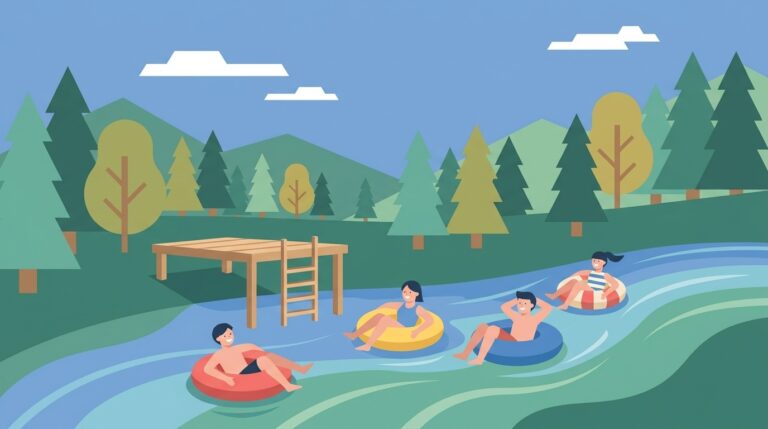
When summer hits Korea, locals skip the crowded ocean beaches and head straight to 계곡 (Gyegok – mountain valleys)! Picture this: towering pine trees shading you from the scorching sun, ice-cold mountain water trickling over smooth granite rocks, and the aroma of freshly cooked herbal chicken broth (백숙) wafting from a wooden platform (평상).
Many of our B1 intermediate learners tell us that while they feel confident ordering coffee in Seoul, they freeze up when taking a day trip to natural spots like Songchu or Gapyeong Valley. How do you ask how deep the water is before diving in? How do you rent an inner tube or reserve a cozy platform seat?
Don’t worry! Based on real student feedback, this guide will equip you with essential, natural Korean expressions so you can navigate Korean valley culture smoothly and confidently like a true insider.
Phase 2: Top 3 Core Expressions
1. 물 깊이가 얼마나 돼요? (Mul gip-i-ga ol-ma-na dwae-yo?)
- Pronunciation: [Mul geep-ee-ga ol-mah-nah dwae-yo?] (Sounds like “mul” + “deep-e-gah” + “all-mah-nah” + “dway-yo”)
- Meaning: Literal: How much is the water depth? / Nuance: “How deep is the water here?”
- K-Culture Moment: Seen in K-variety shows like Running Man right before cast members jump into mountain streams.
- Editor’s Insight: Using
얼마나 돼요?instead of formal measurements is the most natural, conversational way to inquire about depth or size on the spot. - Situation Spectrum: Casual ✅ | Semi-formal ✅ | Formal ⚠️
- 🤔 Think About It: In English, we ask “How deep is it?”, but Korean often connects quantity/degree (
얼마나) with existence/becoming (돼요). Why do you think Korean uses state-change verbs for measurements?
2. 평상 자리 있나요? (Pyeong-sang ja-ri in-na-yo?)
- Pronunciation: [Pyeong-sang jah-ree een-nah-yo?]
- Meaning: Literal: Is there a flat wooden bench seat? / Nuance: “Do you have any platform seats available?”
- K-Culture Moment: Highlighted in summer travel vlogs where visitors check availability at streamside restaurants.
- Editor’s Insight:
평상(Pyeong-sang) refers to the iconic large low wooden platforms set up right next to valley waters where families lounge and eat. - Situation Spectrum: Casual ✅ | Semi-formal ✅ | Formal 🚫
- 🤔 Think About It: How does sitting together on a shared low wooden platform reflect Korea’s collective dining and gathering culture?
3. 튜브 하나 대여해 주세요. (Tyu-beu ha-na dae-yeo-hae ju-se-yo.)
- Pronunciation: [Tew-beu ha-nah dae-yuh-hae joo-seh-yo]
- Meaning: Literal: Please rent one tube. / Nuance: “I’d like to rent one inner tube, please.”
- K-Culture Moment: Essential phrase at valley rental booths when preparing for water games (물놀이).
- Editor’s Insight: While
빌려주세요(lend me) works,대여해 주세요is slightly more polite and precise when paying a rental fee. - Situation Spectrum: Casual ⚠️ | Semi-formal ✅ | Formal ✅
- 🤔 Think About It: Loanwords like
튜브(tube) adapt into Korean phonetics. Notice how English words get friendly Korean endings!
Phase 3: Textbook Korean vs. Real Korean
Situation 1: Checking if the stream water is too cold
- 📖 Textbook Korean: 수온이 낮습니까? (Su-on-i nat-seum-ni-ka? – Is the water temperature low?)
- 🗣️ Real Korean: 물 생각보다 안 차가워요? / 물 엄청 차갑네요! (Mul saeng-gak-bo-da an cha-ga-wo-yo? / Mul eom-cheong cha-gap-ne-yo!)
- 💡 Why the difference?: Koreans rarely use formal words like
수온(water temperature) in natural summer chats. Expressing immediate physical sensation (차갑다– cold) with emphasis (엄청– super) creates warmth and rapport.
Situation 2: Asking where to clean up food containers after eating
- 📖 Textbook Korean: 쓰레기를 어디에 버려야 합니까? (Seu-re-gi-reul eo-di-e beo-ryeo-ya hap-ni-ka?)
- 🗣️ Real Korean: 쓰레기 어디에 치우면 돼요? (Seu-re-gi eo-di-e chi-u-myeon dwae-yo?)
- 💡 Why the difference?:
치우다(to clear away/tidy up) sounds much more responsible and polite than simply saying버리다(to throw away) in natural scenic spots.
Phase 4: K-Culture Deep Dive & Non-verbal Manners
4-1. Nunchi (눈치) & Gestures
- Aqua Shoes & Rocks: Streams have slippery green moss (이끼). Pointing downward with two fingers while saying
조심하세요(Be careful) shows caring Nunchi. - Hand Height for Depth: When asking
물 깊이가 얼마나 돼요?, hold your hand flat against your waist or chest to visually confirm depth before stepping in.
4-2. Culture Code: Valley Gastronomy (계곡 백숙)
In Korea, summer water play is incomplete without 닭백숙 (Herbal Whole Chicken Soup) cooked over long hours. Eating hot, nourishing chicken while dipping your feet in cold mountain water embodies the traditional concept of 이열치열 (I-yeol-chi-yeol – fighting heat with heat).
Phase 5: Real Roleplay Scenario
Setting: Songchu Valley rental & dining desk on a hot July afternoon.
Characters: Mindy (B1 Learner) & Valley Owner (사장님 – Sa-jang-nim).
- Mindy: 안녕하세요! 혹시 평상 자리 있나요?
(An-nyeong-ha-se-yo! Hok-si pyeong-sang ja-ri in-na-yo?)
🎭 Smiling brightly while pointing toward the streamside platforms.
“Hello! By any chance, do you have platform seats available?” -
Owner: 네, 저쪽 물가 옆에 한 자리 남았어요! 들어오세요.
(Ne, jeo-jjok mul-ga yeop-e han ja-ri na-mas-seo-yo! Deul-eo-o-se-yo.)
🎭 Waving warmly toward a shady spot under the trees.
“Yes, there’s one spot left right next to the water over there! Come on in.” -
Mindy: 다행이네요! 그런데 저 앞쪽 물 깊이가 얼마나 돼요?
(Da-haeng-i-ne-yo! Geu-ren-de jeo ap-jjok mul gip-i-ga ol-ma-na dwae-yo?)
🎭 Looking closely at the stream pool.
“Phew, what a relief! By the way, how deep is the water right in front?” -
Owner: 허리 정도 와요. 성인이 놀기에딱 좋아요!
(Heo-ri jeong-do wa-yo. Seong-in-i nol-gi-e ttak jo-a-yo!)
🎭 Patting his hip to demonstrate depth.
“It comes up to about waist level. Perfect for adults to splash around!” -
Mindy: 그렇군요! 그럼 튜브 하나 대여해 주세요.
(Geu-reot-gun-yo! Geureom tyu-beu ha-na dae-yeo-hae ju-se-yo.)
🎭 Handing over payment card politely with two hands.
“I see! Then please rent me one inner tube.” -
Owner: 네, 여기 튜브요. 혹시 백숙도 주문하시겠어요?
(Ne, yeo-gi tyu-beu-yo. Hok-si baek-suk-do ju-mun-ha-si-get-seo-yo?)
🎭 Handing over a bright yellow tube.
“Here is your tube. Would you also like to order chicken soup?” -
Mindy: 네! 닭백숙 하나 주시고, 다 먹고 쓰레기 어디에 치우면 돼요?
(Ne! Dak-baeksuk ha-na ju-si-go, da meok-go seu-re-gi eo-di-e chi-u-myeon dwae-yo?)
🎭 Nodding appreciatively.
“Yes! One chicken soup please. And where should we clean up our trash after eating?” -
Owner: 그릇만 평상에 두시면 저희가 치워 드려요! 편하게 즐기세요.
(Geu-reut-man pyeong-sang-e du-si-myeon jeo-hui-ga chi-wo deu-ryeoy-o. Pyeon-ha-ge jeul-gi-se-yo!)
🎭 Giving a reassuring thumbs-up.
“Just leave the dishes on the platform and we’ll clear them! Enjoy yourself!”
🔀 Interactive Decision Point
The owner asks if you want your chicken broth served right away or after swimming. What do you say?
- Option A: 지금 바로 주세요! 물놀이하고 먹으면 식잖아요.
- Option B: 물놀이 먼저 하고 30분 뒤에 준비해 주세요!
- Option C: 아무거나 상관없습니다.
Feedback:
* Best Choice (Option B): 🌟 Excellent! Valley food takes 30-40 minutes to prepare fresh. Ordering before going into the water ensures your hot meal is ready right when you get cold and hungry!
* Bad Choice (Option A): ⚠️ If served immediately before you swim, the broth gets cold while you are in the stream.
* Risk Choice (Option C): 🚫 Sounds overly blunt and robot-like for a relaxing summer trip.
Phase 6: 10-Second Emotional Shadowing Drill
Practice these with natural emotion pauses (/):
1. [😊 Excitement] 저기요! / 평상 자리 / 아직 있나요?
2. [😲 Surprise & Caution] 와, / 물 생각보다 / 진짜 차갑네요!
3. [🥺 Polite Request] 물 깊이가 / 허리보다 / 더 깊어요?
Phase 7: K-Culture Mini Dictionary
- 계곡 (Gyegok) | Mountain Stream / Valley | The ultimate natural Korean summer vacation destination.
- 평상 (Pyeongsang) | Low Wooden Platform | Traditional wide wooden bench used for sitting, dining, and napping outdoors.
- 닭백숙 (Dak-baeksuk) | Herbal Whole Chicken Soup | Essential nutrient-dense summer dish eaten stream-side.
- 물놀이 (Mulnori) | Water Play / Swimming | Any fun activity involving splashing in water with friends.
Phase 8: Traveler’s Survival Kit
Top 3 Survival Phrases
- 수건 있어요? (Su-geon it-seo-yo?) – Do you have towels?
- 미끄러우니까 조심하세요! (Mi-kkeu-reo-u-ni-kka jo-sim-ha-se-yo!) – It’s slippery, so be careful!
- 구명조끼 빌릴 수 있나요? (Gu-myeong-jjok-ki bil-ril su in-na-yo?) – Can I rent a life jacket?
Editor’s Travel Note
Before heading into mountain valleys, download the Naver Map navigation application to search for specific stream locations (계곡 추천) and check public bus or taxi routes from nearby stations.
Phase 9: One Step Deeper
Korean valley culture highlights the deep-rooted spirit of communal relaxation (정 – Jeong). Instead of individual picnic blankets isolated from one another, people share large platform areas, exchange food friendly with neighboring tables, and watch out for each other’s kids playing in the water. Swimming in Korea isn’t just sport—it’s shared community warmth.
💬 Your Turn: Have you ever visited a natural mountain stream in your home country or Korea? Share your favorite summer memory in the comments below!
Phase 10: FAQ & Common Mistakes
Q: Can I bring my own snacks and drinks to a Korean valley?
A: Yes! Most public stream areas allow picnics. However, if you rent a restaurant’s private 평상 (platform), buying their main dish (like 백숙) is customary.
Q: Do I need special footwear for valley streams?
A: Absolutely. Flip-flops easily float away. Wearing aqua shoes or sturdy strapped sandals is strongly recommended to avoid slipping on mossy rocks.
Q: Is swimming allowed in every valley?
A: No. Look out for red signs reading 수영금지 (No Swimming) or 입산통제 (Restricted Access) which protect clean drinking water reservoirs.
🚨 Common Mistakes TOP 3
- Calling water play “수영” (Swimming) always: Say
물놀이(Water play) instead when playing casually with friends. - Dropping honorifics with local staff: Always use
~요or~주세요with local elders running rental stalls. - Asking for depth in meters right away: Locals naturally describe depth using body parts (e.g.,
발목– ankle,허리– waist,가슴– chest).
Phase 11: Action Mission & Engagement
- Bronze Mission: Practice saying
물 깊이가 얼마나 돼요?out loud three times. - Silver Mission: Save this guide and share it on Instagram tagging
@DailyHangul! - Gold Mission: Use at least two valley expressions on your next weekend trip in Korea!
🎮 K-Culture Mission: Watch a summer episode of a Korean travel vlog and spot the moment someone orders 닭백숙 on a 평상!
Phase 12: Interactive Quiz Challenge
Test your knowledge!
- What is the traditional wide wooden platform near stream restaurants called?
- Fill in the blank: “튜브 하나 ____ 주세요.” (Please rent me one tube.)
- True or False: In Korean, water depth is often described by body parts like waist (
허리) or chest (가슴).
🔍 Click to reveal Answers & Explanations
- 평상 (Pyeongsang)
- 대여해 (or 빌려)
- True! It is the most natural way locals communicate depth on site.







