

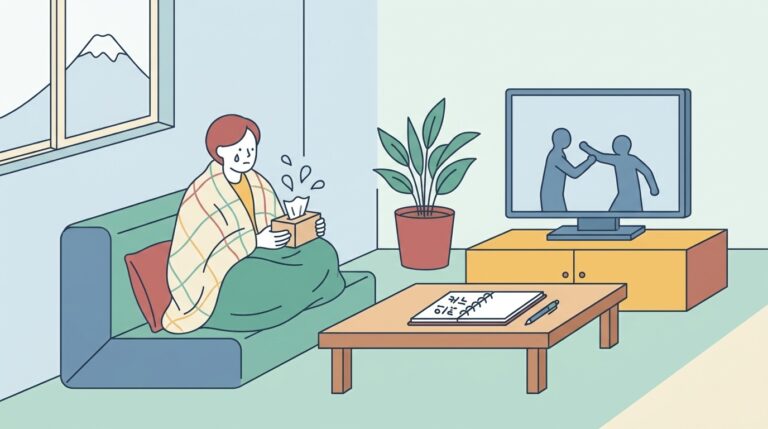
안녕하세요! 매일한글 에디터입니다. 🎬😭
Have you ever finished a K-Drama or movie late at night, staring at the screen with swollen eyes and a pile of crumpled tissues beside you? You are definitely not alone! From classic tear-jerkers like Miracle in Cell No. 7 to heartbreaking romance dramas, Korean media is world-famous for making audiences weep uncontrollably.
When international learners try to express this emotional overload in Korean, they often default to simple textbook phrases like “영화가 슬펐어요” (The movie was sad). But to truly sound like a local friend sharing emotional drama reviews over coffee, you need expressive, vivid, and culturally rich phrases! In this lesson, based on real feedback from our daily learners, we’ll explore how to talk about crying your eyes out during a sad Korean movie with confidence and authentic flair.
Phase 2: Core Expressions Deep Dive
1. 펑펑 울다 (Peong-peong ul-da)
- Pronunciation: [peong-peong ul-da] (Think of heavy popping tear drops hitting the floor: PEONG-PEONG!)
- Meaning: To cry buckets / To weep uncontrollably
- K-Culture Moment: Watching the tragic final episode of a historical K-Drama with your blanket pulled up to your chin.
- Editor’s Insight: “펑펑” is an expressive mimetic word describing pouring abundance—used both for pouring tears and heavy falling snow!
- Situation Spectrum: Casual ✅ | Semi-formal ✅ | Formal ⚠️
- 🤔 Think About It: Does your native language use physical sound words to describe intense crying like Korean does?
2. 눈물이 쏟아지다 (Nun-mu-ri ssod-a-ji-da)
- Pronunciation: [nun-mu-ri ssod-a-ji-da] (ssod-a sounds like liquid pouring down from a tipped bucket)
- Meaning: Tears pouring down / Bursting into tears
- K-Culture Moment: The exact second when the main characters part ways forever and the soundtrack climax drops.
- Editor’s Insight: The verb “쏟아지다” means to spill or shower down, emphasizing that your tears fell involuntarily.
- Situation Spectrum: Casual ✅ | Semi-formal ✅ | Formal ✅
- 🤔 Think About It: Why do you think Korean uses dynamic water-related verbs to depict strong emotions?
3. 휴지 필수예요 (Hyu-ji pil-su-yeo-yo)
- Pronunciation: [hyu-ji pil-su-yeo-yo]
- Meaning: Tissues are a total must / Bring tissues!
- K-Culture Moment: Warning your group chat before they watch the latest box-office hit movie.
- Editor’s Insight: Combining “휴지” (tissue) and “필수” (essential) creates a short, trendy warning phrase used heavily on social media reviews.
- Situation Spectrum: Casual ✅ | Semi-formal ✅ | Formal ⚠️
- 🤔 Think About It: How do you give emotional “trigger warnings” or tissue alerts in your culture?
Phase 3: Textbook Korean vs. Real Korean
Situation 1: Describing a very sad movie
- 📖 Textbook: 이 영화는 매우 슬픕니다. (I yeong-hwa-neun mae-u seul-feum-ni-da.)
- 🗣️ Real Korean: 이 영화 완전 눈물버튼이에요! (I yeong-hwa wan-jeon nun-mul-beot-teun-i-e-yo!)
- 💡 Why the difference? Koreans love creative compound words. “눈물버튼” (tear button) refers to any trigger or movie guaranteed to turn on your waterworks instantaneously!
Situation 2: Telling someone you cried a lot
- 📖 Textbook: 저는 많이 울었습니다. (Jeo-neun ma-ni u-reos-seum-ni-da.)
- 🗣️ Real Korean: 저 휴지 한 통 다 썼잖아요. (Jeo hyu-ji han tong da sseot-ja-na-yo.)
- 💡 Why the difference? Native speakers often use relatable exaggerations (“I used an entire box of tissues!”) to emphasize their authentic emotional reaction.
Phase 4: K-Culture Deep Dive & Non-Verbal Manners
4-1. Nunchi & Gestures
When walking out of a Korean movie theater after a tear-jerker, it is common Nunchi (social tact) to lower your voice and avoid staring directly at others who are wiping away red eyes. If a friend starts tearing up beside you, silently passing them a tissue without interrupting the movie is considered the ultimate thoughtful gesture.
4-2. Cultural Code: The Art of “Shinpa” (신파)
In Korean film and drama, the concept of Shinpa (신파) refers to unabashedly passionate, melodramatic plot points revolving around family sacrifice, deep affection (정), and tragic fate. While some critics debate its sentimentality, Shinpa remains the heartbeat of Korean emotional storytelling that brings viewers together in shared catharsis.
Phase 5: Interactive Roleplay Scenario
Setting: Outside Megabox Cinema in Seongsu-dong. You just finished watching a sad movie with your friend Minjun (민준).
- Minjun: 🎭 (wiping tears with a tissue) 아… 영화 진짜 대박이다. 너 괜찮아? (Ah… this movie was insane. Are you okay?)
- You: 🎭 (sniffling) 저 완전 펑펑 울었어요. (I cried completely buckets.)
- Minjun: 🎭 (nodding sympathetically) 맞지? 마지막 장면에서 눈물이 쏟아지더라고. (Right? Tears were just pouring out in the last scene.)
- You: 🎭 (showing an empty tissue pack) 휴지 한 통 다 썼어요! (I used a whole box of tissues!)
- Minjun: 🎭 (laughs gently) 다음부터는 이 배우 나오는 영화 볼 때 휴지 필수야. (From next time, tissues are a must when watching this actor’s movies.)
- You: 🎭 (sighing with deep emotion) 여운이 진짜 오래 남을 것 같아요. (I think the lingering feelings will stay for a long time.)
- Minjun: 🎭 (pointing to a cozy cafe) 카페 가서 마음 좀 추스릴까? (Shall we go to a cafe and calm our hearts down?)
- You: 🎭 (nodding with a faint smile) 좋아요, 단 것 좀 먹어야겠어요. (Sounds good, I need to eat something sweet.)
🔀 Interactive Choice Point
How do you respond when Minjun asks if you want sweet dessert at the cafe?
- Choice A (Best): “좋아요! 초코 케이크 먹으면서 영화 얘기 더 해요.” (Great! Let’s eat chocolate cake and talk more about the movie.)
- Feedback: Perfect! Natural, warm, and keeps the friendly conversation flowing.
- Choice B (Bad): “아니요, 저는 울어서 슬픕니다.” (No, I am sad because I cried.)
- Feedback: Too stiff and grammatically unnatural for B1 conversational tone.
- Choice C (Risk): “울어서 배고파요. 고기 10인분 먹어요!” (I’m hungry from crying. Let’s eat 10 servings of meat!)
- Feedback: Humorous among very close best friends, but a bit sudden right after a cinema exit!
Phase 6: 10-Second Emotion Shadowing Drill
[🥺 Sniffling & Tearful]
저 / 진짜 / 펑펑 / 울었잖아요.
(Jeo / jin-jja / peong-peong / u-reos-ja-na-yo.)-
[😭 Emotional Overload]
마지막 장면에서 / 눈물이 / 쏟아졌어요.
(Ma-ji-mak jang-myeon-e-seo / nun-mu-ri / ssod-a-jyeos-seo-yo.) -
[💡 Enthusiastic Warning]
이 영화 보려면 / 휴지 / 필수예요!
(I yeong-hwa bo-ryeo-myeon / hyu-ji / pil-su-yeo-yo!)
Phase 7: K-Culture Mini Dictionary
- 신파 (Sin-pa) | Melodramatic storyline designed to evoke powerful tears and empathy.
- 여운이 남다 (Yeo-un-i nam-da) | To leave lingering emotional aftertastes after a movie or song ends.
- 최애 (Choe-ae) | Your absolute favorite actor, idol, or character.
- 맴찢 (Maem-jjit) | Slang short for “마음이 찢어지다” (heart-shredding / deeply heartbreaking).
Phase 8: Traveler’s Survival Kit
TOP 3 Survival Phrases for Korean Theaters
- 휴지 좀 주시겠어요? (Hyu-ji jom ju-si-ges-seo-yo?) – Could I please get some tissues?
- 이 영화 많이 슬퍼요? (I yeong-hwa ma-ni seul-feo-yo?) – Is this movie very sad?
- 눈물이 안 멈춰요. (Nun-muri an meom-chwo-yo.) – I can’t stop crying.
📝 Editor’s Travel Note
When booking movie tickets or checking theater locations in Seoul, skip standard global maps. Use the 네이버 지도 앱 다운로드 (Naver Map App) to easily search for CGV, Megabox, or Lotte Cinema locations near popular spots like Hongdae or Seongsu!
Phase 9: One Step Deeper (Reflection)
In Korean culture, sharing tears over a tragic story isn’t seen as weakness; it’s seen as a sign of deep empathy and shared human warmth (정, Jeong). Experiencing a movie together and crying side-by-side creates a unique bond among friends in Korea.
💬 Your Turn: What is the one K-Drama or movie that made you cry buckets (펑펑 울다)? Share your favorite tear-jerker title in the comments below!
Phase 10: FAQ & Common Mistakes
Q: Is “펑펑” only used when someone is crying?
A: Not exclusively! While most famous for crying (펑펑 울다), it also describes heavy snow falling in thick flakes (눈이 펑펑 내리다).
Q: Can I use “눈물버튼” in formal writing?
A: No, “눈물버튼” is vibrant colloquial slang. For formal contexts, use expressions like “감동적인 장면” (touching scene).
Q: Is it okay to cry loudly in Korean movie theaters?
A: Silent crying and sniffling are completely fine! However, wailing out loud might distract other viewers during silent drama climaxes.
🚨 Common Mistakes Warning
- ❌ Mistake: “눈물이 흐르다” used incorrectly for heavy crying.
- 👉 Correct Action: Use “펑펑 울다” or “눈물이 쏟아지다” when you mean intense crying, not just a single tear rolling down.
- ❌ Mistake: Saying “휴지가 필요해요” in a casual recommendation.
- 👉 Correct Action: Use the catchy phrase “휴지 필수예요!” for movies.
- ❌ Mistake: Confusing “슬프다” (to be sad) with “아프다” (to be sick/in pain).
- 👉 Correct Action: Remember: movies make you 슬퍼요, not 아파요!
Phase 11: Action Mission & K-Culture Challenge
- 🥉 Bronze: Repeat the Phase 6 Shadowing Drill out loud 3 times with exaggerated emotions.
- 🥈 Silver: Post a K-Drama review on your Instagram/X account using
#펑펑울었다and#휴지필수. - 🥇 Gold: Watch an episode of a sad K-Drama without subtitles and identify when characters express sadness using today’s vocabulary!
🎮 K-Culture Mission: Find a K-Pop ballad or drama soundtrack (OST) that has “눈물” in the title or lyrics and write down the sentence in your study journal!
Phase 12: Interactive Quiz Challenge
Question 1: Situation Check
Which phrase best fits when warning a friend about an extremely heartbreaking drama?
* A) 영화가 아주 심심해요.
* B) 휴지 필수예요!
* C) 눈물이 안 나와요.
Click to reveal answer & explanation
Answer: B) 휴지 필수예요!
Explanation: “휴지 필수예요” means “Tissues are a must-have!”, making it the perfect recommendation phrase for tear-jerkers.
Question 2: Fill in the Blank
마지막 장면이 너무 슬퍼서 ________ 울었어요.
* A) 펑펑
* B) 반짝반짝
* C) 미끌미끌
Click to reveal answer & explanation
Answer: A) 펑펑
Explanation: “펑펑” is the mimetic word used with “울다” to describe crying heavily/pouring tears.
Question 3: True / False Culture Quiz
In Korea, watching emotional movies and crying together is considered a natural way to bond and build Jeong (정).
Click to reveal answer & explanation
Answer: True!
Explanation: Sharing emotional catharsis through movies and media is a popular social bonding activity in modern Korea.







