

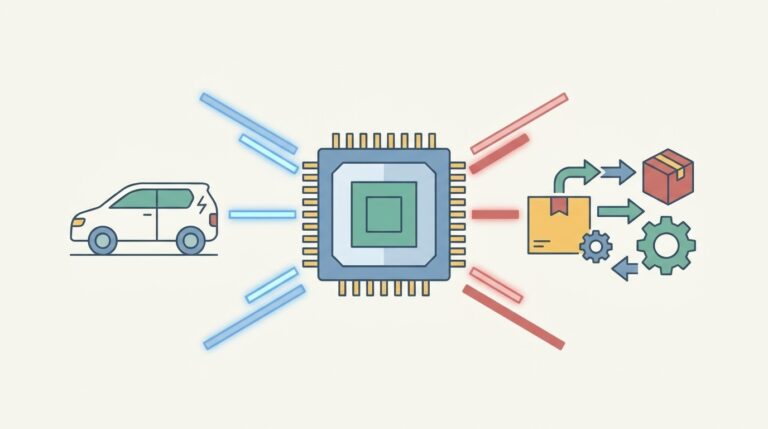
안녕하세요! 매일한글 에디터입니다. Welcome back to another deep dive into high-level Korean language mastery! Today, we are tackling a sophisticated, C2-level topic straight from the front pages of global business news: the global semiconductor war, specifically focusing on automotive microchip shortages and supply chain diversification (차량용 반도체 수급난 원인과 공급망 다변화).
If you’ve ever tried reading economic news articles in Korean or listened to executive briefings in Pangyo Techno Valley, you know how daunting terms like ‘공급망 다변화’ or ‘수급 불균형’ can feel. You might understand the literal dictionary meanings, but deploying them naturally in formal discussions or high-level business negotiation is a completely different ballgame. Don’t worry! Based on years of mentoring corporate professionals and advanced learners, I’m here to bridge that gap with authentic Korean business nuances. Let’s master the language of modern industry leadership together!
Phase 2: Core Expressions Deep Dive
1. 수급 불균형 (Su-geup bul-gyun-hyeong)
- Pronunciation: [Su-geup bul-gyun-hyeong] (Sounds like “soo-goop bool-gyun-hyeong”)
- Meaning: Literal: Supply and demand imbalance | Nuance: A structural deficit where market demand severely outpaces supply chains.
- K-Culture Moment: Commonly heard in executive boardroom scenes in high-stakes business K-dramas like Reborn Rich (재벌집 막내아들) or economic news broadcasts on KBS.
- Editor’s Insight: ‘수’ (收/需 – demand/receipt) and ‘급’ (給 – supply) combine to form ‘수급’ (supply-demand dynamics). Pairing it with ‘불균형’ elevates your language instantly to professional policy level.
- Situation Spectrum: Casual 🚫 | Semi-formal ⚠️ | Formal ✅
- 🤔 Think About It: How does using precise economic terminology change your professional credibility when pitching strategy in a Korean corporate setting?
2. 공급망 다변화 (Gong-geub-mang da-byeon-hwa)
- Pronunciation: [Gong-geub-mang da-byeon-hwa] (Sounds like “gong-geup-mang dah-byeon-hwah”)
- Meaning: Literal: Supply chain diversification | Nuance: Strategic expansion of vendor bases to mitigate geopolitical and logistics risks.
- K-Culture Moment: Panel discussions among tech industry titans debating semiconductor independence on news programs.
- Editor’s Insight: ‘다변화’ (diversification) is a key C2 corporate buzzword. Instead of saying “우리는 다른 회사도 찾아야 해요” (We need to find other companies), using this term marks you as a strategist.
- Situation Spectrum: Casual 🚫 | Semi-formal ⚠️ | Formal ✅
- 🤔 Think About It: Why has risk mitigation become such a central theme in modern Korean business communication?
3. 발목을 잡다 (Bal-mog-eul jab-da)
- Pronunciation: [Bal-mog-eul jab-da] (Sounds like “bal-mog-eul jahp-dah”)
- Meaning: Literal: To grab someone by the ankle | Nuance: To impede progress, hold back, or create a bottleneck.
- K-Culture Moment: Frequently used in business reporting when key component shortages delay major product launches.
- Editor’s Insight: Idiomatic yet widely accepted in professional Korean media to vividly describe bottlenecks.
- Situation Spectrum: Casual ✅ | Semi-formal ✅ | Formal ✅
- 🤔 Think About It: Expressing serious business bottlenecks through vivid physical metaphors is a classic Korean communication style.
Phase 3: Textbook Korean vs. Real Native Korean
Scenario 1: Discussing vehicle delivery delays due to chip shortages
- 📖 Textbook: 차량용 반도체가 부족해서 자동차 생산이 지연되고 있습니다.
- 🗣️ Real Native (C2): 반도체 수급 난항으로 신차 출고 대기 기간이 1년 넘게 밀렸어요.
- 💡 Why different?: Natives use ‘수급 난항’ (supply distress) and ‘밀리다’ (backed up) to express business reality realistically and concisely.
Scenario 2: Suggesting new vendor partnerships
- 📖 Textbook: 우리는 다른 공급 업체를 찾아야 합니다.
- 🗣️ Real Native (C2): 리스크 관리를 위해서라도 공급처 다변화가 시급한 시점입니다.
- 💡 Why different?: Executive Korean relies on precise nominal compounds like ‘공급처 다변화’ (vendor diversification) and ‘시급한 시점’ (urgent juncture).
Phase 4: K-Culture Deep Dive & Non-Verbal Etiquette
4-1. Nunchi & Gesture in Tech Boardrooms
In Korean corporate culture (especially in tech hubs like Pangyo and Suwon), maintaining calm posture while acknowledging systemic risks shows executive authority. When discussing ‘공급망 다변화’, slightly nod with two hands loosely clasped on the table to show strategic consensus.
4-2. Cultural Code: Pangyo Techno Valley & The Tech Race
South Korea’s ‘Semiconductor DNA’ runs through giant industrial clusters. The interplay between automotive giants (Hyundai/Kia) and chip designers highlights a national priority: technological sovereignty. Understanding these corporate dynamics allows you to talk business like a true insider.
Phase 5: Real Role-Play Scenario
Setting: Strategy meeting room at a mobility tech enterprise in Pangyo. You are presenting supply chain risk management solutions to Executive Director Director Park (박 이사).
- 박 이사: 이번 분기 차량용 반도체 수급 상황은 어떤가요?
- (How is our automotive semiconductor supply situation this quarter?)
- You: 🎭 [Calm and professional] 해외 파운드리 생산 차질로 인해 핵심 칩 수급 불균형이 심화되고 있습니다.
- (Due to overseas foundry disruptions, the supply-demand imbalance for core chips is deepening.)
- 박 이사: 그렇다면 우리 라인 생산에도 영향이 크겠군요.
- (Then it will significantly affect our production lines.)
- You: 🎭 [Confidently pointing at a slide] 네, 일부 부품의 병목 현상이 전체 출고 일자의 발목을 잡고 있는 실정입니다.
- (Yes, bottlenecks in certain components are grabbing our overall delivery timeline by the ankle.)
- 박 이사: 해결책은 뭡니까?
- (What is our solution?)
- You: 🎭 [Delivering strategic solution] 단기적으로는 재고 확보에 집중하고, 장기적으로는 공급망 다변화를 추진해야 합니다.
- (In the short term we focus on securing inventory, and in the long term we must drive supply chain diversification.)
- 박 이사: 좋은 접근입니다. 국내 대안 공급처 타당성 검토를 바로 진행하세요.
- (Good approach. Proceed immediately with a feasibility study on domestic alternative suppliers.)
- You: 🎭 [Bowing slightly with hands clasped] 네, 검토 보고서를 조속히 작성하여 보고드리겠습니다.
- (Understood. I will draft and submit the review report promptly.)
🔀 Interactive Choice Point
How do you respond when the Executive asks for immediate action?
* Option A: “네, 열심히 해볼게요!” (Bad – Too casual and imprecise for C2 level)
* Option B: “네, 검토 보고서를 조속히 작성하여 보고드리겠습니다.” (Best – Polished, authoritative C2 business phrasing)
* Option C: “글쎄요, 공급 업체를 바꾸는 건 불가능한데요.” (Risk – Dismissive tone, lacks executive problem-solving attitude)
Phase 6: 10-Second Emotion Shadowing Drill
[👔 Executive Tone]반도체 수급 난항이 / 생산 일정에 / 발목을 잡고 있습니다.[💡 Strategic & Firm]리스크 관리를 위해 / 공급망 다변화가 / 시급한 시점입니다.[🤝 Professional Consensus]조속히 대안 공급처를 / 타당성 검토하겠습니다.
Phase 7: K-Culture Mini Dictionary
- 파운드리 (Pa-un-deu-ri) | Semiconductor Foundry | Manufacturing facility producing chips designed by fabless tech firms.
- 병목 현상 (Byeong-mog hyeon-sang) | Bottleneck Phenomenon | System blockage slowing overall throughput.
- 출고 지연 (Chul-go ji-yeon) | Delivery Delay | Post-production vehicle release delay caused by missing components.
- 기술 내재화 (Gi-sul nae-jae-hwa) | In-house Technology Localization | Strategy to internalize critical chip technologies within domestic supply chains.
Phase 8: Traveler & Business Visitor Survival Kit
- Top 3 Business Survival Phrases:
- “공급처 리스크 분산이 필요합니다.” (We need vendor risk diversification.)
- “납기 일정을 재조율할 수 있을까요?” (Could we readjust the delivery schedule?)
- “대안 부품 테스트를 완료했습니다.” (We completed testing alternative components.)
- Editor’s Travel Note: Attending tech expos in Gangnam or Pangyo? Make sure to utilize 네이버 지도 앱 다운로드 for navigating corporate tech parks hassle-free!
Phase 9: One Step Deeper
South Korea’s economic development trajectory from heavy industry to advanced semiconductor dominance reflects a deep-seated cultural value: Ppalli-Ppalli (speed) coupled with meticulous risk management. Navigating technological friction requires not just technical vocabulary, but an understanding of how Korean corporate structures value proactive crisis mitigation.
💬 Your Turn: How does your local industry handle sudden supply chain disruptions compared to Korea’s strategic diversification approach? Share your thoughts below!
Phase 10: FAQ & Common Mistakes
Q: Is ‘발목을 잡다’ appropriate in formal economic reports?
A: Yes! While idiomatic, it is widely used in mainstream financial press, editorial articles, and corporate briefings.
Q: What is the difference between ‘공급처’ and ‘공급망’?
A: ‘공급처’ refers to specific supplier companies/vendors, whereas ‘공급망’ refers to the broader macro supply chain infrastructure.
Q: Can I use ‘수급’ for non-industrial contexts?
A: Yes, it applies anywhere supply and demand interact, such as labor supply (인력 수급) or housing markets (주택 수급).
🚨 Common Mistakes TOP 3
- Saying ‘물건 공급이 안 맞아요’ instead of ‘수급 불균형’ -> Correct Action: Use ‘수급 불균형’ in business contexts.
- Confusing ‘다변화’ with ‘다양성’ -> Correct Action: Use ‘다변화’ (diversification process), not ‘다양성’ (diversity condition) when speaking on strategy.
- Overusing literal translations of Western business idioms -> Correct Action: Adopt Korean native structural phrases like ‘시급한 시점입니다’.
Phase 11: Action Mission
- Bronze: Pronounce ‘공급망 다변화’ 5 times cleanly using the Shadowing Drill.
- Silver: Leave a comment using ‘발목을 잡다’ in a business scenario.
- Gold: Write a 3-sentence summary of a Korean tech news article using today’s key terms.
- 🎮 K-Culture Mission: Watch an episode of a business K-drama and spot when economic terms appear in executive meetings!
Phase 12: Interactive Quiz Challenge
- Which term best means ‘Supply chain diversification’?
- A) 공급망 다변화
- B) 수급 불균형
- C) 기술 내재화
- True or False: ‘발목을 잡다’ is too informal and should never be used in corporate briefings.
- A) True
- B) False
Click to reveal answers & explanations!
- Answer: A) 공급망 다변화
- Explanation: ‘공급망 다변화’ specifically denotes diversifying supply chain channels.
- Answer: B) False
- Explanation: It is an accepted business idiom frequently featured in financial media and executive speeches.
- Explanation: It is an accepted business idiom frequently featured in financial media and executive speeches.






