

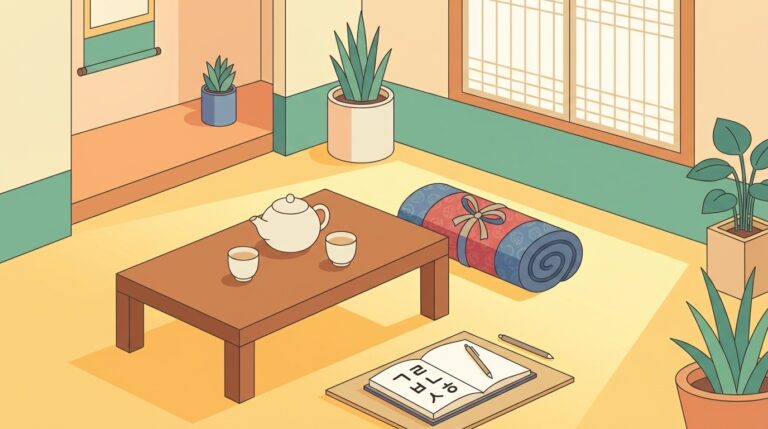
Phase 1: Welcome to the Cozy World of Ondol!
안녕하세요! I’m your lead editor at Daily Hangul. Have you ever stepped into a traditional Korean house (Hanok) during a chilly morning, took off your shoes, and immediately felt a wave of soothing warmth radiating straight up through your feet? That magically warm floor is Ondol (온돌), Korea’s unique underfloor heating system!
When foreign travelers visit a Hanok stay or a cozy local guesthouse in South Korea, many get confused about how to talk about the heated floors, ask for temperature adjustments, or describe how cozy they feel. You might know the basic word for warm (ttatteuthada), but how do native Koreans casually compliment the room or ask the host for help without sounding like a textbook robot? Today, based on feedback from hundreds of our A2 learners, I’ll guide you through the exact natural phrases and cultural manners you need to master Korean Ondol culture with confidence!
Phase 2: Key Expressions Analysis
1. 바닥이 진짜 따뜻해요! (Badagi jinja ttatteuthaeyo!)
- Pronunciation: [bah-dahg-ee jeen-jah ttah-tteut-hae-yo] (Think of ‘ttah’ like a sharp ‘T’ sound with extra tension!)
- Meaning: Literal: “The floor is really warm!” | Nuance: “This floor feels so warm and wonderful!”
- K-Culture Moment: You’ll hear this in almost every winter episode of Korean reality shows like Three Meals a Day when guests lie down on the floor right after coming inside.
- Editor’s Insight: In Korea, people don’t just sit on chairs; the floor (badak) is a living space. Saying this shows appreciation for the host’s hospitality.
- Situation Spectrum: Casual ✅ | Semi-formal ✅ | Formal ⚠️
- 🤔 Think About It: Does your home culture treat the floor as a main living surface, or is heating usually coming from wall vents?
2. 아랫목이 따뜻해서 너무 좋아요 (Araenmogi ttatteuthaeseo neomu joayo)
- Pronunciation: [ah-raen-mog-ee ttah-tteut-hae-seo nuh-mu joh-ah-yo]
- Meaning: Literal: “The lower floor spot is warm so I love it!” | Nuance: “I love sitting on this extra cozy warm spot on the floor!”
- K-Culture Moment: Seen in historical dramas (Sageuk) or family dramas when elders sit on the warmest spot near the heat source to relax.
- Editor’s Insight: Araenmok (아랫목) is traditionally the warmer section of the room closest to the fireplace or heating element. It’s considered the guest of honor’s spot!
- Situation Spectrum: Casual ✅ | Semi-formal ✅ | Formal 🚫
- 🤔 Think About It: How do you show respect to guests in your culture when offering them the best seat?
3. 온도를 조금만 높여 주시겠어요? (Ondoreul jogeumman nopyeo jusigesseoyo?)
- Pronunciation: [ohn-doh-reul joh-geum-mahn noh-pyuh joo-shee-geh-ssuh-yo?]
- Meaning: Literal: “Could you raise the temperature a little bit?” | Nuance: “Polite request to turn up the heating slightly.”
- K-Culture Moment: Common at Hanok guesthouses when the floor thermostat is controlled by the host.
- Editor’s Insight: Adding jogeumman (just a little) makes your request softer and polite in Korean.
- Situation Spectrum: Casual ⚠️ | Semi-formal ✅ | Formal ✅
- 🤔 Think About It: Why does adding softening words like “a little bit” make polite requests sound much warmer in Korean?
Phase 3: Textbook Korean vs. Real Korean
Situation 1: Expressing that you love the floor warmth
* 📖 Textbook Korean: 방이 따뜻합니다. (Bangi ttatteut-hamnida. / The room is warm.)
* 🗣️ Real Korean: 바닥이 지질 정도로 따뜻해요! (Badagi jijil jeongdoro ttatteuthaeyo! / The floor is warm enough to bake my back!)
* 💡 Why the difference?: Koreans love using playful exaggerated expressions like jijida (to toast/bake gently) to describe deep muscle-relaxing warmth on an Ondol floor.
Situation 2: Asking if you can turn up the floor heater
* 📖 Textbook Korean: 난방을 켜 주세요. (Nanbangeul kyeo juseyo. / Please turn on the heater.)
* 🗣️ Real Korean: 방이 좀 썰썰한데 온도를 조금만 올릴까요? (Bangi jom sseolsseolhande ondoreul jogeumman ollilkkayo? / The room is a bit chilly, shall we turn up the warmth a little?)
* 💡 Why the difference?: Stating the context (bangi jom sseolsseolhande) first softens the request and invites agreement rather than sounding like a blunt order.
Phase 4: K-Culture Deep Dive & Non-Verbal Manners
4-1. Nunchi & Gestures for Ondol Experience
- Shoes Off First!: Always remove your shoes at the entrance (hyeon-gwan) before stepping onto wooden or Ondol floors. Walking on Ondol with shoes is a major social taboo.
- Sitting Manners: When sitting on the heated floor, men often sit cross-legged (yangban-dani), while women traditionally sit with legs folded to one side. Standing or sitting directly on pillows meant for seating is considered impolite.
- Offering the Araenmok: If you are staying with older host family members, invite them to sit on the warmest spot on the floor first.
4-2. Culture Code: The Magic of Ondol
In Korea, winter lifestyle revolves around floor heating. Unlike Western radiators that heat the air, Ondol warms your body directly through floor contact. That’s why Koreans love lying flat on the floor (badak-e nupda) after a long day. Even modern apartments use water-pipe Ondol underneath wooden laminate flooring!
Phase 5: Real-Life Roleplay Scenario
Background: You are checking into a traditional Hanok stay in Bukchon Hanok Village, Seoul. You meet Mrs. Park, your friendly Hanok host.
- Turn 1 (Mrs. Park): 🎭 (Welcoming you at the door with a warm smile) 안녕하세요! 오느라 고생했어요. 신발 벗고 들어오세요.
- Turn 2 (You): 🎭 (Taking off shoes and stepping onto the warm floor) 감사합니다! 와, 바닥이 진짜 따뜻해요!
- Turn 3 (Mrs. Park): 🎭 (Nodding proudly) 다행이네요. 온돌이 잘 작동하고 있어요. 편하게 앉으세요.
- Turn 4 (You): 🎭 (Sitting cross-legged on the cozy floor) 이 방이 정말 포근하고 좋네요.
- Turn 5 (Mrs. Park): 🎭 (Pointing to the wall controller) 혹시 밤에 추우면 온도를 조금 높이세요.
- Turn 6 (You): 🎭 (Looking at the controller) 네! 온도를 어떻게 조정해요?
- Turn 7 (Mrs. Park): 🎭 (Demonstrating) 이 버튼을 누르면 돼요. 어렵지 않죠?
- Turn 8 (You): 🎭 (Smiling gratefully) 네, 알겠습니다! 따뜻하게 잘 잘게요.
🔀 Interactive Choice Point
Mrs. Park asks: “방이 너무 덥지는 않으세요?” (Is the room too hot for you?)
* Choice A: “네, 너무 더워요! 꺼 주세요!” (Yes, it’s too hot! Turn it off!)
* Choice B: “아니요, 딱 좋아요! 정말 따뜻해요.” (No, it’s just right! It’s really warm.)
* Choice C: “조금 따뜻하지만 상관없어요.” (It’s a bit warm but whatever.)
Feedback:
* Best Choice (B): Perfect! It expresses satisfaction and respects the host’s efforts to keep you comfortable.
* Risk Choice (A): A bit too blunt! Saying “turn it off” directly can sound demanding. Better to say: 조금 따뜻한데 온도를 약간 낮춰 주시겠어요?
* Bad Choice (C): Too dismissive. 상관없어요 (whatever/I don’t care) sounds unappreciative.
Phase 6: 10-Second Emotion Shadowing Drill
[😊 Delighted and relaxed]바닥이 / 진짜 / 따뜻해서 / 너무 좋아요!
(Ba-da-gi / jin-ja / ttah-tteut-hae-seo / neomu jo-ah-yo!)[🥺 Polite and gentle]온도를 / 조금만 / 높여 / 주시겠어요?
(Ohn-do-reul / joh-geum-mahn / noh-pyuh / joo-shee-geh-ssuh-yo?)[😌 Cozy and peaceful]방이 / 참 / 포근하고 / 따뜻해요.
(Bang-i / cham / po-geun-ha-go / ttah-tteut-hae-yo.)
Phase 7: K-Culture Mini Dictionary
- 온돌 (Ondol) | Traditional Korean underfloor radiant heating system.
- 한옥 (Hanok) | Traditional Korean wooden house designed for natural air flow and Ondol heating.
- 아랫목 (Araenmok) | The warmer section of an Ondol floor room, traditionally reserved for elders or respected guests.
- 이불 (Ibul) | Korean traditional floor bedding/duvet laid directly over the warm floor.
Phase 8: Traveler’s Survival Kit
Top 3 Survival Phrases
- 방이 좀 차가워요. (Bangi jom chagawoyo.) – The room is a bit cold.
- 온돌 스위치가 어디에 있어요? (Ondol seuwichiga eodie isseoyo?) – Where is the Ondol switch?
- 따뜻하게 잘 쉬었습니다. (Ttatteut-hage jal swieosseumnida.) – I had a warm and wonderful rest (when checking out).
Editor’s Travel Note
When booking a traditional Hanok stay in Seoul or Jeonju, search for places using the Naver Map app download for real guest reviews on floor heating quality! Always check if the room heating is central or individually controlled.
Phase 9: Deep Dive – The Mindset of Ondol
In Western cultures, comfort often means soft furniture elevated off the ground. In Korea, true comfort comes from grounded connection—literally sitting together on a warm floor. This shared floor warmth fosters intimacy, where families sit around an ibul blanket in winter to eat mandarins and chat.
💬 Your Turn: What is your culture’s favorite way to stay warm during winter? Share your thoughts in the comments below!
Phase 10: FAQ & Common Mistakes
Q: Can I leave the Ondol heating on high all night?
A: It’s better to set it to a moderate temperature (around 20-22°C). Because the floor stays warm for hours, setting it too high might make the floor uncomfortably hot to sleep on!
Q: Is Ondol only found in old traditional houses?
A: No! Over 90% of modern Korean residential apartments use built-in water-pipe Ondol heating.
Q: What should I wear when sleeping on an Ondol floor?
A: Light, comfortable pajamas are best. Since the heat comes directly from the floor, heavy layers can make you sweat easily.
🚨 Common Mistakes Warning Board
- Mistake 1: Stepping onto the room floor with socks that you wore outside on wet streets.
- Correct Action: Wear clean indoors socks or go barefoot inside!
- Mistake 2: Leaving heat-sensitive items (like chocolates or electronic devices) directly on the floor hot spot.
- Correct Action: Place sensitive items on low tables or luggage racks!
- Mistake 3: Calling the floor heater a “radiator” (radi-eiter).
- Correct Action: Use the correct term 보일러 (bo-illeo) or 온돌 (ondol)!
Phase 11: Action Mission
- 🥉 Bronze: Practice saying “바닥이 따뜻해요” three times out loud!
- 🥈 Silver: Record your voice practicing Phase 6 Emotion Shadowing and share it with your study buddy.
- 🥇 Gold: Visit a Hanok stay or Korean sauna (Jjimjilbang) and use at least two Ondol expressions with staff!
- 🎮 K-Culture Mission: Watch a winter Hanok scene in your favorite Korean drama and spot when characters lie on the warm floor!
Phase 12: Interactive Quiz Challenge
Q1. What is the traditional warm spot on an Ondol floor called?
A) 현관 (Hyeongwan)
B) 아랫목 (Araenmok)
C) 베란다 (Beranda)
Click to see Answer
Answer: B) 아랫목 (Araenmok). Araenmok refers to the warmest floor spot closest to the heating source!
Q2. True or False: You should keep your outdoor shoes on when walking on an Ondol floor.
Click to see Answer
Answer: False! Shoes must always be taken off at the entrance before stepping on floor surfaces in Korea.







