

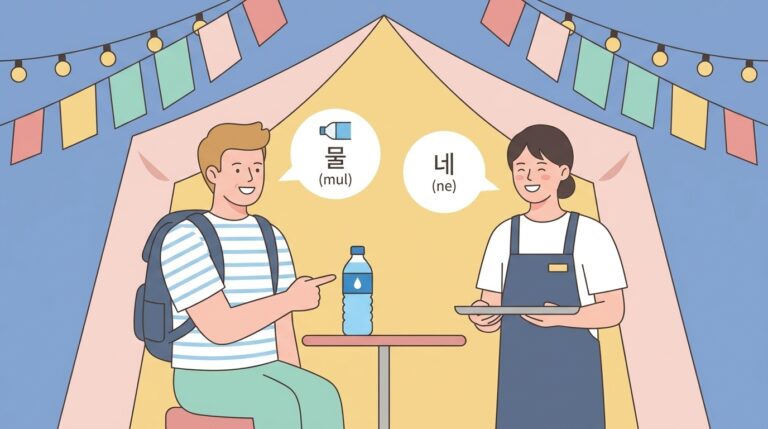
Korean Drinking Culture Survival: How to Ask for Water Like a Local!
안녕하세요! I’m your Korean editor and best friend from Daily Hangul! Have you ever found yourself sitting at a lively Korean barbecue restaurant or a pocha (street tavern), surrounded by sizzling meat, cold drinks, and laughter, only to realize… your mouth is completely on fire from that spicy tteokbokki? You look around, see everyone clinking glasses, but all you desperately need right now is a glass of cold water. You try to catch the waiter’s eye, but you freeze. What do you say?
Don’t worry! Every Korean learner goes through this exact moment. Asking for water might sound simple, but in Korea’s fast-paced dining and drinking culture, knowing the right phrase—and how to say it—makes all the difference between feeling like a lost tourist and blending in like a cool local. Today, we’re unlocking the absolute essential survival phrase for your nights out in Korea: “물 좀 주세요” (Mul jom juseyo). Based on real feedback from thousands of beginner learners, this guide will give you the confidence to order water smoothly without breaking the vibe!
Phase 2: Core Expressions Breakdown
1. 물 좀 주세요 (Mul jom juseyo)
- Pronunciation: [Mul jom ju-se-yo] (Think of ‘Mul’ like ‘Mool’, ‘Jom’ like ‘Jahm’, and ‘Juseyo’ like ‘Zoo-say-yo’)
- Meaning: Literally “Please give me some water.” (Water + Please/A little + Please give).
- K-Culture Moment: You’ll hear this in almost every K-Drama scene where characters are eating spicy Samgyeopsal or drinking Soju late at night!
- Editor’s Insight: The magic word here is “좀” (jom). While it means “a little,” adding it makes your request sound much softer, friendlier, and more natural than just saying “물 주세요”.
- Situation Spectrum: Casual ✅ | Semi-formal ✅ | Formal ⚠️
- 🤔 Think About It: In English, asking for “a little water” might sound overly specific, but in Korean, adding “a little” softens the whole tone. Isn’t it neat how politeness works differently across languages?
2. 물은 셀프입니다 (Mureun selpeu-imnida)
- Pronunciation: [Moo-reun sell-peu im-nee-da]
- Meaning: “Water is self-service.”
- K-Culture Moment: You walk up to a server to ask for water, and they point smilingly to a sign on the wall near the water purifier.
- Editor’s Insight: Korea loves efficiency! At many informal dining spots and pubs, fetching your own water from the purifier or fridge is standard.
- Situation Spectrum: Casual ✅ | Semi-formal ✅ | Formal ✅
- 🤔 Think About It: Why do you think self-service water is so popular in Korea? (Hint: It keeps dining quick and affordable!)
3. 시원한 물 주세요 (Siwonhan mul juseyo)
- Pronunciation: [See-won-han mul ju-se-yo]
- Meaning: “Please give me cold water.”
- K-Culture Moment: After a long night of dancing or spicy hot pot, asking specifically for ice-cold water.
- Editor’s Insight: “시원하다” (Siwonhada) means refreshing/cool. Koreans love ice-cold water even in winter!
- Situation Spectrum: Casual ✅ | Semi-formal ✅ | Formal ⚠️
- 🤔 Think About It: Does your home culture prefer room temperature or chilled water during meals?
Phase 3: Textbook Korean vs. Real Korean
Situation 1: Asking the server for water
- 📖 Textbook Korean: 저기요, 물을 주십시오. (Jeogiyo, mureul jusipsio.)
- 🗣️ Real Korean: 저기요, 물 좀 주세요! (Jeogiyo, mul jom juseyo!)
- 💡 Why is it different? Textbook phrases ending in ‘-십시오’ sound like an army manual or official announcement. Real Koreans use ‘-요’ for polite, friendly everyday requests.
Situation 2: Asking where to get water
- 📖 Textbook Korean: 물은 어디에 있습니까? (Mureun eodie isseumnida?)
- 🗣️ Real Korean: 물 셀프예요? (Mul selpeu-yeyo?)
- 💡 Why is it different? Using the Konglish word “Selpeu” (Self) is fast, natural, and instantly understood in modern Korean restaurants.
Phase 4: K-Culture Deep Dive & Mannerisms
4-1. Eye Contact, Gestures, & Nunchi
When calling a staff member in a crowded Korean restaurant or pub, don’t be shy! Raise one hand lightly (about chest/head height) and politely say “저기요~” (Jeogiyo~ / Excuse me~). Avoid shouting aggressively across the room. Make brief eye contact and give a small head nod when saying “물 좀 주세요”.
4-2. Drinking Etiquette: Hydration is Key!
In Korean drinking culture (Hoesik or night out with friends), taking care of people around you is highly valued. If you see your friend’s water glass empty, pour water for them using two hands (one holding the bottle, the other lightly supporting your forearm or wrist). It’s a subtle mark of respect and consideration that locals will love!
Phase 5: Real-Life Roleplay Scenario
Setting: A cozy Korean Pocha (pub) in Hongdae with your Korean friend, Minho.
- Turn 1 (Minho): 와, 이 닭발 진짜 맵다! (Wa, i dakbal jinja maepda! / Wow, these chicken feet are so spicy!)
- Turn 2 (You): 🎭 [Gasping slightly, fanning your mouth] 맞아요! 너무 매워요! (Majayo! Neomu maewoyo! / Right! It’s so spicy!)
- Turn 3 (You): 🎭 [Raising hand lightly] 저기요~ (Jeogiyo~ / Excuse me~)
- Turn 4 (Staff): 네! 무엇을 도와드릴까요? (Ne! Mueoseul dowadeuril kkayo? / Yes! How can I help you?)
- Turn 5 (You): 물 좀 주세요! (Mul jom juseyo! / Please give us some water!)
- Turn 6 (Staff): 아, 물은 저쪽에서 셀프입니다! (A, mureun jeojjok-eseo selpeu-imnida! / Ah, water is self-service over there!)
- Turn 7 (You): 🎭 [Smiling and nodding] 아, 네! 감사합니다! (A, ne! Gamsahamnida! / Ah, okay! Thank you!)
- Turn 8 (Minho): 내가 가져올게! (Naega gajeoolge! / I’ll go grab it!)
🔀 Interactive Choice Point
The staff member points to the back and says “물은 셀프입니다!”. What do you do?
- Choice A: Say “네, 감사합니다!” (Ne, gamsahamnida!) and walk over to get the water yourself.
- Choice B: Cross your arms and demand that they bring it to your table.
- Choice C: Ignore them and keep waiting at the table.
👉 Click to see feedback on your choice!
- Choice A (BEST): Perfect! You understood Korean self-service culture and responded politely.
- Choice B (RISK): Oh no! This is considered rude. Self-service is standard in many casual spots.
- Choice C (BAD): You’ll stay thirsty all night! Remember to fetch it yourself if it’s self-service.
Phase 6: 10-Second Emotion Shadowing Drill
Practice saying these out loud with feeling!
[🥺 Desperate & Polite]저기요… / 물 좀 / 주세요! (Je-gi-yo… / mul jom / ju-se-yo!)[😊 Cheerful & Grateful]아, 셀프예요? / 감사합니다! (A, sel-peu-ye-yo? / gam-sa-ham-ni-da!)
Phase 7: K-Culture Mini Dictionary
- 저기요 (Jeogiyo) | Excuse me | Used exclusively to call staff at restaurants/shops.
- 셀프 (Selpeu) | Self-service | Common sign indicating you get your own water/side dishes.
- 시원하다 (Siwonhada) | Cool / Refreshing | Used for cold drinks, hot soups, or refreshing weather!
- 휴지 (Hyuji) | Tissues / Napkins | Essential word when your mouth is watering from spicy food!
Phase 8: Traveler’s Survival Kit
Top 3 Survival Phrases
- 물 좀 주세요 (Mul jom juseyo) – Please give me water.
- 얼음물 주세요 (Eoreummul juseyo) – Please give me ice water.
- 이거 매워요? (Igeo maewoyo?) – Is this spicy?
Editor’s Travel Note
When navigating Korea’s amazing food scene, Google Maps often lacks detailed local info. Make sure to check out our step-by-step guide on Naver Map App Download and Setup to easily find top-rated local pubs and restaurants near you!
Phase 9: A Step Deeper (Reflection)
In Korean dining culture, ordering water or picking up chopsticks isn’t just about satisfying a physical need; it’s deeply tied to community and mutual care. Notice how water jugs are almost always placed in the center of the table for everyone to share, rather than served in individual tiny cups. Sharing food and drink fosters warmth (Jeong).
💬 Your Turn: Have you ever experienced a unique water or dining rule in another country? Share your stories in the comments below!
Phase 10: FAQ & Common Mistakes
Q: Can I use “물 좀 주세요” at upscale formal restaurants?
A: Yes! It is polite enough for almost any setting. If you want to be extra formal, you can say “물 좀 주시겠어요?” (Mul jom jusigesseoyo?).
Q: Is “저기요” rude to call waiters?
A: Not at all! It is the standard, polite way to get attention in Korea.
Q: What if I accidentally say “물 주십시오”?
A: People will understand you perfectly, though it might sound a bit like a movie character or textbook!
🚨 Common Mistakes Warning
- ❌ Mistake 1: Calling waiters “여기요!” aggressively.
- 👉 Correct Action: Say “저기요~” softly with a gentle hand gesture.
- ❌ Mistake 2: Waiting forever for water at a self-service restaurant.
- 👉 Correct Action: Look around for the sign “물은 셀프”. If you see it, grab a cup from the machine!
Phase 11: Action Mission
- 🥉 Bronze: Practice saying “물 좀 주세요” 3 times in front of a mirror.
- 🥈 Silver: Watch a K-Drama eating scene and spot when characters ask for water or call the server!
- 🥇 Gold: Next time you visit a Korean restaurant, try ordering water in Korean!
Phase 12: Interactive Quiz Challenge
1. What does the word “좀” (jom) do in “물 좀 주세요”?
* A) Makes it sound faster
* B) Softens the request politely
* C) Means “hot”
2. True or False: “물은 셀프입니다” means the waiter will bring water right away.
👉 Click to see Answers & Explanations!
- Answer: B – “좀” literally means “a little”, but acts as a politeness softener!
- Answer: False – It means water is self-service, so you should get it yourself!







