

Phase 1: Empathy & Storytelling
안녕하세요! 매일한글 에디터입니다. 👋
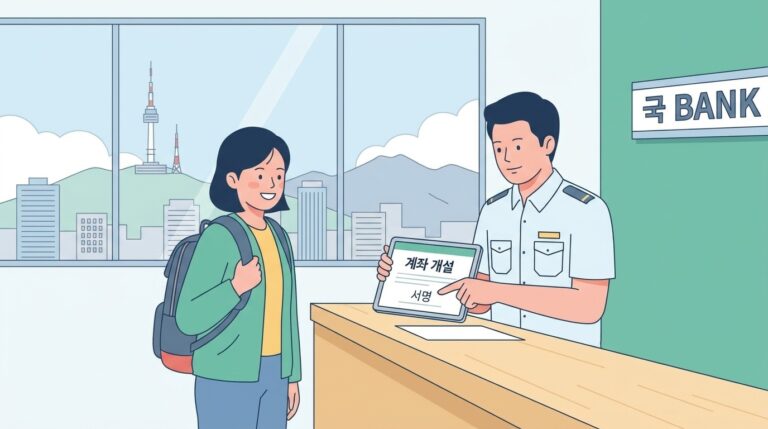
Imagine this: You’ve just arrived in Seoul to live, work, or study. You enter a sleek bank branch in Yeouido, surrounded by glass skyscrapers. You step up to the counter, ready to open a bank account so you can finally order late-night chimaek (chicken and beer) via delivery apps or connect your salary. But suddenly, the teller asks, “증빙 서류 가지고 오셨나요?” (Did you bring proof documents?), and hands you a form filled with complex financial terms. You freeze.
Opening a bank account in Korea as a foreigner can feel like boss-level gaming! Between strictly regulated rules for financial security and nuanced business etiquette, navigating Korean banks can be intimidating. But don’t worry—hundreds of our B2-level learners have been in your shoes and successfully walked out with a shiny new debit card. By mastering just a few authentic expressions and understanding local banking etiquette, you’ll feel completely in control. Let’s tackle this challenge together!
Phase 2: Key Expressions Analysis
1. 계좌를 개설하고 싶어요 (Gyejwa-reul gaeseol-hago sipeoyo)
- Pronunciation: [Gyeh-jwa-reul gae-seol-ha-go shi-peo-yo] (Sounds like: “Gyeh-jwa” + “Gae-seol”)
- Meaning: Literal: “I want to open an account.” / Nuance: Polite, direct standard phrasing for formal bank counter requests.
- K-Culture Moment: Seen in office K-Dramas like Misaeng when a new intern gets onboarded and needs a company payroll account.
- Editor’s Insight: While “계좌 만들러 왔어요” (I came to make an account) works informally, using “개설” (to establish/open) shows polished, intermediate-level fluency.
- Situation Spectrum: Casual ⚠️ | Semi-formal ✅ | Formal ✅
- 🤔 Think About It: How does switching from everyday verbs (만들다) to Sino-Korean terms (개설하다) change how professionals perceive your skill level in your native language?
2. 필요 서류가 어떻게 되나요? (Pilyo seoryu-ga eotteohge doenayo?)
- Pronunciation: [Peel-yo seo-ryu-ga uh-tteoh-ge doe-na-yo?]
- Meaning: Literal: “How do the required documents become?” / Nuance: “What documents do I need to prepare?”
- K-Culture Moment: Frequently used by expats in lifestyle vlogs when navigating Korean administrative offices (주민센터) or bank branches.
- Editor’s Insight: Using “어떻게 되나요?” instead of “무엇입니까?” adds a soft, polite, and natural conversational cadence preferred in service settings.
- Situation Spectrum: Casual 🚫 | Semi-formal ✅ | Formal ✅
- 🤔 Think About It: In Korean culture, indirect questions like “어떻게 되나요?” sound much gentler than direct demands. Do you have a similar mechanism in your language?
3. 재직증명서를 발급받아야 해요 (Jaejik-jeungmyeongseo-reul balgeup-badaya haeyo)
- Pronunciation: [Jae-jik jeung-myeong-seo-reul bal-geup-ba-da-ya hae-yo]
- Meaning: Literal: “I need to be issued a Certificate of Employment.” / Nuance: Informing someone that you require official employment verification to unlock full account features.
- K-Culture Moment: A classic line in K-dramas when characters deal with HR departments before applying for loans or major financial steps.
- Editor’s Insight: Unverified accounts in Korea have daily transfer limits (한도제한계좌). To clear this, documents like 재직증명서 (Employment Certificate) or 근로계약서 (Work Contract) are required.
- Situation Spectrum: Casual 🚫 | Semi-formal ✅ | Formal ✅
- 🤔 Think About It: Notice the passive-active verb combo “발급(issuance) + 받다(to receive)”. Korean administrative actions heavily rely on these compound nouns!
Phase 3: Textbook vs. Real Korean
Situation 1: Asking about required documents
- 📖 Textbook Korean: 무슨 서류를 제출해야 합니까? (Which documents must I submit?)
- 🗣️ Real Korean: 계좌 만들 때 필요한 서류가 뭐예요? / 어떤 서류 챙겨와야 해요? (What documents do I need to pack/bring when opening an account?)
- 💡 Why the difference? Native speakers use the cozy verb “챙기다” (to pack/bring/take care of) instead of formal legal terms like “제출하다” in conversational settings.
Situation 2: Explaining daily transfer limits
- 📖 Textbook Korean: 이 계좌는 출금 금액에 제한이 있습니다. (This account has a restriction on withdrawal amounts.)
- 🗣️ Real Korean: 이 계좌는 한도제한계좌라서 하루에 30만 원까지만 이체돼요. (This is a limited-type account, so you can only transfer up to 300,000 won per day.)
- 💡 Why the difference? Bank staff use practical buzzwords like “한도제한계좌” (limit-restricted account) and “이체” (transfer) in everyday banking transactions.
Phase 4: K-Culture Deep Dive & Manner
4-1. Nunchi & Gestures
When handing over your Alien Registration Card (여권/외국인등록증) or forms, always use two hands (양손) or support your right elbow with your left hand. This demonstrates respect (Nunchi in action!). When signing digital pads, take a second to read where the clerk points with their pen cap rather than rushing to sign everywhere.
4-2. Cultural Insight: Financial Safety & The “Hando-Jehan”
Due to strict anti-voice-phishing laws in Korea, banks automatically place new accounts under a “Limited Daily Limit” (한도제한) until you prove your purpose of account use (재직, 학업, 등). Knowing this upfront stops you from taking it personally when tellers ask for extra documentation—it’s standard security practice for everyone!
Phase 5: Real Roleplay Scenario
Setting: Yeouido Bank Branch. You are talking to Bank Clerk Kim (김 은행원).
- 김 은행원: 안녕하세요, 손님! 어떤 업무 도와드릴까요? (Hello, customer! How can I help you today?)
- You (🎭 Handing over your ID politely with two hands): 안녕하세요! 외국인 계좌 개설하고 싶어서 왔어요. (Hello! I came because I want to open a foreign national bank account.)
- 김 은행원: 네, 알겠습니다. 혹시 한국에서 직장에 다니시나요, 아니면 학생이신가요? (I see. Do you work in Korea, or are you a student?)
- You (🎭 Smiling confidently): 회사원이에요. 필요 서류가 어떻게 되나요? (I’m an office worker. What documents do I need?)
- 김 은행원: 외국인등록증이랑 재직증명서 있으시면 바로 한도 제한 해제해 드릴 수 있어요. (If you have your Alien Registration Card and Employment Certificate, I can lift the transfer limit right away.)
- You (🎭 Checking your folder): 네, 여기 재직증명서랑 여권, 등록증 다 챙겨왔어요. (Yes, I brought my employment certificate, passport, and ARC all together here.)
- 김 은행원: 서류 완벽하시네요! 이 서명란에 싸인해 주시겠어요? (Your documents are perfect! Could you sign here on this signature line?)
- You (🎭 Signing carefully): 네, 됐습니다. 체크카드도 같이 발급해 주세요! (Yes, done. Please issue a debit card together with it!)
🔀 Interactive Branching Choice
What if the clerk says: “재직증명서가 없으면 하루 30만 원 제한 계좌만 가능한데요?” (Without employment proof, you can only get a 300,000 won limit account.)
- Choice A: “에이, 그냥 해주시면 안 돼요?” (Aww, can’t you just do it for me?)
- ❌ Risk Feedback: Tellers cannot bypass government regulations. It sounds unprofessional and pushes boundaries.
- Choice B: “아, 그래요? 그럼 나중에 서류 떼서 다시 오면 한도 풀 수 있나요?” (Ah, really? If I bring the paper later, can I lift the limit?)
- ✅ Best Feedback: Perfect! Shows deep understanding of Korean system processes while keeping polite manners.
- Choice C: “무슨 말인지 모르겠어요. 한국어 잘 못해요.” (I don’t know what you’re saying. I don’t speak Korean well.)
- ⚠️ Bad Feedback: Misses the chance to practice B2 problem-solving skills. Stay in the conversation!
Phase 6: Emotion Shadowing Drill
[😊 Politeness & Confidence]
안녕하세요! / 외국인 계좌 / 개설하고 싶어서 왔어요.
(An-nyeong-ha-se-yo! / Oe-guk-in gye-jwa / gae-seol-ha-go shi-peo-seo wa-sseo-yo.)-
[🧐 Inquiring curiosity]
혹시 / 한도 제한 해제하려면 / 무슨 서류가 필요한가요?
(Hok-shi / han-do je-han hae-je-ha-ryeo-myeon / mu-seun seo-ryu-ga peel-yo-han-ga-yo?) -
[🎉 Relief & Satisfaction]
아, 다행이네요! / 여기 서류 다 챙겨왔어요.
(A, da-haeng-i-ne-yo! / Yeo-gi seo-ryu da chaeng-yeo-wa-sseo-yo.)
Phase 7: K-Culture Mini Dictionary
- 외국인등록증 (Oeguk-in Deongnok-jeung) | Alien Registration Card (ARC) | The holy grail ID card for long-term foreign residents in Korea. Essential for banking.
- 한도제한계좌 (Hando-Jehan-Gyejwa) | Limited-Limit Account | Initial accounts capped at low daily limits (usually 300k-1M KRW) to prevent fraud.
- 체크카드 (Chekeu-Kadeu) | Debit Card | Card connected directly to your checking account; widely used everywhere in Korea.
- 인터넷뱅킹 (Inteonet-Baengking) | Online Banking | Essential mobile app setup (e.g., KakaoBank, Toss, KB) for instant P2P transfers.
Phase 8: Traveler’s Survival Kit
Top 3 Banking Survival Phrases
- 비밀번호 4자리 누르세요. (Pim-il-beon-ho ne-ja-ri nu-reu-se-yo.) -> Please enter your 4-digit PIN.
- 통장도 같이 만드시겠어요? (Tong-jang-do gat-i man-deu-si-ges-seo-yo?) -> Would you also like a physical bankbook?
- 이체 수수료 있나요? (I-che su-su-ryo in-na-yo?) -> Is there a transfer fee?
Editor’s Travel Note
Before heading to the bank branch, use KakaoMap to search for “외국인 전용 창구” (Foreigner Friendly Branch) in major areas like Itaewon, Hongdae, or Gangnam. Also, keep your mobile passport verification ready!
Phase 9: A Step Deeper (Reflection)
In Korea, opening a bank account isn’t just about money—it’s your gateway to digital identity verification (본인인증). Almost every Korean app service (food delivery, online shopping, taxi hailing) requires your phone number and bank account details to match your identity perfectly. Understanding this administrative interconnectedness reveals how high-tech and security-conscious modern Korean society is.
💬 Your Turn: Have you ever opened a bank account in a foreign country? What was the hardest document for you to get? Tell us in the comments below!
Phase 10: FAQ & Common Mistakes
Q: Can I open an account with just a tourist passport?
A: Most major Korean banks require a long-term visa and ARC (외국인등록증). Some banks allow limited tourist accounts, but functions are extremely restricted.
Q: How long does it take to set up mobile banking apps?
A: Once your account is opened at the branch, setting up the app takes about 10 minutes with the teller’s assistance!
Q: What is the PIN code called in Korea?
A: It’s called 비밀번호 (Secret Number). It must be 4 digits for debit cards.
🚨 Common Mistakes TOP 3
- Mistake: Forgetting to bring hard copies of physical documents.
- Correct Action: Korean institutions often prefer printed certificates over digital phone screenshots.
- Mistake: Signing names differently than how they appear on the official ARC.
- Correct Action: Spell your full name in exact capital letters matching your ARC.
- Mistake: Assuming all branches have English service.
- Correct Action: Prepare key Korean banking terms or visit specialized international banking centers.
Phase 11: Action Mission
- 🥉 Bronze: Practice saying “계좌 개설하고 싶어요” 5 times using the Emotion Shadowing guide.
- 🥈 Silver: Write down the 3 required documents (외국인등록증, 재직증명서, 여권) on a sticky note in Korean.
- 🥇 Gold: Visit a bank branch (or attempt online bank registration) and successfully ask: “필요 서류가 어떻게 되나요?”
🎮 K-Culture Mission: Watch an episode of a workplace K-Drama (like Work Later, Drink Now or Start-Up) and spot any scene where characters mention “통장” (bankbook) or “월급” (salary)!
Phase 12: Interactive Quiz Challenge
Test your knowledge before visiting the bank counter!
Q1. What is the most natural B2-level way to ask for required documents at a bank counter?
1) 서류 다 내놓으세요.
2) 필요 서류가 어떻게 되나요?
3) 서류 어디 있어요?
🔍 Check Answer & Explanation
Answer: 2. “필요 서류가 어떻게 되나요?” is the most polite, professional, and natural way to ask bank staff.
Q2. True or False: You can easily lift daily transfer limits without showing proof of employment or study.
🔍 Check Answer & Explanation
Answer: False. To prevent financial fraud, Korean banks require proof documents (재직증명서, 재학증명서, etc.) to convert a “한도제한계좌” to a normal account.







