

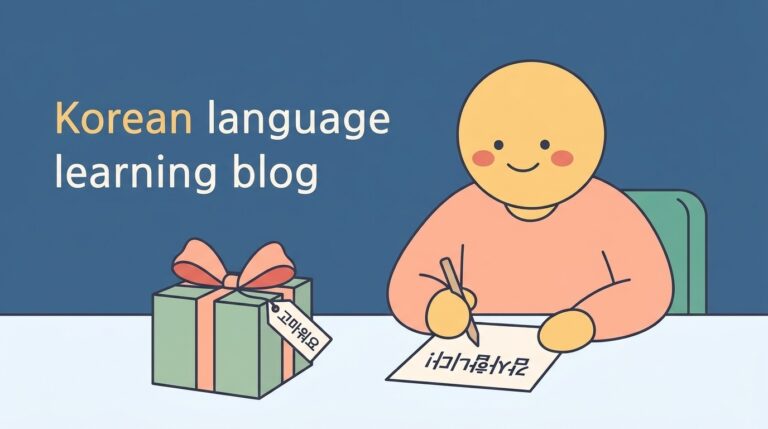
Warm Hearts, Written Words: Writing Your First Thank You Card in Korean!
안녕하세요! (Hello!) I’m your Daily Hangul lead editor and your Korean culture bestie. Have you ever bought a super cute gift for a Korean friend, K-pop buddy, or coworker, only to freeze when holding the tiny blank card that comes with it? Writing a thank you note in a new language feels intimidating, but don’t worry! Today, we are going to master simple, heartwarming Korean thank-you card expressions together.
Phase 1: Common Mistakes & Warm Welcome
Picture this: You are attending a Korean friend’s birthday party or sending a small thank-you gift to your favorite tutor. You picked out a lovely present, but you want to attach a handwritten card. You open Google Translate and type “Thank you for everything, you are the best!”… and out comes a sentence so stiff it sounds like an official government decree!
Many of our A1 learners tell us: “I want to sound warm, but I’m afraid of using words that are too formal or completely wrong for a gift card!” Take a deep breath! Writing a Korean card doesn’t require complex grammar. In Korean culture, a short, heartfelt message written clearly with the right polite ending (-요) means the world. Let’s learn 3 simple phrases that will make your Korean friends smile from ear to ear!
Phase 2: Key Expressions Analysis
1. 정말 감사합니다 (Jeong-mal gam-sa-ham-ni-da)
- Pronunciation: Jeong-mal gam-sa-ham-ni-da (Sounds like: Jung-mahl gahm-sah-hahm-nee-dah)
- Meaning: Direct: “Really thank you” | Nuance: “Thank you so much!”
- K-Culture Moment: You will see main characters in K-Dramas write this on handwritten notes when leaving homemade side dishes for their neighbors!
- Editor’s Insight: This is your safest, most polite foundation. Jeong-mal adds genuine warmth without being over-the-top.
- Situation Spectrum: Casual ⚠️ / Semi-formal ✅ / Formal ✅
- 🤔 Think About It: In English, we often say “Thanks a lot!” How does adding the word “really” change the emotional weight in your native language?
2. 선물 마음에 들었으면 좋겠어요 (Seon-mul ma-eum-e deul-eoss-eu-myeon jo-kkes-seo-yo)
- Pronunciation: Seon-mul ma-eum-e deul-eoss-eu-myeon jo-kkes-seo-yo (Sounds like: Sun-mool mah-um-eh deul-eoss-eu-myun joh-gess-uh-yo)
- Meaning: Direct: “If the gift enters your heart, it would be good” | Nuance: “I hope you like the gift!”
- K-Culture Moment: Idols writing letters to fans alongside personalized gifts often include this gentle phrase.
- Editor’s Insight: Koreans love modest expressions when giving gifts. Rather than saying “You will love this!”, hoping they like it shows humility and care.
- Situation Spectrum: Casual ⚠️ / Semi-formal ✅ / Formal ✅
- 🤔 Think About It: Why do you think Korean culture values showing humble hope rather than bold confidence when giving a gift?
3. 항상 고마워요 (Hang-sang go-ma-weo-yo)
- Pronunciation: Hang-sang go-ma-weo-yo (Sounds like: Hahng-sahng go-mah-woh-yo)
- Meaning: Direct: “Always thankful” | Nuance: “Thank you always!”
- K-Culture Moment: Used between close colleagues, friends, or senior-junior relationships (Sunbae-Hoebae) in cozy K-Drama scenes.
- Editor’s Insight: The word Go-ma-weo-yo ends with -요, making it friendly yet respectful for friends and close acquaintances.
- Situation Spectrum: Casual ✅ / Semi-formal ✅ / Formal 🚫
- 🤔 Think About It: Is there someone in your life you “always” feel thankful for?
Phase 3: Textbook Korean vs. Real Korean
Situation 1: Saying “Thank you for your help”
- 📖 Textbook: 도와주셔서 깊이 감사드립니다. (Do-wa-ju-seo-seo gip-i gam-sa-deu-rim-ni-da.)
- 🗣️ Real Life: 도와주셔서 정말 감사해요! (Do-wa-ju-seo-seo jeong-mal gam-sa-hae-yo!)
- 💡 Why is it different? The textbook sentence sounds like a speech at a corporate ceremony. The real-life version adds -요 (gam-sa-hae-yo) which sounds personal, sweet, and perfectly polite for a card.
Situation 2: Wishing them happiness
- 📖 Textbook: 늘 행복하십시오. (Neul haeng-bok-ha-sip-si-o.)
- 🗣️ Real Life: 늘 행복하세요! (Neul haeng-bok-ha-se-yo!)
- 💡 Why is it different? Nobody uses -하십시오 in cards unless writing to an emperor! -하세요 is warm, polite, and very standard.
Phase 4: K-Culture Deep Dive & Mannerisms
4-1. Gesture & Nunchi (Tact)
When handing over a card or a gift in Korea, never hand it over with just one hand! Always use two hands (or support your right wrist with your left hand). Keep your eye contact soft with a slight nod. This small gesture instantly shows deep respect!
4-2. Culture Spot: Birthday & Thank You Traditions
In Korea, cards are almost always paired with food gifts! Whether it’s a birthday cake, coffee electronic coupons (via KakaoTalk), or a box of delicious strawberries, adding a handwritten card makes the heart (Jeong) extra rich.
Phase 5: Real-Life Roleplay Scenario
Setting: You are handing a small coffee gift box and a thank-you card to your Korean language partner, Min-jun, after he helped you study for your test.
- Min-jun: 어? 이게 뭐예요? (Eo? I-ge mwo-ye-yo? / Huh? What is this?) 🎭 Looking surprised with round eyes.
- You: 민준 씨, 작은 선물이에요. (Min-jun ssi, jak-eun seon-mul-i-e-yo. / Min-jun, it’s a small gift.) 🎭 Handing the gift bag with both hands.
- Min-jun: 와, 정말요? 감사해요! (Wa, jeong-mal-yo? Gam-sa-hae-yo! / Wow, really? Thank you!) 🎭 Smiling widely.
- You: 카드도 썼어요. 읽어 보세요! (Ka-deu-do sseoss-eo-yo. Ilg-eo bo-se-yo! / I also wrote a card. Please read it!) 🎭 Pointing gently at the card tag.
- Min-jun: “도와주셔서 항상 고마워요.” 와… 감동이에요! (“Do-wa-ju-seo-seo hang-sang go-ma-weo-yo.” Wa… gam-dong-i-e-yo! / “Thank you always for helping me.” Wow… I’m touched!) 🎭 Placing a hand over his heart.
- You: 선물 마음에 들었으면 좋겠어요. (Seon-mul ma-eum-e deul-eoss-eu-myeon jo-kkes-seo-yo. / I hope you like the gift.) 🎭 Smiling warmly.
- Min-jun: 당연히 마음에 들죠! 잘 마실게요. (Dang-yeon-hi ma-eum-e deul-jyo! Jal ma-sil-ge-yo. / Of course I like it! I will enjoy drinking it.) 🎭 Bowing head slightly in gratitude.
- You: 천만에요! (Cheon-man-e-yo! / You’re welcome!) 🎭 Nodding happily.
🔀 Interactive Choice Point
What should you do after giving the gift?
* Choice A: Say “이거 엄청 비싼 거예요!” (I-geo eom-cheong bi-ssan geo-ye-yo! / This was super expensive!)
* Choice B: Smile and say “맛있게 드세요!” (Mas-iss-ge deu-se-yo! / Please enjoy eating/drinking it!)
* Choice C: Grab the card back to check your spelling mistakes.
Feedback:
* Choice A (Risk): Yikes! Mentioning how expensive a gift is creates unnecessary pressure in Korean gift etiquette.
* Choice B (Best): Perfect! It’s polite, friendly, and matches the joyful moment.
* Choice C (Bad): Awkward! Even if there’s a typo, your effort is what makes the card precious.
Phase 6: 10-Second Emotion Shadowing Drill
Practicing saying these out loud with feeling!
[😊 Delighted & Warm]정말 / 감사해요! (Jeong-mal / gam-sa-hae-yo!)[🥺 Shy & Hoping]선물 / 마음에 들었으면 / 좋겠어요. (Seon-mul / ma-eum-e deul-eoss-eu-myeon / jo-kkes-seo-yo.)[💖 Sweet & Sincere]항상 / 고마워요! (Hang-sang / go-ma-weo-yo!)
Phase 7: K-Culture Mini Dictionary
- 정 (Jeong) | Deep affection/bond felt over time. Writing a handwritten card is a classic way to express Jeong.
- 손편지 (Son-pyyeon-ji) | Handwritten letter. Highly valued in Korea over digital messages.
- 선물 (Seon-mul) | Gift / Present.
- 감동 (Gam-dong) | Being deeply touched or moved emotionally.
Phase 8: Traveler’s Survival Kit
Survival Expressions TOP 3
- 카드 있어요? (Ka-deu iss-eo-yo?) – Do you have cards? (When looking for gift cards in a shop)
- 이거 포장해 주세요. (I-geo po-jang-hae ju-se-yo.) – Please gift-wrap this.
- 감사합니다! (Gam-sa-ham-ni-da!) – Thank you!
Editor’s Travel Note
When shopping for cute mini cards in Seoul, visit stationary stores like ARTBOX or Kyobo Bookstore. You can locate the nearest branches easily using the Naver Map App Download. Always keep a small card in your bag so you can write a quick note!
Phase 9: A Step Deeper (Reflection)
In Korean culture, gift-giving is less about the item itself and more about acknowledging the relationship. Writing a short note with polite language shows that you value the person and respect your connection. It bridges cultural gaps faster than any grand gesture.
💬 Your Turn: Who is the first person you want to write a Korean thank-you card to? Tell us in the comments below!
Phase 10: FAQ & Common Mistakes
Q: Can I use
Frequently Asked Questions (FAQ)
Q: What does "정말 감사합니다 (Jeong-mal gam-sa-ham-ni-da)" mean in Korean and how do you pronounce it?
A: In Korean, "정말 감사합니다 (Jeong-mal gam-sa-ham-ni-da)" is pronounced [Jeong-mal gam-sa-ham-ni-da (Sounds like: Jung-mahl gahm-sah-hahm-nee-dah] and means: Direct: "Really thank you" | Nuance: "Thank you so much!"
Q: What does "선물 마음에 들었으면 좋겠어요 (Seon-mul ma-eum-e deul-eoss-eu-myeon jo-kkes-seo-yo)" mean in Korean and how do you pronounce it?
A: In Korean, "선물 마음에 들었으면 좋겠어요 (Seon-mul ma-eum-e deul-eoss-eu-myeon jo-kkes-seo-yo)" is pronounced [Seon-mul ma-eum-e deul-eoss-eu-myeon jo-kkes-seo-yo (Sounds like: Sun-mool mah-um-eh deul-eoss-eu-myun joh-gess-uh-yo] and means: Direct: "If the gift enters your heart, it would be good" | Nuance: "I hope you like the gift!"
Q: What does "항상 고마워요 (Hang-sang go-ma-weo-yo)" mean in Korean and how do you pronounce it?
A: In Korean, "항상 고마워요 (Hang-sang go-ma-weo-yo)" is pronounced [Hang-sang go-ma-weo-yo (Sounds like: Hahng-sahng go-mah-woh-yo] and means: Direct: "Always thankful" | Nuance: "Thank you always!"






