

Phase 1: Empathy & K-Culture Connection
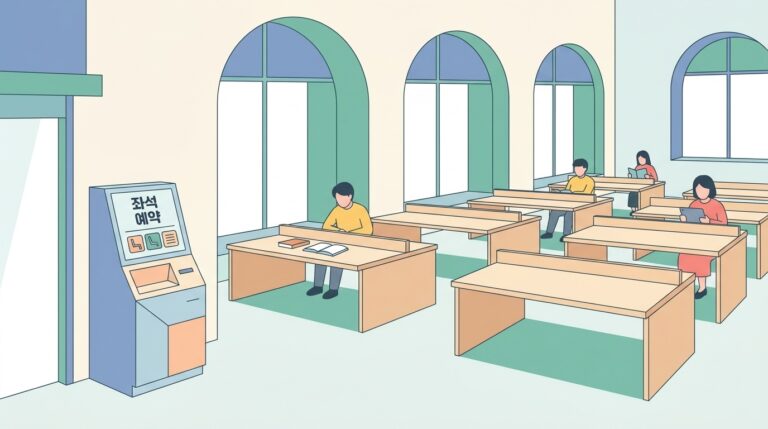
안녕하세요! Welcome back to another lesson with your Daily Hangul editor! Have you ever walked into a sleek, modern public library in Seoul or a university reading room, fully ready to study, only to freeze when trying to claim a seat? You see a quiet desk with an available chair, but someone’s notebook is nearby, or there’s an electronic kiosk system near the entrance with a long line. You wonder: Can I sit here? Is this seat taken? How do I assign this seat to myself?
Don’t worry! In K-Dramas, reading rooms (열람실) are hotspots for cute student encounters, but in real life, finding and claiming a seat requires a tiny bit of local etiquette and specific key phrases. This step-by-step guide is designed specifically from learner feedback so you can confidently grab a seat in any Korean reading room without any awkwardness!
Phase 2: Core Expressions Deep Dive
1. 여기 자리 있나요? (Yeo-gi ja-ri in-na-yo?)
- Pronunciation: [Yeo-gi ja-ri in-na-yo?] (Sounds like ‘Yoh-gee jah-ree in-nah-yoh?’)
- Meaning: “Is this seat taken?” (Literal: Is there a seat here?)
- K-Culture Moment: You walk up to a study table in a university library, tap gently on the desk, and ask the student sitting next to an empty spot.
- Editor’s Insight: It’s polite and direct. Even if a seat looks empty, asking this avoids accidentally taking a spot someone stepped away from for a quick coffee break.
- Situation Spectrum: Casual ⚠️ | Semi-formal ✅ | Formal ✅
- 🤔 Think About It: In your home country, do people reserve seats with personal items, or do you always have to ask first?
2. 자리 발권은 어디서 해요? (Ja-ri bal-gwyeon-eun eo-di-seo hae-yo?)
- Pronunciation: [Ja-ri bal-gwyeon-eun eo-di-seo hae-yo?] (Sounds like ‘Jah-ree bahl-gweon-eun oh-dee-seoh hae-yoh?’)
- Meaning: “Where do I issue/assign a seat ticket?”
- K-Culture Moment: Most modern Korean libraries use automated kiosks (키오스크) or mobile apps to assign reading room seats.
- Editor’s Insight: ‘발권’ (bal-gwyeon) means ticketing/issuing. Using this word makes you sound like a seasoned resident!
- Situation Spectrum: Casual 🚫 | Semi-formal ✅ | Formal ✅
- 🤔 Think About It: How does technology change how public spaces are managed in your culture compared to Korea?
3. 잠시 써도 될까요? (Jam-si sseo-do doel-kka-yo?)
- Pronunciation: [Jam-si sseo-do doel-kka-yo?] (Sounds like ‘Jahm-shee sseh-doh doehl-kkah-yoh?’)
- Meaning: “May I use this for a moment?”
- K-Culture Moment: Asking to use an outlet (콘센트) near another person’s desk in a crowded reading room.
- Editor’s Insight: ‘잠시’ means ‘for a short while’. Adding it softens your request tremendously.
- Situation Spectrum: Casual ⚠️ | Semi-formal ✅ | Formal ✅
- 🤔 Think About It: Why is softening requests with time words like ‘just a second’ universal across languages?
Phase 3: Textbook vs. Real Korean
Situation 1: Asking if a seat is free
- 📖 Textbook: 이 자리가 비어 있습니까? (I ja-ri-ga bi-eo it-seum-ni-ka?)
- 🗣️ Real Korean: 여기 자리 있어요? (Yeo-gi ja-ri it-eo-yo? / usually spoken with rising intonation to mean ‘Is this taken?’)
- 💡 Why the difference? Textbook Korean uses formal honorific endings that sound like a military report! Native speakers use simple, warm ‘해요체’ (hae-yo-che) in daily public settings.
Situation 2: Asking how to use the seat kiosk
- 📖 Textbook: 좌석 배정 기계 사용법을 가르쳐 주십시오. (Jwa-seok bae-jeong gi-gye sa-yong-beob-eul ga-reu-chyeo ju-sip-si-o.)
- 🗣️ Real Korean: 저기요, 이거 자리 어떻게 잡아요? (Jeo-gi-yo, i-geo ja-ri eo-tteo-ke jab-a-yo?)
- 💡 Why the difference? Real spoken Korean prefers short, active verbs like ‘자리 잡다’ (grab a seat) instead of complex terms like ‘좌석 배정’ (seat assignment).
Phase 4: K-Culture Deep Dive & Mannerisms
4-1. Nunchi (눈치) & Gestures in the Reading Room
When approaching someone in a quiet reading room:
1. Lower Your Voice: Whispering is essential. Use gentle hand gestures pointing to the open chair.
2. The Half-Bow: Give a quick 15-degree head tilt before and after speaking to show respect.
3. Desk Belongings: If you see a laptop charger or jacket, that seat is claimed via Nunchi! Don’t move their belongings yourself.
4-2. Cultural Code: The Library Kiosk System
In Korea, reading rooms in public libraries and universities are hyper-organized. You usually need a library membership card (digital or physical) to scan at a kiosk near the entrance. You select a seat number on a touchscreen, receive a printed slip, and then proceed to your assigned desk! Remember to checkout (퇴실) at the kiosk when you leave so others can use the seat.
Phase 5: Real-life Roleplay Scenario
Setting: A quiet public library reading room in Seoul. You want to take an empty seat next to a helpful student (NPC: Min-woo).
- You: 저기요, 실례지만 여기 자리 있나요? 🎭 (Whispering softly while pointing to the empty chair)
(Jeo-gi-yo, sil-lye-ji-man yeo-gi ja-ri in-na-yo? / Excuse me, is this seat taken?) - Min-woo: 아, 아니요! 비어 있어요. 앉으세요. 🎭 (Smiles and pulls his backpack closer to his chair)
(A, a-ni-yo! Bi-eo it-eo-yo. An-jeu-se-yo. / Oh, no! It’s empty. Please sit.) - You: 감사합니다! 혹시 여기 콘센트 써도 될까요? 🎭 (Politely pointing to the power outlet under the desk)
(Gam-sa-ham-ni-da! Hok-si yeo-gi kon-sen-teu sseo-do doel-kka-yo? / Thank you! By the way, may I use this outlet?) - Min-woo: 네, 편하게 쓰세요. 🎭 (Nods kindly)
(Ne, pyeon-ha-ge sseu-se-yo. / Yes, feel free to use it.) - You: 저… 혹시 여기 자리 발권해야 하나요? 🎭 (Looking slightly confused, holding your phone)
(Jeo… hok-si yeo-gi ja-ri bal-gwyeon-hae-ya ha-na-yo? / Um… do I need to get a seat ticket for here?) - Min-woo: 네! 1층 키오스크에서 좌석표 찍고 오셔야 해요. 🎭 (Points towards the floor exit)
(Ne! Il-cheong ki-o-seu-keu-e-seo jwa-seok-pyo jjik-go o-syeo-ya hae-yo. / Yes! You need to scan for a seat ticket at the 1st floor kiosk.) - You: 아, 그렇군요! 정말 감사합니다. 🎭 (Doing a gentle half-bow)
(A, geu-reot-gun-yo! Jeong-mal gam-sa-ham-ni-da. / Ah, I see! Thank you so much.) - Min-woo: 아니에요, 열공하세요! 🎭 (Gives a small encouraging smile)
(A-ni-e-yo, yeol-gong-ha-se-yo! / No problem, happy studying!)
🔀 Interactive Choice Point
What do you do when you finish studying and prepare to leave?
* Option A: Leave your seat immediately without doing anything.
* Option B: Go to the 1st-floor kiosk and select ‘퇴실’ (Check-out/Release seat).
* Option C: Leave a note on the desk for the next person.
Feedback:
* Option A (Bad/Risk): 🚫 If you don’t check out, the seat stays blocked in the system, preventing others from assigning it!
* Option B (BEST): ✅ Perfect! Checking out at the kiosk frees up the seat for other library users.
* Option C (Bad): ⚠️ Thoughtful, but unnecessary and might confuse people since seats are assigned via kiosk.
Phase 6: 10-Second Emotion Shadowing Drill
Practice these lines with the indicated emotional inflection!
[🥺 Hesitant & Polite]저기요… / 여기 자리 / 있나요?
(Jeo-gi-yo… / yeo-gi ja-ri / in-na-yo?)[😊 Grateful & Relieved]아, 감사합니다! / 잘 쓸게요.
(A, gam-sa-ham-ni-da! / jal sseul-ge-yo.)[❓ Curious & Polite]자리 발권은 / 어디서 / 해요?
(Ja-ri bal-gwyeon-eun / eo-di-seo / hae-yo?)
Phase 7: K-Culture Mini Dictionary
- 열공 (Yeol-gong) | Studying hard (Short for ‘열심히 공부’). Frequently used to wish students good luck!
- 키오스크 (Ki-o-seu-keu) | Kiosk. Automated touchscreens used for seat assignments, food ordering, and ticketing in Korea.
- 퇴실 (Toe-sil) | Checking out / Leaving a room. Crucial button to press at library kiosks when leaving.
- 콘센트 (Kon-sen-teu) | Power outlet / Socket. (Derived from ‘concentric plug’).
Phase 8: Traveler’s Survival Kit
Top 3 Survival Phrases
- 여기 비어 있어요? (Yeo-gi bi-eo it-eo-yo? – Is this empty?)
- 와이파이 비번이 뭐예요? (Wa-i-pha-i bi-beon-i mwo-yeo-yo? – What is the Wi-Fi password?)
- 퇴실 처리 어떻게 해요? (Toe-sil cheo-ri eo-tteo-ke hae-yo? – How do I process checkout?)
Editor’s Travel Note
Before visiting major public libraries like the Seoul Metropolitan Library, make sure to check their visitor access rules on the 서울도서관 공식 웹사이트 (Seoul Library Official Site). Many libraries allow visitors to get temporary pass cards with proper ID!
Phase 9: A Step Deeper (Reflection)
In Korea, shared public spaces like reading rooms operate on high mutual trust and consideration. People often leave valuable laptops and bags unattended on desks while taking breaks, relying on community trust and CCTV coverage. However, respect for quietness and rules (like registering at kiosks) is strictly maintained.
💬 Your Turn: How are public libraries managed in your home country? Do you use automated seat systems? Let us know in the comments below!
Phase 10: FAQ & Common Mistakes
Q: Can I reserve a seat in advance before going to the library?
A: Many Korean libraries offer mobile app reservations, but foreign tourists usually need to visit the venue kiosk in person with a guest pass.
Q: What if someone left their belongings on an empty desk for over an hour?
A: Do not move their items yourself! Ask library staff at the main counter (안내데스크) for assistance.
Q: Is eating allowed in Korean reading rooms?
A: Water in covered bottles is usually fine, but snacks and food are strictly prohibited inside the reading room (열람실). Use the library cafe or designated rest area (휴게실).
🚨 Common Mistakes
- ❌ Mistake 1: Moving someone’s notebook to sit down.
- 👉 Correct Action: Ask library staff or find an unreserved desk.
- ❌ Mistake 2: Leaving without scanning your seat ticket at the kiosk.
- 👉 Correct Action: Always press 퇴실 (Check-out) before heading home.
- ❌ Mistake 3: Talking at normal volume inside reading rooms.
- 👉 Correct Action: Whisper softly or step outside into the hallway.
Phase 11: Action Mission
- 🥉 Bronze: Practice saying “여기 자리 있나요?” out loud 3 times in front of a mirror!
- 🥈 Silver: Leave a comment below using the phrase “여기 자리 있나요?” in a sentence.
- 🥇 Gold: Visit a Korean library or Korean-style study cafe (스터디카페) and successfully claim a seat using kiosk or polite Korean!
🎮 K-Culture Mission: Next time you watch a school or college K-drama, spot the scene where characters are studying in a library! See if you can spot the seat registration kiosk in the background.
Phase 12: Interactive Quiz Challenge
Question 1: Situation Judgment
You want to ask if an empty chair next to someone is free. Which phrase is most natural and polite?
* A) 이거 내 자리예요. (I-geo nae ja-ri-yeo-yo.)
* B) 여기 자리 있나요? (Yeo-gi ja-ri in-na-yo?)
* C) 저기서 공부하세요. (Jeo-gi-seo gong-bu-ha-se-yo.)
🔍 Click to reveal Answer & Explanation
Correct Answer: B) 여기 자리 있나요?
Explanation: “여기 자리 있나요?” is the standard, polite way to ask if a seat is taken in public places.
Question 2: Fill in the Blank
When you are leaving the library, you must process your checkout at the kiosk. What is the Korean word for checkout?
* [ ______ ] (Hint: ㅌㅅ)
🔍 Click to reveal Answer & Explanation
Correct Answer: 퇴실 (Toe-sil)
Explanation: ‘퇴실’ means leaving/checking out of a room or seat.
Question 3: True / False
In Korean reading rooms, it is totally okay to eat crunchy chips as long as you eat quietly.
* True
* False
🔍 Click to reveal Answer & Explanation
Correct Answer: False
Explanation: Eating food inside reading rooms (열람실) is strictly prohibited to maintain a clean and quiet environment. Use the designated lounge (휴게실) instead!






