

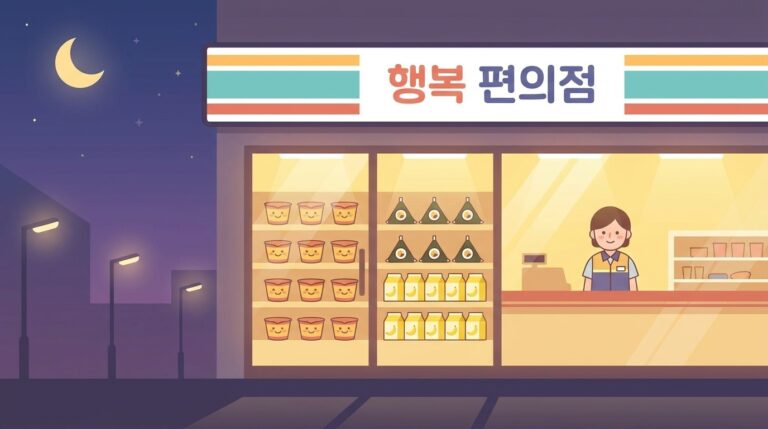
안녕하세요! Welcome to Your Late-Night Korean Convenience Store Guide!
I’m your Daily Hangul editor, your friendly local culture navigator! Imagine it is 2 AM in the vibrant heart of Seoul. You just landed, checked into your hotel, and your stomach starts rumbling. You step outside into the crisp night air, drawn by the bright neon lights of a local convenience store—CU, GS25, or Seven-Eleven.
Inside, colorful aisles packed with spicy cup ramen, shiny triangle kimbap, sweet banana milk, and sizzling hot snacks await you. But suddenly, uncertainty kicks in! How do you ask if a drink is on a ‘2+1’ deal? How do you ask to heat up your lunchbox? Don’t worry at all! Based on real experiences from hundreds of A2 learners, this guide will give you the exact phrases and cultural confidence to master your late-night snack haul like a true Seoulite.
Phase 2: Core Expressions Deep Dive
1. 이것 2+1(투플러스원)이에요?
- Pronunciation: [I-geot tu-pleu-seuh-won-i-e-yo?] (Think: ‘Two-Plus-One’ pronounced with a fast Korean cadence!)
- Meaning: Literal: “Is this 2+1?” | Real Niuance: “Is this item currently on the Buy 2 Get 1 Free promotion?”
- K-Culture Moment: In popular youth K-dramas, university students celebrate saving money by stocking up their dorm fridges with 2+1 deals.
- Editor’s Insight: Koreans love promotional deals (1+1, 2+1). Spotting these tags on shelves helps you get maximum snacks on a budget!
- Situation Spectrum: Casual ✅ | Semi-formal ✅ | Formal ⚠️
- 🤔 Think About It: Why do you think Korean convenience stores use direct English numbers like ‘2+1’ instead of translating it into pure Korean numbers?
2. 데워 주실 수 있나요?
- Pronunciation: [De-wo ju-sil su in-na-yo?] (Sounds like: “Day-wooo ju-sil soo in-nah-yo?”)
- Meaning: Literal: “Can you heat this up for me?” | Real Niuance: “Could you please warm this up in the microwave for me?”
- K-Culture Moment: Buying a tasty bento box (도시락) late at night and asking the clerk for a warm-up before eating at the store counter.
- Editor’s Insight: While many stores have self-service microwaves, asking politely with this phrase is helpful when you are unsure how to operate the settings.
- Situation Spectrum: Casual ⚠️ | Semi-formal ✅ | Formal ✅
- 🤔 Think About It: Is heating up store-bought packaged meals for customers a common free service in convenience stores in your home country?
3. 봉투 필요 없어요.
- Pronunciation: [Bong-tu pil-yo eop-seo-yo.] (Sounds like: “Bong-two peel-yo op-seo-yo”)
- Meaning: Literal: “Bag not needed.” | Real Niuance: “I don’t need a plastic bag, thank you!”
- K-Culture Moment: Striding out of the convenience store carrying your ramen and iced coffee directly in your hands like a cool local.
- Editor’s Insight: Due to eco-friendly laws in Korea, plastic bags cost extra (100–200 KRW). Saying this immediately shows great local etiquette!
- Situation Spectrum: Casual ✅ | Semi-formal ✅ | Formal ✅
- 🤔 Think About It: How do environmental policies in everyday retail shops shape spoken daily phrases in different cultures?
Phase 3: Textbook Korean vs. Real-World Korean
Situation 1: Asking where the microwave is located
- 📖 교과서 한국어: 전자레인지가 어디에 있습니까? (Eon-ja-re-in-ji-ga eo-di-e it-seum-ni-ka?)
- 🗣️ 진짜 한국어: 전자레인지 어디 있어요? (Eon-ja-re-in-ji eo-di it-seo-yo?)
- 💡 왜 다를까?: In everyday natural spoken Korean, native speakers frequently drop subject particles like ‘-가’ and location markers like ‘-에’ to keep spoken flow fast and effortless.
Situation 2: Asking for a straw or extra utensil
- 📖 교과서 한국어: 빨대를 저에게 주시겠습니까? (Ppal-dae-reul jeo-e-ge ju-si-get-seum-ni-ka?)
- 🗣️ 진짜 한국어: 빨대 하나만 주세요~ (Ppal-dae ha-na-man ju-se-yo~)
- 💡 왜 다를까?: Adding the small word ‘-만’ (just/only) softens your request, making you sound friendly and polite without sounding overly formal or rigid.
Phase 4: K-Culture Deep Dive & Non-verbal Manners
4-1. Nunchi (눈치) & Essential Gestures
When handing over your credit card or cash at the counter, always hold the card with both hands or lightly support your right forearm with your left hand. This subtle ‘Nunchi’ move demonstrates respect and warmth to the store staff!
4-2. Culture Code: The Late-Night Yashik (야식) Tradition
In Korea, ‘Yashik’ (late-night snacking) is practically a cultural art form. Convenience stores serve as 24/7 culinary hubs where people craft legendary DIY recipes, such as mixing spicy cup ramen with string cheese and sausage (famously known as the ‘Mark Meal’).
Phase 5: Real-World Roleplay Scenario
Setting: 1:30 AM at a bright GS25 near Hongdae. Store clerk Min-jun is restocking beverages near the counter.
- Min-jun (Clerk): 안녕하세요! 어서 오세요! (An-nyeong-ha-se-yo! Eeo-seo o-se-yo! / Hello! Welcome!) 🎭 Bows slightly from behind the counter.
- You: 안녕하세요! 이 라면 1+1이에요? (An-nyeong-ha-se-yo! I ra-myeon won-pleu-seuh-won-i-e-yo? / Hello! Is this ramen 1+1?) 🎭 Pointing enthusiastically at a spicy ramen cup.
- Min-jun (Clerk): 아, 네! 1+1 맞아요. 하나 더 가져오세요. (A, ne! Won-pleu-seuh-won ma-ja-yo. Ha-na deo ga-jyeo-o-se-yo. / Ah, yes! It’s 1+1. Feel free to grab one more!) 🎭 Smiles and gestures toward the shelf.
- You: 감사합니다! 이것도 데워 주실 수 있나요? (Gam-sa-ham-ni-da! I-geot-do de-wo ju-sil su in-na-yo? / Thank you! Could you heat this up too?) 🎭 Holding up a tasty lunchbox.
- Min-jun (Clerk): 전자레인지는 저쪽에서 직접 쓰시면 돼요! (Eon-ja-re-in-ji-neun jeo-jjok-e-seo jik-jeop sseu-si-myeon dwae-yo! / You can use the microwave over there directly!) 🎭 Points toward the customer microwave station.
- You: 아, 그렇군요! 봉투는 필요 없어요. (A, geu-reot-gun-yo! Bong-tu-neun pil-yo eop-seo-yo. / Ah, I see! I don’t need a plastic bag.) 🎭 Tapping your tote bag cheerfully.
- Min-jun (Clerk): 네, 카드 올려주세요. 감사합니다! (Ne, ka-deu ol-ryeo-ju-se-yo. Gam-sa-ham-ni-da! / Great, please tap your card here. Thank you!) 🎭 Gesturing toward the payment terminal.
- You: 수고하세요! (Su-go-ha-se-yo! / Have a good shift!) 🎭 Waving lightly as you walk over to the hot water dispenser.
🔀 Interactive Branch
The clerk tells you the beverage you picked is part of a 2+1 deal, but you only brought one bottle to the counter. What do you do?
* Option A: Say “하나 더 가져올게요!” (I’ll grab one more!)
* Option B: Say “괜찮아요, 하나만 살게요.” (It’s okay, I’ll just buy one.)
* Option C: Stand quietly and freeze in confusion.
Feedback:
* Option A (Best): Fantastic! You get your free item and practice shopping like a seasoned resident!
* Option B (Bad): Perfectly fine if you aren’t thirsty, but you miss out on a free item!
* Option C (Risk): Creates an awkward silence. Remember, clerks are used to waiting gracefully!
Phase 6: 10-Second Emotion Shadowing Drill
- [😊 Excitedly] 이 라면 / 1+1 / 맞아요? (I ra-myeon / won-pleu-seuh-won / ma-ja-yo?)
- [🥺 Politely] 빨대 하나만 / 주실 수 있나요? (Ppal-dae ha-na-man / ju-sil su in-na-yo?)
- [😎 Confidently] 봉투는 / 필요 없어요! (Bong-tu-neun / pil-yo eop-seo-yo!)
Phase 7: K-Culture Mini Dictionary
- 야식 (Ya-sik) | Late-Night Snack | Popular food eaten late at night, usually after 10 PM in Korea.
- 편털 (Pyeon-teol) | Convenience Store Haul | Short for ‘편의점 털기’, meaning buying lots of delicious snacks at once.
- 2+1 (Tu-pleu-seuh-won) | Buy 2 Get 1 Free | Extremely popular convenience store discount deal tag.
- 삼각김밥 (Sam-gak-gim-bap) | Triangle Kimbap | Affordable, iconic triangular rice ball wrapped in crispy seaweed.
Phase 8: Traveler’s Survival Kit
Survival Expressions TOP 3
- 얼마예요? (Eol-ma-ye-yo?) — How much is it? (Pro Tip: Simply point at any unlabeled item while asking.)
- 젓가락 주세요. (Jeot-ga-rak ju-se-yo.) — Please give me chopsticks. (Pro Tip: Essential when buying instant cup ramen!)
- 영수증은 버려주세요. (Yeong-su-jeung-eun beo-ryeo-ju-se-yo.) — Please toss the receipt. (Pro Tip: Saves paper at checkout!)
Editor’s Travel Note: Before taking off for Seoul, make sure to set up the Naver Map App for smooth Korean navigation to instantly locate 24-hour convenience stores near your accommodation, and carry a loaded T-Money card for instant tap-and-pay convenience!
Phase 9: One Step Deeper
In Korea, late-night convenience stores represent more than quick commerce; they act as warm, safe, 24/7 sanctuaries for night-shift workers, students, and travelers alike. Using polite sentence endings like ‘-요’ (-yo) even during late hours builds mutual warmth between service workers and tired night owls.
💬 Your Turn: What is your all-time favorite late-night snack in your home country? Tell us in the comments section below!
Phase 10: FAQ & Common Mistakes
Q: Can I sit inside every Korean convenience store to eat my food?
A: Most medium-to-large stores offer a counter bar or outdoor tables, but small neighborhood shops might not have seating. Look for microwave stands or window seating bars before opening your food!
Q: Do I need to pay extra for wooden chopsticks or plastic spoons?
A: No! Chopsticks, spoons, and straws are free when purchasing instant meals or beverages. Just ask politely with “주세요” (ju-se-yo).
Q: What is the best way to pay at Korean convenience stores?
A: Credit cards, Apple Pay, Samsung Pay, and local transit cards (T-Money) are universally accepted across almost all stores.
🚨 Common Mistakes TOP 3
- Mistake: Handing over cash or cards using only one hand abruptly. -> Correct Action: Use both hands or support your right wrist lightly.
- Mistake: Throwing food trash directly into paper recycle bins. -> Correct Action: Separate food leftovers into designated waste bins at store cleaning stations.
- Mistake: Leaving microwave doors open after heating food. -> Correct Action: Gently close the microwave door when you finish warming your meal!
Phase 11: Action Missions
- Bronze Mission: Practice saying “봉투 필요 없어요” (Bong-tu pil-yo eop-seo-yo) 3 times out loud today!
- Silver Mission: Share a photo of your favorite Korean snack haul on social media and tag #DailyHangul!
- Gold Mission: Visit an Asian market or local Korean store and successfully ask for item prices or promotional deals in Korean!
- 🎮 K-Culture Mission: Watch a Korean vlog or drama scene featuring a convenience store run and spot someone eating cup ramen!
Phase 12: Interactive Quiz Challenge
-
Situation Quiz: You want to warm up your lunchbox at the counter. What do you ask?
Click to view Answer & Explanation
Answer: “데워 주실 수 있나요?” (De-wo ju-sil su in-na-yo?). You can also ask where the microwave is using “전자레인지 어디 있어요?”.
-
Fill-in-the-Blank: “봉투는 _____ 없어요.” (I don’t need a plastic bag.)
Click to view Answer & Explanation
Answer: 필요 (pil-yo). The full sentence is “봉투는 필요 없어요.”.
-
True or False: You must pay extra for wooden chopsticks when buying instant cup ramen.
Click to view Answer & Explanation
Answer: False! Wooden chopsticks are provided free upon request when buying cup ramen.






