

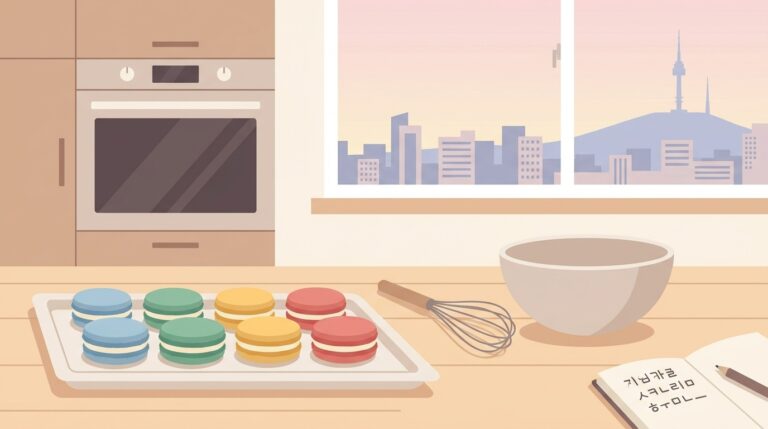
Why Did My Macaron Shells Fail? Mastering Korean Baking Vocab & Nuances
안녕하세요! Welcome back to Daily Hangul! I’m your Korean culture navigator and senior editor. Today, we’re diving into the sweet, meticulous world of Korean baking! If you’ve ever stepped foot into a trendy cafe in Seongsu-dong or Yeonnam-dong, you know Koreans take their desserts seriously—especially macarons. Korean home bakers and professional pastry chefs have elevated macaron making into a fine art, complete with their own colorful vocabulary.
Have you ever spent hours whipping meringue, carefully measuring almond flour, only to pull hollow or cracked shells (coque) out of the oven? In Korean baking communities, diagnosing baking mishaps is practically a national pastime! Knowing how to express subtle culinary issues in natural, native Korean will elevate your language skills from advanced textbook Korean to authentic C1 fluency. Based on real feedback from dessert lovers and baking enthusiasts, this guide will equip you with exact phrases, technical slang, and cultural insights to discuss baking failures like a true Seoul baker.
Phase 2: Core Korean Baking Expressions Deep-Dive
1. 꼬끄가 뻥튀기 되었어요 / 뻥꼬끄가 됐어요
- Pronunciation: [Ggog-geu-ga ppeong-thwi-gi doe-eoss-eo-yo] (Sounds like ggog-geu with a sharp tense ‘g’, paired with ppeong like the pop of popcorn!)
- Meaning: Literal: The shell became puffed popcorn. / Nuance: The macaron shell turned out hollow with empty air pockets inside.
- K-Culture Moment: Seen on baking YouTube channels (베이킹 유튜버) when a baker cuts open a macaron cross-section (단면샷) and groans over the empty space inside.
- Editor’s Insight: 뻥 comes from 뻥튀기 (puffed rice snack) or 뻥치다 (to lie/exaggerate). Calling a hollow shell 뻥꼬끄 is cute slang used widely across Korean online baking forums like Naver Cafe.
- Situation Spectrum: Casual ✅ | Semi-formal ✅ | Formal ⚠️
- 🤔 Think About It: How does using playful slang like 뻥꼬끄 soften the disappointment of a baking failure compared to strict technical jargon?
2. 마카로나주가 과하게 됐어요
- Pronunciation: [Ma-ka-ro-na-ju-ga gwa-hae-ge doe-eoss-eo-yo] (Smooth flow, pronouncing French loanwords with Korean cadence: Ma-ka-ro-na-ju)
- Meaning: Literal: Macaronage was done excessively. / Nuance: Over-mixing the batter, causing it to lose structural air and turn runny.
- K-Culture Moment: In a baking masterclass reel on Instagram, an instructor tilts the spatula and warns: “여기서 더 섞으면 마카로나주가 과하게 됩니다!” (If you mix more here, it will be over-macaronaged!)
- Editor’s Insight: Korean bakers use Sino-Korean prefixes like 과(過 – excessive) or 미(未 – incomplete/under) to create precise technical terms naturally: 과유불급 (too much is as bad as too little).
- Situation Spectrum: Casual ✅ | Semi-formal ✅ | Formal ✅
- 🤔 Think About It: How easily does your native language adapt foreign technical terms into everyday verbs and adjectives?
3. 꼬끄 윗면이 싹 다 터졌어요
- Pronunciation: [Ggog-geu wing-myeoni ssag da teo-jyeoss-eo-yo] (Emphasize ssag with a sweeping tone to express completeness!)
- Meaning: Literal: The top surface of the shell completely burst open. / Nuance: The macaron tops cracked during baking due to high heat or insufficient drying time.
- K-Culture Moment: A dramatic vlogger shot showing the oven door opening, accompanied by sad background music as cracked shells appear.
- Editor’s Insight: The adverb 싹 adds vivid visual imagery, meaning “completely” or “swept clean.” Combining 싹 다 creates an empathetic, dramatic effect when sharing mishaps with friends.
- Situation Spectrum: Casual ✅ | Semi-formal ✅ | Formal 🚫
- 🤔 Think About It: Notice how Korean uses dramatic vivid adverbs (싹, 푹, 딱) to express physical outcomes. What adverbs perform a similar role in your language?
Phase 3: Textbook Korean vs. Real Native Korean
Situation 1: Explaining hollow macaron shells
- 📖 Textbook Korean: 마카롱 껍질 내부가 비어 있어서 실패했습니다. (The inside of the macaron skin is empty, so it failed.)
- 🗣️ Real Native Korean: 아, 완전 뻥꼬끄 나왔네. 건조를 너무 오래 했나 봐요. (Ah, it turned out totally hollow. I guess I dried them for too long.)
- 💡 Why the difference? Native bakers rarely call macaron shells 껍질 (skin/peel). They use the borrowed French word 꼬끄 (coque). Also, 뻥꼬끄 immediately conveys hollow shells without long explanations.
Situation 2: Asking for troubleshooting help on Instagram
- 📖 Textbook Korean: 제 마카롱의 표면이 갈라진 원인을 알려주십시오. (Please inform me of the reason my macaron surface cracked.)
- 🗣️ Real Native Korean: 꼬끄 터진 원인 좀 봐주세요! 마카로나주 문제일까요, 오븐 온도 문제일까요? (Please check why my shells cracked! Is it a macaronage issue or an oven temp issue?)
- 💡 Why the difference? C1 level Korean speakers use natural questions and compound nouns like 오븐 온도 문제 rather than formal imperative forms when engaging with online baking communities.
Phase 4: K-Culture Deep-Dive & Non-Verbal Manners
4-1. Nunchi & Baking Gestures
When discussing failed bakes in a Korean workshop, subtlety matters. Instead of pointing directly at someone’s cracked macaron, bakers gently palm their hand beneath the tray and tilt their head slightly while saying, “아쉽네요~” (What a pity~). Touching the top surface of a shell with the tip of your index finger while lightly pressing tests its hollow structure—a classic 손끝 감각 (fingertip intuition) gesture!
4-2. Cultural Code: The Korean Macaron Revolution (Fatcarons / 뚱카롱)
Korea took the traditional dainty French macaron and reinvented it into the famous 뚱카롱 (Fatcaron—thick, generously filled macarons). Because Korean 뚱카롱 feature thick buttercream, ganache, and fresh fruit, the structural integrity of the 꼬끄 (shell) must be flawless. A hollow shell (뻥꼬끄) will collapse under the weight of rich fillings. Thus, mastering shell mechanics is a badge of honor among Korean home bakers!
Phase 5: Real-Life Interactive Roleplay Scenario
Setting: You are attending a popular weekend baking class in Hongdae. Your partner, Min-ji (a veteran home baker), notices your macaron shells in the oven.
- Min-ji: 어? OO 씨, 오븐 속 꼬끄 한번 보세요. 윗면이 조금 스멀스멀 터지는 것 같은데요?
- You: 아, 정말요? 헉, 진짜 윗면이 싹 다 터지고 있어요! 왜 이러죠?
- Min-ji: 🎭 (ticking finger against cheek attentively) 혹시 반죽 건조할 때 손에 안 묻어날 때까지 바짝 말리셨어요?
- You: 앗… 살짝 겉면만 만져보고 다 말랐다 싶어서 바로 오븐에 넣었어요.
- Min-ji: 아하! 겉건조가 부족했나 봐요. 수분이 갇혀 있다가 열 받아서 위로 터진 거예요.
- You: 그렇군요… 마카로나주도 조금 과했던 것 같은데, 뻥꼬끄까지 나오면 어쩌죠?
- Min-ji: 🎭 (pats your shoulder gently) 괜찮아요! 식히고 나서 속 단면 잘라보면 알 수 있어요. 뚱카롱으로 만들면 덮어질 수도 있어요!
- You: 다행이에요. 다음 프렌치 머랭 칠 때는 건조 시간을 더 신경 써야겠어요!
🔀 Interactive Branching Choice
How will you respond to Min-ji’s advice?
- Option A: “맞아요! 실패는 성공의 어머니니까 다음엔 제대로 해볼게요!” (Standard cheer)
- Option B: “속상하지만… 뻥꼬끄라도 필링 듬뿍 넣어서 뚱카롱으로 심폐소생술 해봐야겠어요!” (Native humor & baking slang)
- Option C: “선생님한테 가서 오븐 온도 낮춰달라고 따져야겠어요.” (Blaming oven temp aggressively)
Feedback:
* Option A (Good): Grammatically correct and positive, though a bit textbook-like.
* Option B (Best! 🌟): Uses native slang like 심폐소생술 (CPR/revival) and 뚱카롱, showcasing high C1 natural conversational dexterity!
* Option C (Risk 🚫): Too aggressive for Korean group baking etiquette (눈치), creating unnecessary awkwardness.
Phase 6: 10-Second Emotion Shadowing Drill
[🥺 Disappointed & Pouting]
아… / 꼬끄가 싹 다 터져버렸어요… / 어떡하죠?
(Ah… / The shells cracked completely… / What should I do?)-
[😊 Hopeful & Energetic]
괜찮아! / 필링 듬뿍 넣어서 / 뚱카롱으로 심폐소생술 하면 돼!
(It’s okay! / Just add tons of filling / and revive it as a Fatcaron!) -
[🧐 Analytical & Focused]
마카로나주 문제일까, / 아니면 건조 시간이 부족했던 걸까?
(Is it a macaronage issue, / or was the drying time insufficient?)
Phase 7: K-Culture Mini Dictionary
- 꼬끄 (Coque) | Pronounced: Ggog-geu
The meringue-based macaron shell. In Korean baking context, never translated literally as “껍질”. - 마카로나주 (Macaronage) | Pronounced: Ma-ka-ro-na-ju
The technique of deflating whipped meringue and almond flour batter to achieve ribbon-like consistency. - 숙성 (Aging/Maturation) | Pronounced: Sug-seong
The process of chilling filled macarons in the fridge for 24 hours so moisture migrates into the shells for maximum chewiness (쫀득함). - 심폐소생술 (Baking CPR / Revival) | Pronounced: Sim-pyae-so-saeng-sul
Literally “CPR.” Figuratively used when saving failed bakes with clever decoration or extra filling.
Phase 8: Traveler & Baker Survival Kit
Survival Top 3 Phrases
- “꼬끄만 따로 판매하시나요?” (Do you sell just the macaron shells separately?)
- “이 마카롱 꼬끄 쫀득한 편인가요, 바삭한 편인가요?” (Are these shells chewy or crispy?)
- “냉장 보관은 며칠 동안 가능한가요?” (How many days can these be kept refrigerated?)
Editor’s Travel Note
When looking for specialty baking ingredients or top-rated dessert studios in Seoul (like Bangbae-dong Dessert Street or Seongsu), open your phone and search via 네이버 지도 앱 다운로드 to find local baking supply shops (베이킹 재료상) near Euljiro or Bangsan Market!
Phase 9: One Step Deeper (Thoughtful Essay)
Korean baking culture reflects the broader societal value of 정성 (Jeong-seong)—devoted earnestness and attention to detail. Baking macarons, notorious for being sensitive to atmospheric humidity and tiny technique shifts, perfectly captures Korean youth’s dedication to mastering intricate skills (장인 정신). Even when shells crack, bakers share their failures online openly, receiving supportive troubleshooting advice. This collaborative spirit turns individual baking mishaps into warm community learning.
💬 Your Turn: Have you ever experienced a baking disaster? How would you describe your culinary fail using native Korean slang in the comments below?
Phase 10: FAQ & Common Mistakes
Q: What is the difference between 뻥꼬끄 and 그냥 꼬끄?
A: 그냥 꼬끄 refers to a normal, well-baked macaron shell filled solid with delicate crumbs. 뻥꼬끄 is slang specifically for a hollow shell filled with air pockets.
Q: Why do Koreans keep talking about “숙성” (aging) macarons?
A: Unlike Western macarons eaten fresh, Korean macarons are almost always aged in the fridge for 12-24 hours. This allows filling moisture to soften the shell, creating the prized 겉바속촉 (crispy outside, moist inside) texture.
Q: Can I use 껍질 instead of 꼬끄?
A: While understood, using 껍질 sounds unnatural and amateurish in baking contexts. Always stick to 꼬끄 for shells!
🚨 Common Mistakes Warning Board
- Wrong: 마카롱 껍질이 비었어요. ❌
Correct Action: 마카롱 꼬끄가 뻥튀기 되었어요 / 뻥꼬끄예요. ⭕ - Wrong: 마카롱을 너무 많이 섞었어요. ❌
Correct Action: 마카로나주가 과하게 되었어요. ⭕ - Wrong: 오븐 온도가 너무 뜨거워서 파괴되었어요. ❌
Correct Action: 오븐 온도가 높아 꼬끄가 터졌어요. ⭕
Phase 11: Action Missions
- 🥉 Bronze: Record yourself saying “꼬끄가 싹 다 터졌어요” with dramatic emotion.
- 🥈 Silver: Watch a Korean baking YouTube tutorial on macaron troubleshooting and spot words like 마카로나주 and 숙성.
- 🥇 Gold: Post a photo of your favorite dessert on Instagram with a caption in natural Korean using C1 baking descriptors!
🎮 K-Culture Mission: Search for the hashtag #뚱카롱맛집 or #꼬끄후기 on Instagram and find three creative ways Korean bakeries decorate their macaron shells!
Phase 12: Interactive Quiz Challenge
Q1. What does calling a macaron shell “뻥꼬끄” mean?
a) It is extra spicy
b) It turned out hollow inside
c) It was baked with puffed rice
Q2. Fill in the blank:
“반죽을 너무 오랫동안 섞어서 __________가 과하게 되었다.”
a) 숙성
b) 마카로나주
c) 뚱카롱
Q3. True or False:
Koreans use the word ‘껍질’ (skin/peel) when talking professionally about macaron shells. (True / False)
🔍 Click here to reveal Answers & Explanations!
- Q1 Answer: b) It turned out hollow inside. (뻥 comes from puffed/hollow structure slang).
- Q2 Answer: b) 마카로나주. (Mixing macaron batter is called 마카로나주).
- Q3 Answer: False. Native bakers almost exclusively use the term 꼬끄 (coque).







