

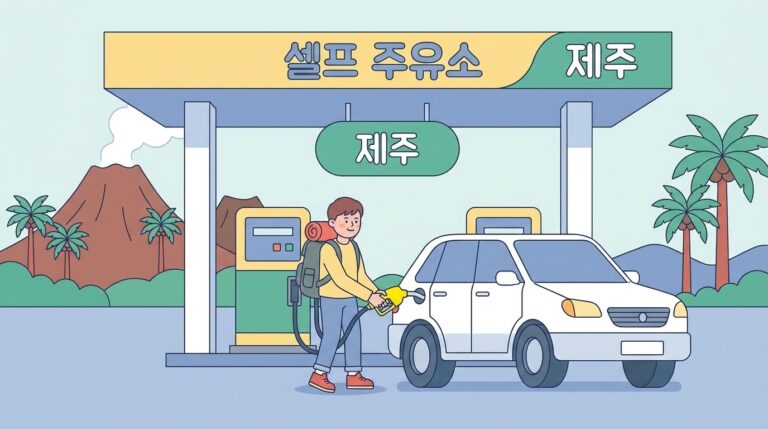
Master Korean Self Gas Stations: A Beginner’s Survival Guide
Phase 1: Empathy (Storytelling Opening)
안녕하세요! 매일한글 에디터입니다. (Hello! This is your Daily Hangul Editor.)
Picture this: You’ve rented a sleek car in Jeju Island, enjoying the ocean breeze with your favorite K-Pop playlist playing softly in the background. Suddenly, the fuel light blinks! You pull into a colorful station marked ‘셀프’ (Self). You step out, confident—until you face a giant touchscreen flashing rapid Korean text: 휘발유, 경유, 일반, 고급, 정액, 정량…
Panic kicks in! A driver behind you waits quietly, and you worry about accidentally putting diesel into a gasoline engine. Don’t worry, you are not alone! Over 80% of our A2 learners share that using a self-service gas station in Korea is one of the most intimidating real-life challenges. But here is the good news: once you know just 3 core Korean words and the step-by-step touchscreen logic, fueling your rental car becomes as easy as ordering boba! Let’s transform this stressful moment into a fun K-Travel milestone today.
Phase 2: Core Expressions Deep Dive
1. 휘발유 (Gasoline / Petrol)
- Pronunciation: [Hwi-bal-yu] (Sounds like ‘Hwee-bahn-yoo’)
- Meaning: Literal: Volatile oil | Actual Nuance: Standard gasoline fuel for regular sedan engines.
- K-Culture Moment: In K-Dramas, whenever characters take spontaneous road trips to the East Sea, you’ll see yellow nozzle handles at gas stations designated specifically for 휘발유!
- Editor’s Insight: Most small and mid-sized Korean rental cars (like Avante or K3) use 휘발유. Gas station nozzles are color-coded: Yellow is always 휘발유!
- Situation Spectrum: Casual ✅ | Semi-formal ✅ | Formal ✅
- 🤔 Think About It: In English, we say ‘Gas’ or ‘Petrol’. Korean uses scientific Chinese characters (揮發油 – oil that evaporates easily). How does your native language name fuel types?
2. 가득 채워 주세요 (Please fill it up full)
- Pronunciation: [Ga-deuk chae-wo ju-se-yo] (Sounds like ‘Gah-deuk chae-wo Joo-seh-yo’)
- Meaning: Direct: Fill it up to the brim, please.
- K-Culture Moment: On screen options, look for the big button labeled 가득 (Full / ~100,000 KRW preset). The machine pre-authorizes 100,000 won and automatically refunds the difference once full!
- Editor’s Insight: At full-service stations, simply saying “가득이요!” (Gadeuk-iyo!) is the ultimate local native shortcut.
- Situation Spectrum: Casual ⚠️ | Semi-formal ✅ | Formal ✅
- 🤔 Think About It: Why does Korean use ‘주세요’ (Give/Do for me) for services instead of direct commands? It reflects polite request culture.
3. 영수증 주세요 (Please give me the receipt)
- Pronunciation: [Yeong-su-jeung ju-se-yo] (Sounds like ‘Yuhng-soo-jung joo-seh-yo’)
- Meaning: Direct: Receipt please.
- K-Culture Moment: Essential for rental car returns to prove you refueled near the airport or for tracking trip expenses!
- Editor’s Insight: At self-service screens, you will see a pop-up: “영수증을 출력하시겠습니까?” (Would you like to print a receipt?). Tap 예 (Yes).
- Situation Spectrum: Casual ⚠️ | Semi-formal ✅ | Formal ✅
- 🤔 Think About It: Receipts in Korea often show tax and payment details clearly. Is keeping physical receipts common in your country?
Phase 3: Textbook Korean vs. Real Korean
Situation 1: Requesting a full tank of fuel
- 📖 Textbook Korean: 휘발유를 탱크에 가득 채워 주시기를 바랍니다. (I wish that you fill the tank full with gasoline.)
- 🗣️ Real Korean: 휘발유 가득이요! (Gasoline, full please!)
- 💡 Why the difference? In busy Korean gas stations, speed and clarity are key. Dropping redundant grammar markers makes communication clear and natural.
Situation 2: Asking where the payment card goes
- 📖 Textbook Korean: 신용카드를 어디에 삽입해야 합니까? (Where should I insert my credit card?)
- 🗣️ Real Korean: 카드 어디에 넣어요? (Where do I put the card?)
- 💡 Why the difference? ‘넣다’ (to put in) is far more common in everyday spoken Korean than formal technical terms like ‘삽입하다’ (to insert).
Phase 4: K-Culture Deep Dive & Non-Verbal Manners
4-1. Nunchi (눈치) & Essential Gestures
- Touch the Static Electricity Pad (정전기 방지 패드): Before grabbing the nozzle, you must touch the rubber pad (usually red or blue) on the screen frame. Locals do this naturally to prevent spark hazards. Doing this smoothly shows high K-travel Nunchi!
- Wear Plastic Gloves: Next to the machine, you will find disposable plastic gloves (비닐장갑). Put one on your hand before touching the nozzle to keep your hands clean and odor-free.
4-2. K-Travel & Road Trip Culture
Gas station rest stops in Korea aren’t just for fuel—they are culinary highlights! Known as 휴게소 (Hyugeso), major highways feature gourmet food courts selling So-tteok So-tteok (sausage and rice cake skewers) and walnut cakes (Hodu-gwaja). Refueling your car is just the prelude to refueling yourself!
Phase 5: Real-Life Roleplay Scenario
Setting: A sunny Jeju Self-Service Gas Station (셀프 주유소).
Characters: You (The Driver) & Min-jun (Friendly Gas Station Staff nearby).
- You: 저기요, 셀프 주유 처음이에요. (Jeo-gi-yo, seul-peu ju-yu cheo-eum-i-e-yo.)
🎭 [Hand scratching head sheepishly, holding credit card]
“Excuse me, it’s my first time doing self-refueling.” - Min-jun: 아, 안녕하세요! 먼저 화면에서 유종을 선택해 주세요. (A, an-nyeong-ha-se-yo! Meon-jeo hwa-myeon-e-seo yu-jong-eul seon-taek-hae ju-se-yo.)
🎭 [Points kindly to the touchscreen]
“Ah, hello! First, please select your fuel type on the screen.” - You: 휘발유 선택했어요. 다음은 가득이요? (Hwi-bal-yu seon-taek-haess-eo-yo. Dae-um-eun ga-deuk-i-yo?)
🎭 [Tapping the yellow 휘발유 button]
“I selected Gasoline. Next is ‘Full’, right?” - Min-jun: 네! ‘가득’ 누르시고 카드를 넣으세요. (Ne! ‘Ga-deuk’ nu-reu-si-go ka-deu-reul neo-eu-se-yo.)
🎭 [Nodding with a reassuring smile]
“Yes! Press ‘Full’ and insert your card.” - You: 정전기 패드도 터치해야 하죠? (Jeong-jeon-gi pae-deu-do teo-chi-hae-ya ha-jyo?)
🎭 [Placing hand firmly on the red anti-static pad]
“I need to touch the anti-static pad too, right?” - Min-jun: 맞아요, 잘하시네요! 노란색 노즐을 넣고 당기세요. (Ma-ja-yo, jal-ha-si-ne-yo! No-ran-saek no-jeu-reul neo-ko dang-gi-se-yo.)
🎭 [Giving a thumb-up]
“That’s right, great job! Insert the yellow nozzle and pull the trigger.” - You: 주유 끝났어요. 영수증 챙길게요! (Ju-yu kkeut-nass-eo-yo. Yeong-su-jeung chaeng-gil-ge-yo!)
🎭 [Returning nozzle safely and taking receipt]
“Refueling is finished. I’ll take the receipt!” - Min-jun: 수고하셨습니다! 즐거운 여행 되세요! (Su-go-ha-syeoss-seub-ni-da! Jeul-geo-un yeo-haeng doe-se-yo!)
🎭 [Waving goodbye cheerfully]
“Great job! Have a wonderful trip!”
🔀 Interactive Choice Point
The machine screen asks: “결제 방식을 선택하세요” (Select Payment Method). What do you do?
- Option A: Insert cash into the card slot.
- Option B: Select 신용카드 (Credit Card) and insert your foreign IC card into the glowing slot.
- Option C: Press 취소 (Cancel) and run inside to shout at the manager.
🔍 Click to view Feedback for your Choice!
- Option A (Bad): ❌ Inserting cash into a card slot can damage the reader!
- Option B (Best): ✅ Perfect! Tap 신용카드, insert your IC credit card, follow screen prompts, and remember to remove your card when done.
- Option C (Risk): 🚫 Unnecessary stress! Self-service machines are designed for automated card transactions.
Phase 6: 10-Second Emotional Shadowing Drill
Practice these lines out loud with feeling! Notice the rhythmic pauses marked by /.
- [😊 Confident & Polite]
휘발유 / 가득 / 채워 주세요!
(Hwi-bal-yu / ga-deuk / chae-wo ju-se-yo!) -
[🤔 Curious & Gentle]
카드는 / 어디에 / 넣어요?
(Ka-deu-neun / eo-di-e / neo-eo-yo?) -
[🥳 Relieved & Happy]
주유 / 성공했어요! / 영수증 / 주세요!
(Ju-yu / seong-gong-haess-eo-yo! / Yeong-su-jeung / ju-se-yo!)
Phase 7: K-Culture Mini Dictionary
- 셀프 주유소 (Seul-peu Ju-yu-so) | Self-Service Gas Station | Look for stations with big yellow or blue signs reading ‘셀프’. Fuel prices are noticeably cheaper here!
- 휘발유 (Hwi-bal-yu) | Gasoline/Petrol | Represented by YELLOW nozzles and icons. Essential for standard gasoline cars.
- 경유 (Gyeong-yu) | Diesel | Represented by BLUE or GREEN nozzles. Never mix this up with 휘발유!
- 정전기 방지 패드 (Jeong-jeon-gi Bang-ji Pae-deu) | Anti-Static Pad | Small rubber pad on self-service stations to prevent static electricity discharge.
Phase 8: Traveler’s Survival Kit
Top 3 Survival Phrases
- 휘발유 주세요. (Gasoline, please.)
Pro Tip: Use this if you end up at a full-service gas station. - 카드 돼요? (Do you accept credit cards?)
Pro Tip: Almost all Korean gas stations accept major international credit cards (Visa/Mastercard). - 영수증 주실 수 있나요? (Could I please get a receipt?)
Pro Tip: Polite phrasing when asking staff directly.
Editor’s Travel Note
Before starting your road trip, download the Naver Map Navigation App. It allows you to filter gas stations along your route by price and self-service availability! When paying at self-service stations, remember that international cards pre-authorize a lump sum (e.g., 100,000 KRW) first, then immediately charge the exact final amount while cancelling the pre-authorization.
Phase 9: A Step Deeper (Culture Insight)
In Korea, convenience and speed (Pali-pali culture) are deeply ingrained in everyday life. The rise of self-service gas stations reflects modern automated technology, yet social etiquette remains strong. Even at unmanned stations, drivers tidy up plastic gloves in designated bins and move their cars promptly so others don’t wait. Korean technology emphasizes self-reliance, but public consideration remains at its heart.
💬 Your Turn: Have you ever used a self-service gas station in a foreign country? What was the most surprising difference compared to your hometown? Leave a comment below!
Phase 10: FAQ & Common Mistakes
Q: What happens if I accidentally select 100,000 won but my tank only holds 60,000 won worth of fuel?
A: Don’t panic! The self-service machine automatically detects when your tank is full, stops pumping, cancels the initial 100,000 won pre-authorization, and re-bills your card for exactly 60,000 won instantly.
Q: How do I know whether my rental car takes 휘발유 (Gasoline) or 경유 (Diesel)?
A: Check the inside of your fuel door flap or your key ring tag! Rental companies place clear sticker labels there. Gasoline cars usually have a yellow sticker saying 휘발유.
Q: Can I pay with cash at a self-service station?
A: Most automated screens accept Korean cash notes (10,000 won / 50,000 won), but using a credit card is much faster and hassle-free.
🚨 Common Mistakes TOP 3
- Mistake: Grabbing the green/blue nozzle for a gasoline vehicle.
- Correct Action: Gasoline is ALWAYS yellow (휘발유 = Yellow nozzle).
- Mistake: Forgetting to remove the IC card after payment.
- Correct Action: Wait for the machine to beep and prompt “카드를 회수해 주세요” before pulling out your card.
- Mistake: Skipping the static pad step during dry winter months.
- Correct Action: Always touch the 정전기 방지 패드 first for safety!
Phase 11: Action Mission & Participation
Action Mission 3-Steps
- Bronze Mission: Say “휘발유 가득 채워 주세요!” 3 times out loud in front of a mirror.
- Silver Mission: Save a screenshot of the fuel terms (휘발유/경유/가득) on your phone before your trip.
- Gold Mission: Visit a Korean self-service gas station, refuel successfully, and snap a picture of your printed receipt!
🎮 K-Culture Mission
Watch a Vlog or K-Drama road trip scene (like Heart Signal or In the SOOP) and spot the yellow fuel nozzle at a gas station. Drop the timestamp in the comments!
Phase 12: Interactive Quiz Challenge
1. Situation Judgment
You are driving a regular gasoline rental sedan in Jeju. Which color nozzle should you pick at the self-service station?
* A) Blue nozzle (경유)
* B) Yellow nozzle (휘발유)
* C) Black nozzle (LPG)
2. Fill-in-the-blank
Fill in the missing word to say “Please fill it up full”:
“________ 채워 주세요!” (Gadeuk chae-wo ju-se-yo!)
* A) 조금 (Jogeum)
* B) 가득 (Gadeuk)
* C) 빨리 (Ppalli)
3. True or False Culture Quiz
Statement: In Korean self-service gas stations, touching the anti-static pad (정전기 방지 패드) is an optional step that locals usually ignore.
* A) True
* B) False
🎁 Click here for Quiz Answers & Explanations!
- Answer: B) Yellow nozzle (휘발유)
Explanation: Gasoline (휘발유) in Korea is standardized with yellow nozzles. - Answer: B) 가득 (Gadeuk)
Explanation: ‘가득’ means full / completely filled. - Answer: B) False
Explanation: Touching the anti-static pad is an essential safety precaution that Korean drivers practice habitually!







